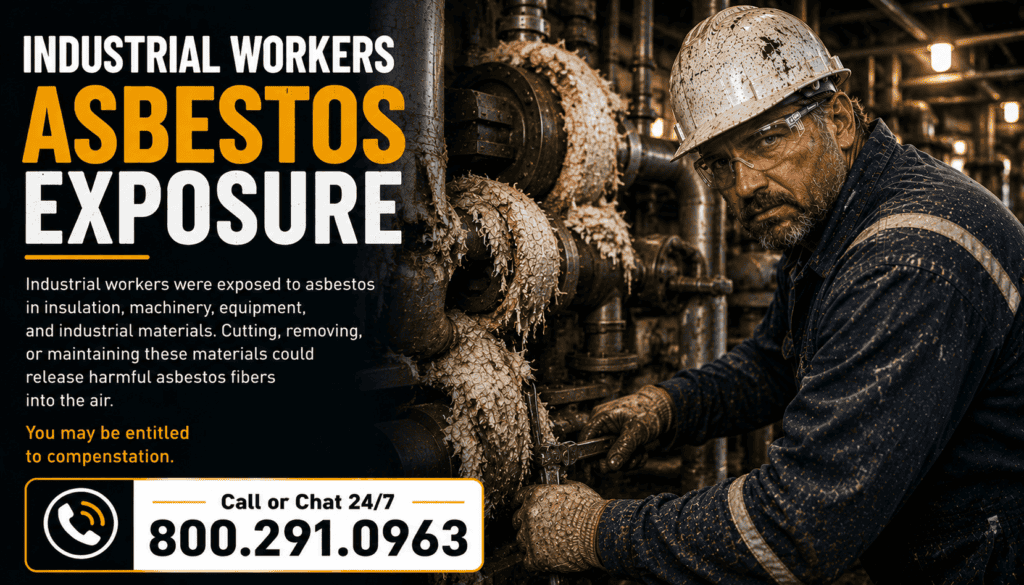
Industrial Workers Asbestos Exposure Lawsuit
Industrial workers in factories, refineries, chemical plants, mills, power facilities and other heavy-industry workplaces may have encountered asbestos in historical manufacturing processes, thermal insulation, boilers, piping, machinery components and building materials. CDC identifies manufacturing among the industrial operations where hazardous occupational asbestos exposure has occurred.
Industrial employment alone does not prove asbestos exposure or establish a lawsuit. OSHA notes that asbestos exposure in general industry occurs in many industrial and commercial settings, including asbestos-product manufacturing and housekeeping around installed asbestos-containing materials. A claim requires evidence connecting a worker’s actual job history to asbestos exposure, disease and applicable legal requirements.
Industrial Workers and Occupational Asbestos Exposure
Industrial workers can include production employees, machinists, millwrights, maintenance mechanics, pipe trades, boiler personnel, fabricators, operators and other workers who keep plants and manufacturing systems operating. Potential asbestos exposure depended on the facility, era, products, equipment and tasks.
OSHA’s general-industry asbestos standard applies broadly to occupational asbestos exposures outside construction and shipyard work. OSHA specifically identifies employees manufacturing asbestos-containing products, employees repairing or replacing certain brakes and clutches, and housekeeping employees in industrial facilities with asbestos-product manufacturing operations as groups that may encounter asbestos fibers.
CDC’s mesothelioma surveillance research identifies hazardous historical asbestos exposure in industrial operations including manufacturing. It also found significantly elevated mesothelioma proportionate mortality ratios in several industries, including petroleum refining and industrial and miscellaneous chemicals. Those population-level findings do not establish exposure or causation for an individual worker.
Readers can also review industrial and manufacturing factory workers asbestos exposure, factory workers asbestos exposure and production workers asbestos exposure.
Industrial Asbestos Sources and Materials
Potential industrial asbestos sources varied by plant and process. OSHA’s technical information identifies historical asbestos uses in heat-resistant clothing, brake and clutch linings, floor and ceiling tiles, roofing materials, asbestos-cement pipe and sheet, pipe and boiler insulation, and sprayed-on materials.
- Thermal insulation on older boilers, steam lines, piping, tanks and ducts
- Asbestos-containing gaskets and packing in pumps, valves and industrial equipment where documented
- Historical asbestos brake, clutch and other friction materials
- Asbestos-containing products intentionally manufactured or processed in some factories
- Sprayed or troweled asbestos-containing surfacing and fireproofing materials
- Older asbestos flooring, roofing, cement products and other building materials
- Asbestos-containing materials disturbed during plant repair, renovation or demolition
OSHA requires certain installed thermal-system insulation and sprayed-on or troweled-on surfacing material in buildings constructed no later than 1980 to be treated as presumed asbestos-containing material unless properly rebutted under the standard. That regulatory presumption does not mean every industrial material contained asbestos.
Plant records, product specifications, asbestos surveys, bulk-sample results, maintenance files and purchasing documents can provide more specific evidence.
How Industrial Worker Asbestos Exposure Could Occur
Potential exposure could occur when asbestos-containing material was manufactured, cut, removed, repaired, damaged or cleaned up, or when a worker performed tasks close to those activities.
- Production: handling or processing confirmed asbestos-containing products
- Maintenance: removing older insulation, gaskets or packing during equipment repair
- Boiler and piping work: disturbing confirmed asbestos thermal-system insulation
- Machine repair: opening equipment containing asbestos components where documented
- Housekeeping: cleaning asbestos-containing waste, debris or settled dust in affected industrial areas
- Renovation and demolition: disturbing installed legacy asbestos-containing materials
OSHA requires asbestos-contaminated surfaces to be kept as free as practicable of asbestos waste, debris and accompanying dust and restricts dry cleanup methods. These requirements reflect the potential for fibers to become airborne during disturbance and cleanup.
Industrial dust is not automatically asbestos. Metal dust, silica, welding fumes, chemical vapors and other workplace contaminants are distinct hazards and should be evaluated separately.
Industrial Plants, Machinery and High-Risk Work
Industrial exposure histories are strongest when they identify the actual facility and task instead of relying only on a broad occupational label.
Manufacturing and Factory Plants
Some historical facilities intentionally manufactured asbestos-containing products. Other factories did not. Product records, production-line information and raw-material purchasing documents can help distinguish those settings.
Refineries and Chemical Plants
These facilities can contain extensive piping, boilers, tanks, valves and high-temperature equipment. CDC’s 1999–2015 mesothelioma mortality analysis found significantly elevated proportionate mortality ratios for petroleum refining and industrial and miscellaneous chemical industries, although death-certificate industry data cannot identify the exposure source for an individual case.
Steel Mills, Foundries and Smelters
Heavy-industry facilities can combine furnaces, steam systems, machinery and extensive maintenance operations. Asbestos exposure should be tied to a confirmed material such as insulation, gaskets or other ACM rather than inferred from furnace or metal dust.
Boiler Rooms and Utility Systems
OSHA specifically identifies pipe and boiler insulation as historical asbestos applications. Workers who repaired or removed confirmed asbestos insulation could have a more direct exposure history than employees who merely worked elsewhere in the same plant.
Machine Shops and Mechanical Maintenance
Machinists, millwrights and mechanics may dismantle equipment, service friction components or replace gaskets. Some historical components contained asbestos, but component-specific evidence is important.
Plant Renovation and Demolition
CDC reports that current occupational asbestos exposure occurs predominantly during maintenance and remediation of older asbestos-containing buildings. Industrial renovation can therefore create exposure potential when legacy ACM is disturbed without adequate controls.
Related resources include machinists asbestos exposure, millwrights asbestos exposure, steel workers asbestos exposure, foundry workers asbestos exposure and maintenance mechanics asbestos exposure.
Secondary or Household Exposure
Asbestos fibers carried on contaminated work clothing could historically create a secondary exposure pathway. CDC recognizes potential take-home exposure among family members of workers with occupational asbestos exposure. An individual household claim still requires evidence concerning the worker’s asbestos source, tasks and circumstances.
Need help now? Call 800.291.0963
Live chat available 24/7, 365 days a year.
Submit Your Case
Mesothelioma and Other Asbestos-Related Health Risks
CDC identifies malignant mesothelioma as a cancer associated with occupational and environmental inhalation exposure to asbestos fibers and other elongate mineral particles. Occupational asbestos exposure is also associated with lung cancer and nonmalignant asbestos-related disease.
CDC reported 45,221 U.S. deaths with malignant mesothelioma listed as an underlying or contributing cause during 1999–2015. The report also explains that mesothelioma can develop decades after first causative exposure, which is why a detailed lifetime occupational history can be important.
Population statistics do not prove that a particular worker’s disease resulted from a specific plant, employer or product. Industrial workers may also have encountered silica, metals, welding fumes, solvents and other hazards that require separate evaluation.
Medical questions about occupational exposure, symptoms, screening or diagnosis should be discussed with a qualified healthcare professional.
Documenting an Industrial Worker Exposure History
A potential industrial asbestos lawsuit usually requires more than an occupational title. Useful evidence can help establish where the person worked, what materials were present, what tasks were performed and which companies or products may be relevant.
- Employment evidence: employer names, Social Security earnings records, W-2s, payroll files and union records
- Plant evidence: facility names, addresses, owners, departments and dates worked
- Product evidence: manufacturer names, labels, catalogs, specifications and purchasing records
- Maintenance evidence: work orders, equipment manuals, boiler and piping records and shutdown files
- Asbestos evidence: surveys, abatement records, laboratory reports and industrial-hygiene sampling
- Task evidence: production, insulation removal, gasket work, machinery repair, cleanup or renovation
- Witness evidence: coworkers, supervisors, maintenance personnel and other trades who can describe conditions
When exact product names are forgotten, record the plant, department, approximate years, equipment, job duties, material appearance, dust conditions, shutdown or repair work, nearby trades and whether asbestos warnings or abatement procedures were present.
Why Facility and Product Evidence Matters
CDC cautions that industry and occupation information on death certificates does not reveal the actual source of asbestos exposure. A legal investigation therefore benefits from plant-specific and product-specific evidence whenever available.
Industrial Worker Lawsuits, Trust Funds and Compensation
An industrial worker diagnosed with an asbestos-related disease may have potential legal or compensation options when evidence supports occupational asbestos exposure and applicable legal requirements are satisfied. Potential avenues can include claims against legally responsible companies and claims involving asbestos bankruptcy trusts.
An asbestos lawsuit generally requires evidence beyond proof that a person worked in industry. Relevant issues can include exposure to an asbestos-containing product or material, responsible companies, medical diagnosis, causation requirements, jurisdiction and filing deadlines.
Asbestos trust funds have their own medical and exposure criteria. A worker may need evidence connecting employment to a covered company’s asbestos product, operation or approved site during a qualifying period. Trust eligibility and payment are not established by job title alone.
Possible documentation includes Social Security and employment records, union files, product and supplier records, plant documents, maintenance records, asbestos surveys, photographs, industrial-hygiene reports, coworker statements and medical records. Statutes of limitation and other filing rules vary by jurisdiction and claim type.
Related Industrial, Factory and Mechanical Resources
Industrial and factory work: Industrial & Manufacturing Factory Workers Asbestos Exposure · Factory Workers Asbestos Exposure · Production Workers Asbestos Exposure
Heavy industry: Steel Workers Asbestos Exposure · Foundry Workers Asbestos Exposure · Smelter Workers Asbestos Exposure
Mechanical work: Machinists Asbestos Exposure · Millwrights Asbestos Exposure · Maintenance Workers Asbestos Exposure
Authoritative Sources
This page was researched using OSHA and CDC/NIOSH government sources addressing asbestos in general industry, historical asbestos products, industrial exposure and malignant mesothelioma mortality.
- OSHA — 29 CFR 1910.1001, Asbestos in General Industry
- OSHA — Appendix G, Substance Technical Information for Asbestos
- OSHA — Asbestos Overview
- NIOSH — Workplace Exposure to Asbestos
- CDC/NIOSH — Malignant Mesothelioma Mortality, United States, 1999–2015
- CDC/NIOSH — Malignant Mesothelioma Mortality in Women, United States, 1999–2020
Industrial Workers Asbestos Exposure Lawsuit FAQ
Were all industrial workers exposed to asbestos?
No. Exposure depended on the facility, era, products, equipment and work performed. Industrial employment alone does not prove asbestos exposure.
Where could industrial workers have encountered asbestos?
Potential sources included older boiler and pipe insulation, asbestos-containing manufacturing materials, gaskets, packing, friction products and legacy building materials where those materials were actually present.
Does working in a factory automatically establish an asbestos lawsuit?
No. A claim generally requires evidence connecting the worker’s circumstances to asbestos exposure, a diagnosed disease, potentially responsible parties and applicable legal requirements.
What records can help prove industrial asbestos exposure?
Employment and Social Security records, union files, plant records, product specifications, purchasing documents, asbestos surveys, industrial-hygiene reports and coworker statements can help reconstruct exposure.
Can a coworker help document an old industrial exposure?
Potentially. Coworkers may help identify job duties, equipment, products, insulation, maintenance practices and working conditions when records are incomplete.
Can industrial workers file asbestos trust fund claims?
Some may qualify if they satisfy a trust’s medical and exposure criteria and can connect their work to a covered company, product, operation or qualifying site. Employment alone does not establish eligibility.
How long can mesothelioma take to develop after exposure?
CDC reports that malignant mesothelioma can develop decades after first causative exposure. The latency period is one reason historical employment and exposure records can be important.
Is compensation guaranteed in an industrial worker asbestos case?
No. Compensation depends on the facts, evidence, applicable law, claim requirements and other circumstances. Compensation is not guaranteed.
Get Help Reviewing an Industrial Worker Asbestos Claim
Call 800.291.0963
Live chat is available 24/7, 365 days a year.
Prior industrial work does not automatically prove asbestos exposure, disease causation, liability, claim eligibility or compensation. Each situation depends on the facility, dates, products, materials, tasks, responsible parties, medical evidence and applicable legal requirements. Compensation is not guaranteed.
⚕️ Legal & Medical Information Disclaimer
This page provides general educational information and is not medical or legal advice. The information does not establish asbestos exposure, diagnosis, causation, liability, claim eligibility or compensation. Medical concerns should be discussed with a qualified healthcare professional, and legal questions should be reviewed with a qualified attorney.