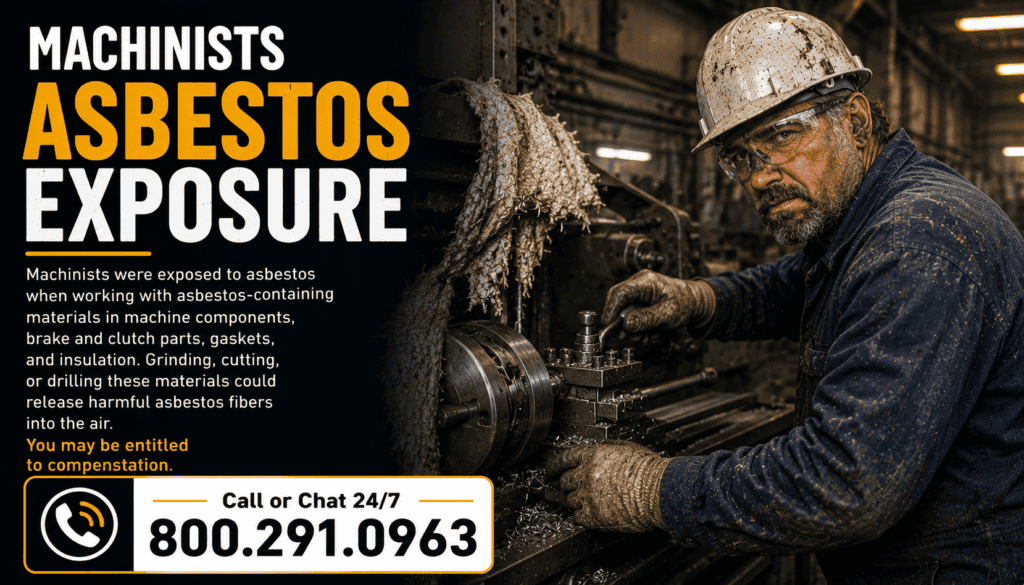
Machinists Asbestos Exposure
Machinists manufacture, fit, repair and rebuild precision metal parts using lathes, mills, grinders, drills and other machine tools. Historical asbestos exposure could occur in some industrial settings when machinists handled or worked near asbestos-containing gaskets, packing, insulation, friction products or older machinery components during repair and maintenance.
A machinist job title alone does not prove asbestos exposure. A stronger occupational history identifies the employer, facility, years worked, machines or equipment serviced, specific components handled and evidence showing whether documented asbestos-containing material was removed, cut, scraped, cleaned or otherwise disturbed.
🧭 On This Page
- Machinists and Occupational Asbestos Exposure
- Potential Asbestos Sources
- How Asbestos Exposure Could Occur
- Machinist Tasks and Industrial Work Environments
- Secondary or Household Exposure
- Mesothelioma and Occupational Health Risks
- Documenting a Machinist Exposure History
- Lawsuits, Trust Funds and Compensation
- Machinists Asbestos Exposure FAQ
Machinists and Occupational Asbestos Exposure
Machinists work in manufacturing plants, machine shops, maintenance departments, power facilities, shipyards, transportation facilities and other industrial environments. Their work may include producing new components, rebuilding worn equipment and assisting with repairs to pumps, valves, engines, compressors and other machinery.
Asbestos was historically used in a range of industrial and commercial products because of its heat-resistant and durable properties. OSHA identifies insulation, friction products and other industrial materials among historical asbestos applications. NIOSH likewise notes that asbestos was widely used in industrial processes and products, including insulation and friction applications.
For machinists, exposure questions are often most useful when tied to a specific component or maintenance activity. OSHA has specifically addressed asbestos-containing gaskets and packing, including removal, residue scraping and replacement. The existence of these products does not establish that every machinist handled them, but it provides a documented pathway to investigate.
Related industrial occupations are organized under Industrial, Manufacturing & Factory Workers Asbestos Exposure.
Potential Asbestos Sources
Depending on the employer, equipment and period, potential asbestos sources for machinists could include:
- Gaskets: Certain historical flange, equipment and machinery gaskets contained asbestos.
- Packing: Some historical valve, pump and machinery packing materials contained asbestos.
- Thermal insulation: Pipes, boilers, tanks, ducts and other heated industrial systems could use asbestos-containing insulation.
- Machinery insulation: Older industrial equipment could incorporate heat-resistant insulation or other asbestos-containing materials.
- Friction products: Certain historical brakes, clutches and other friction materials contained asbestos.
- Industrial building materials: Older factories and machine shops could contain asbestos-containing flooring, fireproofing or other installed materials.
- Adjacent maintenance work: Machinists could work near mechanics, millwrights, pipe trades or maintenance crews disturbing documented asbestos-containing products.
The age of a machine or factory does not by itself prove asbestos was present. Parts catalogs, manufacturer specifications, maintenance manuals, invoices, asbestos surveys and product records can provide stronger evidence.
How Asbestos Exposure Could Occur
Where asbestos-containing components were present, potential exposure could occur when the material was disturbed during equipment repair, rebuilding or maintenance.
- Removing old asbestos-containing gaskets from machinery or flanges.
- Scraping gasket residue from metal surfaces before reassembly.
- Removing or replacing asbestos-containing packing.
- Opening equipment located near deteriorated thermal insulation.
- Repairing machinery containing documented asbestos components.
- Cleaning equipment or work areas after asbestos-containing components were disturbed.
- Working near pipefitters, millwrights, maintenance mechanics or other trades performing asbestos-related work.
- Working in older facilities during renovation or removal of installed asbestos materials.
OSHA has documented that removal and replacement of asbestos-containing gaskets and packing can create occupational exposure under some conditions. Actual exposure varies with the product, task, work practice, frequency and controls used.
Machinist Tasks and Industrial Work Environments
Machine Shops
Machinists may spend much of their time producing or finishing metal parts rather than handling asbestos-containing products. Ordinary machining of metal should not automatically be characterized as asbestos exposure. A specific asbestos-containing source should be identified.
Equipment Repair and Rebuilding
Machinists involved in repair work may disassemble equipment, measure worn components, fabricate replacement parts and prepare machinery for reassembly. If historical equipment used asbestos-containing gaskets or packing, component removal and cleanup may be relevant.
Gasket Removal and Surface Preparation
Old gaskets can adhere to metal mating surfaces. OSHA has evaluated exposure associated with removing asbestos-containing gaskets and scraping residue. A work history should identify whether the machinist personally performed this task and whether the gasket was documented to contain asbestos.
Pumps and Valves
Industrial pumps and valves can require periodic maintenance involving sealing components. Historical asbestos-containing packing or gaskets may be relevant where documentation connects the material to the specific equipment.
Power Plants and Utility Facilities
Machinists working in generating stations or utility facilities may have repaired rotating equipment and other machinery near insulated piping, boilers or turbines. Potential exposure can come from the equipment itself or from nearby maintenance involving documented asbestos-containing insulation.
Manufacturing Plants
Factory machinists can work near production equipment, steam systems and maintenance operations. Facility records and industrial-hygiene documentation can help distinguish direct component work from nearby exposure pathways.
Shipyards and Maritime Facilities
Machinists in shipbuilding and ship repair may work on engines, pumps, valves and other vessel machinery. OSHA maintains a separate asbestos standard for shipyard employment, including repair and maintenance activities involving asbestos-containing materials.
Related Mechanical Trades
Machinist duties can overlap with maintenance mechanics and other industrial trades. See Maintenance Mechanics Asbestos Exposure and Industrial Maintenance Technicians Asbestos Exposure.
Secondary or Household Exposure
If a machinist actually worked with asbestos-containing materials and fibers contaminated clothing, footwear, tools or belongings, a historical household exposure pathway may also be relevant. The original occupational source and a plausible route by which contamination left the workplace should be established.
General information about this pathway is available at Secondhand Asbestos Exposure.
Need help now? Call 800.291.0963
Live chat available 24/7, 365 days a year.
Submit Your Case
Mesothelioma and Occupational Health Risks
Asbestos is a recognized occupational carcinogen. NIOSH and OSHA identify mesothelioma and lung cancer among diseases associated with asbestos exposure. Risk depends on the circumstances and extent of exposure.
Machinists also face workplace hazards unrelated to asbestos, including rotating machinery, cutting tools, flying chips, metalworking fluids, noise and other industrial hazards. Those hazards should not be confused with asbestos exposure.
A diagnosis does not by itself establish that a particular employer, machine, gasket, packing product or facility was the source of asbestos exposure. Medical questions should be discussed with a qualified healthcare professional. General diagnostic information is available at Mesothelioma Diagnosis.
Documenting a Machinist Exposure History
A useful machinist exposure history reconstructs the actual equipment, components, employers and work practices rather than relying solely on the occupation.
- Employment evidence: Social Security records, payroll, W-2 forms, personnel and union records.
- Facility evidence: factory, machine shop, power plant, shipyard or other worksite.
- Equipment evidence: manufacturer, model, equipment type and approximate service period.
- Component evidence: gaskets, packing, insulation or friction materials documented as containing asbestos.
- Task evidence: equipment teardown, gasket scraping, packing replacement, cleanup and rebuilding.
- Product evidence: catalogs, invoices, labels, specifications and manufacturer literature.
- Maintenance evidence: work orders, repair logs, manuals and preventive-maintenance records.
- Exposure evidence: industrial-hygiene reports, air-monitoring records and asbestos surveys.
- Witness evidence: coworkers, supervisors, millwrights, mechanics and pipe trades.
- Medical evidence: records relevant to diagnosis and occupational history.
Additional guidance is available through Worker Safety, Documentation & Occupational Resources and Occupational Exposure — Identifying Where & When You Were Exposed.
Questions That Can Strengthen an Exposure History
- Which employer and facility?
- What years did the machinist work there?
- Which machines or industrial systems were repaired?
- Did the machinist remove gaskets or packing?
- Were old gasket surfaces scraped or cleaned?
- Can equipment manufacturers or model numbers be identified?
- Were asbestos-containing products identified in manuals or specifications?
- Did pipefitters, millwrights or maintenance crews disturb insulation nearby?
- Were asbestos surveys or industrial-hygiene records created?
- Are former coworkers or supervisors available?
- Did work clothing or tools leave the facility?
Asbestos Lawsuits, Trust Funds and Compensation
A machinist diagnosed with mesothelioma or another asbestos-related disease may have potential legal or compensation options when evidence supports occupational asbestos exposure and applicable requirements are satisfied.
Machinist employment alone does not establish liability, trust-fund eligibility or entitlement to compensation. An investigation may examine documented manufacturers of asbestos-containing gaskets, packing, insulation or other products, as well as suppliers, contractors, premises and other legally relevant entities.
Historical manufacturer research can begin with Asbestos Manufacturers. General information about bankruptcy trusts is available at What Are Asbestos Trust Funds?.
Potential evidence can include employment and union records, machinery manuals, parts catalogs, work orders, invoices, product specifications, industrial-hygiene records, photographs, coworker statements and medical documentation. Applicable laws and filing deadlines vary and should be evaluated individually.
Related High-Risk Jobs Resources
- High-Risk Jobs Asbestos Exposure
- Industrial, Manufacturing & Factory Workers Asbestos Exposure
- Maintenance Mechanics Asbestos Exposure
- Industrial Maintenance Technicians Asbestos Exposure
- Asbestos Exposure at Work — Hidden Occupational Risks
- Asbestos Exposure in Equipment
- Asbestos Exposure in Machinery
Authoritative Sources
- OSHA — Asbestos Overview
- OSHA — 29 CFR 1910.1001, Asbestos — General Industry
- OSHA — Application of the Asbestos Standard to Gaskets and Packing
- OSHA — Asbestos: Evaluating and Controlling Exposure
- OSHA — 29 CFR 1915.1001, Asbestos — Shipyard Employment
- NIOSH — Asbestos: Workplace Safety and Health Topic
Machinists Asbestos Exposure FAQ
Were all machinists exposed to asbestos?
No. Machinist employment alone does not prove asbestos exposure. The specific facility, equipment, product and task should be identified.
Could machinists encounter asbestos-containing gaskets?
Potentially. OSHA has specifically addressed asbestos-containing gaskets and occupational exposure associated with their removal and replacement.
Could machinists encounter asbestos packing?
Yes, some historical packing products contained asbestos. Equipment-specific and product-specific documentation can help establish whether a machinist handled such material.
Could scraping old gasket residue create exposure?
Potentially. OSHA has evaluated exposure associated with scraping residue from asbestos-containing gaskets. Actual exposure depends on the material, task and work practices.
Did ordinary metal machining itself necessarily involve asbestos?
No. Operating lathes, mills or other machine tools does not by itself establish asbestos exposure. A specific asbestos-containing source should be identified.
Could machinists be exposed by nearby trades?
Potentially. Machinists working near maintenance or pipe trades disturbing asbestos-containing insulation or components may have a pathway worth investigating.
Could shipyard machinists have asbestos exposure?
Potentially. Shipyard repair and maintenance involving asbestos-containing vessel materials is covered by a specific OSHA asbestos standard. Individual exposure still requires supporting evidence.
What records can help document machinist exposure?
Employment records, machinery manuals, parts catalogs, work orders, invoices, product literature, asbestos surveys, industrial-hygiene reports and coworker statements can help.
Can machinists qualify for asbestos trust funds?
Some may qualify if they meet a trust’s medical and exposure requirements and can connect their history to a covered company, product or qualifying site. Job title alone does not establish eligibility.
Should old machinery be dismantled to look for asbestos?
No. Suspected asbestos-containing components should not be disturbed merely to identify them. Appropriate records or qualified professionals should be used to evaluate suspected materials.
Get Help Reviewing a Machinist Exposure History
Call 800.291.0963
Live chat is available 24/7, 365 days a year.
Submit Your Case
Machinist employment does not automatically prove asbestos exposure, disease causation, liability, claim eligibility or compensation. Each situation depends on the employer, facility, dates, equipment, components, products, tasks, work practices, medical evidence and applicable legal requirements. Compensation is not guaranteed.
⚕️ Legal & Medical Information Disclaimer
This page provides general educational information and is not medical or legal advice. The information does not establish asbestos exposure, diagnosis, causation, liability, claim eligibility or compensation. Medical concerns should be discussed with a qualified healthcare professional, and legal questions should be reviewed with a qualified attorney.