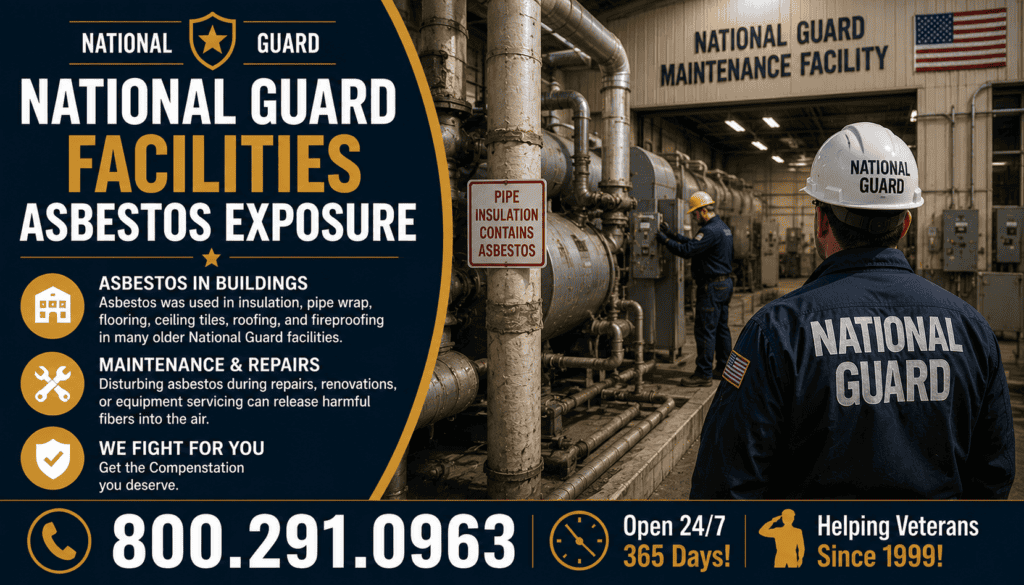
🏢 National Guard Facilities Asbestos Exposure
National Guard Facilities Asbestos Exposure concerns how National Guard buildings, construction materials, and maintenance operations intersected with asbestos-containing materials used in certain older workplaces or buildings. A person’s exposure depends on the specific materials, dates, tasks, and conditions—not the title of a job or facility alone.
People diagnosed with mesothelioma or asbestos-related lung cancer can use this information to identify possible exposure settings, preserve records, and understand medical and compensation questions. Families may also need records from earlier military, civilian, or household exposures.
📑 On This Page
🧭 Overview and Historical Context
The relevant history begins with the age of the equipment or building and the work performed there. A building being old does not establish asbestos exposure. The material, condition, work activity, and dates must be identified; undisturbed intact materials generally present less risk than disturbed materials. Asbestos was used historically for heat resistance, insulation, fire protection, and friction or sealing components. Its presence cannot be established by visual appearance alone.
The broader National Guard Vehicle Maintenance Facilities Asbestos Exposure and National Guard Training Facilities Asbestos Exposure resources can help distinguish aircraft, installation, and occupational exposure questions. Records showing a person worked at a location are a starting point, not proof that respirable fibers were released in their breathing zone.
Military personnel, civilian mechanics, contractors, and family members may have had very different exposure circumstances. Duty orders, payroll documents, work logs, construction files, and medical histories can help distinguish these situations without treating every older military site as contaminated.
⚙️ Equipment and Materials
The central subject is older National Guard facilities and the materials that could have created airborne asbestos dust. Historical asbestos-containing products may have included thermal insulation, heat-resistant fabrics, pipe coverings, gaskets, packing, certain floor tiles, ceiling materials, or older friction components. The relevant product mix differs sharply between an aircraft overhaul facility and a residential building.
For related equipment and occupational context, consult National Guard Power Facilities Asbestos Exposure, National Guard Medical Facilities Asbestos Exposure, and National Guard Armories Asbestos Exposure. A part catalog, purchase order, engineering specification, or laboratory report can be more probative than a generic list of materials sometimes used in that industry.
Some products were replaced or reformulated over time. The same type of equipment might have used different materials in different years, and maintenance crews might have installed aftermarket replacements. Establishing the manufacturer and service date can therefore be important for both exposure assessment and legal identification.
Asbestos-containing materials that remain intact and undisturbed are not equivalent to friable insulation that is cut, scraped, removed, or damaged. The EPA recommends qualified assessment before disturbing suspected materials; attempting to identify or sample them without training can create additional hazards.
🌬️ How Asbestos Exposure May Have Occurred
Potential pathways include dust released during repair, demolition, drilling, sanding, insulation removal, or replacement of older components. Work near a disturbance may matter even when the individual did not handle the material directly. The precise pathway depends on the tasks undertaken in armories, hangars, vehicle shops, training buildings, medical rooms, storage warehouses, and boiler rooms.
Workers reviewing National Guard Aircraft Hangars Asbestos Exposure or National Guard Base Housing Asbestos Exposure should look for dated repair orders, trade assignments, and descriptions of the material disturbed. Airborne asbestos exposure cannot be assumed merely because a room, helicopter, or base appears on a historical roster.
Dust can spread through adjoining rooms, work bays, ventilation paths, and clothing. However, proving secondary or bystander exposure requires details such as proximity, frequency, ventilation, cleaning practices, and the condition of the material. A credible account should distinguish observed dusty work from an unverified belief that the dust contained asbestos.
Routine cleaning methods may have worsened past exposures if they swept or blew dust into the air. Current response to suspected asbestos should follow professional inspection and applicable safety rules rather than dry sweeping, sanding, or disturbing material to check its composition.
📍 Where Exposure May Have Occurred
| Work Area | Why Exposure May Have Occurred |
|---|---|
| Mechanical and maintenance spaces | Servicing insulated pipes, heat-resistant seals, equipment housings, or older mechanical components could disturb material if asbestos was present. |
| Building interiors and utility rooms | Renovation of older flooring, ceiling systems, boiler insulation, or wall materials may have generated dust. |
| Storage and component shops | Handling replacement parts or cleaning accumulated dust could create a pathway when asbestos-containing products were actually present. |
| Renovation and demolition zones | Cutting, removing, or breaking suspected materials can release fibers and calls for qualified controls. |
| Nearby occupied areas | Bystanders might encounter migrating dust depending on barriers, ventilation, timing, and work practices. |
The location should be cross-checked with National Guard Boiler Equipment Asbestos Exposure and National Guard Storage Warehouses Asbestos Exposure when these resources match the actual assignment. Photographs and recollections can identify a work area, but material identification usually requires more specific records.
👥 Workers, Service Members, and Families
The people potentially affected are not limited to a single military rank. Mechanics, electricians, boiler technicians, construction trades, custodial personnel, contractors, and nearby workers could have different histories of contact with old materials. An individual might also have prior civilian industrial employment that is relevant to a medical or legal assessment.
The distinction between service-member and contractor roles matters when reading National Guard Asbestos Exposure and VA Benefits for Reservists and National Guard Members. Service dates, duty status, employer, and work location can affect access to records and potential benefit programs. Military affiliation alone does not establish that every exposure occurred during qualifying federal service.
Family members may have encountered dust brought home on work clothes or belongings, or may have occupied a residence during renovation. Such an exposure pathway is possible, but should be evaluated separately from the service member’s occupational history. A family member’s diagnosis does not establish that the household dust contained asbestos.
When speaking with relatives or former coworkers, ask for concrete recollections: the type of job, building or aircraft identifier, season or year, products handled, dusty work practices, and whether others performed nearby repairs. Recording these details while memories remain available can help avoid later confusion.
📁 Records and Evidence
| Record or Evidence | What It May Establish |
|---|---|
| Duty, assignment, and personnel records | Place the individual at an installation, unit, workplace, or project during relevant dates. |
| Maintenance logs and work orders | Identify repair tasks, equipment numbers, replacement components, and contractors. |
| Material specifications and purchase records | Help establish whether a particular product contained asbestos and who supplied it. |
| Building plans and renovation files | Show dates, rooms, demolition work, or historical insulation and flooring specifications. |
| Medical records and pathology reports | Document the diagnosis, clinical history, and the medical evaluation of potential asbestos disease. |
| Witness statements and photographs | Support work patterns and proximity, subject to independent confirmation of materials. |
Records should be preserved in their original form, including dates and source information. Pages such as U.S. National Guard Ranks Asbestos Exposure and E-1 – National Guard Private / Airman Basic (AB) provide additional context for organizing the history without assuming that every listed product or installation applies to the claimant.
For a deceased individual, relatives may need to locate discharge papers, medical authorizations, death certificates, pathology records, or estate documents. The exact records and who can request them vary. A qualified representative can help identify lawful ways to obtain them without promising that a missing document can be recovered.
🫁 Mesothelioma and Historical Asbestos Exposure
Mesothelioma is a cancer of the lining around the lungs or, less commonly, other internal surfaces. Asbestos is an established major cause. The disease may appear decades after exposure, so an exposure history often extends far beyond the most recent military assignment or job. A diagnosis should be confirmed and managed by qualified medical professionals.
For someone evaluating a possible exposure connected with National Guard buildings, construction materials, and maintenance operations, a medical team may review occupational and household histories along with imaging, pathology, and other clinical findings. Related information appears in E-2 – National Guard Private (PV2) / Airman (Amn). Neither a diagnosis nor an old building automatically identifies a specific responsible product or defendant.
People with persistent respiratory symptoms or a new diagnosis should tell their clinician about any possible asbestos contact, even if it occurred long ago. Screening and treatment decisions depend on individual medical circumstances, not on a generalized description of the installation or aircraft.
🩺 Asbestos-Related Lung Cancer
Asbestos exposure can also contribute to lung cancer. Smoking independently raises lung-cancer risk, and combined asbestos and tobacco exposure increases risk substantially. A clinician evaluates diagnosis and causation using the complete medical, occupational, and smoking history rather than a single factor.
The E-3 – National Guard Private First Class – Airman First Class and E-4 – National Guard Specialist – Senior Airman pages may help readers identify related workplace histories to discuss with clinicians. These links are informational: they do not establish that a person was exposed to asbestos, or that a particular cancer was caused by it.
Medical records are important for any benefits or legal review, but legal causation standards can differ from clinical reasoning. The existence of a lung cancer diagnosis does not, by itself, determine eligibility for a trust payment, civil damages, or a VA disability award.
⚖️ Compensation, FAQs, and Next Steps
Potential options can include asbestos bankruptcy trust claims, civil lawsuits, and—where service and medical requirements are met—VA benefits. For this topic, the relevant question is older National Guard facilities and the materials that could have created airborne asbestos dust. The availability of any option depends on evidence, the applicable rules, and the individual’s circumstances.
Trusts have their own eligibility criteria and exposure schedules. Civil lawsuits may have state-specific deadlines and rules about defendants and damages. See National Guard Asbestos Exposure Articles and National Guard Emergency Operations Centers Asbestos Exposure for adjacent topics. Claims involving National Guard duty require particular attention to qualifying service and whether an injury or disease is connected to the relevant duty period.
The VA states that asbestos disability claims require medical evidence of a condition, evidence of asbestos contact during military service, and a medical link between them. VA reviews asbestos-related claims individually; asbestos exposure is not an automatic compensation presumption. National Guard and Reserve service classifications can add eligibility questions.
A practical first step is to obtain the diagnosis and assemble a dated timeline of work locations, military assignments, maintenance tasks, and any potential nonmilitary exposures. Next, gather product or building records when possible. Ask a qualified medical professional about health questions and an appropriately licensed legal professional about claim deadlines and legal options.
❓ Frequently Asked Questions
Does this page mean everyone in the described role was exposed to asbestos?
No. Exposure depends on whether asbestos-containing material was present and disturbed, as well as the person’s tasks, proximity, and dates.
Can asbestos be identified from an old photograph?
A photograph may identify a location or component, but it ordinarily cannot confirm asbestos content. Product records or qualified testing may be needed.
Can asbestos disease develop years after military service?
Yes. Asbestos-related diseases can have long latency periods. A clinician should review a complete lifetime exposure history.
Does a military assignment automatically qualify someone for VA compensation?
No. VA considers qualifying service, a current condition, evidence of exposure, and the medical relationship between the condition and service.
Are civilian contractors covered by the same rules as military personnel?
Not necessarily. Employment status, service history, applicable laws, and potential defendants or trusts can change the available options.
Can a surviving spouse or family member seek compensation?
Sometimes. Eligibility and filing deadlines vary by claim type and jurisdiction, and survivor benefits have separate requirements.
What should someone do about suspected asbestos in a building?
Avoid disturbing it. Seek a qualified asbestos professional and follow applicable facility and environmental safety requirements.
Which records are most useful to preserve?
Start with medical and pathology reports, dates and locations of service or work, maintenance records, product information, and reliable witness accounts.
🧭 Summary
National Guard Facilities Asbestos Exposure is best understood through a specific chronology of materials, tasks, locations, and health history. A building being old does not establish asbestos exposure. The material, condition, work activity, and dates must be identified; undisturbed intact materials generally present less risk than disturbed materials. Accurate records help families distinguish plausible historical exposure from unsupported assumptions and identify questions for medical and legal professionals.
📚 Confirmed Sources
These public resources explain established asbestos hazards, safe handling, military benefits requirements, and relevant aircraft history. They do not verify exposure at a specific facility or in an individual claim.
- U.S. Department of Veterans Affairs — Veterans Asbestos Exposure
- VA Public Health — Asbestos
- U.S. EPA — Protect Your Family from Exposures to Asbestos
- VA — Eligibility for Disability Benefits
Find out if you may qualify for asbestos compensation today.
Call 800.291.0963 — Help is available 24/7/365. 25+ years of experience.
Disclaimer: This information is educational, not medical or legal advice. Mesothelioma Help Center is not a law firm or medical provider and does not determine legal or VA eligibility.