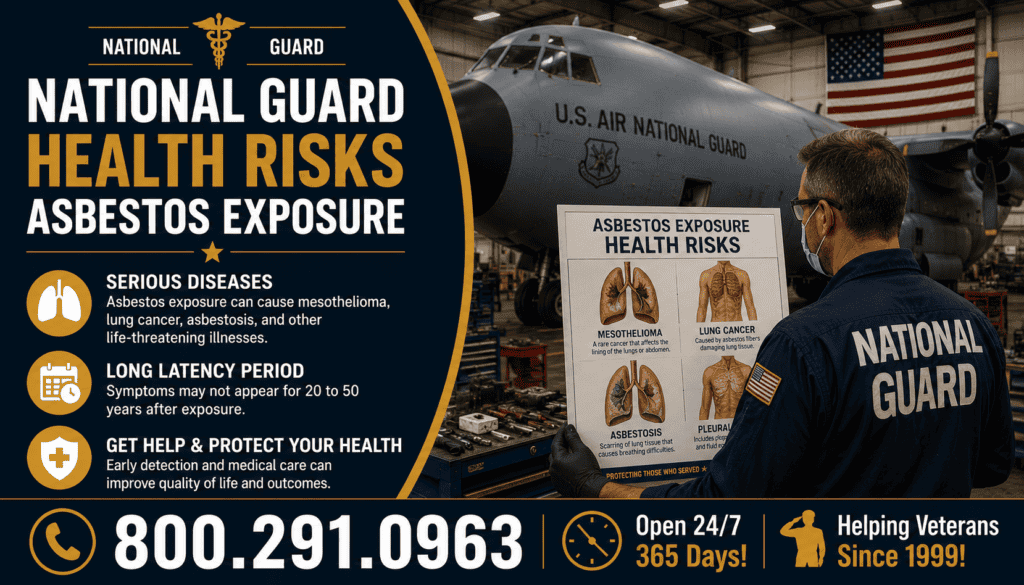
National Guard Health Risks Asbestos Exposure
National Guard personnel may have encountered asbestos while repairing military vehicles, maintaining aircraft, operating heavy machinery, servicing boilers and generators, renovating older facilities, or responding to natural disasters and structural emergencies. These duties could disturb asbestos-containing products and release microscopic fibers into the surrounding air.
Asbestos was widely used throughout military facilities and equipment because it resisted heat, fire, friction, electricity, and corrosion. It was commonly found in brake systems, clutches, engine gaskets, boilers, steam pipes, pumps, generators, HVAC equipment, electrical systems, insulation, roofing materials, flooring, cement products, and fireproof construction materials.
Whenever asbestos-containing materials were cut, drilled, scraped, sanded, removed, crushed, burned, or allowed to deteriorate, microscopic fibers could become airborne. National Guard members performing maintenance, repairs, demolition, or emergency response could inhale these fibers, while nearby personnel might also be exposed without directly handling asbestos products.
Unlike many workplace hazards, asbestos exposure often causes no immediate symptoms. Veterans may not realize they were exposed until decades later when an asbestos-related disease develops.
This guide explains how asbestos affects the body, the diseases associated with exposure, why National Guard personnel may have faced increased health risks, and how veterans can recognize possible warning signs while documenting their exposure history.
🫁 How Asbestos Affects the Body
Asbestos fibers are extremely small and cannot normally be seen with the naked eye. Once inhaled, some fibers can become trapped deep inside the lungs or migrate into the protective membranes surrounding the lungs and other organs.
Unlike ordinary dust particles that the body can often remove, asbestos fibers may remain in the body for decades. Persistent fibers may contribute to chronic inflammation, scarring, cellular damage, and other biological changes associated with asbestos-related disease.
The amount of asbestos inhaled, frequency of exposure, duration of exposure, fiber type, ventilation, respiratory protection, smoking history, and individual health factors may all influence disease risk.
National Guard personnel could encounter airborne asbestos while performing routine maintenance, repairing vehicles and aircraft, replacing insulation, renovating older facilities, responding to disasters, or cleaning contaminated work areas.
Learn more about occupational exposure through the National Guard Personnel and Jobs Asbestos Exposure hub.
⏳ Why Asbestos Diseases Take Decades to Develop
One of the defining characteristics of asbestos-related disease is its long latency period. Latency refers to the time between asbestos exposure and the appearance of symptoms or diagnosis.
Mesothelioma frequently develops 20 to 50 years after exposure. Asbestos-related lung cancer and asbestosis may also take decades before becoming apparent.
Because of this long delay, National Guard veterans often do not associate a current illness with military duties performed many years earlier.
Someone who repaired military vehicles during annual training in the 1970s or maintained aircraft throughout the 1980s may not receive a diagnosis until retirement age.
The passage of time can also make exposure investigations more difficult. Equipment may have been retired, facilities demolished, units reorganized, and coworkers unavailable to verify working conditions.
The National Guard Asbestos Exposure Timeline provides additional historical information about periods when asbestos-containing products were commonly used.
🎗️ Mesothelioma Risk
Mesothelioma is a rare and aggressive cancer that develops within the mesothelium, the thin membrane covering certain organs and body cavities.
Medical research has consistently identified asbestos exposure as the primary cause of malignant mesothelioma.
The four recognized forms include:
• Pleural mesothelioma affecting the lining around the lungs
• Peritoneal mesothelioma affecting the abdominal lining
• Pericardial mesothelioma affecting the lining surrounding the heart
• Testicular mesothelioma affecting the lining surrounding the testes
Pleural mesothelioma accounts for most diagnoses and may produce symptoms including chest pain, shortness of breath, persistent coughing, fluid around the lungs, fatigue, and unexplained weight loss.
Peritoneal mesothelioma commonly causes abdominal pain, swelling, digestive problems, nausea, decreased appetite, and weight loss.
National Guard personnel could have inhaled asbestos while working around vehicle brakes, aircraft brake systems, boiler insulation, generators, electrical equipment, steam pipes, HVAC systems, heavy machinery, or deteriorating building materials.
Veterans diagnosed with mesothelioma can learn more through the National Guard Mesothelioma Lawsuit resource.
🫁 Asbestos-Related Lung Cancer
Asbestos exposure can also cause lung cancer. Unlike mesothelioma, lung cancer develops within the lung tissue itself rather than the lining surrounding the lungs.
Possible symptoms include a persistent cough, coughing up blood, chest pain, hoarseness, recurring respiratory infections, shortness of breath, fatigue, and unexplained weight loss.
Determining whether lung cancer is associated with asbestos exposure often requires reviewing a veteran’s military occupation, work assignments, facilities, equipment, and civilian employment history.
Smoking and asbestos exposure together significantly increase the likelihood of developing lung cancer. However, smoking does not cause mesothelioma, and many veterans diagnosed with asbestos-related lung cancer never smoked.
Veterans diagnosed with lung cancer should discuss their complete military and civilian work history with their physician, including assignments involving vehicle maintenance, aircraft maintenance, construction, electrical work, boiler repair, demolition, disaster response, and industrial equipment.
Additional information is available in the Asbestos Lung Cancer guide.
🌬️ Asbestosis
Asbestosis is a chronic lung disease caused by inhaling asbestos fibers over time. Persistent inflammation eventually produces scar tissue within the lungs, reducing their ability to transfer oxygen effectively.
Unlike cancer, asbestosis is a noncancerous condition, but it can significantly reduce quality of life and may continue progressing even after exposure ends.
Symptoms commonly include increasing shortness of breath, a persistent dry cough, fatigue, chest tightness, reduced exercise tolerance, abnormal lung sounds, and finger clubbing during advanced disease.
National Guard mechanics, engineers, electricians, maintenance workers, aircraft mechanics, boiler technicians, and heavy equipment operators may have experienced repeated exposure depending on their military duties.
Medical treatment focuses on managing symptoms, monitoring lung function, preventing complications, and improving quality of life.
Learn more through the Asbestosis resource.
🩻 Pleural Plaques
Pleural plaques are localized areas of thickened tissue that develop on the lining surrounding the lungs after asbestos exposure.
Many veterans experience no symptoms and learn they have pleural plaques only after undergoing chest imaging for another medical condition.
Although pleural plaques are not cancer, they are considered evidence of previous asbestos exposure and may support an occupational exposure history.
Veterans diagnosed with pleural plaques should ensure that healthcare providers understand both their military and civilian occupational history.
🫁 Diffuse Pleural Thickening
Diffuse pleural thickening affects larger portions of the pleural lining than pleural plaques and may interfere with normal lung expansion.
Possible symptoms include shortness of breath, reduced lung capacity, chest discomfort, difficulty taking deep breaths, and decreased tolerance for physical activity.
Pleural thickening may occur following asbestos exposure, although physicians must evaluate other possible medical causes before establishing a diagnosis.
Chest imaging and pulmonary-function testing are commonly used to evaluate pleural disease.
💧 Pleural Effusion
A pleural effusion occurs when excess fluid collects between the layers of tissue surrounding the lungs.
Although asbestos exposure may contribute to certain pleural effusions, fluid around the lungs may also result from infections, heart disease, lung cancer, mesothelioma, or numerous other medical conditions.
Symptoms may include chest pain, shortness of breath, coughing, chest pressure, and difficulty breathing while lying flat.
Veterans experiencing these symptoms should seek prompt medical evaluation to determine the underlying cause rather than assuming the condition is related to aging or previous military service.
🧬 Other Diseases Associated With Asbestos
Research has linked asbestos exposure to additional medical conditions beyond mesothelioma and lung cancer.
Evidence supports an increased risk of cancers affecting the larynx and ovaries, while researchers continue evaluating associations involving additional organs and tissues.
Not every cancer diagnosed in an exposed veteran was necessarily caused by asbestos. Physicians consider the veteran’s complete occupational history, medical history, pathology findings, imaging studies, smoking history, and other potential risk factors when evaluating an illness.
Providing healthcare providers with a complete history of National Guard service, civilian employment, and possible environmental exposure can assist in developing an accurate diagnosis.
🚬 Smoking and Asbestos Exposure
Smoking and asbestos exposure are independent health hazards. When combined, they substantially increase the likelihood of developing lung cancer.
Stopping smoking remains one of the most important actions individuals can take to improve long-term health, but quitting cannot eliminate asbestos fibers that have already entered the lungs.
Smoking does not cause mesothelioma. Veterans who previously smoked should not assume that an asbestos-related disease cannot also be associated with occupational asbestos exposure.
Healthcare providers typically evaluate smoking history alongside military duties, occupational exposure history, pathology reports, imaging studies, and overall medical findings when determining the likely cause of disease.
⚠️ Factors That Influence Disease Risk
Every individual exposed to asbestos does not develop an asbestos-related disease.
Disease risk may be influenced by the amount of asbestos inhaled, duration of exposure, frequency of exposure, type of asbestos fibers, condition of the asbestos-containing material, workplace ventilation, respiratory protection, smoking history, age, genetics, and overall health.
Some veterans experienced repeated occupational exposure over many years, while others encountered asbestos only occasionally. Both situations deserve careful medical evaluation when symptoms develop decades later.
Understanding exposure requires reviewing military occupations, assigned facilities, equipment maintained, construction activities, emergency-response duties, and civilian employment after National Guard service.
🔧 Health Risks for National Guard Mechanics
National Guard mechanics routinely repaired military trucks, tactical vehicles, trailers, generators, construction equipment, and other machinery that frequently incorporated asbestos-containing components. Brake linings, clutch facings, engine gaskets, heat shields, insulation, and sealing materials often contained asbestos because of its heat resistance and durability.
Opening brake assemblies, replacing clutches, scraping old gasket material, sanding replacement parts, or cleaning components with compressed air could release large amounts of asbestos dust into the surrounding work area. Mechanics performing these repairs repeatedly over many years may have experienced cumulative occupational exposure.
Even personnel working nearby—including drivers, supervisors, parts specialists, and maintenance helpers—could inhale airborne asbestos fibers without directly performing the repairs themselves.
Learn more in the National Guard Mechanics Asbestos Exposure guide.
✈️ Health Risks for National Guard Aircraft Mechanics
Aircraft maintenance personnel worked around numerous components historically manufactured with asbestos, including brake assemblies, engine insulation, gaskets, heat shields, fire-resistant blankets, electrical systems, and auxiliary equipment.
Aircraft brake maintenance was one of the most common potential exposure sources because worn brake components generated fine dust during inspections and replacement procedures.
Maintenance performed inside older aircraft hangars could further increase exposure because many buildings contained asbestos insulation, steam piping, boilers, roofing materials, ceiling systems, floor tiles, and fireproof structural materials.
Additional information is available through the National Guard Aircraft Mechanics Asbestos Exposure resource.
🏗️ Health Risks for National Guard Engineers
Engineers frequently performed construction, demolition, utility installation, bridge repair, disaster recovery, excavation, and infrastructure restoration.
These projects often disturbed asbestos-containing insulation, roofing, floor tile, pipe covering, cement board, wall systems, boilers, electrical equipment, and HVAC materials.
Building demolition and debris removal presented additional risks because damaged asbestos-containing materials could release fibers throughout a worksite before controlled asbestos abatement procedures were completed.
Learn more through the National Guard Engineers Asbestos Exposure page.
⚡ Health Risks for National Guard Electricians
Electricians maintained generators, transformers, switchgear, electrical panels, circuit breakers, motors, emergency power systems, and facility wiring.
Historically, asbestos was widely used within electrical products because it resisted heat and electrical current. Drilling, cutting, replacing wiring, or opening aging electrical equipment could disturb asbestos-containing insulation.
Electricians also worked near boilers, mechanical rooms, steam lines, HVAC equipment, and deteriorating pipe insulation where additional asbestos exposure could occur.
Read more in the National Guard Electricians Asbestos Exposure guide.
🔨 Health Risks for National Guard Maintenance Workers
Maintenance personnel repaired virtually every type of building system found on National Guard installations. Daily duties often included servicing boilers, pumps, HVAC equipment, plumbing systems, roofs, flooring, ceilings, walls, generators, and mechanical equipment.
Many asbestos-containing products remained hidden behind finished walls, above suspended ceilings, beneath flooring, or wrapped around mechanical systems. Workers often disturbed these materials without knowing asbestos was present.
Routine cleanup activities, including sweeping dust and using compressed air, could also redistribute asbestos fibers released during earlier maintenance work.
Learn more through the National Guard Maintenance Workers Asbestos Exposure resource.
🚜 Health Risks for Heavy Equipment Operators
Heavy equipment operators used bulldozers, loaders, excavators, graders, cranes, dump trucks, forklifts, and other machinery during construction projects and disaster response operations.
Many older machines contained asbestos brakes, clutches, gaskets, insulation, and friction materials. Operators could also disturb asbestos-containing debris while demolishing damaged buildings, clearing roads, or removing collapsed structures.
The National Guard Heavy Equipment Operators Asbestos Exposure page explains these risks in greater detail.
🚨 Emergency Response Health Risks
National Guard personnel frequently respond to hurricanes, tornadoes, floods, wildfires, earthquakes, explosions, and structural collapses.
Natural disasters may damage older buildings containing asbestos insulation, roofing materials, flooring, ceiling products, pipe insulation, boilers, siding, and fireproof construction materials. Cleanup operations can release fibers into the air long before environmental testing is completed.
Personnel involved in rescue operations, debris removal, utility restoration, road clearing, temporary shelters, and emergency medical support may encounter airborne asbestos released from damaged structures.
Additional information is available through the National Guard Emergency Response Asbestos Exposure hub.
🏢 Health Risks Inside National Guard Facilities
Many National Guard installations were constructed during decades when asbestos-containing building products were commonly used.
Potential exposure locations include National Guard bases, armories, aircraft hangars, maintenance shops, storage warehouses, training facilities, power plants, boiler rooms, medical facilities, emergency operations centers, and base housing.
Asbestos-containing materials generally present the greatest risk when they become damaged, deteriorate with age, or are disturbed during renovation, maintenance, demolition, or disaster recovery.
The National Guard Facilities Asbestos Exposure hub examines these locations in greater detail.
⚙️ Health Risks From National Guard Equipment
Military equipment often contained asbestos components designed to withstand high temperatures, friction, pressure, and electrical current.
Potential exposure sources included tactical vehicles, aircraft, generators, boilers, electrical equipment, pumps, HVAC systems, compressors, heavy machinery, and numerous replacement parts.
Maintenance, rebuilding, cleaning, sanding, grinding, or replacing worn components could release asbestos fibers into maintenance facilities.
The National Guard Equipment Asbestos Exposure guide explains how these products contributed to occupational exposure.
🏠 Family Secondhand Asbestos Exposure
National Guard personnel could unknowingly carry asbestos fibers home on uniforms, boots, gloves, tools, hair, skin, and personal vehicles.
Family members may then inhale asbestos while washing uniforms, cleaning equipment, handling contaminated clothing, or riding in vehicles containing accumulated dust.
This pathway is commonly referred to as secondhand, take-home, para-occupational, or household asbestos exposure.
Learn more in the National Guard Family Secondhand Asbestos Exposure guide.
🩺 Symptoms That Should Prompt Medical Evaluation
Asbestos-related illnesses often begin gradually and resemble many other respiratory diseases. Veterans should discuss persistent symptoms with a qualified healthcare provider, particularly if they performed maintenance, engineering, aviation, construction, or disaster-response duties.
Possible warning signs include persistent coughing, shortness of breath, chest pain, chest pressure, unexplained weight loss, fatigue, coughing up blood, recurrent respiratory infections, abdominal swelling, abdominal pain, hoarseness, and reduced exercise tolerance.
Only appropriate medical testing can determine whether symptoms are related to asbestos exposure.
🧪 Medical Evaluation
Veterans concerned about previous asbestos exposure should provide physicians with a complete occupational history, including National Guard assignments, military occupations, facilities worked in, equipment maintained, civilian employment, smoking history, and current symptoms.
Medical evaluation may include physical examinations, chest X-rays, CT scans, pulmonary-function testing, blood work, biopsies, pathology review, and additional diagnostic procedures depending on the patient’s condition.
📋 Documenting Exposure History
Documenting exposure may strengthen both medical evaluation and potential legal claims.
Helpful records may include military personnel records, duty assignments, training records, unit history, maintenance records, facility assignments, deployment history, equipment manuals, photographs, coworker statements, civilian employment records, and medical records.
Veterans may not remember the exact manufacturers involved. Detailed descriptions of daily duties, equipment repaired, facilities entered, nearby trades, and maintenance procedures often provide valuable exposure information.
The National Guard Equipment Manufacturers Asbestos Exposure guide may help identify products associated with military service.
⚖️ Legal Options After Diagnosis
National Guard veterans diagnosed with mesothelioma, asbestos-related lung cancer, asbestosis, or other qualifying asbestos diseases may have several potential compensation options depending on their exposure history.
Possible resources include:
• National Guard mesothelioma lawsuits
• Asbestos trust fund claims
• VA disability benefits
• Wrongful death claims for surviving family members
Compensation options depend upon the specific facts of each case, including the products involved, exposure history, medical diagnosis, and applicable state law.
⏰ Statute of Limitations
Every state establishes deadlines limiting how long individuals have to file asbestos-related legal claims.
Because asbestos diseases often develop decades after exposure, filing periods generally begin when a disease is diagnosed or reasonably discovered rather than when exposure originally occurred. These rules differ by state.
Veterans and family members should not delay investigating potential legal rights after receiving a diagnosis.
Additional information is available through the National Guard Asbestos Statute of Limitations guide.
📚 Additional National Guard Resources
Related educational resources include:
• National Guard Asbestos Exposure
• National Guard Facilities Asbestos Exposure
• National Guard Equipment Asbestos Exposure
• National Guard Personnel and Jobs Asbestos Exposure
• National Guard Emergency Response Asbestos Exposure
• National Guard Asbestos Exposure Timeline
Together, these resources help veterans better understand potential exposure sources, identify high-risk occupations, document service history, and explore available medical and legal resources.
📞 Request a Free National Guard Asbestos Case Evaluation
If you or a family member developed mesothelioma, asbestos-related lung cancer, asbestosis, or another asbestos-related disease after National Guard service, you may be entitled to compensation through one or more legal avenues.
A free case evaluation may help identify likely exposure sources, manufacturers responsible for asbestos-containing products, available asbestos trust funds, potential lawsuit eligibility, VA benefits, and documentation that may support your claim.
Call 800.291.0963 today to speak with an experienced asbestos legal team and receive a free National Guard asbestos exposure case evaluation.