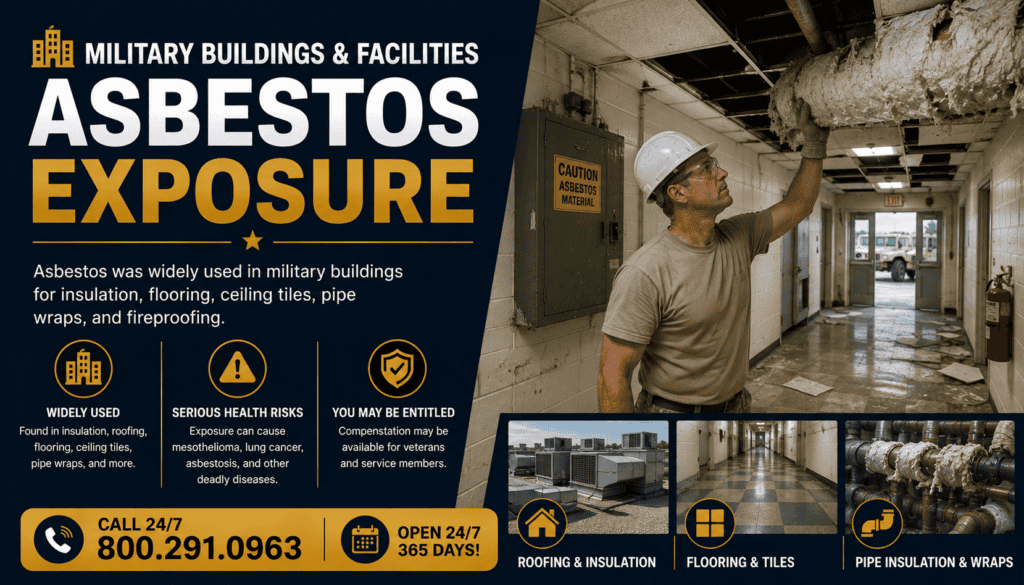
Military Buildings & Facilities Asbestos Exposure
Military buildings constructed or renovated during periods of widespread asbestos use may have incorporated asbestos-containing materials in insulation, flooring, roofing, cement products, mechanical systems and other building components. Veterans, civilian employees and contractors could have encountered these materials when maintenance, repair, renovation or demolition disturbed them.
The Department of Veterans Affairs identifies construction, carpentry, demolition, insulation work and the installation of flooring, roofing, cement sheet and pipe products among military occupations or products associated with potential asbestos exposure. VA emphasizes that asbestos becomes hazardous when asbestos-containing material is damaged or disturbed and fibers become airborne.
🏢 Military Buildings & Asbestos Exposure
A military installation can contain housing, barracks, offices, clinics, schools, warehouses, hangars, maintenance shops, boiler rooms, power facilities and specialized structures. Each building can have a different construction history and different materials. A veteran should therefore avoid assuming that all buildings on a base contained asbestos or created the same exposure conditions.
EPA explains that asbestos-containing building materials can remain in place without necessarily creating an exposure. The risk increases when material is damaged, deteriorating or disturbed during renovation, repair or demolition. OSHA similarly regulates construction, alteration, repair, maintenance and renovation of structures containing asbestos.
A useful exposure history identifies the building, room or work area, dates, job duties, material or system involved, and the activity that may have released fibers.
🏗️ Types of Military Buildings to Investigate
| Building or facility | Historical issues to investigate | Related page |
|---|---|---|
| Barracks | Flooring, ceilings, pipe systems, renovation and maintenance | Military Base Barracks Asbestos Exposure |
| Base housing | Flooring, roofing, insulation and remodeling | Base Housing Asbestos Exposure |
| Schools & clinics | Building materials, utility systems and renovations | Base Schools & Clinics Asbestos Exposure |
| Warehouses | Building materials and stored replacement products | Base Warehouses Asbestos Exposure |
| Hangars | Large-building systems and aviation maintenance areas | Base Hangars Asbestos Exposure |
| Maintenance buildings | Mechanical repair, gaskets, insulation and building materials | Base Maintenance Facilities Asbestos Exposure |
| Boiler/power buildings | Thermal insulation, pipes, boilers, valves and gaskets | Base Power Plants & Boiler Rooms |
These are research categories, not proof that a specific military building contained asbestos. Construction specifications, asbestos surveys, renovation records and laboratory documentation can provide stronger building-specific evidence.
🧱 Where Asbestos May Have Been Used in Military Buildings
EPA identifies several categories of asbestos-containing material historically found in buildings, including thermal-system insulation, surfacing material, floor and ceiling tiles, asbestos-cement panels, siding, roofing and electrical or sound insulation. VA also identifies flooring, roofing, cement sheet, pipes and insulation as products relevant to military asbestos exposure.
| Building area | Potential historical material | Evidence to look for |
|---|---|---|
| Mechanical rooms | Pipe/boiler insulation, gaskets and packing | Equipment files, surveys, maintenance records |
| Floors | Floor tile and associated materials | Specifications, renovation files, laboratory results |
| Ceilings/walls | Surfacing, ceiling materials, cement panels | Asbestos surveys and construction records |
| Roof systems | Roofing and some cement products | Roof replacement and project records |
| Pipes/utility corridors | Thermal-system insulation | Blueprints, inspection and abatement files |
| Electrical/acoustic areas | Electrical or sound insulation | Specifications and product records |
EPA cautions that asbestos cannot reliably be identified by sight alone. Suspect material that may be disturbed should be evaluated by appropriately trained professionals.
🔧 Maintenance, Renovation & Demolition Exposure
Maintenance and renovation can turn an installed material into an airborne exposure hazard when asbestos-containing material is cut, drilled, scraped, removed, broken or otherwise disturbed. OSHA specifically covers demolition, removal, alteration, repair, maintenance and renovation of structures containing asbestos.
OSHA also notes that maintenance workers can encounter asbestos around insulated boilers, old piping, floor or ceiling tiles and renovation work in older buildings. EPA advises reviewing asbestos records before renovations or utility-system replacement because those activities increase the potential for disturbing asbestos-containing materials.
For deeper coverage, see Base Renovation & Demolition Asbestos Exposure. Current OSHA and EPA requirements provide useful hazard context but do not prove what work practices existed at a military building decades ago.
👷 Military Personnel, Families, Civilians & Contractors
Potential exposure depended on actual duties and proximity to disturbed material. Personnel worth investigating can include construction workers, boiler operators, electricians, maintenance mechanics, custodians and renovation crews. Relevant active pages include Military Construction Personnel Asbestos Exposure, Military Boiler Room Personnel Asbestos Exposure, Electricians & Signal Technicians Asbestos Exposure and Groundskeepers, Custodians & Renovation Contractors.
For broader occupational context, see Military Base Personnel Asbestos Exposure. Private-company workers on military installations can also review Civilian Contractors Asbestos Exposure.
Construction-focused military histories may naturally connect with Seabees Construction Battalions and U.S. Army Corps of Engineers Asbestos Exposure when those organizations are actually relevant to the veteran’s assignment.
📂 Documenting Asbestos Exposure in a Military Building
VA states that an asbestos disability claim requires medical records, service records identifying the veteran’s job or specialty, and medical evidence connecting military asbestos contact with the claimed condition. VBA adds that military occupational specialty and duty location may help establish exposure.
| Record | What it may help establish |
|---|---|
| Personnel/service records | Base, unit, specialty and dates |
| Building plans/blueprints | Rooms, utility systems and building configuration |
| Construction specifications | Materials specified for the building |
| Maintenance/work orders | Repair or disturbance activity |
| Asbestos surveys | Documented ACM and location |
| Abatement/renovation files | Removal projects and affected areas |
| Procurement records | Products, suppliers and manufacturers |
| Buddy/coworker statements | Corroboration of duties and work areas |
For building-specific records, see Locating Base and Barracks Blueprints for Asbestos Exposure. A building’s age alone should not be used as proof that a particular material contained asbestos.
🫁 Mesothelioma & Lung Cancer After Building Exposure
VA states that symptoms of asbestos-related disease often do not appear until 20 to 50 years after exposure. Veterans concerned about possible exposure during military service should discuss their occupational and service history with a health-care provider or VA Environmental Health Coordinator.
A diagnosis can establish disease, but it does not by itself identify the military building, product or company responsible for exposure. Those facts require separate investigation. Veterans diagnosed with lung cancer can review the Asbestos Lung Cancer Lawsuit resource for separate legal information.
⚖️ VA Benefits, Asbestos Trust Funds & Legal Options
VA says veterans may qualify for disability compensation when they have a health condition caused by asbestos and had asbestos contact during military service. VA evaluates asbestos claims individually and requires supporting evidence.
Private compensation is a separate process. If building records identify an asbestos manufacturer or supplier that later established a bankruptcy trust, the Asbestos Trust Funds resource explains that option. Simply having worked in an older military building does not establish trust eligibility.
Military Building and Facility Records That May Help
Military installations can include barracks, administrative buildings, hospitals, hangars, warehouses, maintenance shops, boiler and power rooms, training structures and other support facilities. The age or type of a building can help narrow research, but it does not prove that asbestos was present. The strongest documentation identifies a specific material, system or component and connects it to the veteran’s work area and service period.
Construction specifications, engineering drawings, asbestos surveys, renovation files and abatement records can identify materials used in particular buildings. Depending on the facility and era, records may address insulation, flooring, ceiling materials, wall systems, fire-resistant products or mechanical equipment. Later surveys can provide historical clues, but renovation dates should be checked before assuming a material was present during earlier service.
Mechanical and utility spaces may require separate research when duties involved boilers, steam lines, pumps, valves, generators or ventilation equipment. Technical manuals, work orders, parts lists and maintenance records can sometimes identify insulation, gaskets or other components used during a specific period. Equipment could be rebuilt or upgraded, so evidence should be matched to the relevant dates.
Renovation, repair and demolition work can matter when older materials were cut, drilled, scraped, removed or otherwise disturbed. A veteran documenting nearby activity should record the location, approximate date, task, distance and duration when those facts are known. Dust or debris alone is not proof of asbestos; identifying the material through reliable records is important.
Personnel files, performance reports, unit histories, installation maps, building numbers, photographs and witness statements can help establish where a veteran worked. Coworker statements are most useful when they describe firsthand observations. When exact dates or building identifiers are uncertain, marking them as estimates helps keep confirmed facts separate from items that still need research.
Medical records should be preserved separately, including pathology, imaging, diagnosis and treatment information. These records can document disease but generally do not identify a particular military facility or material as the exposure source. For VA and other claims, organizing service history, exposure evidence and medical documentation as distinct parts of the file can make evidentiary gaps easier to identify.
❓ Frequently Asked Questions
Did All Older Military Buildings Contain Asbestos?
No. Asbestos was widely used historically, but building age alone does not prove that a specific material or building contained asbestos.
Where Might Asbestos Have Been Used in a Military Building?
Potential areas include thermal-system insulation, flooring, ceilings, roofing, cement products, pipes, mechanical systems and certain electrical or sound-insulation materials.
Was Simply Living or Working in a Military Building Enough to Cause Exposure?
Not necessarily. Exposure depends on whether asbestos-containing material was present and whether fibers became airborne through damage, deterioration or disturbance.
Why Are Renovation and Demolition Important?
Cutting, breaking, removing or otherwise disturbing asbestos-containing material can release fibers. EPA and OSHA specifically address asbestos hazards during renovation, repair and demolition.
Could Maintenance Workers Have Been Exposed?
Potentially. OSHA identifies boilers, old piping, floor and ceiling materials and renovation work as examples of asbestos concerns for maintenance personnel when asbestos-containing material is present.
Can I Identify Asbestos by Looking at a Building Material?
No. EPA says visual inspection alone cannot confirm asbestos content. Appropriate professional sampling and laboratory analysis may be needed when suspect material will be disturbed.
What Records Can Help Prove Military Building Exposure?
Service records, building plans, specifications, maintenance logs, asbestos surveys, abatement files, procurement records and coworker statements can help reconstruct the history.
Can Military Building Exposure Support VA Compensation?
Potentially. VA requires evidence of military asbestos contact, an asbestos-related health condition and a relationship between the two.
Can Building Exposure Support an Asbestos Trust or Lawsuit?
Potentially, when evidence identifies qualifying exposure to a responsible product or company and the requirements of the particular trust or civil claim are satisfied.
📞 Review Your Military Building Exposure History
If you or a family member has been diagnosed with mesothelioma after military service, gather the base or installation, building name or number, dates, job duties, rooms or systems worked around, renovation history, remembered products and medical records.
Call 800.291.0963 for a no-obligation case evaluation. Talk to a real person 24/7, 365 days a year.
Many mesothelioma law firms handle qualifying civil cases on a contingency-fee basis; confirm fees and expenses with the firm you retain.
📝 Summary
Military buildings can be important locations in a veteran’s asbestos exposure history, particularly when documented asbestos-containing materials were disturbed during construction, maintenance, renovation or demolition. The strongest investigation identifies the specific building, material, task and time period rather than assuming exposure based on building age alone. Service records, blueprints, specifications, asbestos surveys, work orders and coworker evidence can help reconstruct what occurred.
🔗 Confirmed Sources
- U.S. Department of Veterans Affairs — Veterans Asbestos Exposure
- VA Public Health — Asbestos
- VA Veterans Health Library — Veteran Exposure to Asbestos
- U.S. EPA — Buildings That Contain Asbestos
- U.S. EPA — Asbestos Operations & Maintenance
- OSHA — Asbestos Construction Standard
Disclaimer: General information only—not legal or medical advice. This website is not a law firm. Exposure, VA eligibility, liability and deadlines vary by case and jurisdiction. Do not disturb suspected asbestos. Past results do not guarantee future outcomes.