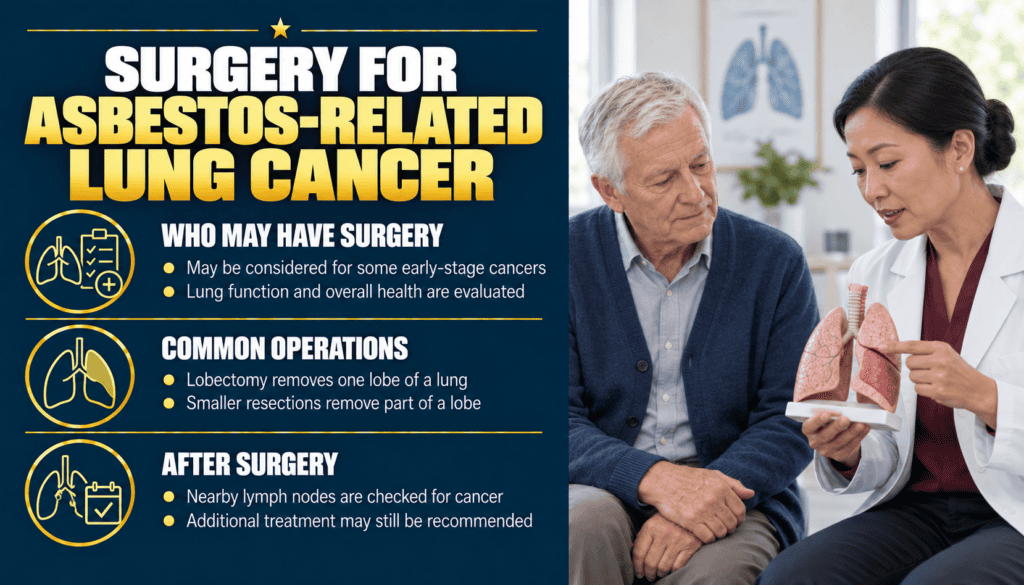
Surgery for Asbestos-Related Lung Cancer
Surgery can be an important treatment option for selected patients with asbestos-related lung cancer when the cancer is sufficiently localized and the patient is healthy enough for an operation. Whether surgery is appropriate depends on the type and stage of lung cancer, tumor location, lymph-node involvement, lung function, heart health, other medical conditions, and the patient’s overall ability to tolerate treatment.
Asbestos exposure does not create a separate type of lung cancer surgery. Surgical decisions are based on the medical characteristics of the cancer. However, asbestos-exposed patients may also have asbestosis, pleural thickening, chronic obstructive pulmonary disease, or other lung conditions that can affect breathing capacity and surgical planning.
This page is a child of the Asbestos Lung Cancer Treatment hub within the broader Diagnosed With Lung Cancer silo. Patients still establishing the diagnosis or stage can also review Diagnosing Asbestos-Related Lung Cancer.
🩺 Who May Qualify for Lung Cancer Surgery?
Surgery is most often considered for selected patients with non-small cell lung cancer whose disease has not spread too far for complete surgical removal. Surgery is used much less often for small cell lung cancer because SCLC commonly spreads earlier in the course of the disease.
Doctors consider several factors before recommending an operation:
| Factor | Why It Matters |
|---|---|
| Cancer type | NSCLC is more commonly treated surgically than SCLC. |
| Stage | Surgery is generally most useful when disease remains sufficiently localized. |
| Tumor location | Determines what portion of lung may need to be removed. |
| Lymph nodes | Nodal involvement can affect stage and whether surgery is appropriate. |
| Lung function | The remaining lung must provide enough breathing capacity after surgery. |
| Heart health | Cardiovascular disease can affect operative risk. |
| Overall health | Frailty and other medical conditions may influence safety and recovery. |
Surgical candidacy should be evaluated by a thoracic surgeon as part of a multidisciplinary cancer team.
🔬 Testing Before Lung Cancer Surgery
Before surgery, the medical team needs to confirm the diagnosis, understand the stage, and determine whether the patient can safely tolerate removal of lung tissue.
Preoperative evaluation may include:
- CT imaging of the chest and surrounding structures
- PET/CT to evaluate suspicious lymph nodes or distant disease
- Brain imaging when appropriate
- Bronchoscopy or other procedures to evaluate the airways
- Lymph-node sampling when needed
- Pulmonary function testing
- Cardiac evaluation for selected patients
- Routine laboratory testing and general preoperative assessment
The goal is to avoid an operation when the cancer has already spread too extensively or when removal of lung tissue would create unacceptable medical risk.
🔪 Types of Surgery for Asbestos-Related Lung Cancer
The amount of lung removed depends on the tumor’s size and location, the patient’s lung function, and what is necessary to achieve an adequate cancer operation.
| Surgical Procedure | What Is Removed | When It May Be Considered |
|---|---|---|
| Wedge resection | Tumor plus a small margin of surrounding lung | Selected small tumors or patients who cannot tolerate larger resection |
| Segmentectomy | An anatomical segment of a lung lobe | Selected early-stage tumors when appropriate |
| Lobectomy | One complete lobe of the lung | Common operation for operable NSCLC when medically suitable |
| Sleeve resection | Part of an airway with tumor, reconnecting the remaining airway | Selected central tumors when lung tissue can be preserved |
| Pneumonectomy | An entire lung | Selected tumors that cannot be adequately removed with a smaller operation |
A larger operation is not automatically better. Surgeons balance complete cancer removal with preservation of healthy lung tissue whenever medically appropriate.
🧬 Lymph-Node Evaluation During Lung Cancer Surgery
Lymph-node evaluation is an important part of lung cancer staging. Cancer cells in regional lymph nodes can change the stage and may affect recommendations for surgery, chemotherapy, immunotherapy, radiation, or other treatment.
Some lymph nodes may be sampled before surgery using bronchoscopy-based techniques or other procedures. During lung cancer surgery, the surgeon may also remove or sample lymph nodes so a pathologist can examine them.
Accurate lymph-node assessment helps determine whether the cancer was more extensive than imaging initially suggested and whether additional treatment may be recommended after surgery.
🏥 Open vs. Minimally Invasive Lung Cancer Surgery
Lung cancer operations can sometimes be performed through traditional open surgery or through minimally invasive techniques.
Thoracotomy
A thoracotomy is an open surgical approach through the chest. It may be necessary for certain tumors, complex anatomy, or extensive procedures.
Video-assisted thoracic surgery
Video-assisted thoracic surgery, often called VATS, uses smaller incisions and a camera to allow the surgeon to operate inside the chest.
Robotic-assisted surgery
Some thoracic surgeons use robotic systems for selected lung cancer operations. Like VATS, robotic surgery uses smaller incisions than a traditional thoracotomy.
The appropriate approach depends on tumor location, stage, surgeon expertise, prior operations, anatomy, and the patient’s medical condition. Minimally invasive surgery is not appropriate for every patient.
🫁 How Asbestos-Related Lung Disease Can Affect Surgery
Some asbestos-exposed patients have respiratory conditions in addition to lung cancer. These can include asbestosis or asbestos-related pleural abnormalities. A history of smoking may also contribute to chronic obstructive pulmonary disease or reduced pulmonary reserve.
These conditions do not automatically prevent surgery, but they can make lung-function testing especially important.
| Condition or Finding | Possible Surgical Relevance |
|---|---|
| Reduced lung function | May limit how much lung tissue can safely be removed. |
| Asbestosis | Fibrotic lung disease can reduce respiratory reserve. |
| COPD or emphysema | May increase respiratory risk and affect postoperative recovery. |
| Pleural disease | May affect surgical anatomy depending on extent and location. |
| Heart disease | Can increase operative risk and require additional evaluation. |
The treatment team evaluates the whole patient rather than the cancer alone when determining whether surgery is reasonable.
⚠️ Risks and Possible Complications of Lung Cancer Surgery
Lung cancer surgery is a major medical procedure. Risks vary according to the operation, age, lung function, heart health, smoking status, other illnesses, and surgical approach.
Possible complications can include:
- Bleeding
- Infection
- Pneumonia
- Air leak from the remaining lung
- Blood clots
- Heart rhythm problems
- Breathing complications
- Pain or nerve-related symptoms
- Need for prolonged oxygen or respiratory support in some patients
The surgeon should explain the expected benefits, alternatives, and individualized risks before an operation.
❤️ Recovery After Lung Cancer Surgery
Recovery varies considerably depending on the procedure and the patient’s health. A smaller resection performed minimally invasively may have a different recovery course than an open lobectomy or pneumonectomy.
Recovery often includes pain management, breathing exercises, walking and physical activity as tolerated, prevention of blood clots, monitoring for infection or air leaks, and follow-up imaging or appointments.
Pulmonary rehabilitation and breathing recovery
Some patients benefit from pulmonary rehabilitation, respiratory therapy, exercise guidance, smoking cessation support, or other services designed to improve breathing and physical function.
Patients should follow the specific postoperative instructions provided by their surgical and oncology teams.
💉 Treatment Before or After Lung Cancer Surgery
Surgery may be one part of a larger treatment plan. Depending on the stage, cancer type, lymph nodes, pathology, biomarkers, and molecular findings, treatment may also include chemotherapy, immunotherapy, targeted therapy, or radiation.
| Treatment Timing | Purpose |
|---|---|
| Neoadjuvant treatment | Treatment given before surgery to address cancer systemically and, in some cases, improve resectability. |
| Adjuvant treatment | Treatment given after surgery to reduce the risk from microscopic cancer that may remain. |
| Surveillance | Regular follow-up imaging and clinical assessment after treatment. |
Treatment recommendations continue to evolve as new clinical evidence becomes available. Patients should discuss the current standard of care for their exact stage and tumor characteristics with their oncology team.
Diagnosed with lung cancer after a history of asbestos exposure? Call 800.291.0963 or Submit Your Case. Live help is available 24/7, 365 days a year.
❓ Frequently Asked Questions
Can asbestos-related lung cancer be treated with surgery?
Yes. Selected patients with sufficiently localized lung cancer may be candidates for surgery. Eligibility depends on cancer type, stage, tumor location, lymph nodes, lung function, heart health, and overall condition.
What is the most common surgery for operable lung cancer?
Lobectomy is a common operation for operable non-small cell lung cancer, although smaller resections or larger operations may be appropriate in selected cases.
Can a person with asbestosis have lung cancer surgery?
Possibly. Asbestosis can reduce lung capacity, so pulmonary function and overall surgical risk must be assessed carefully. It does not automatically exclude every patient from surgery.
Is surgery used for small cell lung cancer?
Only in a relatively small number of carefully selected patients with very early-stage disease. Most small cell lung cancer is treated primarily with systemic therapy, often with radiation depending on the case.
Why are lymph nodes checked during lung cancer surgery?
Lymph-node findings help determine the true stage of the cancer and can affect recommendations for treatment after surgery.
What is the difference between lobectomy and pneumonectomy?
A lobectomy removes one lobe of the lung. A pneumonectomy removes an entire lung and is generally reserved for selected cases where a smaller operation cannot adequately remove the tumor.
Will I need chemotherapy or immunotherapy after surgery?
Some patients do and some do not. Recommendations depend on stage, pathology, lymph nodes, molecular and biomarker findings, previous treatment, and other medical factors.
Does asbestos exposure change the type of surgery performed?
Not by itself. The procedure is selected according to the tumor and the patient’s ability to tolerate surgery. Asbestos-related lung disease may influence lung-function assessment and operative risk.
📞 Lung Cancer Surgery After Occupational Asbestos Exposure?
If you or a family member is undergoing treatment for lung cancer after years in construction, shipyards, industrial plants, military service, mechanical trades, power generation, refineries, or another potentially exposed setting, medical care should remain the priority. At the same time, documenting an old asbestos exposure history may help determine whether legal options should be investigated.
Call 800.291.0963 to discuss jobs, military assignments, worksites, equipment, and materials that may be relevant to past asbestos exposure. Live help is available 24/7, 365 days a year.
Submit Your Case for a case-specific review of potential asbestos exposure and legal options. Eligibility depends on diagnosis, exposure evidence, responsible companies or trusts, jurisdiction, and applicable filing deadlines.
For additional legal information, visit Lung Cancer Asbestos Lawsuit.
⚕️ Legal & Medical Information Disclaimer
This page provides general educational information only. It does not establish a diagnosis, treatment plan, medical causation, legal liability, VA eligibility, or entitlement to compensation. Consult qualified medical and legal professionals about your specific situation.