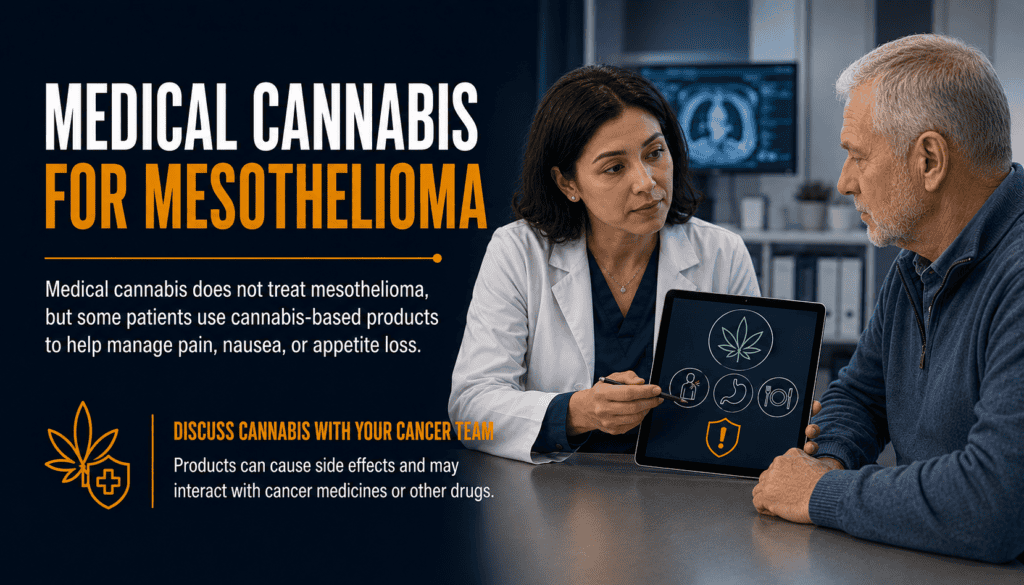
Medical Cannabis for Mesothelioma: Symptom Relief, Evidence and Risks
A patient-focused guide to what is known, what remains uncertain, and how to discuss cannabis safely with your oncology team.
Key point: Cannabis is not a proven treatment or cure for mesothelioma. Some prescription cannabinoid medications have a defined role in chemotherapy-related nausea when other anti-nausea treatments have not worked. Evidence for dispensary cannabis products and many other cancer symptoms remains limited. Tell your oncology team about every product you use before combining it with treatment.
What medical cannabis can and cannot do
People living with mesothelioma may ask about cannabis because of nausea, pain, appetite loss, poor sleep or anxiety. Medical cannabis is a broad term: plant products, THC-containing products, CBD products and prescription cannabinoid medicines are not interchangeable. Product composition, dose, route and quality can differ markedly.
Laboratory findings about cancer cells do not demonstrate that cannabis treats cancer in people. The American Society of Clinical Oncology (ASCO) advises against using cannabis or cannabinoids in place of cancer-directed treatment or to enhance it outside a clinical trial. Do not postpone evaluation or replace a treatment plan based on a product’s cancer-cure claim.
| Question | Evidence-based answer |
|---|---|
| Does cannabis cure mesothelioma? | No clinical evidence establishes cannabis as a cure. |
| Can it replace immunotherapy, surgery or chemotherapy? | No. Discuss standard treatment options with a mesothelioma specialist. |
| Might some cannabinoids help certain symptoms? | Some prescription cannabinoids can help refractory chemotherapy-induced nausea; evidence for other symptoms varies. |
| Are over-the-counter CBD products FDA-approved for cancer? | No. FDA has not approved cannabis or CBD products to treat cancer. |
Evidence for common symptoms
Studies often combine different cancer populations, formulations and doses. Findings should not automatically be assumed to apply to mesothelioma or to a product sold locally. ASCO considers evidence insufficient for most cancer-related symptoms; it allows consideration of cannabis/cannabinoids for refractory chemotherapy-induced nausea and vomiting after standard antiemetics fail, with clinical oversight.
| Symptom | What the evidence supports | What to ask |
|---|---|---|
| Chemotherapy nausea/vomiting | Prescription dronabinol or nabilone are FDA-approved for chemotherapy-related nausea/vomiting that has not responded adequately to conventional antiemetics. | Have standard anti-nausea medicines been optimized first? |
| Cancer pain | Evidence is mixed or insufficient for routine recommendations. | What pain treatments address the cause and type of pain? |
| Appetite/weight loss | Do not assume a dispensary product reverses cancer-related weight loss. | Should a dietitian evaluate nutrition and causes of poor intake? |
| Sleep or anxiety | Cancer-specific evidence is limited; THC can also worsen anxiety or confusion. | Could symptoms reflect pain, medication effects or another treatable issue? |
| Breathlessness | Cannabis is not an established treatment for mesothelioma-related breathlessness. | Should fluid, anemia, infection or another cause be evaluated? |
Cannabis, THC, CBD and prescription medicines
THC can cause intoxication, altered perception, slowed reactions and increased heart rate. CBD does not produce the same typical intoxication, but it can still cause adverse effects and interact with medicines. A label such as “natural” does not establish safety. Concentrations and contaminants may differ in unapproved products.
| Product category | Important distinction |
|---|---|
| Plant cannabis / dispensary preparations | Not FDA-approved as cancer treatment; composition and oversight vary. |
| THC-dominant preparations | May impair attention, balance and driving; effects can be unpredictable. |
| CBD oils or gummies | Not approved for mesothelioma; possible liver injury, sedation and drug interactions. |
| Dronabinol (Marinol, Syndros) | Prescription synthetic THC; approved for specified indications including refractory chemotherapy nausea/vomiting. |
| Nabilone (Cesamet) | Prescription synthetic cannabinoid; approved for refractory chemotherapy nausea/vomiting. |
| Epidiolex (prescription CBD) | Approved for certain seizure disorders, not cancer symptoms or mesothelioma. |
Prescription medicines have defined labeling, indications and monitoring. A store-bought product with similar ingredients should not be treated as equivalent.
Side effects and high-risk situations
Potential harms include dizziness, drowsiness, falls, impaired driving, anxiety, confusion, rapid heartbeat and problems with attention or memory. Edible products can have delayed effects, increasing the risk of taking more before the first dose is felt. Products may also contain inaccurate cannabinoid concentrations or contaminants. Smoking exposes the lungs to irritants and toxic substances; this is especially relevant when breathing is already compromised.
| Situation | Safety concern |
|---|---|
| Weakness, unsteady walking or prior falls | Sedation and impaired balance may increase injury risk. |
| Lung disease or shortness of breath | Avoid assuming inhaled products are safe; ask the pulmonary/oncology team. |
| Confusion, delirium or severe anxiety | THC may worsen symptoms. |
| Liver problems or abnormal liver tests | CBD can cause liver injury; monitoring may be needed. |
| Alcohol, opioids, sleep medicines or sedatives | Combined impairment and sedation may increase. |
| Driving or operating equipment | Do not drive while impaired; product effects may last longer than expected. |
Seek urgent medical attention for severe breathing difficulty, chest pain, fainting, severe confusion or another sudden serious symptom. Do not assume these symptoms are simply a cannabis side effect.
Need help now? Call 800.291.0963 / Live chat available 24/7, 365 days a year / Submit Your Case.
Interactions with cancer treatment
Share cannabis, THC, CBD, herbal supplements and all prescriptions with your oncologist and oncology pharmacist. CBD can affect drug-metabolizing pathways and liver enzymes. Cannabis may also compound sedation from opioids, anti-anxiety medicines and sleep medications. Possible interactions with immunotherapy remain an active research question; observational studies cannot establish cause and effect. Never change or stop prescribed cancer medicine without the treating team.
| Treatment or medicine | Discussion point |
|---|---|
| Immunotherapy | Ask whether cannabis use could complicate treatment monitoring; research on outcomes is not conclusive. |
| Chemotherapy and targeted medicines | Check for drug-specific metabolism and side-effect interactions with the pharmacist. |
| Opioid pain medicines | Review drowsiness, falls and breathing risks. |
| Anticoagulants and other chronic medicines | Ask about product-specific interactions and monitoring. |
| Sedatives, alcohol and sleep medicines | Discuss additive impairment and safety. |
| Medicines affecting the liver | Review liver tests and possible CBD-related risks. |
Discussing options with your care team
A useful conversation starts with the symptom, not the product. Explain what you want to improve, how severe it is, which treatments you have already tried and what medicines you take. Ask whether a reversible cause requires evaluation. Your doctor can weigh possible benefits against your lung function, other diagnoses, fall risk, cancer regimen and local rules.
| Ask your team | Why it matters |
|---|---|
| What is causing this symptom? | Breathlessness, nausea and pain may have treatable causes. |
| Which first-line treatments have we tried? | Better-supported options may work without cannabis-related risks. |
| Is a prescription cannabinoid appropriate? | Its indication and monitoring differ from dispensary products. |
| Could this affect my cancer treatment? | The answer depends on your exact regimen and product. |
| Which side effects require a call? | Agree on a plan for sedation, confusion, falls or worsening symptoms. |
| Who will monitor the outcome? | Choose a symptom goal and follow-up rather than relying on impressions alone. |
Evidence-based symptom care
Mesothelioma supportive care can be provided alongside cancer-directed treatment. Palliative-care clinicians, oncology nurses, pharmacists and dietitians can help tailor a plan. Examples include prescribed antiemetics for nausea, appropriate pain medicines and procedures, evaluation of pleural fluid for breathlessness, nutrition support and counseling for distress. No single approach fits everyone.
| Problem | Potential care-team options |
|---|---|
| Nausea | Review cause and optimize guideline-based antiemetics. |
| Pain | Assess pain type; adjust analgesics or consider specialty procedures. |
| Poor appetite | Dietitian review; address nausea, constipation, swallowing or mood issues. |
| Breathlessness | Assess urgent causes, fluid management and symptom-focused care. |
| Insomnia or anxiety | Treat contributing symptoms and discuss behavioral or medication options. |
Explore the site’s mesothelioma treatment overview, immunotherapy guide and herbal medicines safety guide for related questions.
Patient safety checklist
Before considering any cannabis-related product, use this checklist at your next appointment. Do not start a product merely because it is advertised as “medical,” “full spectrum,” or “cancer fighting.”
| Step | Action |
|---|---|
| 1 | Write down the symptom, its severity and what you hope to improve. |
| 2 | List all cancer medicines, prescriptions, OTC drugs and supplements. |
| 3 | Tell the oncologist about current or planned THC/CBD use, including route and product label. |
| 4 | Ask about interactions, liver tests, sedation, breathing concerns and falls. |
| 5 | Discuss standard symptom treatments and whether a prescription cannabinoid is indicated. |
| 6 | Clarify applicable local laws and whether any insurance coverage applies. |
| 7 | Agree on a follow-up plan and stop/seek-help warning signs. |
Remember: evidence and product regulations can change. Ask your treating clinician for guidance based on your current medications and health status.
Frequently asked questions
Can medical cannabis cure mesothelioma?
No. Cannabis and cannabinoids have not been shown to cure mesothelioma in clinical trials and should not replace cancer-directed care.
Is cannabis FDA-approved for mesothelioma?
No. FDA has not approved cannabis for cancer treatment or cancer-related symptoms. Certain prescription synthetic cannabinoids have approval for refractory chemotherapy-related nausea and vomiting.
Can cannabis help chemotherapy nausea?
Prescription dronabinol and nabilone are approved for chemotherapy-related nausea and vomiting after inadequate response to conventional antiemetics. Ask the oncology team whether they are appropriate.
Is CBD safer than THC?
CBD does not cause the same typical intoxication as THC, but it can cause liver injury, drowsiness and drug interactions. Neither is automatically safe.
Can cannabis interfere with immunotherapy?
Potential effects on immunotherapy outcomes are being studied; current observational findings do not prove a causal effect. Disclose use to the oncology team.
Should someone with pleural mesothelioma smoke cannabis?
Smoking exposes the lungs to harmful substances. Patients with breathing problems should discuss respiratory risks and symptom alternatives with their clinician.
What if a product claims it kills mesothelioma cells?
Laboratory claims do not prove benefit in patients. Ask for human clinical-trial evidence and do not delay established treatment.
What should I bring to my appointment?
Bring a full medicine list, the product name and ingredient label if applicable, your symptom diary and questions about interactions and safer alternatives.
Confirmed medical sources and further reading
- National Cancer Institute: Cannabis and Cannabinoids (patient information)
- FDA: Regulation of Cannabis and Cannabis-Derived Products
- FDA: CBD safety and drug interactions
- ASCO guideline: Cannabis and Cannabinoids in Adults With Cancer
- CDC: Cannabis and Cancer
Source scope: these resources address cancer generally; mesothelioma-specific cannabis efficacy has not been established. This article does not offer dosing instructions or product recommendations.
Questions About Mesothelioma and Your Options?
Call 800.291.0963 for information about mesothelioma-related legal options. Live chat is available 24/7, 365 days a year. Submit Your Case to request a case review. Eligibility and compensation depend on individual circumstances; no outcome is guaranteed.
⚕️ Legal & Medical Information Disclaimer
This page is general information, not medical or legal advice. Discuss cannabis, medicines and treatment decisions with your licensed oncology team. Consult a qualified attorney about individual legal questions.