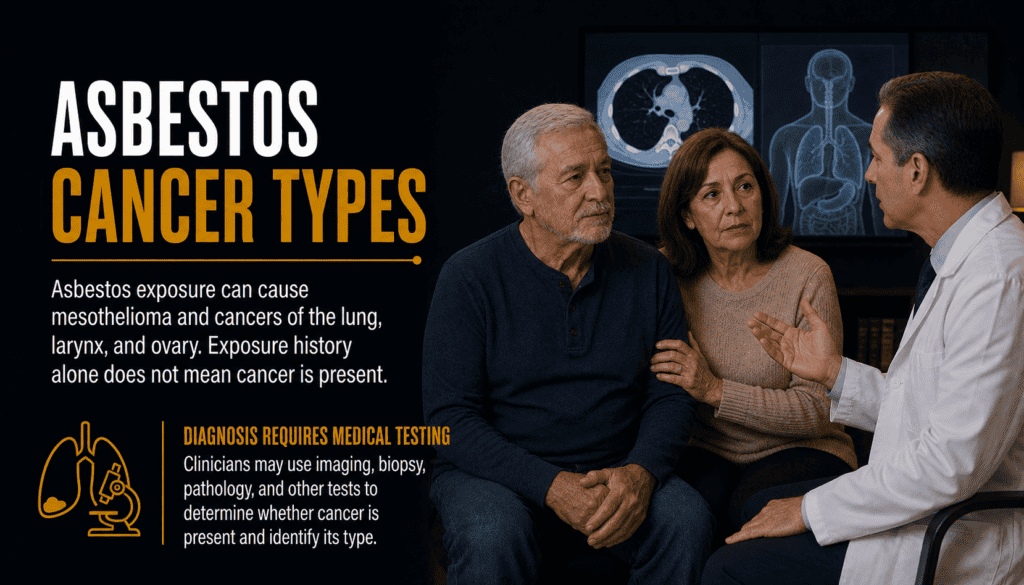
Asbestos Cancer Types: Which Cancers Are Linked to Exposure?
Asbestos is linked to several cancers, but the strength of the evidence differs by cancer site. This guide explains established causal links, diagnostic differences and how to discuss past exposure with your care team.
Which Cancer Types Are Linked to Asbestos?
Asbestos is a known human carcinogen. Major cancer authorities identify causal links with mesothelioma and cancers of the lung, larynx (voice box), and ovary. Research also examines other cancer sites, but an observed association is not always sufficient to establish causation. Asbestos exposure does not mean cancer is inevitable, and an individual cancer diagnosis does not automatically establish asbestos as its cause.
These diseases arise in different tissues and require different tests and treatment plans. This page compares cancer types; it does not replace a cancer-specific medical assessment.
| Cancer | Site | Asbestos evidence |
|---|---|---|
| Mesothelioma | Mesothelial linings | Established cause |
| Lung cancer | Lung tissue | Established cause |
| Laryngeal cancer | Voice box | Established cause |
| Ovarian cancer | Ovaries | Established cause |
| Other proposed sites | Varies | Evidence differs; do not assume causation |
Mesothelioma: Cancer of Body Linings
Mesothelioma develops in the mesothelium, the lining of several body cavities. Pleural mesothelioma affects the lining around the lungs; peritoneal mesothelioma affects the abdominal lining. Rare forms involve the lining around the heart or testes. Mesothelioma is not the same disease as lung cancer, even when both cause chest symptoms.
Symptoms may include shortness of breath, chest pain, abdominal swelling, or unexplained weight loss. Imaging can identify abnormalities, but diagnosis usually requires tissue reviewed by a pathologist. Cell type, location, stage and overall health help determine treatment.
| Type | Location | Possible clinical presentation |
|---|---|---|
| Pleural | Lining around lungs | Breathlessness, chest pain, fluid |
| Peritoneal | Abdominal lining | Abdominal pain or swelling |
| Pericardial | Heart lining | Rare; symptoms vary |
| Tunica vaginalis | Testicular lining | Rare; swelling or mass |
Read about mesothelioma treatments and mesothelioma prognosis.
Asbestos-Related Lung Cancer
Asbestos can cause lung cancer, a malignancy arising in lung tissue. The main clinical groupings are non-small cell lung cancer and small cell lung cancer. Both require appropriate diagnosis and staging. Asbestos-related lung cancer cannot be identified by a unique symptom or by exposure history alone.
Smoking independently causes lung cancer, and the combined risk from smoking and asbestos exposure is substantially greater than either risk alone. A person who never smoked can still develop asbestos-related lung cancer. Ask a clinician whether your overall history meets current low-dose CT screening criteria; screening is not a substitute for evaluating symptoms.
| Feature | Asbestos-related lung cancer | Pleural mesothelioma |
|---|---|---|
| Origin | Lung tissue | Lining surrounding lung |
| Common classification | Non-small cell or small cell | Mesothelioma histologic subtypes |
| Smoking | Important additional risk | Not established as a cause |
| Diagnosis | Imaging and cancer tissue testing | Imaging and specialist tissue testing |
Laryngeal Cancer and Asbestos Exposure
The larynx is the voice box. Authoritative evaluations have concluded that asbestos exposure causes laryngeal cancer. Tobacco and alcohol are also important risk factors, so a clinician evaluates the complete history rather than attributing a specific case to one exposure without investigation.
Persistent hoarseness, pain or difficulty swallowing, a neck lump, or breathing changes deserve medical assessment. An ear, nose and throat specialist may examine the larynx and arrange a biopsy when indicated.
| Concern | Possible evaluation | Why it matters |
|---|---|---|
| Persistent hoarseness | Clinical exam and laryngoscopy | Visualizes the voice box |
| Suspicious lesion | Biopsy | Determines whether cancer is present |
| Confirmed cancer | Staging and specialist review | Guides treatment choices |
Ovarian Cancer and Asbestos Exposure
Asbestos is an established cause of ovarian cancer in authoritative carcinogen evaluations. Exposure may have occurred in workplaces or through other circumstances, but the evidence linking a substance to a cancer across populations does not prove the cause of any one patient’s diagnosis. Ovarian cancer has multiple possible risk factors.
Persistent abdominal bloating, pelvic discomfort, feeling full quickly or urinary changes warrant assessment, particularly when new and frequent. Evaluation may include examination, imaging and other tests chosen by a clinician. Peritoneal mesothelioma can sometimes resemble ovarian cancer; expert pathology review may be important in complex cases.
| Condition | Origin | Diagnostic distinction |
|---|---|---|
| Ovarian cancer | Ovary or related reproductive tissue | Pathology establishes tumor type |
| Peritoneal mesothelioma | Abdominal mesothelial lining | Specialist pathology and marker testing |
| Benign pelvic condition | Various | Clinical workup avoids assuming cancer |
Explore asbestos exposure and ovarian cancer.
Other Cancers: What the Evidence Does and Does Not Show
Researchers have examined associations between asbestos and cancers at additional sites, including the pharynx, stomach and colorectum. Findings and conclusions vary by cancer site and the evidence reviewed. Do not describe these as established asbestos-caused cancers merely because an individual study reported an association.
Studies can be affected by smoking, other workplace exposures, differences in exposure measurement and the number of cases. A healthcare professional can assess a diagnosed cancer, while questions about causation in an individual claim require case-specific evidence.
| Evidence category | Meaning | Reader takeaway |
|---|---|---|
| Established causal link | Expert bodies find sufficient evidence | Still not proof of an individual case’s cause |
| Observed association | Studies find a statistical relationship | May need stronger or more consistent evidence |
| Inadequate evidence | Available studies cannot resolve the question | Do not claim a proven link |
Symptoms, Diagnosis and Screening
Asbestos-linked cancers can appear many years after exposure, and early symptoms may resemble common noncancerous illnesses. Symptoms alone cannot determine which cancer, if any, is present. Report a persistent cough, coughing blood, new hoarseness, unexplained weight loss, abdominal swelling or other ongoing changes to a clinician.
Doctors select tests based on the suspected organ and symptoms. Imaging identifies areas of concern; biopsy and pathology often establish a cancer diagnosis. No single blood test diagnoses or rules out all asbestos-related cancers. Low-dose CT lung screening is designed for eligible people at elevated lung-cancer risk and does not screen for every asbestos-linked cancer.
| Symptom or finding | Possible next step | Important caution |
|---|---|---|
| Persistent cough or chest symptoms | Clinical review and chest tests | Many causes are possible |
| Persistent hoarseness | ENT evaluation | Do not assume laryngeal cancer |
| Abdominal or pelvic symptoms | Medical examination and targeted tests | Different conditions overlap |
| Suspicious scan | Specialist and possible biopsy | Imaging alone may not identify tumor type |
Sudden severe breathlessness, severe chest pain or significant coughing of blood requires urgent emergency evaluation.
Exposure History, Treatment and Next Steps
Write down job titles, military duties, worksites, dates, products handled and whether asbestos-containing material was cut, removed or disturbed. Include possible household exposure from contaminated work clothing. An exposure history can inform medical evaluation, but it cannot replace a biopsy or prove individual causation.
After a confirmed cancer diagnosis, ask the treating team about the exact pathology, stage, treatment goals, specialist referral and supportive care. Treatment varies considerably among mesothelioma, lung, laryngeal and ovarian cancers; no single asbestos-cancer treatment applies to all. Avoid disturbing suspected asbestos materials yourself and consult qualified abatement professionals when needed.
| Action | What to collect or ask | Purpose |
|---|---|---|
| Document exposure | Jobs, dates, tasks and materials | More complete clinical history |
| Confirm diagnosis | Pathology report and cancer origin | Avoids confusing cancer types |
| Review care plan | Stage, options and second opinion | Informed treatment decisions |
| Discuss legal questions | Diagnosis and documented exposure | Case-specific professional guidance |
Related reading: related asbestos diseases, asbestosis (a noncancerous disease), pleural plaques, and pleural thickening.
Frequently Asked Questions
Which cancers are conclusively linked to asbestos?
Major authoritative evaluations establish causal links with mesothelioma and cancers of the lung, larynx and ovary.
Is asbestosis a type of cancer?
No. Asbestosis is asbestos-related scarring of lung tissue, not a malignancy.
Are pleural plaques cancer?
No. Pleural plaques are noncancerous pleural scarring and can indicate past asbestos exposure.
Is asbestos-related lung cancer the same as mesothelioma?
No. Lung cancer begins in lung tissue; pleural mesothelioma begins in the lining around the lungs.
Does every cancer in someone exposed to asbestos come from asbestos?
No. A history of exposure alone cannot determine the cause of an individual cancer.
Does smoking cause mesothelioma?
Smoking is not an established cause of mesothelioma. It substantially increases lung-cancer risk, especially alongside asbestos exposure.
Can a blood test detect every asbestos-related cancer?
No. Diagnostic tests depend on the suspected cancer, and tissue pathology is often essential.
What should I bring to a medical appointment?
Bring symptom dates, prior scans or pathology, smoking history if relevant, and a written timeline of possible asbestos exposure.
Authoritative Sources and Further Reading
The following public-health and cancer resources explain asbestos carcinogenicity and cancer-specific evaluation. Check current clinical recommendations with your care team.
Questions About Asbestos Exposure and a Cancer Diagnosis?
Call 800.291.0963. Live chat is available 24/7, 365 days a year. Submit Your Case using the form below. Contacting us does not establish eligibility for compensation.
⚕️ Legal & Medical Information Disclaimer
This article is general information, not a diagnosis, treatment recommendation or legal advice. Consult qualified healthcare professionals for medical questions and an attorney for case-specific legal advice.