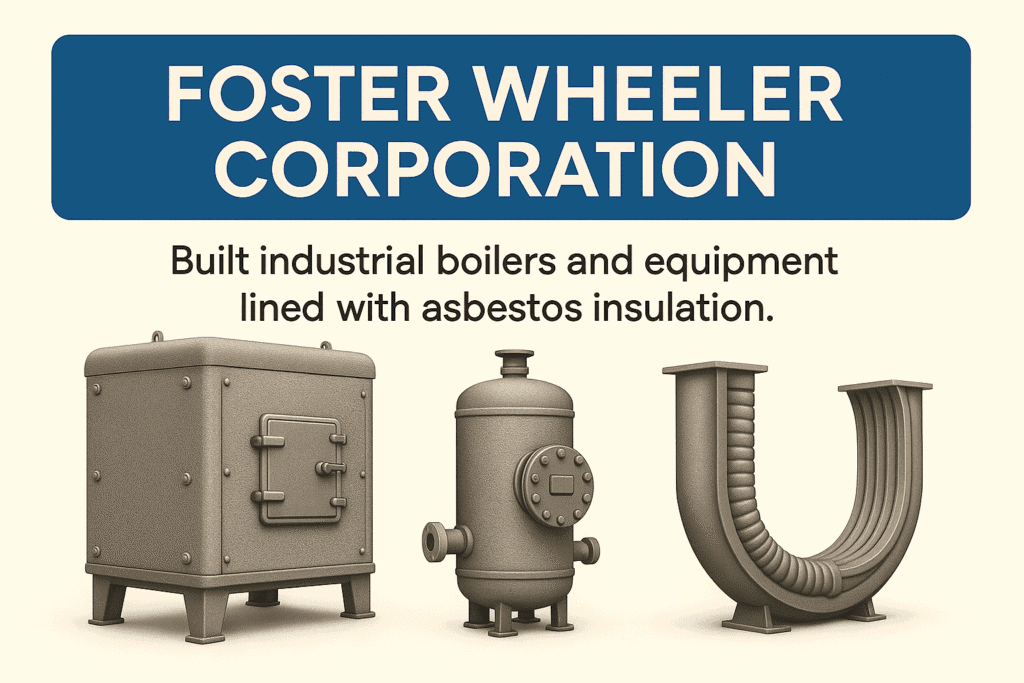
🏭 Foster Wheeler Corporation Asbestos Exposure
Foster Wheeler Corporation asbestos exposure concerns historical products and work associated with industrial boilers, steam-generating equipment and engineered process systems. Potential exposure sources must be established through the actual product, worksite, period and materials involved; the company name alone cannot prove that a person inhaled asbestos.
People diagnosed with mesothelioma or asbestos-related lung cancer may need to reconstruct where Foster Wheeler Corporation equipment or products were installed, maintained or removed. This page explains possible pathways, relevant workers, documentation and legal options without assuming that every product contained asbestos.
📑 On This Page
- Company & Exposure Overview
- Where Exposure May Have Occurred
- Workers & Occupations
- Products & Exposure Pathways
- Records & Evidence
- Mesothelioma & Asbestos-Related Lung Cancer
- Lawsuits, Trust Funds & Compensation
- Frequently Asked Questions
- Summary & Confirmed Sources
🏭 Company & Exposure Overview
Explore the wider company category through Asbestos Companies. The page offers related context, not proof of asbestos content in a particular product.
Compare manufacturer and supplier relationships with Industrial Equipment Manufacturers. The page offers related context, not proof of asbestos content in a particular product.
Foster Wheeler Corporation is discussed here in relation to industrial boilers, steam-generating equipment and engineered process systems. Identifying a manufacturer or corporate name is an important lead, but product formulations, manufacturing dates and suppliers may have varied. Company identity should be corroborated with dated records.
Potential material questions include boiler insulation, refractory systems, high-temperature seals and associated piping products where asbestos was present. A machine or facility may also have contained materials supplied by unrelated manufacturers. Evidence should separate company-supplied products from insulation, replacement parts and nearby building materials.
Historical ownership changes, corporate subsidiaries, acquisitions and product-line transfers can complicate the identification of a responsible entity. A brand on an equipment plate does not automatically establish which business supplied later replacement parts.
A worker may remember the equipment color, an operating unit, a job foreman or a maintenance shutdown better than a model number. Those details can guide a search through photographs, plant diagrams, service records and dated purchase orders.
📍 Where Exposure May Have Occurred
For another historical manufacturer profile, see Asbestos Manufacturers. The page offers related context, not proof of asbestos content in a particular product.
A related corporate or equipment history appears in Alfa Laval Inc.. The page offers related context, not proof of asbestos content in a particular product.
Possible exposure settings involving Foster Wheeler Corporation include facilities where industrial boilers, steam-generating equipment and engineered process systems were installed, operated, repaired or dismantled. The relevant question is whether a documented asbestos-containing product was disturbed during the worker’s actual assignment.
The relevant industry category is Metals, Mining & Steel Companies. The page offers related context, not proof of asbestos content in a particular product.
| Work Area or Activity | What Evidence Can Clarify Exposure |
|---|---|
| industrial pipe racks | Purchase records, labels, supplier information and dates of use |
| boiler and steam rooms | Installation methods, cutting or removal activities and nearby trades |
| shipyard mechanical spaces | Maintenance records, product replacement history and dust controls |
| refinery maintenance shutdowns | Contractor logs, worker proximity and the frequency of work |
| insulation removal zones | Disposal practices, renovation documents and firsthand accounts |
Maintenance may involve boiler insulation, refractory systems, high-temperature seals and associated piping products where asbestos was present. The exposure pathway depends on material composition, removal methods, proximity, ventilation and duration; routine operation does not by itself establish exposure.
A single site can contain products from many manufacturers. Distinguish original equipment from contractor-installed insulation, replacement gaskets, packing and later alterations when building a product timeline.
👷 Workers & Occupations
Another company profile to compare is Anchor Packing Company. The page offers related context, not proof of asbestos content in a particular product.
Compare another manufacturer through P&H Mining Equipment Inc.. The page offers related context, not proof of asbestos content in a particular product.
Occupations to examine include boilermakers, power plant operators, insulators and maintenance crews. A title alone is insufficient; the worker’s actual duties, shift, location and dates should be documented.
For a different equipment supplier, review American Standard Inc.. The page offers related context, not proof of asbestos content in a particular product.
Repair technicians may have handled components directly while operators or nearby trades could have been present during overhauls. Such roles involve different potential exposure pathways and should not be described as equivalent.
Witness accounts can identify the work area and tasks, but should be checked against manuals, invoices, engineering records and photographs whenever possible.
🧰 Products & Exposure Pathways
For connected valve and sealing work, consult Valve Actuator Machinery. The page offers related context, not proof of asbestos content in a particular product.
Power and electrical equipment is discussed in Power Generation & Electrical Machinery. The page offers related context, not proof of asbestos content in a particular product.
For equipment installed in processing facilities, see Refinery Process Unit Machinery. The page offers related context, not proof of asbestos content in a particular product.
Product Identification
Possible historical products include historical asbestos-containing pipe and equipment insulation where product records support identification. A product name should be connected to a particular formulation, batch, supplier and time period before its asbestos content is asserted.
Relevant machinery and repair tasks are described in Industrial Pump Machinery. The page offers related context, not proof of asbestos content in a particular product.
Manufacture, Fabrication and Distribution
During industrial boilers, steam-generating equipment and engineered process systems, product handling could involve cutting, packaging, storage or movement. Such activities matter only when the material is shown to contain asbestos and fibers could be released.
Installation and Repair
Installation and repair tasks may disturb insulation, friction material, adhesives or other historical products. Identify the task and the product rather than assuming routine work caused airborne asbestos exposure.
Relevant evidence can include a dated invoice, a photograph of packaging, an installation specification, a laboratory report from an appropriate sample, or testimony describing how the product was used. A generic catalog entry is not proof that a particular worker encountered that product.
Product and worksite histories should be built as timelines. Replacement parts, new suppliers and changing safety practices may have altered the exposure circumstances over time. State what is documented, what is uncertain and what still needs verification.
Renovation, Removal and Cleanup
Removal of old materials can differ from ordinary product use. Debris handling, scraping, dry sweeping and demolition may be important to reconstruct when the disturbed material contained asbestos.
Relevant evidence can include a dated invoice, a photograph of packaging, an installation specification, a laboratory report from an appropriate sample, or testimony describing how the product was used. A generic catalog entry is not proof that a particular worker encountered that product.
Product and worksite histories should be built as timelines. Replacement parts, new suppliers and changing safety practices may have altered the exposure circumstances over time. State what is documented, what is uncertain and what still needs verification.
Nearby and Household Exposure
Nearby workers or household members sometimes report indirect exposure. Such claims require evidence about the source, transport of fibers, frequency and applicable legal standards.
Relevant evidence can include a dated invoice, a photograph of packaging, an installation specification, a laboratory report from an appropriate sample, or testimony describing how the product was used. A generic catalog entry is not proof that a particular worker encountered that product.
Product and worksite histories should be built as timelines. Replacement parts, new suppliers and changing safety practices may have altered the exposure circumstances over time. State what is documented, what is uncertain and what still needs verification.
📁 Records & Evidence
For equipment evidence in extractive industries, review Mining Equipment. The page offers related context, not proof of asbestos content in a particular product.
For mining workplace context, consult Mining Job Sites. The page offers related context, not proof of asbestos content in a particular product.
A complete record set helps distinguish a documented exposure pathway from a general association with a company. Preserve original dates and sources for each document, especially where product formulations or corporate entities changed.
| Record or Evidence | What It May Establish |
|---|---|
| Employment and union records | Employer, worksite, occupation and dates |
| Purchase orders and supplier invoices | Product names, quantities, suppliers and delivery dates |
| Product labels and specifications | Historical composition, model or formulation |
| Contractor and maintenance logs | Tasks, work areas and dates of disturbance |
| Photographs and coworker accounts | Corroboration of material handling and proximity |
| Medical and pathology records | Diagnosis and treatment timeline |
| Corporate and trust documents | Potential entity identity and relevant claim procedures |
Missing records are common for older workplaces. A knowledgeable attorney may seek archives, former employees, union materials and product identification evidence. Gaps should be described honestly; they are not a reason to invent a manufacturer, product or exposure date.
🫁 Mesothelioma & Asbestos-Related Lung Cancer
Mesothelioma
Mesothelioma is a malignancy of the mesothelium, commonly affecting the lining of the lungs. Asbestos exposure is the principal established cause, and diagnosis may follow exposure by decades. A specialist may rely on imaging, biopsy and pathology to establish the diagnosis.
Other industrial product categories appear in Asbestos Exposure in Equipment. The page offers related context, not proof of asbestos content in a particular product.
A mesothelioma diagnosis does not, by itself, identify which employer, product or company contributed to exposure. Occupational and product evidence is a separate part of a potential claim. A complete history should include jobs before and after the work associated with the company discussed here.
Asbestos-Related Lung Cancer
Asbestos is an established cause of lung cancer. Smoking is also a major risk factor, and the effects of smoking and asbestos exposure can be greater together. Individual medical evaluation is required; a lung cancer diagnosis in an industrial worker is not automatic proof of asbestos causation.
Keep pathology reports, treatment notes and any documented occupational history. A medical team can address diagnosis and treatment, while legal professionals evaluate product identification and applicable claim requirements.
⚖️ Lawsuits, Trust Funds & Compensation
A related maintenance environment is described in Shipyard Boiler & Heating Equipment. The page offers related context, not proof of asbestos content in a particular product.
Civil Lawsuits and Responsible Parties
A civil asbestos case may involve manufacturers, installers, distributors or other responsible parties, depending on the facts and governing law. The claimant generally needs evidence of a qualifying injury and legally relevant exposure. Corporate relationships and historical successor liability require individual review.
Bankruptcy Trust Funds
Some asbestos-related companies have bankruptcy trusts, while others do not. Each trust has its own rules for disease, exposure, documents and deadlines. Do not assume that every company named on an asbestos website has a currently available trust or that a trust filing preserves civil lawsuit deadlines.
Family Claims and Filing Deadlines
Depending on state law, surviving relatives may have wrongful-death or related claims. Filing periods and eligible family members vary. A prompt, case-specific legal assessment can help avoid missing deadlines and clarify which records to preserve.
No page can promise a settlement amount or determine legal eligibility from a job title alone. Trust payments, lawsuit results and other potential benefits depend on evidence, applicable law and the particular responsible entities.
❓ Frequently Asked Questions
Did every Foster Wheeler Corporation product contain asbestos?
No. Materials, formulations and suppliers varied. Product-specific historical evidence is needed.
Which Foster Wheeler Corporation products should be identified?
Potentially relevant occupations include insulators, pipefitters, boiler crews, shipyard maintenance workers. Their actual tasks and dates matter more than job titles alone.
Could maintenance on related equipment disturb asbestos?
Purchase orders, labels, specifications, job records and corroborated witness accounts may help identify it.
Does working near Foster Wheeler Corporation equipment prove exposure?
No. A worksite association is only a starting point; the material and exposure pathway must be supported.
How can historical product dates be established?
Possibly, if confirmed asbestos-containing material was disturbed nearby. Distance, duration and frequency matter.
Which occupations might have relevant exposure records?
No. Diagnosis and product-specific exposure identification are separate questions.
What evidence matters for a Foster Wheeler Corporation asbestos claim?
No. Trust availability and criteria must be checked for the specific entity and current trust procedures.
Can family members seek legal guidance after a death?
Medical records, work histories, employment documents, product information and contacts for coworkers can be useful.
📌 Summary & Confirmed Sources
Foster Wheeler Corporation Asbestos Exposure concerns historically relevant materials and work activities, but any individual claim depends on documentation. Identify the product, manufacturer or contractor role, workplace, dates, tasks and medical diagnosis before drawing conclusions.
For additional machinery context, review Asbestos Exposure in Machinery. The page offers related context, not proof of asbestos content in a particular product.
For additional context, consult the company and product categories linked throughout this article. They are supporting reading, not evidence that all listed companies shared responsibility for a particular person’s exposure.
Confirmed Sources
OSHA — Asbestos in General Industry
National Cancer Institute — Asbestos Exposure and Cancer Risk
Find Out If You May Qualify for Asbestos Compensation Today
Call 800.291.0963 — help is available 24/7/365. 25+ years of experience.
Disclaimer: Mesothelioma Help Center is not a law firm or medical provider and does not determine legal or VA eligibility. This page provides general information and is not legal or medical advice.