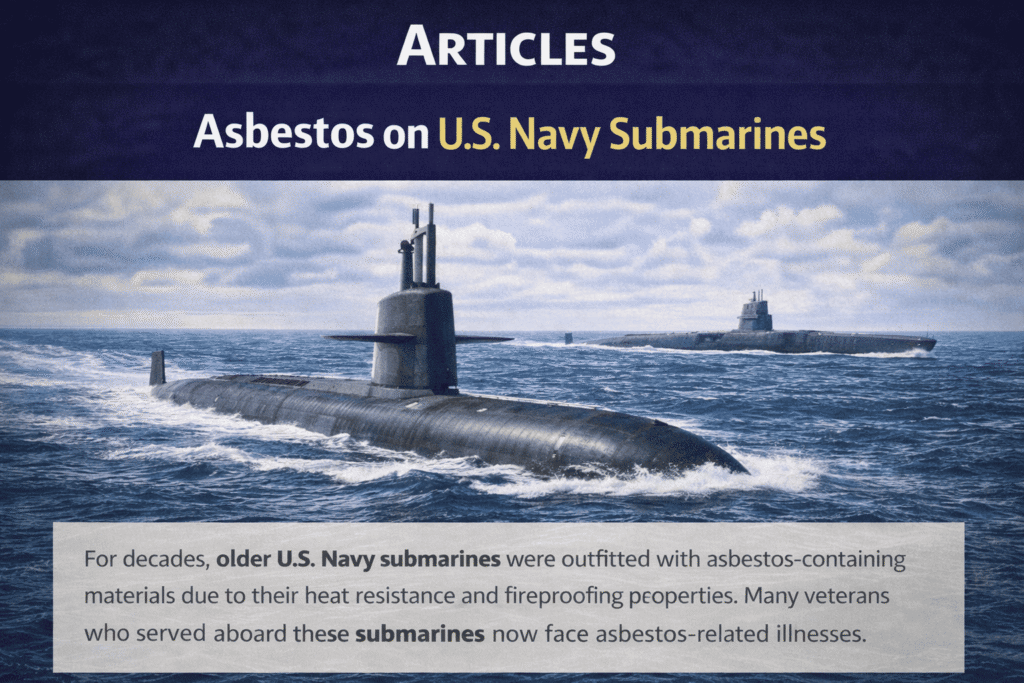
⚓ Articles About Asbestos on Navy Submarines
U.S. Navy submarines evolved from early gasoline and diesel-electric boats into World War II fleet submarines and later nuclear-powered attack and ballistic-missile submarines. Their confined machinery spaces, piping, pumps, valves, electrical systems, ventilation equipment, crew compartments, and major overhaul periods create distinct historical questions for veterans researching possible asbestos exposure.
Naval History and Heritage Command (NHHC) identifies the Balao class as a major World War II submarine type and USS Nautilus (SSN-571) as the world’s first nuclear-powered submarine. Nautilus was commissioned in 1954 and later underwent major overhauls at Portsmouth Naval Shipyard. These changes in propulsion and design mean submarine exposure research must be tied to the specific boat, hull number, class, service dates, propulsion type, rating, compartment, equipment, material, and repair period.
NAVSEA’s historical asbestos archive documents Navy asbestos-containing material categories including thermal insulation felt, metallic-asbestos piping and boiler gaskets, high-pressure asbestos packing, compressed asbestos gasket material, pipe covering, and cable-related packing. Those records support historical product research but do not prove installation aboard every submarine.
🚢 Diesel-Electric and Nuclear Submarine History
NHHC traces the U.S. submarine force from USS Holland (SS-1), commissioned in 1900, through S-class boats, World War II fleet submarines, and nuclear-powered submarines. Its submarine-evolution history identifies the Balao class as a backbone of Pacific submarine operations during World War II.
Diesel-electric submarines required diesel engines for surface operations and battery charging, electric propulsion equipment, ventilation, pumps, valves, compressed-air systems, hydraulic systems, and extensive piping in a relatively compact hull. World War II boats such as the Balao-class Argonaut (SS-475) carried crews of roughly 80 sailors.
Nuclear propulsion changed submarine operations dramatically. NHHC states that Nautilus was commissioned September 30, 1954 and became the first commissioned nuclear-powered ship in the U.S. Navy. Later nuclear submarines included attack submarines, ballistic-missile submarines, and increasingly advanced classes.
Nuclear propulsion does not mean that every older material concern disappeared. It means the boat’s exact generation and configuration must be researched rather than applying diesel-boat assumptions or surface-ship boiler assumptions indiscriminately.
🔧 Confined Submarine Spaces and Maintenance Work
Submarines place propulsion, electrical, hydraulic, ventilation, weapons, navigation, living, and auxiliary systems within a compact pressure hull. Sailors often worked close to piping, machinery, electrical equipment, valves, pumps, and ventilation components.
Potential research areas aboard older submarines include:
- Engine rooms on diesel-electric boats.
- Motor and electrical spaces.
- Auxiliary-machinery compartments.
- Pump and valve locations.
- Battery and electrical-support spaces.
- Ventilation and air-conditioning equipment.
- Hydraulic and compressed-air systems.
- Passageways and compartments containing insulated piping.
- Machinery removed or rebuilt during overhaul.
Confined quarters can be relevant when evaluating proximity to maintenance, but proximity alone does not prove asbestos exposure. A credible history identifies the material being disturbed, the task, the compartment, distance from the work, frequency, and duration.
See Navy Engine Room Equipment Asbestos Exposure, Navy Electrical Equipment Asbestos Exposure, and Navy HVAC Equipment Asbestos Exposure.
⚙️ Machinery, Piping, Pumps, Valves, and Electrical Systems
Submarine machinery varied sharply by era. Diesel-electric boats relied on diesel engines, electric motors, generators, batteries, pumps, valves, piping, air compressors, and auxiliary machinery. Nuclear submarines introduced reactor and steam-plant systems while retaining extensive ship-service electrical, pumping, ventilation, hydraulic, and piping systems.
NAVSEA’s historical asbestos files identify asbestos-containing Navy product categories relevant to machinery research, including metallic-asbestos spiral-wound piping gaskets, high-pressure asbestos rod packing, compressed asbestos gasket material, thermal insulation, and packing for electric-cable stuffing and terminal tubes.
Potential maintenance pathways to investigate include:
- Opening piping flanges and machinery connections.
- Removing old gaskets.
- Repacking pumps or valves.
- Removing insulation to reach piping or equipment.
- Repairing generators, motors, and electrical systems.
- Maintaining ventilation equipment.
- Working beside machinery overhaul or insulation work.
- Cleaning confined spaces after maintenance.
Not every gasket, packing material, insulation product, cable component, or electrical part contained asbestos. Manufacturer, model, Navy specification, installation date, replacement history, and the submarine’s configuration during the veteran’s service matter.
See Navy Pump Equipment Asbestos Exposure, Navy Valve Equipment Asbestos Exposure, and Navy Generator Equipment Asbestos Exposure.
🔩 Potential Asbestos-Containing Submarine Materials
NAVSEA’s public asbestos reading room preserves historical Navy specifications and Qualified Products Lists. The archive includes asbestos-fiber thermal insulation felt, metallic-asbestos spiral-wound piping gaskets, high-pressure asbestos rod packing, compressed asbestos gasket material, thermal pipe covering, insulation compounds, and electric-cable packing.
Material categories worth investigating aboard older submarines include:
- Thermal insulation and pipe covering.
- Piping and machinery gaskets.
- Pump and valve packing.
- Compressed gasket sheet.
- Electrical-cable stuffing and terminal-tube packing.
- High-temperature insulation compounds.
- Historical deck or interior materials where documented.
- Replacement products installed during overhaul.
Chronology is essential. A NAVSEA specification dated in the 1960s cannot automatically prove that a particular product was installed on a World War II submarine. Conversely, an older nuclear submarine could have undergone repeated overhauls in which original materials were removed or replaced.
For a specific boat, period-appropriate plans, technical manuals, shipyard work packages, Bureau of Ships records, manufacturer documents, specifications, and asbestos surveys provide stronger evidence than a generic product list.
See Navy Equipment Asbestos Exposure and Navy Equipment Manufacturers Asbestos Exposure.
👷 Submarine Crew Occupations and Exposure Pathways
Submarine crews were smaller than crews aboard many surface combatants, and sailors often worked in close proximity to one another. Rating can identify likely responsibilities, but actual duties and compartments provide stronger evidence of a possible exposure pathway.
- Navy Machinist’s Mates Asbestos Exposure — propulsion and auxiliary machinery, pumps, valves, and piping.
- Navy Electricians Asbestos Exposure — motors, generators, switchboards, wiring, and electrical systems.
- Navy Pipefitters Asbestos Exposure — piping, flanges, insulation, gaskets, valves, and packing.
- Navy Welders Asbestos Exposure — piping and structural repairs near legacy materials.
- Navy Hull Maintenance Technicians Asbestos Exposure — piping, valves, structural maintenance, and repair.
- Navy Damage Controlmen Asbestos Exposure — emergency repair, firefighting, damaged materials, and piping work.
Submarine-specific ratings and nuclear-trained personnel require boat- and era-specific analysis. A rating title alone should not be used to claim asbestos exposure. The work history should identify the equipment, material, maintenance procedure, and location.
🏗️ Overhauls, Refueling Periods, and Shipyard Work
Major submarine overhauls can be important research periods because machinery, piping, electrical systems, ventilation, insulation, and interior components may be opened, removed, rebuilt, or replaced.
NHHC documents this clearly for Nautilus. In May 1959 she entered Portsmouth Naval Shipyard for her first complete overhaul, including replacement of her second fuel core, overhaul of almost all machinery, and installation of new sensors and other equipment. She returned to service in August 1960. Nautilus later entered Portsmouth again for an extensive overhaul that lasted 27 months before returning to New London in May 1966.
Potentially relevant shipyard activities include:
- Removing insulation to reach piping or machinery.
- Opening propulsion and auxiliary systems.
- Replacing gaskets and packing.
- Rebuilding pumps and valves.
- Repairing generators and electrical equipment.
- Modifying ventilation and cooling systems.
- Removing obsolete equipment.
- Renovating crew and machinery compartments.
A submarine’s presence in a shipyard does not itself prove asbestos exposure. Work packages, technical specifications, material lists, asbestos surveys, manufacturer files, and witness evidence are needed to identify the work and materials involved.
📂 Submarine Deck Logs and Technical Evidence
Submarine records require special care. The National Archives states that World War II and early postwar submarine deck logs are generally similar to surface-ship logs, but actual warfare operations often appear instead in submarine war patrol reports because of operational sensitivity. NARA holds declassified World War II submarine war patrol reports from 1941–1945.
NARA also explains that submarine deck logs became increasingly vague for underway boats beginning in the 1960s. Some submarine patrol logs were segregated because of classification and may remain classified or require Freedom of Information Act procedures.
For asbestos research more broadly, NARA states that Navy deck logs and muster rolls provide no direct evidence of asbestos use or presence aboard Navy vessels or components. They can establish assignment and identify major work dates that narrow Bureau of Ships and technical-record searches.
Useful submarine evidence can include:
- DD-214 and Official Military Personnel Files.
- Muster rolls and personnel records.
- Available submarine deck logs.
- War patrol reports for applicable World War II boats.
- Official NHHC submarine histories.
- Bureau of Ships and NAVSEA records.
- Ship plans and machinery arrangements.
- Navy specifications and Qualified Products Lists.
- Technical manuals and equipment instruction books.
- Shipyard overhaul and refueling work packages.
- Manufacturer catalogs and parts lists.
- Asbestos surveys or abatement records when available.
- Shipmate or coworker statements.
- Medical records documenting diagnosis.
See Navy Records & Documentation for Asbestos Exposure, How to Obtain Navy Bureau of Ships Technical Manuals, and Documents Needed for Navy Asbestos Claims.
⚕️ Health Risks, VA Benefits, and Legal Options
Asbestos exposure is associated with mesothelioma, lung cancer, asbestosis, and pleural disease. These illnesses can develop decades after exposure, but diagnosis alone does not establish the submarine, product, manufacturer, or exposure event.
For a submarine veteran, useful details include the boat name and hull number, class, propulsion type, dates aboard, rating, division, machinery compartments, piping, pumps, valves, insulation, gasket or packing work, overhaul periods, shipyards, and witnesses. Other Navy assignments and civilian employment should also be included in a complete lifetime exposure history.
Veterans diagnosed with an asbestos-related disease may investigate VA disability benefits. Depending on the evidence and potentially responsible companies, civil lawsuits or asbestos trust fund claims may also be possible. Eligibility, deadlines, and outcomes depend on the facts and applicable law.
See Navy Asbestos Exposure Health Risks, Navy VA Benefits for Mesothelioma, and Navy Asbestos Legal Options.
No submarine assignment, historical asbestos record, diagnosis, or exposure history guarantees VA benefits or compensation.
❓ Navy Submarine Asbestos FAQ
Were all Navy submarines diesel-electric?
No. Earlier U.S. submarines used conventional propulsion, while Nautilus became the world’s first nuclear-powered submarine in 1954 and began the Navy’s nuclear-submarine era.
Why does submarine class matter for asbestos research?
Different classes used different propulsion, electrical, piping, ventilation, and auxiliary systems. The relevant configuration is the one that existed during the veteran’s service.
Could older submarines contain asbestos-containing materials?
Potentially. Historical NAVSEA records document asbestos-containing insulation, gaskets, packing, pipe-covering products, and cable packing, but installation on a particular boat should be established through specific evidence.
Does confined submarine service prove asbestos exposure?
No. Confined spaces can affect proximity, but exposure still should be connected to a documented asbestos-containing material and the work that disturbed it.
Are submarine deck logs different from surface-ship logs?
They can be. NARA states that early submarine logs resemble surface-ship logs, while underway submarine logs became less informative beginning in the 1960s. War patrol reports can provide additional operational history for World War II boats.
Can deck logs prove asbestos was aboard a submarine?
No. NARA states that deck logs provide no direct evidence of asbestos. They can help establish dates for deeper technical and shipyard research.
Why are submarine overhaul records important?
Major overhauls can involve extensive machinery, piping, electrical, ventilation, insulation, and compartment work, making the work package and material records important evidence.
What should a submarine veteran document first?
Start with the submarine name and hull number, class, dates aboard, rating, propulsion type, work spaces, equipment, overhaul periods, shipyards, suspected materials, witnesses, and medical records.
⚓ Get Help Researching Asbestos on Navy Submarines
If you or a family member served aboard a U.S. Navy submarine and has been diagnosed with mesothelioma, asbestos-related lung cancer, asbestosis, or another potentially asbestos-related disease, reconstruct the service history carefully. Submarine name, hull number, class, propulsion type, dates aboard, rating, machinery spaces, piping, pumps, valves, insulation, overhaul periods, shipyards, technical records, manufacturers, and witnesses can help determine whether a credible exposure pathway can be documented.
Call 800.291.0963 to discuss Navy submarine service and asbestos exposure history. Live chat is available 24/7, 365 days a year. You can also Submit Your Case. No exposure determination, diagnosis, VA benefit, settlement, trust payment, or legal outcome is guaranteed.
⚕️ Legal & Medical Information Disclaimer
This page provides general educational information and is not legal or medical advice. Historical submarine, personnel, archival, procurement, or technical records do not by themselves establish asbestos exposure, diagnosis, causation, VA eligibility, liability, or entitlement to compensation. Consult qualified health care professionals about medical concerns and a licensed attorney or accredited veterans representative about legal or benefits questions.