Ford Motor Company Asbestos Exposure: Vehicles, Workers and Claims
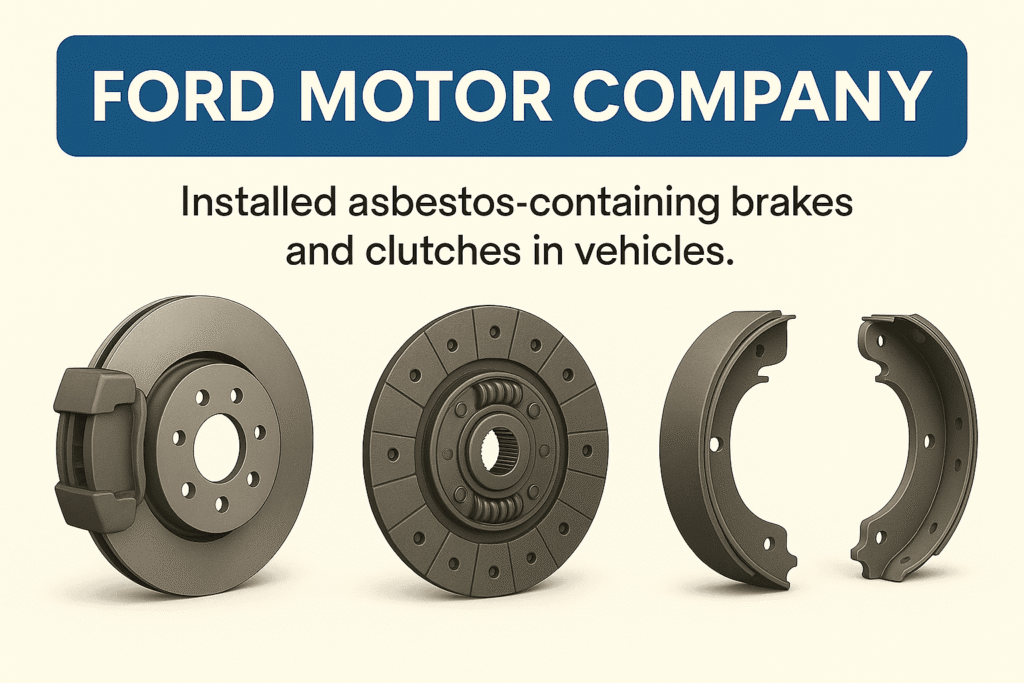
Ford Motor Company’s SEC filings confirm that asbestos was used in some brakes, clutches and other automotive components beginning in the early 1900s. Historical exposure allegations have involved mechanics who serviced older Ford vehicles, employees and contractors at Ford facilities, and workers associated with the company’s former maritime fleet.
Not every Ford vehicle or component contained asbestos. Product composition varied by part, supplier, model and year. A Ford-related claim therefore requires evidence connecting a person to a specific asbestos-containing product, facility condition or operation. Ford remains an operating company and has not established a dedicated asbestos bankruptcy trust.
🏢 Ford Motor Company History and Asbestos Context
Ford Motor Company was incorporated in Michigan on June 16, 1903. It grew into a major vehicle manufacturer with assembly operations, dealerships, parts distribution and industrial facilities. That scale created several distinct asbestos questions: component exposure during vehicle repair, material exposure at plants, and work involving vessels formerly operated by Ford.
| Date or period | Confirmed development | Research significance |
|---|---|---|
| June 16, 1903 | Ford Motor Company was incorporated in Michigan. | Establishes the company’s operating history. |
| Early 1900s onward | Ford reports that some automotive components used asbestos. | Requires part-specific historical investigation. |
| 1945–1948 | Court records describe asbestos-insulation installation at Ford’s Metuchen plant. | Documents a facility-related pathway distinct from vehicle repair. |
| 1970s | Records discussed in litigation addressed brake servicing and compressed-air cleaning. | Shows why work practices can matter to exposure reconstruction. |
| Current reporting | Ford continues to disclose asbestos matters in SEC filings. | Confirms ongoing litigation without creating a dedicated trust. |
| Category | Possible historical source | Key distinction |
|---|---|---|
| Vehicle component | Some brakes, clutches or other qualifying automotive parts. | Identify the actual manufacturer and installation. |
| Manufacturing facility | Insulation or other asbestos materials used in older buildings and systems. | Facility presence alone does not prove personal exposure. |
| Dealer or service shop | Maintenance of older vehicles using original or replacement parts. | A Ford vehicle could contain a third-party replacement component. |
| Former maritime fleet | Shipboard insulation or equipment alleged in litigation. | Vessel, job, dates and material must be established. |
| Household contact | Dust brought home from qualifying work. | Source-worker exposure and household contact both require proof. |
Ford’s present operations should not be described as proof that current vehicles contain asbestos. The company’s SEC language refers to historical use and allegations involving older products and facilities.
⚙️ Ford Asbestos-Containing Automotive Components
Ford’s 2025 annual report identifies historical asbestos use in certain friction parts and additional vehicle components. Court records provide more detail about brake and clutch claims. Those sources support product investigation, but they do not justify labeling every Ford part, vehicle or model as asbestos-containing.
| Component | Historical function | Evidence to seek |
|---|---|---|
| Drum-brake linings and shoes | Created friction against a brake drum. | Vehicle, model year, Ford part number and service date. |
| Disc-brake pads | Applied friction to a rotor. | Packaging, supplier, installation record and application. |
| Clutch facings | Transferred power in manual transmissions. | Part identity, manufacturer, vehicle and replacement history. |
| Gaskets and seals | Sealed joints exposed to heat, pressure or fluids. | Exact location, composition, removal method and supplier. |
| Other automotive components | Ford’s SEC disclosure uses this broader category. | Component-specific documentation is essential. |
| Third-party replacement parts | Serviced Ford vehicles but were produced by other companies. | Brand, seller and chain of distribution. |
| Question | Accurate treatment |
|---|---|
| Did Ford acknowledge historical asbestos use? | Yes, in some brakes, clutches and other automotive components. |
| Did every Ford vehicle contain asbestos? | No blanket conclusion is supported. |
| Does a Ford vehicle identify the maker of a replacement brake? | No. Independent aftermarket brands were also installed. |
| Were original and replacement parts always identical? | No; product source and composition could change. |
| Can appearance alone confirm asbestos content? | No. Contemporaneous records or qualified analysis are stronger evidence. |
| Should an old part be disturbed to create evidence? | No. Preserve markings and records without releasing dust. |
Useful evidence may include boxes, labels, catalogs, dealer invoices, repair orders and testimony from people who bought or installed the parts. Vehicle identification numbers and model years help narrow the search but do not independently establish composition.
👨🔧 Workers and Job Sites Associated With Ford Exposure
Ford’s SEC disclosures describe allegations arising from older vehicle components, company facilities and a former maritime fleet. Mechanics represent the largest category identified in the company’s current filing. Plant employees, outside contractors, dealership technicians, ship workers and household members may present different exposure histories.
| Worker | Possible historical contact | Useful evidence |
|---|---|---|
| Automotive mechanic | Brake, clutch, gasket or related component service. | Employer, vehicles, parts, dates and coworkers. |
| Ford dealership technician | Warranty and routine maintenance on older vehicles. | Dealer records, service manuals and parts invoices. |
| Assembly employee | Installation or handling of qualifying components. | Plant, department, job classification and production period. |
| Plant maintenance worker | Insulation, boilers, piping, ovens or building systems. | Facility plans, contractor files and maintenance records. |
| Outside insulator or contractor | Installing or removing qualifying material at Ford premises. | Employer, contract, location, task and dates. |
| Fleet or government mechanic | Repeated service on Ford vehicles. | Fleet inventories, purchase records and repair logs. |
| Maritime worker | Work aboard or around vessels formerly associated with Ford. | Vessel, department, sailing or repair history. |
| Household member | Contact with dust on work clothing or belongings. | Source worker, residence, laundry and contact history. |
| Setting | Research focus |
|---|---|
| Independent repair garage | Ford vehicle volume, parts suppliers and cleaning methods. |
| Ford or Lincoln dealership | Original-equipment and replacement-part purchasing. |
| Assembly plant | Department, process, component and production dates. |
| Plant boiler or maintenance area | Insulation, equipment, repairs and contractor activity. |
| Fleet maintenance shop | Recurring vehicle service and product documentation. |
| Former Ford-associated vessel | Shipboard systems, job duties and material disturbance. |
| Home garage | Specific vehicle, component, purchase and repair frequency. |
A job title, plant name or vehicle brand is only a starting point. The strongest history identifies the material, work method, duration, proximity and supporting records.
Need help now? Call 800.291.0963
Live chat is available 24/7, 365 days a year.
Submit Your Case
🌫️ How Ford-Related Asbestos Exposure May Have Occurred
Historical brake and clutch work could disturb dust created by wear or by servicing an asbestos-containing friction component. Plant and shipboard work could involve a different pathway, such as installing, cutting or removing insulation. The exposure account should identify the material and explain how fibers may have become airborne.
| Activity | Possible fiber-release mechanism | Details to document |
|---|---|---|
| Opening a brake drum | Accumulated friction dust could be disturbed. | Vehicle, product, visible dust and work frequency. |
| Compressed-air cleaning | Air pressure could disperse dust through a garage. | Tool, shop practice, distance and nearby workers. |
| Sanding or grinding linings | Abrasion could create fine dust from qualifying material. | Component identity, machine and ventilation. |
| Clutch replacement | Removal and cleanup could disturb facing residue. | Vehicle, clutch brand and cleaning method. |
| Gasket scraping | Dry removal could break an asbestos-containing gasket. | Assembly, tool, material and condition. |
| Insulation installation or removal | Cutting or handling could release fibers. | Facility or vessel, product, contractor and dates. |
| Work-clothing laundry | Deposited occupational dust could be resuspended. | Source work, shared home and laundry routine. |
| Fact | Why it matters |
|---|---|
| Exact product or material | Separates a specific exposure from general Ford association. |
| Manufacturer and supplier | Distinguishes Ford parts from third-party replacements. |
| Location and dates | Allows comparison with facility and product records. |
| Dust-producing task | Explains the alleged release mechanism. |
| Frequency and proximity | Describes the scale of the contact. |
| Witnesses or documents | Provides independent corroboration. |
The EPA provides best practices for automotive brake and clutch work because asbestos-containing friction products may be difficult to recognize. Modern safety guidance should be followed when unknown older parts are encountered.
⚖️ Ford Asbestos Lawsuits, Claims and Compensation
Ford has not filed an asbestos bankruptcy or established a Ford asbestos personal-injury trust. Its 2025 annual report instead discusses asbestos matters as litigation and records an accrual for probable losses from asserted and unasserted claims. That accounting disclosure is not a claimant payment schedule and does not establish eligibility or case value.
| Item | Confirmed treatment |
|---|---|
| Dedicated Ford asbestos trust | None identified. |
| Ford bankruptcy payment percentage | None. |
| Scheduled disease values | None. |
| Current claim setting | Company litigation, settlement or other applicable legal process. |
| Main allegation in Ford’s filing | Most cases involve people who say they worked on vehicle brakes. |
| Other reported allegation sources | Older components, facilities and the former maritime fleet. |
| Guaranteed compensation | None. |
| Avenue | Possible application | Limitation |
|---|---|---|
| Product-liability claim | Exposure to a qualifying Ford-made or supplied component. | Product identity, causation and jurisdictional law control. |
| Premises claim | Exposure at a Ford-owned facility. | Ownership, control, duty and state law must be evaluated. |
| Household claim | Exposure through a qualifying worker’s clothing. | Duty rules vary by jurisdiction and factual period. |
| Maritime claim | Work connected to a former Ford vessel or ship operation. | Vessel status, employment and maritime law matter. |
| Other asbestos trust claim | A separate bankrupt component or material manufacturer may have a trust. | It is not a Ford Trust; independent eligibility is required. |
| Factor | Why it matters |
|---|---|
| Diagnosis | Medical evidence must establish the claimed disease. |
| Ford-specific proof | Vehicle ownership or plant employment alone may be insufficient. |
| Alternative exposure | Courts may evaluate other products, employers and work sites. |
| Jurisdiction | Duty, causation and damages rules differ among states. |
| Filing deadline | Statutes of limitation and repose can affect claims. |
| Prior settlements or trust filings | Disclosure, allocation and setoff rules may apply. |
No reliable universal “average Ford settlement” can be calculated from court decisions or SEC disclosures. Verdicts may be affirmed, reduced, reversed or allocated among several defendants. A company reserve, insurance limit or historical verdict should not be presented as an expected individual recovery.
📚 Documented Ford Asbestos Cases and Records
Published decisions show why Ford claims require precise proof. They include cases involving identifiable Ford brake parts, claims involving third-party replacement components, and household exposure connected to insulation contractors at a Ford plant. Results differed because the evidence and governing duty rules differed.
| Record | Documented issue | Accuracy lesson |
|---|---|---|
| Ford 2025 Form 10-K | Historical component use, allegations and current litigation accounting. | Company disclosure does not determine an individual claim. |
| Ford Motor Co. v. Wood | Brake and clutch exposure evidence involving two workers. | The court distinguished stronger Ford-part proof from insufficient identification. |
| Oddo v. Asbestos Corp. | Fleet brake work involving Ford vehicles and parts. | Vehicle mix, original equipment, purchase source and frequency mattered. |
| Campbell v. Ford Motor Co. | Household exposure alleged from insulation contractors at the Metuchen plant. | The appellate court reversed on duty despite detailed exposure evidence. |
| In re Asbestos Litigation: Grenier | Expert evidence concerning automotive friction products. | General causation evidence does not replace product-specific exposure proof. |
| EPA brake and clutch guidance | Controls for work involving potentially asbestos-containing friction products. | Safety guidance is not a finding about a specific Ford part. |
These records are examples, not a verdict database or guarantee. They illustrate that component identity, work practices, frequency, proximity, alternative exposures and jurisdictional law can materially change an outcome.
📋 Evidence for a Ford Asbestos Exposure Claim
A Ford-related investigation should reconstruct the entire exposure history rather than begin and end with the Ford name. Older repair records may be incomplete, so employment documents, vehicle information, product materials and credible witness accounts often need to be evaluated together.
| Category | Examples | Purpose |
|---|---|---|
| Medical | Pathology, imaging, physician reports and death certificate. | Documents diagnosis and medical history. |
| Employment | Social Security earnings, personnel records, union files and pay stubs. | Places the worker at a job and time. |
| Vehicle | VIN, model, year, fleet number and ownership record. | Identifies equipment associated with the work. |
| Product | Ford boxes, labels, part numbers, catalogs, receipts and invoices. | Distinguishes Ford parts from outside replacements. |
| Facility or vessel | Plans, contracts, maintenance records, logs and photographs. | Connects the claimant to a specific material and location. |
| Work method | Tools, cleaning practice, frequency, duration and ventilation. | Explains how dust may have been generated. |
| Witness | Coworker, supervisor, supplier or household statement. | Corroborates products, tasks and conditions. |
| Question | Reason |
|---|---|
| Is the diagnosis medically supported? | Claim type and causation depend on reliable medical evidence. |
| Which Ford vehicle, facility or vessel is involved? | General company association is too broad. |
| What exact component or material contained asbestos? | Product identification is central to liability analysis. |
| Was the part original, Ford replacement or aftermarket? | The responsible manufacturer or seller may differ. |
| What task released dust? | Handling without disturbance may present a different history. |
| Are dates and locations corroborated? | Records can test and strengthen recollection. |
| Have all other exposures been disclosed? | Complete histories help evaluate causation accurately. |
| Have jurisdictional deadlines been reviewed? | Delay can affect otherwise supported claims. |
Do not sand, grind or break an old component to obtain evidence. Preserve packaging, photographs and identifying marks, and have unknown materials handled under appropriate safety procedures.
❓ Frequently Asked Questions About Ford Asbestos Exposure
Did Ford vehicles contain asbestos components?
Ford’s SEC filings acknowledge historical asbestos use in certain brakes, clutches and additional automotive parts. This does not mean every Ford vehicle or component contained asbestos.
When did Ford stop using asbestos brakes?
The reviewed current SEC filing does not provide one universal end date for every component. Published litigation records discuss different product and replacement-part periods, so the specific vehicle, part and year should be researched.
Who may have encountered Ford-related asbestos?
Potential histories include mechanics, dealership technicians, plant workers, maintenance employees, contractors, fleet personnel, maritime workers and household members. Exposure must be individually established.
Does Ford have an asbestos bankruptcy trust?
No dedicated Ford asbestos personal-injury trust was identified. Ford remains an operating company and reports asbestos matters as litigation in its SEC filings.
Does working on a Ford vehicle prove exposure?
No. Investigators should identify the actual brake, clutch, gasket or other material, determine whether it contained asbestos, and distinguish original equipment from third-party replacement parts.
Could Ford plant insulation be relevant?
Possibly. Published litigation documents asbestos-insulation work at Ford’s Metuchen plant. A claim still depends on the facility, material, task, dates, proximity and governing law.
What records may support a Ford claim?
Medical files, employment records, repair orders, product boxes, parts catalogs, vehicle information, plant or vessel documents and witness statements may help reconstruct an exposure history.
Can family members investigate household exposure?
Possibly. The source worker’s exposure, transfer pathway, household contact, diagnosis, jurisdiction and filing deadlines must be evaluated. Courts differ on when a duty exists.
📌 Ford Motor Company Asbestos Exposure Summary
| Topic | Confirmed point |
|---|---|
| Company | Ford Motor Company, incorporated in Michigan in 1903. |
| Historical products | Some brakes, clutches and other automotive components contained asbestos. |
| Other allegations | Older Ford facilities and the company’s former maritime fleet. |
| Primary worker group in current disclosure | People alleging exposure while working on vehicle brakes. |
| Dedicated asbestos trust | None identified. |
| Scheduled or guaranteed payment | None. |
| Essential proof | Diagnosis, product or material identity, work method, dates and corroboration. |
| Current source | Ford’s 2025 Form 10-K filed in February 2026. |
🔗 Confirmed Primary, Government and Court Sources
- Ford Motor Company 2025 Form 10-K: asbestos matters.
- Ford Investor Relations: incorporation and stock history.
- Maryland appellate decision: Ford Motor Co. v. Wood.
- Louisiana appellate decision: Oddo v. Asbestos Corporation Ltd..
- California appellate decision: Campbell v. Ford Motor Co..
- Delaware Superior Court decision: In re Asbestos Litigation, Grenier.
- U.S. EPA: automotive brake and clutch repair guidance.
- National Cancer Institute: asbestos exposure and cancer risk.
☎️ Submit Your Ford Asbestos Exposure Case
If you or a family member developed mesothelioma or another asbestos-related disease after Ford vehicle, facility or maritime work, an investigation can review the diagnosis, employment, product identity, work practices, court records and possible responsible parties.
Call 800.291.0963
Live chat is available 24/7, 365 days a year.
Ford employment, vehicle ownership or repair work does not automatically establish asbestos exposure, liability or compensation. Each matter depends on the diagnosis, product or material, manufacturer, exposure evidence, jurisdiction and filing deadlines. No outcome is guaranteed.
⚕️ Legal & Medical Information Disclaimer
This educational page is not medical or legal advice and does not establish exposure, diagnosis, liability or compensation. Consult qualified medical and legal professionals about individual circumstances.