DAP Inc. Asbestos Exposure: Caulk, Sealants, Workers & Claims
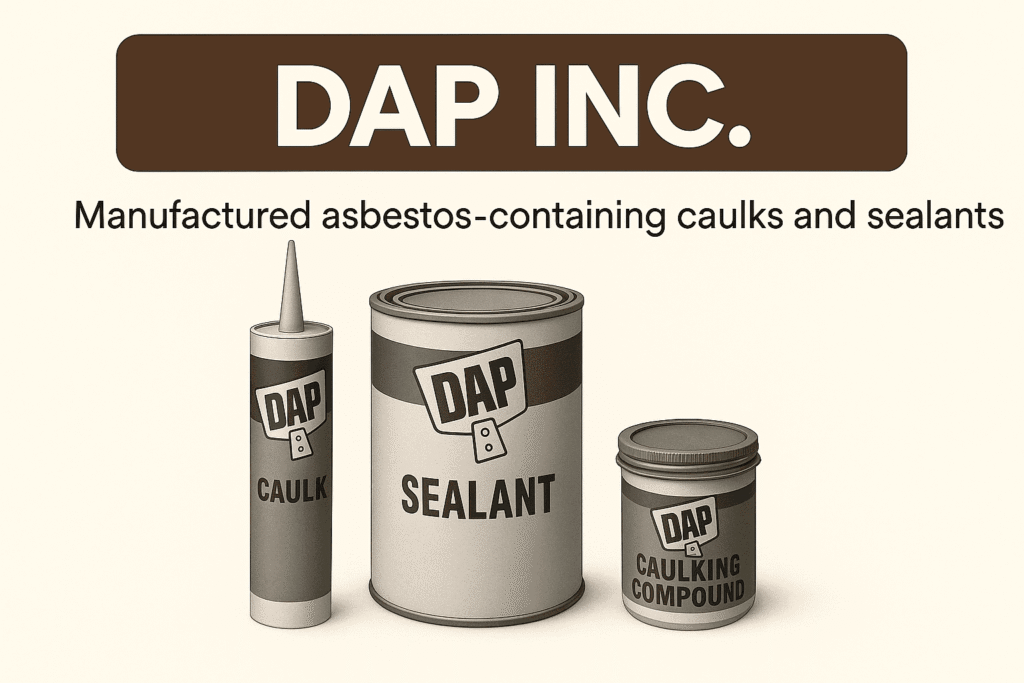
DAP traces its roots to 1865 and became a major manufacturer of caulks, sealants, putties, adhesives and repair products. Published court records provide company-specific evidence that certain historical DAP products contained asbestos. The Indiana Court of Appeals stated that DAP manufactured Black-Tite Roof Sealant and 33 Glazing from 1960 through 1977 and that both products contained asbestos through 1977. Pennsylvania appellate records also identify several DAP caulking, setting, sealing and roof-cement products as asbestos-containing before 1977.
Product and date identification are critical. The court records do not establish that every DAP product contained asbestos, and cases have been dismissed where plaintiffs could not show that the particular DAP product used actually contained asbestos or that the claimant inhaled asbestos fibers from it. DAP remains an operating building-products brand and has been part of RPM International since 1999. No dedicated DAP §524(g) asbestos personal-injury trust was confirmed in the primary and court sources reviewed for this page.
🏢 DAP Company History & Asbestos Timeline
DAP’s official history traces the business to Robert H. Dicks and Elmer Wiggim producing sealing wax in 1865. Dicks-Pontius expanded into putty and caulk; a 1957 merger with the Armstrong Company produced Dicks-Armstrong-Pontius, later shortened to DAP. RPM International acquired DAP Products in 1999.
DAP Facts at a Glance
| Topic | Verified information |
|---|---|
| Origins | 1865, according to DAP’s official history. |
| Dicks-Pontius Company | Established in 1913. |
| DAP name lineage | Dicks-Armstrong-Pontius after 1957 merger; later shortened to DAP. |
| Historical product focus | Putty, caulk, sealants and repair products. |
| RPM acquisition | 1999. |
| Court-documented asbestos products | Includes Black-Tite Roof Sealant and 33 Glazing through 1977. |
| Dedicated DAP §524(g) trust | No dedicated trust confirmed from sources reviewed. |
Company / Product Timeline
| Period | Development |
|---|---|
| 1865 | DAP origins in sealing-wax manufacturing. |
| 1913 | Dicks-Pontius Company established. |
| 1957 | Merger with Chicago-based Armstrong Company; Dicks-Armstrong-Pontius name. |
| 1960–1977 | Indiana appellate record states DAP manufactured Black-Tite Roof Sealant and 33 Glazing; both contained asbestos through 1977. |
| 1964 | DAP introduced latex caulking compounds. |
| 1970 | DAP introduced acrylic latex caulk. |
| 1999 | RPM International acquired DAP Products. |
| 2020s | DAP continues as an operating building-products business; asbestos litigation dockets continue to identify DAP Products as a defendant in some cases. |
🧱 DAP Asbestos Caulks, Sealants & Compounds
The strongest product-specific evidence comes from published appellate decisions. DAP, Inc. v. Akaiwa states that Black-Tite Roof Sealant and 33 Glazing contained asbestos fibers through 1977. Vanaman v. DAP discusses exhibits identifying several DAP products as asbestos-containing before 1977. These records do not support treating every DAP product or every production year as asbestos-containing.
Court-Documented Historical DAP Products
| Product | Documented evidence |
|---|---|
| Black-Tite Roof Sealant | Indiana appellate court: manufactured 1960–1977 and contained asbestos through 1977. |
| 33 Glazing | Indiana appellate court: manufactured 1960–1977 and contained asbestos through 1977. |
| DAP White Caulking Compound | Pennsylvania appellate record discusses exhibit identifying asbestos content before 1977. |
| DAP Bowl Setting Compound | Same Pennsylvania record identifies it on a pre-1977 asbestos-product list. |
| DAP Butyl Gutter and Lap Sealer | Same Pennsylvania record identifies it on a pre-1977 asbestos-product list. |
| DAP Rely-On Roof Cement | Court record states exhibits showed the identified products contained asbestos prior to 1977. |
Product Accuracy Rules
| Statement | Accurate treatment |
|---|---|
| Certain historical DAP products contained asbestos | Confirmed by published court records. |
| Every DAP caulk contained asbestos | Not established. |
| Every DAP product before 1977 contained asbestos | Not established. |
| DAP mined or sold raw asbestos | Akaiwa states DAP did not mine or sell raw asbestos. |
| A modern DAP product can be assumed asbestos-containing | No. |
| Brand identification alone proves exposure | No; formulation, date and work activity matter. |
👷 Workers, Jobsites & Home Repair Exposure
Historical DAP products were used in construction, maintenance and home repair. Potential exposure depends on the exact product and whether work generated respirable dust. Published cases include occupational and household-exposure allegations, but courts have required product-specific and exposure-specific proof.
Workers and Activities to Investigate
| Worker / person | Potential historical activity |
|---|---|
| Roofers | Applying or removing historical roof sealant/cement. |
| Glaziers | Working with glazing compounds around windows. |
| Carpenters / remodelers | Using caulks, setting compounds and sealants. |
| Plumbers / bathroom installers | Using bowl-setting or sealing compounds. |
| Maintenance workers | Repairing roofs, windows, gutters and building joints. |
| Electricians / construction workers | Working near or using sealants during building work. |
| DIY homeowners | Home repairs involving historical caulks, sealants or roof cement. |
| Household members | Secondary-exposure allegations require evidence that asbestos-containing dust reached the person. |
Exposure Settings
| Setting | Evidence to investigate |
|---|---|
| Residential repair | Receipts, containers, photographs and witness testimony. |
| Commercial construction | Specifications, contractor records and invoices. |
| Industrial facilities | Maintenance records and product purchasing files. |
| Roofing work | Product labels, job records and removal practices. |
| Window/glazing work | Glazing-compound identity and application/removal methods. |
| Home renovation | Dates, exact DAP product and whether dust-producing work occurred. |
Need help now? Call 800.291.0963
Live chat is available 24/7, 365 days a year.
Submit Your Case
🌫️ How Historical DAP Exposure Occurred
Exposure cannot be inferred merely from using a DAP-branded product. Courts have distinguished between products that historically contained asbestos and later or different formulations. Dust generation also matters. In Akaiwa, the worker’s later use of DAP sealants did not establish asbestos exposure from those products.
Potential Exposure Activities
| Activity | Why it may matter |
|---|---|
| Removing aged sealant | Could disturb hardened historical material if asbestos-containing. |
| Scraping glazing compound | May create debris or dust depending on condition and method. |
| Roof repair/removal | Could disturb historical roof cement or sealant. |
| Sanding / abrading compound | Abrasive work can generate dust from the material being worked. |
| Cleanup | May re-suspend dust generated during repair/removal. |
| Ordinary intact application | Must not be equated automatically with airborne asbestos exposure. |
Exposure Questions
| Question | Importance |
|---|---|
| Which DAP product? | Different formulations and uses. |
| When was it manufactured or used? | Helps distinguish documented asbestos-era products. |
| Did that formulation contain asbestos? | Central product-identification issue. |
| Was dust generated? | Relevant to inhalation evidence. |
| Was claimant nearby? | Necessary for exposure analysis. |
| Are other asbestos sources present? | Construction workers often encountered multiple manufacturers. |
⚖️ DAP Asbestos Claims & Trust Status
DAP has been a defendant in asbestos personal-injury litigation, including published appellate cases and more recent state-court asbestos dockets. The primary sources reviewed did not establish a dedicated DAP §524(g) asbestos personal-injury trust. Accordingly, this page does not invent a DAP trust payment percentage, scheduled disease value or trust asset figure.
Claim / Trust Status
| Issue | Status |
|---|---|
| Historical asbestos lawsuits involving DAP | Confirmed. |
| Published mesothelioma litigation | Confirmed in Akaiwa and Vanaman. |
| Recent asbestos dockets naming DAP Products | Confirmed in Delaware court records. |
| Dedicated DAP §524(g) trust | No dedicated trust confirmed. |
| DAP trust payment percentage | Not applicable based on sources reviewed. |
| Scheduled DAP trust disease values | Not applicable. |
| Potential legal route | Civil litigation/settlement subject to product, exposure, causation, defenses and deadlines. |
What Not to Infer
| Fact | Do not infer |
|---|---|
| DAP was named as a defendant | That liability was established. |
| A historical product contained asbestos | That every unit/year contained asbestos. |
| A claimant used DAP | That asbestos fibers were inhaled. |
| RPM acquired DAP in 1999 | That RPM created a dedicated DAP asbestos trust. |
| Aggregate corporate asbestos reserves in old RPM filings | That those figures equal DAP-only claim payments or current claimant funds. |
📊 Documented DAP Asbestos Cases
Published decisions illustrate why DAP claims require precise product and exposure proof. Some records establish historical asbestos content; others show dismissal where the plaintiff could not connect the claimant to asbestos fibers from a DAP product.
Selected Court Records
| Case | Significance |
|---|---|
| DAP, Inc. v. Akaiwa, Indiana Ct. App. (2007) | States Black-Tite Roof Sealant and 33 Glazing were manufactured 1960–1977 and contained asbestos through 1977; court reversed on statute-of-repose grounds. |
| Vanaman v. DAP, Pennsylvania Superior Ct. (2009) | Discusses pre-1977 asbestos-product exhibits for DAP White Caulking Compound, Bowl Setting Compound, Butyl Gutter and Lap Sealer, and Rely-On Roof Cement; summary judgment for DAP was affirmed due to insufficient exposure/causation proof. |
| Blystone federal litigation, E.D. Pa. (2020) | Summary judgment granted where plaintiffs did not provide non-speculative proof that DAP caulk used by claimant contained asbestos. |
| Janis federal litigation, D. Del. (2018) | Court record states claimant did not identify an asbestos-containing DAP product or exposure to a DAP product. |
| Delaware asbestos dockets, 2021–2023 | Court dockets continue to show DAP Products named in asbestos cases; a docket entry alone does not establish liability. |
Lessons From the Cases
| Issue | Why it matters |
|---|---|
| Product name | Must identify the actual DAP product. |
| Product date | Historical asbestos content changed. |
| Dust / fiber pathway | Courts examine whether exposure actually occurred. |
| Proximity | Household/bystander claims require evidence connecting the person to dust. |
| Causation | Historical asbestos content alone does not prove individual causation. |
| Case outcome | A dismissal or defense verdict applies to the evidence in that case, not every DAP claim. |
📋 DAP Claim Evidence & Product Identification
A DAP asbestos investigation should identify the exact product, approximate manufacture/use date and the work that allegedly released fibers. Product packaging, historical catalogs, invoices, testimony and court-established formulation dates can be important.
Evidence That May Help
- Medical and pathology records.
- Employment, union and Social Security records.
- DAP product cans, tubes, boxes, labels or photographs.
- Invoices, receipts and purchase records.
- Construction and maintenance records.
- Coworker or household witness testimony.
- Evidence identifying the specific product formulation and date.
- Evidence describing scraping, sanding, removal or other dust-producing work.
Claim Checklist
| Step | Question |
|---|---|
| 1 | Was a specific DAP product identified? |
| 2 | When was it manufactured/purchased/used? |
| 3 | Is asbestos content documented for that product and period? |
| 4 | How was it handled or disturbed? |
| 5 | Was visible or respirable dust generated? |
| 6 | Was the claimant in the exposure area? |
| 7 | Can records or witnesses corroborate the work? |
| 8 | What other asbestos products were present? |
Numbers We Do Not Invent
| Item | Status |
|---|---|
| DAP-only pending claim count | No reliable current primary-source total confirmed. |
| DAP trust payment percentage | No dedicated trust confirmed. |
| Scheduled disease values | Not applicable without a dedicated trust. |
| Average DAP settlement | Not calculated from unrelated or aggregate figures. |
| Nationwide exposed-worker total | No reliable primary-source total confirmed. |
| Guaranteed compensation | None. |
Compensation is not guaranteed.
❓ Frequently Asked Questions
Did DAP manufacture asbestos-containing products?
Yes. Published appellate records identify specific historical DAP products that contained asbestos, including Black-Tite Roof Sealant and 33 Glazing through 1977.
Which DAP products are documented as containing asbestos?
Court records identify Black-Tite Roof Sealant, 33 Glazing, DAP White Caulking Compound, DAP Bowl Setting Compound, DAP Butyl Gutter and Lap Sealer, and DAP Rely-On Roof Cement in historical asbestos-product evidence.
Did every DAP caulk or sealant contain asbestos?
No. The available court records do not support that conclusion. Product and manufacturing period must be established.
Did DAP mine raw asbestos?
The Indiana Court of Appeals stated that DAP did not mine or sell raw asbestos.
How could workers have encountered asbestos from DAP products?
Depending on the historical product, potential exposure allegations may involve scraping, sanding, removal, roof repair or other work that disturbed asbestos-containing material.
Does DAP have an asbestos bankruptcy trust?
No dedicated DAP §524(g) asbestos personal-injury trust was confirmed from the primary and court sources reviewed.
Is DAP still in business?
Yes. DAP remains an operating building-products brand. RPM International states that it acquired DAP Products in 1999.
What evidence is important for a DAP asbestos claim?
Useful evidence includes the exact product name, dates, packaging or purchase records, work history, witnesses, evidence of dust-producing disturbance and medical documentation.
🧾 DAP Inc. Asbestos Summary
| Detail | Confirmed / carefully qualified information |
|---|---|
| Company roots | 1865. |
| Historical product business | Caulks, sealants, putties and repair products. |
| Documented asbestos products | Specific pre-1977 caulks, sealants, glazing and roof products. |
| Black-Tite / 33 Glazing | Court record: asbestos-containing through 1977. |
| RPM acquisition | 1999. |
| Asbestos litigation | Confirmed. |
| Dedicated §524(g) DAP trust | No dedicated trust confirmed. |
| Guaranteed compensation | No. |
📚 Confirmed Primary & Court Sources
- DAP — Official Company History
- RPM International — Official History / 1999 DAP Acquisition
- Indiana Court of Appeals — DAP, Inc. v. Akaiwa
- Pennsylvania Superior Court — Vanaman v. DAP Inc.
- U.S. District Court, E.D. Pennsylvania — Blystone DAP Decision
- U.S. District Court, District of Delaware — Janis Asbestos Decision
Submit Your Case
Call 800.291.0963
Live chat is available 24/7, 365 days a year.
Submit Your Case
Using or working around a DAP product does not automatically establish asbestos exposure, disease causation, liability or compensation. The specific product, formulation, date, work activity, exposure pathway and medical evidence must be evaluated individually. Compensation is not guaranteed.
⚕️ Legal & Medical Information Disclaimer
This page provides general educational information and is not legal or medical advice. Consult qualified healthcare and legal professionals for individual guidance.