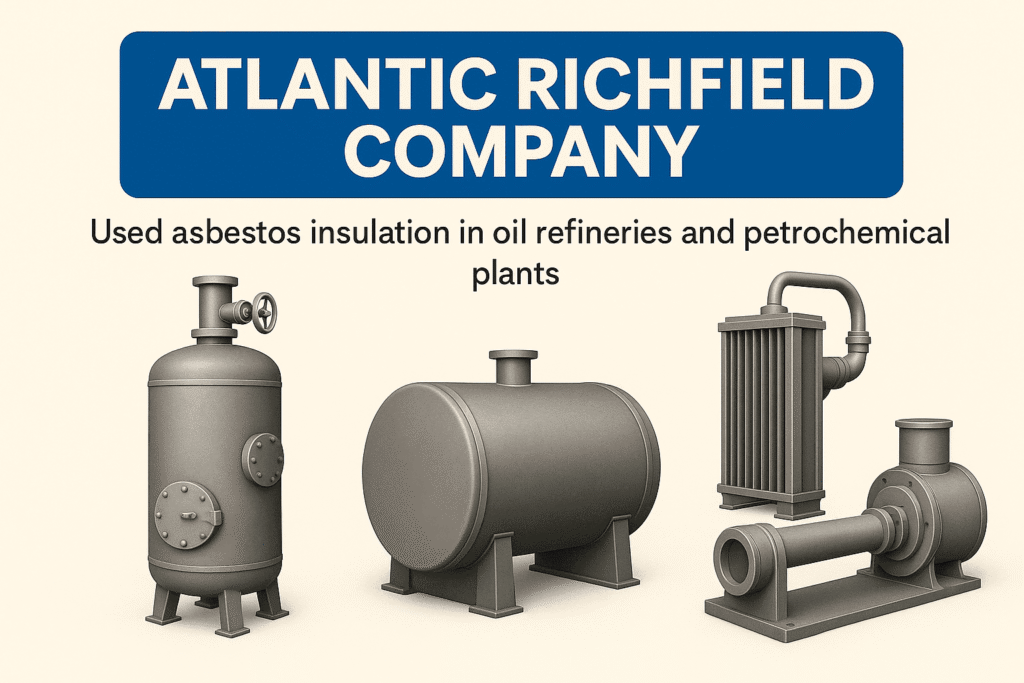
Atlantic Richfield Company (ARCO) Asbestos Exposure
Atlantic Richfield Company, commonly called ARCO, operated oil refineries, terminals, pipelines and other petroleum facilities where high-temperature equipment required extensive insulation and sealing materials. Historical asbestos-containing pipe covering, block insulation, gaskets, packing, fireproofing and building materials may have been present at some locations. Maintenance, repair, renovation and turnaround work could disturb those materials and release airborne fibers.
Employment at an ARCO-owned or ARCO-branded site does not by itself prove asbestos exposure. A reliable claim connects a person to a particular facility, time period, department, task and asbestos-containing product or system. This page explains the records that can help reconstruct that history without assuming every ARCO location used the same materials.
On This Page
- Atlantic Richfield Company history
- Equipment and materials to investigate
- Workers and jobsites
- Potential exposure pathways
- Claims and compensation
- Documented records
- Evidence checklist
- Frequently asked questions
- Submit your case
Atlantic Richfield Company History
Atlantic Richfield was created in 1966 through the merger of Atlantic Refining Company and Richfield Oil Corporation. Its later growth included Sinclair assets and the 1977 acquisition of Anaconda. BP Amoco acquired ARCO in 2000. Later sales and licensing transactions moved certain refineries, retail stations and brand rights to other companies. Those changes matter because the operator, property owner and responsible corporate entity may differ by year and location.
| Period | Corporate development | Why it matters |
|---|---|---|
| Before 1966 | Atlantic Refining and Richfield Oil operated separately | Older records may use predecessor names |
| 1966 | Atlantic Richfield Company formed | ARCO became the principal combined name |
| Late 1960s–1970s | Operations expanded through major transactions | Sites may appear under acquired-company names |
| 2000 | BP Amoco completed its acquisition of ARCO | Post-acquisition records may use BP-related entities |
| Later years | Selected assets and ARCO brand rights changed hands | A current brand sign does not establish historical ownership |
ARCO was primarily a petroleum producer, refiner and marketer, not an asbestos-products manufacturer. The relevant question is generally whether third-party asbestos-containing materials were installed, removed or repaired at a specific facility. Corporate timelines help researchers locate engineering files, contractor records, purchase orders and former coworkers under the correct historical name.
| Identity question | Record to check |
|---|---|
| Who operated the site during the worker’s employment? | Pay records, directories, annual reports and permits |
| Was the unit built before ARCO ownership? | Construction drawings, specifications and acquisition records |
| Did a successor later own the asset? | Purchase agreements, deeds and regulatory filings |
| Was the worker employed by a contractor? | Contract logs, badges, union files and job tickets |
Equipment and Materials to Investigate
Petroleum refineries contain hot process lines, boilers, furnaces, pumps, compressors, valves and vessels. Before asbestos hazards were widely controlled, asbestos was used in industrial insulation and sealing products because it resisted heat and corrosion. EPA identifies insulation, pipe wrap, gaskets, coatings, cement products and fire-resistant materials among historical uses. That general history supports an investigation, but product records are still needed to establish what was actually present at an ARCO site.
| Equipment or area | Possible historical material | Disturbing activity |
|---|---|---|
| Steam and process piping | Pipe covering, elbows, block insulation or cloth | Cutting, stripping and fitting insulation |
| Pumps and valves | Compressed sheet gaskets and packing | Opening flanges, scraping and repacking |
| Boilers and heaters | Insulation, refractory components and door seals | Shutdown repair, demolition and relining |
| Turbines and compressors | Gaskets, lagging and thermal blankets | Overhaul and component removal |
| Buildings and shops | Floor tile, ceiling material, wallboard or fireproofing | Renovation, drilling and demolition |
Brand names, manufacturers and asbestos content varied by plant, unit and year. An old component may also have been replaced more than once. Investigators should avoid identifying a product solely by color or appearance. Useful proof includes labels, packaging, bills of material, procurement records, safety data, specification sheets, photographs and testimony from people who performed the same work.
| Material question | Strong supporting evidence |
|---|---|
| What product was used? | Invoice, carton, label, purchase order or specification |
| Did it contain asbestos? | Manufacturer literature, laboratory result or sworn testimony |
| When was it installed or removed? | Work order, outage schedule or dated photograph |
| Who encountered it? | Job assignment, coworker account and personnel record |
Workers and Jobsites
Direct work could involve handling insulation or gaskets. Bystander exposure could occur when another craft produced dust nearby. Refinery turnarounds deserve special attention because many trades worked together while equipment was opened, stripped and rebuilt. Contractors and temporary workers may have moved among several plants, making union dispatch logs and Social Security earnings records especially helpful.
| Job or trade | Work to investigate |
|---|---|
| Insulators | Installing or removing covering from lines, vessels and equipment |
| Pipefitters and plumbers | Breaking flanges, cutting pipe and replacing gaskets |
| Boilermakers and welders | Opening vessels, repairing heaters and removing nearby insulation |
| Mechanics and millwrights | Overhauling pumps, valves, turbines and compressors |
| Operators and instrument technicians | Working beside maintenance and inspecting operating units |
| Laborers and custodians | Cleaning debris, sweeping shops and supporting demolition |
A jobsite investigation should identify the exact facility rather than relying only on “ARCO refinery.” Records may describe a refinery, terminal, pipeline station, tank farm, chemical unit, maintenance shop, marine facility or office under a predecessor, subsidiary or later owner. The city, unit name, badge number, supervisor and contractor can distinguish similarly named locations.
| Jobsite detail | Examples to preserve |
|---|---|
| Facility identity | Street address, city, plant nickname and historical owner |
| Work location | Unit number, boiler house, pipe rack, shop or dock |
| Time | Employment dates, shifts, shutdowns and construction projects |
| People | Supervisor, crew, union local and contractor |
| Conditions | Dust, ventilation, cleanup methods and protective equipment |
Need help now? Call 800.291.0963
Live chat is available 24/7, 365 days a year.
Submit Your Case
Potential Asbestos Exposure Pathways
Asbestos exposure generally occurs when material is disturbed and fibers become airborne. EPA specifically identifies maintenance, repair, renovation and demolition as activities that can release fibers. At a refinery, removing brittle insulation, wire-brushing a flange or cleaning dusty debris may create a breathing-zone exposure. A person need not have known that the material contained asbestos at the time.
| Pathway | Illustrative refinery scenario | Evidence focus |
|---|---|---|
| Direct | A mechanic scraped an old flange gasket | Equipment, product and frequency |
| Bystander | An operator worked beside insulation removal | Distance, duration and shared airspace |
| Cleanup | A laborer swept dust after a turnaround | Debris source and cleanup method |
| Household | Dust traveled home on work clothing | Laundry practices and contact pattern |
| Renovation | A crew disturbed older building materials | Building age, survey and abatement file |
Risk is not determined by one detail. Frequency, intensity, duration, fiber type, work practice and ventilation may all matter. NCI reports that serious illness has most often followed regular occupational or substantial environmental exposure, while EPA notes that symptoms may take many years to appear. Smoking does not cause mesothelioma, but it can compound asbestos-related lung-cancer risk.
| Exposure detail | Questions to ask |
|---|---|
| Frequency | Was the task daily, weekly or limited to shutdowns? |
| Duration | How long did each event and the overall employment last? |
| Proximity | Was the worker handling the material or nearby? |
| Controls | Were wet methods, enclosures or respirators used? |
| Dust movement | Was work indoors, outdoors or in a confined unit? |
Claims and Compensation
A diagnosed person may have more than one potential legal path. Depending on the facts and governing law, possibilities can include a personal-injury lawsuit, workers’ compensation, claims against solvent product defendants, or claims with bankruptcy trusts established by former asbestos manufacturers. Wrongful-death rights may exist for eligible family members. Each route has different proof, filing rules and offsets.
| Potential route | Typical focus |
|---|---|
| Personal-injury action | Exposure, disease, fault, causation and damages |
| Wrongful-death action | Estate authority, eligible survivors and losses |
| Workers’ compensation | Employment relationship and occupational disease rules |
| Asbestos bankruptcy trust | Approved site, occupation, product and medical criteria |
| Veterans benefits | Qualifying military exposure and service connection |
No dedicated Atlantic Richfield or ARCO asbestos bankruptcy trust was identified in the reviewed public sources. That does not rule out compensation. A worker may have encountered products made by companies that later created trusts, and other defendants may remain solvent. Trust eligibility depends on product and exposure evidence; simply working at an ARCO facility is not enough.
| Claim issue | Why early review matters |
|---|---|
| Filing deadline | Limitation periods vary by state and claim type |
| Corporate identity | Ownership and successor questions change over time |
| Product identification | Memories, labels and records can disappear |
| Multiple exposures | Refinery, construction, military and household histories may overlap |
| Trust coordination | Disclosures and offsets can affect litigation strategy |
Documented Records and Research Boundaries
Public corporate and government records establish ARCO’s long petroleum history and later acquisition by BP. Government asbestos sources establish that asbestos was historically used in pipe insulation, gaskets, fireproofing and other industrial or building materials and that disturbance can release fibers. Those sources do not prove that a named product was present in a particular ARCO unit on a particular date.
| Established by reviewed sources | Requires case-specific proof |
|---|---|
| ARCO operated in petroleum refining and related businesses | The worker’s exact site, unit and dates |
| Asbestos had historical industrial uses | The asbestos content of a specific product |
| Disturbance can release airborne fibers | The frequency and intensity of a person’s exposure |
| Asbestos can cause mesothelioma and lung cancer | Medical diagnosis and legally required causation |
Published opinions, pleadings and verdict reports can identify allegations but should be read carefully. An allegation is not a factual finding, and a settlement may include no admission of liability. Company names may also appear because of premises ownership rather than product manufacture. The strongest page-level conclusion is therefore that historical ARCO industrial sites are appropriate for focused investigation—not that asbestos exposure occurred at every site.
| Record type | What it may show | Important limitation |
|---|---|---|
| Court filing | Parties, allegations, sites and products | Allegations may remain disputed |
| Deposition | Firsthand work and product testimony | Memory may be incomplete |
| Industrial-hygiene file | Sampling, controls and identified material | May cover only one project |
| Abatement survey | Material location and laboratory result | May postdate the claimed exposure |
| Purchase record | Supplier, quantity and delivery date | Does not alone prove personal contact |
Evidence for an ARCO Exposure Claim
Begin with a chronological work history. Record every employer, facility, department, unit, trade, supervisor and date range. Then describe the actual tasks: who removed insulation, what equipment was opened, how old gaskets were cleaned, where dust settled and how clothing was handled. Specific memories are more useful than a general statement that a refinery was dusty.
| Evidence category | Useful examples |
|---|---|
| Employment | Pay stubs, pension files, tax records and Social Security history |
| Jobsite | Badges, maps, directories, permits and project schedules |
| Product | Invoices, specifications, photographs, labels and catalogs |
| Witness | Coworker, foreman, contractor and family testimony |
| Medical | Pathology, imaging, treatment and physician records |
Preserve original documents and make readable copies. Do not alter photographs or discard packaging. A coworker list should include full names, nicknames, trade, shift and last-known contact information. For a household-exposure investigation, document who washed work clothes, how frequently dusty garments came home and whether they were shaken or brushed before laundering.
Also separate personal knowledge from later research. A witness should describe what the witness actually saw, handled or remembered before reviewing catalogs or online photographs. Investigators can then compare that account with plant specifications and supplier records. This sequence helps preserve credibility and may reveal whether the remembered material was original insulation, a replacement product or a non-asbestos substitute.
| Immediate step | Purpose |
|---|---|
| Request complete medical records | Confirm diagnosis and treatment timeline |
| Order earnings and union histories | Reconstruct employers and dispatches |
| List all sites and products | Avoid overlooking non-ARCO exposures |
| Interview coworkers promptly | Preserve task and product memories |
| Check deadlines in the correct state | Protect potentially time-sensitive rights |
Frequently Asked Questions
Did ARCO manufacture asbestos products?
ARCO was principally an oil and gas company. The usual investigation concerns asbestos-containing materials supplied by other manufacturers and used at industrial facilities, not an ARCO-branded asbestos product.
Does working at an ARCO refinery prove asbestos exposure?
No. Proof normally requires the specific site, years, unit, tasks, materials and circumstances. Facility employment is a starting point, not a complete exposure case.
Which refinery tasks may have disturbed asbestos?
Potential tasks include removing insulation, opening flanges, scraping gaskets, repacking pumps or valves, repairing boilers and heaters, cleaning turnaround debris, and renovating older buildings.
Can workers who did not handle insulation have a claim?
Possibly. Bystanders may have shared air with insulators, pipefitters or mechanics. The distance, duration, dust conditions and frequency of nearby work should be documented.
Can family members have secondary-exposure claims?
Some jurisdictions recognize claims involving fibers brought home on clothing, tools or vehicles. The law and proof requirements vary, so laundry and household-contact details matter.
Is there an ARCO asbestos trust?
No dedicated ARCO asbestos bankruptcy trust was identified in the public sources reviewed. Trust claims may still be possible against manufacturers whose qualifying products were encountered.
Does BP’s acquisition determine who is responsible?
Not by itself. Responsibility can depend on the exposure date, facility owner, employer, product supplier, transaction documents and state law. A current ARCO sign is not proof of historical ownership.
What should a diagnosed worker do first?
Obtain medical records, write a detailed work history, identify coworkers and preserve employment or product documents. Because filing periods vary, request a prompt jurisdiction-specific legal review.
Summary
ARCO’s refineries and related petroleum operations used heat-intensive equipment of the kind historically associated with asbestos insulation and sealing materials. The defensible approach is facility-specific: identify the owner, dates, unit, job, task and product, then test those details against employment, purchasing, engineering, witness and medical records.
| Core conclusion | Practical meaning |
|---|---|
| Historical industrial use is plausible | Investigate insulation, gaskets, packing and fireproofing |
| Exposure is not automatic | Prove the particular site, task, product and time |
| Corporate names changed | Search predecessor, ARCO, BP and later-owner records |
| Several claim routes may exist | Review lawsuits, benefits and supplier trusts together |
| Deadlines differ | Seek individualized advice promptly after diagnosis |
This page provides general information, not medical or legal advice. Exposure, eligibility, deadlines and compensation depend on individual facts and applicable law.
Confirmed Sources
- U.S. Environmental Protection Agency — Learn About Asbestos
- U.S. Environmental Protection Agency — Risk Evaluation for Asbestos
- Occupational Safety and Health Administration — Asbestos Standard for General Industry
- National Cancer Institute — Asbestos
- Agency for Toxic Substances and Disease Registry — Asbestos and Your Health
- U.S. Supreme Court — Atlantic Richfield Co. v. Christian
Submit Your Case
Need help now? Call 800.291.0963
Live chat is available 24/7, 365 days a year.
Submit Your Case