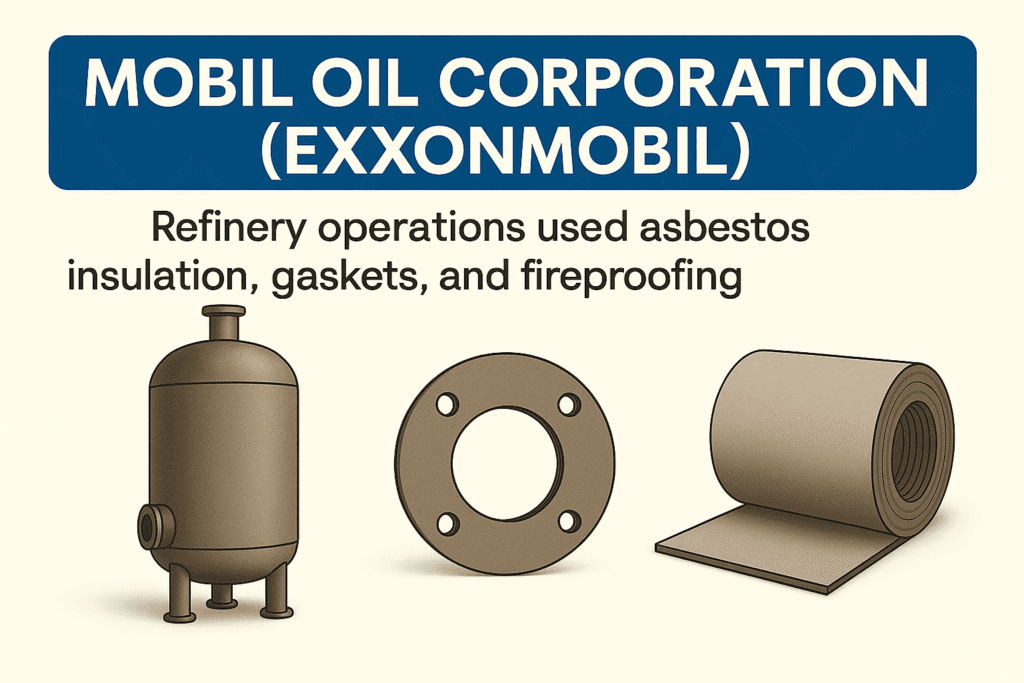
Mobil Oil Corporation and ExxonMobil Asbestos Exposure
Older Mobil refineries used asbestos-containing insulation in at least one documented setting. In 1979, a contractor’s crew removed asbestos insulation from pipes, pumps and other equipment at the Mobil refinery in Ferndale, Washington. A later Washington Supreme Court opinion describes the work, a worker’s mesothelioma and the resulting premises liability case.
The Ferndale record establishes a particular job and time, not exposure at every Mobil or ExxonMobil location. An individual investigation should identify the historic operator, unit, equipment, asbestos-containing material and work activity. Modern Mobil fuel or lubricant branding does not establish that the product itself contained asbestos.
On This Page
- Mobil and ExxonMobil history
- Equipment and materials
- Workers and jobsites
- Exposure pathways
- Claims and compensation
- Documented records
- Claim evidence
- Frequently asked questions
- Submit your case
Mobil Oil, ExxonMobil and Historic Facility Identity
The Washington Court of Appeals identified ExxonMobil Oil Company as successor in interest to Mobil Oil Corporation and explained that Mobil was the name used when Warren Wright worked at the refinery. Its opinion says Mobil operated the Ferndale facility from the mid-1950s until 1988. Historical names matter: a claimant’s badge may say Mobil even when a later legal document names an ExxonMobil entity.
| Record or period | What it establishes |
|---|---|
| Mid-1950s–1988 | Mobil operation of the Ferndale refinery, as recounted by the appellate court |
| 1979 | Northwestern Industrial Maintenance performed a three-month insulation removal job |
| Historic name | Mobil Oil Corporation or Mobil Oil Company in the court record |
| Later party | ExxonMobil Oil Company identified as successor in interest |
The corporate label does not answer who employed a worker. Wright worked for Northwestern Industrial Maintenance (NWIM), an independent contractor; Mobil owned and operated the refinery where the job occurred. The Washington litigation examined duties attributed to a landowner and control over contracted work. It did not turn the contractor’s payroll into Mobil payroll.
At another refinery or year, use contemporaneous deeds, permits, contracts and site directories. Similar logos at service stations, terminals and refineries do not make those locations the same legal or physical worksite. Distinguish a branded retail location from an industrial unit with heat-processing equipment.
| Identity question | Document to obtain |
|---|---|
| Who owned the premises? | Dated property or operating record |
| Who paid the worker? | Payroll, union dispatch or pension history |
| Who directed the project? | Contract, work permit and site safety plan |
| Who supplied insulation? | Invoice, product specification or bag label |
Refinery Equipment and Asbestos Materials
The Ferndale case is unusually specific. The appellate opinion describes an out-of-service refinery unit where NWIM workers demolished old insulation from pipes, pumps and other equipment. The crew had been informed that the insulation contained asbestos. That is evidence about the removed material on this job; it does not identify every insulation manufacturer at the refinery.
| Ferndale item | Documented or investigative status |
|---|---|
| Old insulation on pipes | Asbestos-containing material removed in the documented 1979 job |
| Insulation on pumps | Included in the court’s description of removal |
| Other equipment in that unit | Described by the court without a complete component inventory |
| Particular brand of covering | Must be identified separately from the reported insulation work |
EPA explains that asbestos historically appeared in pipe covering, fire-resistant building materials, gaskets and other manufactured components. For other Mobil facilities, such categories are leads to check in purchasing and maintenance records. The fact that a refinery has steam equipment does not establish that each line had asbestos insulation.
A product brand is also different from premises responsibility. The court’s findings concerned the Ferndale landowner and a contractor’s insulation work. A claim against the maker of that insulation would require evidence of product identity and separate applicable law. Mobil’s current motor oils and retail fuels should not be characterized as asbestos products based on this case.
| Other material to check | Evidence needed |
|---|---|
| Flange gasket | Historical part list, supplier and composition |
| Valve packing | Repacking work order and manufacturer literature |
| Boiler insulation | Location-specific survey and installation history |
| Replacement pipe covering | Install dates and analytical results where available |
Workers, Contractors and Jobsites
Wright was a working foreman. The Washington Supreme Court said he removed insulation alongside his crew while also carrying out supervisory tasks. His employer, NWIM, worked at several refineries. This makes the 1979 Ferndale assignment especially important to distinguish from the crew’s other jobs before Wright retired in 1988.
| Worker or role | Activity to reconstruct |
|---|---|
| Insulation removal crew | Stripping old material and bagging debris |
| Working foreman | Hands-on work, supervision and work-area movement |
| Pipefitter or mechanic | Equipment openings during shutdown maintenance |
| Unit operator | Presence near contractors and shared airspace |
| Cleanup laborer | Handling material after disturbance |
The Ferndale crew reportedly used respirators and wet methods to reduce dust. Coworker testimony explained that water could not always reach every work area. Precautions are part of a credible exposure account; their use does not erase the fact of asbestos removal or establish a precise dose without further analysis.
The opinions offer an unusually detailed account of one short assignment, but a refinery career can span many projects. Ask witnesses to name the jobs they actually shared with the person whose exposure is being evaluated. Their testimony about a different shift or unit may help locate records, yet it does not place the person beside a specific removal event.
A person who worked at a different Mobil refinery should not simply adopt Ferndale’s insulation history. A Washington appellate opinion mentions a Paulsboro newspaper article introduced in the litigation, but the court characterized that limited evidence as unreliable for resolving the Ferndale issue. This page does not transfer the article’s numbers to another plant or use them as verified occupational statistics.
| Jobsite detail | Record to preserve |
|---|---|
| Facility and owner | Address, site map and year of operation |
| Unit and equipment | Pipe number, pump tag or shutdown work package |
| Contractor assignment | Dispatch, badge and job ticket |
| Controls | Wet-method notes, respirator details and area sampling |
| Adjacent work | Shift schedule and coworker observations |
Need help now? Call 800.291.0963
Live chat is available 24/7, 365 days a year.
Submit Your Case
How Mobil Refinery Exposure Could Occur
Disturbing asbestos insulation can release inhalable fibers. At Ferndale, removal from pipes and equipment, movement of debris and incomplete wetting were relevant work conditions described in the court opinions. An exposure account should separate direct removal from merely being elsewhere at a refinery.
| Pathway | Facts that matter |
|---|---|
| Direct stripping | Material, duration, tools and respiratory protection |
| Nearby maintenance | Distance, shared ventilation and task frequency |
| Waste handling | Bagging, transfer and cleanup practices |
| Household contact | Work clothes, transportation and repeated contact |
The appellate court reviewed an expert’s assessment of Wright’s exposure range. The expert considered coworkers’ accounts of work activities and controls, and explained why some perimeter air samples did not distinguish dry from wet methods or indicate the distance to actual removal. That reasoning is specific to the trial record, not a universal measurement for another worker.
EPA and the National Cancer Institute explain that disturbed asbestos can release fibers and that asbestos exposure may cause mesothelioma and lung cancer. Disease may become apparent many years after the work. A medical diagnosis identifies an illness, while employment and product records help identify the historical exposure sources.
| Exposure question | Supporting material |
|---|---|
| What was disturbed? | Survey, specification or confirmed job account |
| How was it removed? | Work plan and witness testimony |
| Where was the person? | Unit log, assignment and shift record |
| What controls were used? | Training, PPE and air-monitoring records |
Claims, Liability and Compensation
The Wright case illustrates a premises claim brought by a contractor’s family. A jury found for Wright on two theories; the appellate court affirmed the verdict based on premises liability while requiring a new hearing concerning settlement reasonableness and setoffs. In 2023, the Washington Supreme Court affirmed the appellate court’s decision about the challenged jury instruction. These decisions are legal findings in one case, not a guarantee of recovery elsewhere.
| Potential route | Claim-specific question |
|---|---|
| Premises action | Who controlled the site and owed a duty under local law? |
| Contractor employment claim | Who employed the person, and what compensation rules apply? |
| Product manufacturer action | Which company made or supplied the specific asbestos material? |
| Separate manufacturer trust | Does that trust’s product and disease criteria fit the exposure? |
ExxonMobil Oil Company appeared in court as Mobil’s successor in interest. That does not mean every similarly named subsidiary operated every historic site. The proper entity and the legal duty should be checked using the period and location. A dedicated Mobil asbestos bankruptcy trust or published Mobil trust payment percentage was not established in the reviewed primary sources.
The Court of Appeals reported a $4 million jury verdict and an initial reduced judgment after offsets, then vacated that judgment and ordered a new settlement reasonableness hearing. Quoting the earlier judgment as the final amount would misstate the procedural record. Case values depend on facts, damages, prior settlements and applicable law.
| Legal record | Careful reading |
|---|---|
| Jury verdict | Specific to Wright’s trial |
| Settlement offsets | Required additional hearing after appellate review |
| 2023 Supreme Court decision | Addressed a jury-instruction issue |
| Other locations | Require independent proof and legal analysis |
Documented Ferndale Records and Their Limits
The 2021 Washington Court of Appeals opinion gives the location, dates, contractor, work and disease history. The 2023 Washington Supreme Court opinion discusses witness testimony, Mobil’s knowledge at the time and the disputed instruction about known or obvious hazards. Both are primary court records, but neither supplies a complete list of asbestos brands installed across all Mobil facilities.
| Source | Supported point |
|---|---|
| 2021 Court of Appeals opinion | Ferndale work history, successor identity and appeal disposition |
| 2023 Supreme Court opinion | 1979 removal testimony and jury-instruction ruling |
| EPA asbestos overview | General historical material uses and disturbance pathway |
| NCI asbestos summary | Established asbestos-associated cancer risks |
One issue deserves particular care: the appellate opinion describes a newspaper article about a different Mobil refinery. It says the evidence was minimal and shown as unreliable for the case, and notes that Ferndale asbestos was not disputed. Readers should rely on the actual Ferndale testimony rather than treat allegations in that old article as verified national Mobil figures.
The Washington opinions also record safety measures without finding they eliminated the hazard. A worker who recalls wetting insulation and wearing a mask should report both faithfully. Records about exact equipment, fit, work duration and material handling are more useful than a blanket claim that controls were absent or perfectly effective.
| What a record cannot establish alone | Follow-up |
|---|---|
| A court case at one refinery | Verify the other site’s own material records |
| A historical operator name | Confirm the relevant entity and dates |
| General disease information | Obtain individual diagnosis and work history |
| A perimeter air reading | Match sample location and task conditions |
Evidence Checklist for Mobil and ExxonMobil Cases
List each refinery, employer, contractor and project separately. For an insulation job, preserve unit number, equipment tags, removal method, approximate frequency and material identification. Do not merge Ferndale details with the histories of Shell, Texaco or other refineries simply because a traveling contractor worked at several locations.
| Evidence | Purpose |
|---|---|
| Medical and pathology records | Establish diagnosis and timeline |
| Union and employment history | Locate work, dates and employer |
| Plant work packages | Identify unit, scope and contractor |
| Material surveys or invoices | Confirm asbestos content and supplier |
| Coworker testimony | Describe actual removal and protective measures |
Document what a witness personally observed, including whether a crew wet the material, where water was unavailable and how waste was handled. If records mention air sampling, identify whether it measured a worker’s breathing zone, an area perimeter or a different task. Those distinctions mattered in the Ferndale litigation.
Finally, preserve settlement agreements, releases and earlier trust submissions. The appellate dispute about offsets shows why the full terms can matter. Filing deadlines vary with jurisdiction, diagnosis and claim type; a qualified adviser should evaluate them promptly using the complete chronology.
| Before filing | Check |
|---|---|
| Site assignment | Correct facility and historic operator |
| Asbestos source | Material, manufacturer and work period |
| Claim route | Premises, employer or product theory |
| Earlier payments | Releases and possible offsets |
Frequently Asked Questions
Was asbestos documented at a Mobil refinery?
Yes. Washington court opinions document removal of asbestos-containing insulation at the Mobil Ferndale refinery during a 1979 contractor job.
Did Wright work directly for Mobil?
No. He worked for independent contractor Northwestern Industrial Maintenance at the Mobil-owned and operated Ferndale site.
Does Ferndale prove asbestos exposure at every Mobil site?
No. Other facilities require their own evidence of materials, activities and individual work locations.
What asbestos materials were involved in the Ferndale job?
Old insulation on pipes, pumps and other equipment in an out-of-service refinery unit, according to the appellate court.
Did respirators and wet methods prevent the claim?
No. The case discusses those precautions and the limits on wetting some areas. The jury verdict was affirmed on premises liability grounds.
Did the Washington Supreme Court set a standard payout?
No. Its 2023 decision addressed a jury instruction in Wright’s case. The earlier appellate court ordered further review of settlement offsets.
Is there a Mobil asbestos trust?
The primary sources reviewed here did not establish a dedicated Mobil asbestos bankruptcy trust. Another supplier’s trust requires its own qualifying evidence.
What should a former worker collect first?
Gather diagnosis records, dated employment history, refinery unit and project information, material evidence and coworker contacts.
Summary
Mobil’s Ferndale refinery is a documented example of asbestos insulation removal and a later premises liability verdict. The 2023 Washington Supreme Court affirmed the appellate ruling on the contested jury instruction; an earlier monetary judgment had been vacated pending a new settlement hearing. Other Mobil or ExxonMobil workplaces require individual proof of asbestos material, disturbance and responsibility.
| Key fact | Documented position |
|---|---|
| Facility | Mobil refinery, Ferndale, Washington |
| Work | 1979 removal of asbestos insulation from refinery equipment |
| Employer | Northwestern Industrial Maintenance, independent contractor |
| Successor | ExxonMobil Oil Company identified by appellate court |
| Case outcome described | Verdict affirmed; judgment vacated for settlement hearing |
| Generalization | Other jobsites require separate proof |
This page provides general information, not medical or legal advice. Exposure, eligibility, deadlines and compensation depend on individual facts and applicable law.
Confirmed Sources
- Washington Court of Appeals: Wright v. ExxonMobil Oil Company (2021)
- Washington Supreme Court: Wright v. 3M Co. and ExxonMobil Oil Company (2023)
- U.S. EPA: Learn About Asbestos
- National Cancer Institute: Asbestos
Submit Your Case
If your work involved a historic Mobil refinery, identify its location, employer, dates, unit and suspected asbestos material for an individual review. Include other refineries separately so each exposure can be evaluated on its own evidence.
Need help now? Call 800.291.0963
Live chat is available 24/7, 365 days a year.
Submit Your Case