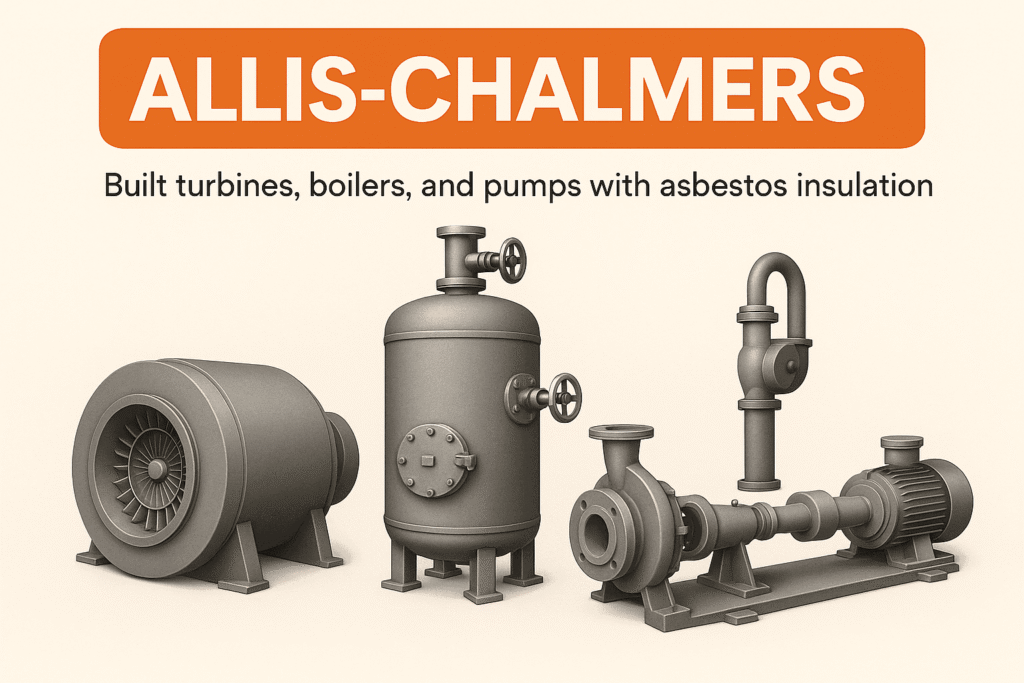
Allis-Chalmers and Asbestos Exposure
Allis-Chalmers is associated with heavy industrial and power-generating equipment. People researching asbestos exposure around equipment bearing this name may need to examine older insulation, gaskets, packing and materials installed by separate suppliers. Whether any particular Allis-Chalmers machine or workplace contained asbestos depends on its model, components, maintenance history and dates.
This page explains the work settings and records that can help investigate a claim. A nameplate on a turbine or pump alone does not establish an asbestos-containing Allis-Chalmers product, personal exposure or legal responsibility. It is especially important to distinguish original equipment from later replacement parts and insulation added at the job site.
🏢 Allis-Chalmers Company and Equipment History
Allis-Chalmers was known for a broad line of industrial, agricultural and electrical machinery. Its name may appear on generating equipment, pumps, motors or other machines at a facility with many suppliers. The machine maker, plant owner, maintenance contractor and supplier of consumable parts can be different businesses. A careful history identifies each role rather than treating the entire site as one company’s product.
| Entity | Possible role | Record to seek |
|---|---|---|
| Allis-Chalmers | Maker or seller of identified historical equipment. | Nameplate, model and original manual. |
| Facility owner | Operated the power plant or factory. | Property and operating records. |
| Installation contractor | Assembled equipment and associated systems. | Installation specifications and invoices. |
| Parts supplier | Provided later gaskets, packing or insulation. | Purchase orders and replacement logs. |
| Maintenance employer | Assigned workers to repairs or outages. | Payroll, dispatch and job tickets. |
| Question | Why it matters |
|---|---|
| Which Allis-Chalmers division or product line? | A shared brand can cover unrelated machinery. |
| When was the unit made and installed? | Design and materials may change over time. |
| Was the material supplied with the machine? | Site-installed products may have another maker. |
| What repairs occurred before the worker arrived? | Replacement components may differ from originals. |
| Who held the business at the relevant date? | Successor questions require transaction-specific review. |
For the surrounding industry, see Power, Utility and Electrical Companies Asbestos Exposure. That overview separates utility operations from manufacturers and construction firms. A modern brand or business bearing a similar name should never be assumed responsible for every historical Allis-Chalmers product.
For a machine still operating years after installation, obtain both the original specification and the records from the most recent overhaul before the worker’s assignment. A plant might keep serial-number files, while a contractor might retain the actual parts invoice. Comparing those records can reveal a change in material or supplier.
⚙️ Allis-Chalmers Equipment and Materials to Investigate
The EPA lists asbestos among historical insulation, gaskets, coatings and fire-resistant products. Those categories describe materials that could have been used around industrial equipment; they are not proof that a specific Allis-Chalmers model contained them. Obtain an original parts list or project specification before assigning a material to the machine maker.
| Equipment area | Material to verify | Best starting evidence |
|---|---|---|
| Steam turbine casing | Thermal covering or sealing materials. | Unit drawing and overhaul file. |
| Industrial pump | Flange gaskets or shaft packing. | Parts list and repair invoice. |
| Generator or motor | Specified heat-resistant components. | Model manual and component catalog. |
| Connected piping | Pipe covering, valve gaskets or insulation. | Piping isometric and supplier order. |
| Equipment foundation | Nearby fireproofing or building materials. | Site survey and construction plan. |
| Material category | Question to resolve | Possible source |
|---|---|---|
| Original component | Was it shipped with the Allis-Chalmers machine? | Bill of materials or shipping file. |
| Replacement component | Who made the part installed during service? | Inventory and work order. |
| External insulation | Who specified and installed the covering? | Construction package or contractor bill. |
| Adjacent equipment | Which other maker’s machine was being serviced? | Floor plan and nameplate photo. |
| Building material | Was the source equipment or the structure? | Asbestos survey and renovation record. |
A pump or turbine can undergo many overhauls across decades. A worker exposed during a later repair may have handled a replacement product rather than an original part. Avoid saying that every Allis-Chalmers turbine, boiler, pump, tractor or electrical machine contained asbestos; specific materials must be established by date and design.
👷 Workers and Job Sites Around Allis-Chalmers Equipment
Allis-Chalmers machinery could be encountered in power generation and other industrial settings. The relevant work history may involve a factory that made equipment, a plant that installed it or a contractor that serviced it. Job titles suggest where to look, while the precise activity and material establish what may have been disturbed.
| Occupation | Possible activity | Detail to record |
|---|---|---|
| Turbine mechanic | Opening casing and replacing service parts. | Unit, outage and component. |
| Pump mechanic | Removing packing or flange gaskets. | Manufacturer, part and repair frequency. |
| Pipefitter | Working on connected valves and lines. | Piping location and material source. |
| Insulator | Installing or removing thermal covering. | Product label and installation contractor. |
| Electrician | Servicing motors or working near repairs. | Equipment and neighboring activity. |
| Cleanup worker | Removing dust and debris after maintenance. | Original dust source and method. |
| Setting | Relevant work | Evidence lead |
|---|---|---|
| Power station | Generating unit overhaul or routine service. | Utility outage schedules. |
| Industrial plant | Pump or motor maintenance. | Equipment inventory. |
| Manufacturing shop | Assembly, machining or testing. | Production records and department roster. |
| Repair shop | Off-site rebuilding or component exchange. | Service tickets and shipment files. |
| Construction project | Installation and insulation of systems. | Bid package and subcontracts. |
The Power Plants Asbestos Exposure page offers additional context about generating stations. Record both the owner and contractor where relevant. A trade working nearby could have a different exposure history from the mechanic who opened the machine.
Need help now? Call 800.291.0963
Live chat is available 24/7, 365 days a year.
Submit Your Case
🌫️ Possible Asbestos Exposure Pathways
EPA explains that fibers can enter the air when asbestos-containing material is damaged or disturbed. Applied to an industrial machine, a possible history could involve stripping insulation to gain access, scraping old gasket material, repacking a pump or cleaning debris after another crew’s work. Each scenario needs both material identification and evidence of the worker’s contact.
| Activity | Possible mechanism | Key fact |
|---|---|---|
| Removing insulation | Covering breaks during access to machinery. | Verified material and installer. |
| Replacing gasket | Old residue is scraped from joint surfaces. | Actual gasket maker and composition. |
| Removing packing | Sealing material is pulled or cut. | Part source and service date. |
| Overhaul or demolition | Legacy equipment or adjacent systems are opened. | Project scope and location. |
| Dry cleanup | Dust from qualifying material is resuspended. | Source, method and frequency. |
| Category | Illustrative account | Evidence focus |
|---|---|---|
| Direct work | Mechanic removes a documented asbestos part. | Tools, duration and repetition. |
| Nearby trade | Pipefitter works beside insulation removal. | Distance and shared airspace. |
| Contaminated area | Worker enters an area after dusty service. | Timing and dust source. |
| Household transfer | Material reaches home on work clothes. | Source worker and laundering practice. |
The National Cancer Institute identifies asbestos as a cause of mesothelioma and links it to lung cancer and other conditions; symptoms can arise many years after exposure. A diagnosis does not identify which company’s material was involved. Treat medical documentation and product identification as separate parts of the investigation. Qualified professionals should assess suspected asbestos without a family member disturbing old equipment.
⚖️ Allis-Chalmers Claims and Compensation Questions
Potential claims depend on the actual material, the responsible business, the worker’s medical history and the law of the relevant jurisdiction. A civil product claim, a claim involving a premises owner or workers’ compensation may have different requirements. A bankruptcy trust claim is available only if a specific debtor trust covers the identified exposure and its criteria are met.
| Route | Possible subject | Evidence or limit |
|---|---|---|
| Product liability | An identifiable asbestos-containing product. | Maker, component and exposure proof. |
| Premises claim | Conditions at a facility controlled by another party. | Ownership, duties and state law. |
| Workers’ compensation | Occupational illness connected to employment. | State requirements and employer history. |
| Other debtor’s trust | Identified asbestos material supplied by a qualifying debtor. | That trust’s product and site criteria. |
| Family claim | Qualifying wrongful-death or household circumstances. | Relationship, exposure and jurisdiction. |
| Claim | Accurate treatment |
|---|---|
| Allis-Chalmers has a dedicated asbestos trust. | No official trust documentation was verified for this page. |
| Every named machine created exposure. | Determine asbestos content and disturbance first. |
| A successor owes every historical liability. | Review the actual transaction and governing law. |
| Any diagnosed worker is guaranteed payment. | Liability, causation and filing rules remain case-specific. |
| A settlement figure is typical. | No company-specific average was verified. |
A trust can pay only claims that meet its own debtor, product, exposure and medical criteria. An Allis-Chalmers nameplate does not qualify a worker for an unrelated supplier’s trust. If historical insulation or a replacement part came from a company with an established trust, that material should be investigated separately through the official trust documents. No official record establishing a dedicated Allis-Chalmers asbestos trust was verified for this review.
📚 Documented Records and Research Limits
Government sources establish broad asbestos uses, exposure mechanisms and health effects. They do not verify that every Allis-Chalmers product contained asbestos. The best company-specific evidence comes from period manuals, bills of materials, repair records and facility purchasing documents matched to the worker’s dates.
| Record | Potential value | Limit |
|---|---|---|
| Original machine manual | Model and specified service parts. | May not reflect later replacements. |
| Installation package | Equipment and external insulation scope. | May not identify the eventual installer. |
| Plant purchase order | Supplier and dated product delivery. | Delivery alone does not prove contact. |
| Overhaul work order | Task, crew, unit and dates. | May omit asbestos composition. |
| Material survey | Sampled asbestos-containing locations. | Survey may postdate the work period. |
| Government health guidance | General hazard and disease context. | Cannot determine a particular defendant. |
| General observation | Unproven leap |
|---|---|
| Some industrial insulation contained asbestos. | All Allis-Chalmers turbines had asbestos insulation. |
| Some historical gaskets contained asbestos. | Every replacement pump gasket did. |
| Machinery was installed in power stations. | All workers near a machine were exposed. |
| Asbestos claims can involve manufacturers. | This manufacturer owes a particular claimant. |
| Trusts exist for some asbestos companies. | There is a verified Allis-Chalmers trust. |
OSHA’s construction and general-industry asbestos standards can inform current handling practices for covered work. They should not be used to declare that a historical Allis-Chalmers site violated a regulation. No primary source consulted here establishes a company-wide worker exposure count, military exposure count or typical asbestos settlement value. An individual assignment and product history remain more useful than those broad estimates.
📋 Evidence for an Allis-Chalmers Equipment Claim
Create a dated account of the worker’s employers, facilities, equipment and tasks. Copy any surviving nameplate details and note whether the material came attached to the machine, was installed at the site or was bought later for maintenance. This distinction helps identify the correct manufacturer and potential claim route.
| Category | Example | Why it matters |
|---|---|---|
| Medical | Pathology, imaging and physician records. | Documents the diagnosed condition. |
| Employment | Payroll, union dispatch or Social Security history. | Places the worker and dates. |
| Equipment | Nameplate, serial number or parts catalog. | Identifies the model and original design. |
| Replacement part | Box label, invoice or stockroom ledger. | Identifies later supplier and composition. |
| Task | Job ticket and work procedure. | Shows how material was disturbed. |
| Witness | Coworker or contractor statement. | Corroborates assignment and conditions. |
| Question | What the answer clarifies |
|---|---|
| Was the machine actually Allis-Chalmers? | Company and model identity. |
| Which material contained asbestos? | Product and maker attribution. |
| Who supplied it and when? | Original versus replacement product. |
| What released fibers? | Handling, proximity and frequency. |
| Were other products present? | Separate sources and potential defendants. |
| What deadline applies? | Jurisdiction-specific filing requirements. |
Preserve documents in their original form and record where each fact came from. When a model manual is missing, facility archives, parts suppliers, union records and former coworkers may provide leads. An expert can assess whether an old material actually contained asbestos without asking the claimant to collect a potentially hazardous sample.
❓ Frequently Asked Questions
Did every Allis-Chalmers machine contain asbestos?
No. Product lines, models, components and service periods differed. Confirm the material in the particular equipment or nearby system.
What parts should a pump worker investigate?
Historical gaskets and packing may merit review, along with the parts supplier, installation date and actual repair method.
Could turbine insulation have another manufacturer?
Yes. Thermal covering may have been specified or installed by a plant contractor rather than supplied with the turbine.
Are nearby trades relevant?
Potentially. Record the disturbed material, distance, duration and whether workers shared an enclosed space.
Is an Allis-Chalmers asbestos trust verified?
No official documentation for a dedicated trust was verified for this page. A separate supplier’s trust may require its own evidence.
Does a diagnosis prove company responsibility?
No. Medical records establish a condition; product records, task history and governing law determine whether a company-specific claim is supportable.
Can family members describe exposure at home?
Yes. Clothing and laundering details may be relevant, subject to proof of the occupational dust source and applicable law.
Which documents are most useful?
Employment records, equipment identification, parts manuals, work orders, product invoices, facility surveys and knowledgeable coworker accounts are valuable starting points.
📝 Summary
An Allis-Chalmers nameplate can focus a historical investigation, but it cannot identify asbestos content or the maker of every later part. Workers should document the exact machine, material, supplier, site, date and disturbance that may have brought fibers into the air.
| Issue | Reliable approach |
|---|---|
| Equipment identity | Verify model, serial number and original specifications. |
| Material source | Separate original parts, replacements and site insulation. |
| Work history | Record employer, task, location, dates and proximity. |
| Health | Document diagnosis through clinical records. |
| Legal route | Assess each responsible entity and deadline independently. |
A dedicated company trust, exposure totals and settlement averages should not be assumed from general industry history. A specific, documented account of the machine, product and work activity is more useful for assessing exposure and possible legal options.
🔗 Confirmed Sources
- U.S. EPA — Learn About Asbestos
- U.S. EPA — Risk Evaluation for Asbestos, including legacy uses
- National Cancer Institute — Asbestos
- OSHA — General Industry Asbestos Standard
- OSHA — Construction Asbestos Standard
📞 Submit Your Case
If you or a family member worked with Allis-Chalmers equipment and later received an asbestos-related diagnosis, gather the model, site, duties, replacement-part history and medical records. Those details can help evaluate possible exposure and available options.
Need help now? Call 800.291.0963
Live chat is available 24/7, 365 days a year.
Submit Your Case
This page provides general information, not medical or legal advice. Exposure, eligibility and compensation depend on individual facts and applicable law.