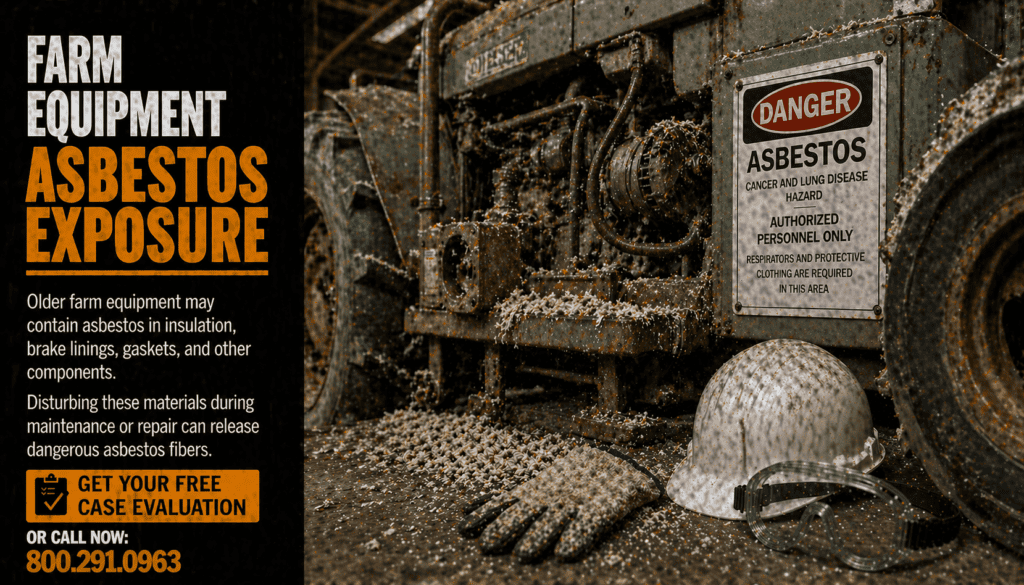
Farm Equipment Asbestos Exposure
Farm equipment asbestos exposure may have occurred when workers repaired older brakes, clutches, gaskets, or other components that actually contained asbestos. Tractors, harvesters, combines, farm trucks, and powered machinery had different designs and service histories, so neither a machine’s age nor its brand establishes exposure by itself.
Farmers, mechanics, operators, and families can begin by identifying the equipment, the parts handled, and the work performed. After a mesothelioma or asbestos-related lung cancer diagnosis, those details may help a qualified professional evaluate possible exposure and legal options while the medical team directs diagnosis and treatment.
🌾 Farm Equipment Asbestos Exposure Overview
Agricultural work often combines equipment operation with maintenance. A farmer might operate a tractor during planting, help replace a clutch later, and clean the workshop afterward. These activities should be described separately. The exposure question concerns contact with an asbestos-containing component or its dust, rather than simply spending years around farm machinery.
Friction and sealing products were used because equipment needed parts that tolerated heat, pressure, and wear. Some historical formulations contained asbestos; others did not. A service history can be particularly important for a machine bought secondhand, rebuilt by a dealer, or maintained with replacement parts from several suppliers over many seasons.
The related agricultural equipment asbestos exposure article covers another equipment category, while the broader asbestos exposure in equipment page addresses additional systems. When recording a farm history, distinguish machine components from building products, such as materials in a farmhouse, barn, or workshop. Different sources require different supporting evidence.
A useful first account can be simple: which machine was involved, who worked on it, where the repair happened, and approximately when. Add whether the person remembers a product label or is uncertain about the part. This keeps an ordinary farm work history separate from conclusions that require technical or legal support.
🚜 Tractors, Harvesters, and Other Farm Machinery
Relevant equipment histories may include tractors, combines, harvesters, balers, loaders, farm trucks, and other powered machines. The presence and design of brakes, clutches, seals, and electrical systems vary. A particular attachment may have no relevant friction component even though the tractor pulling it does. Identify each machine and assembly rather than treating an entire farm fleet as one exposure source.
Write down the manufacturer, model, approximate year, serial number if available, and when the farm acquired the machine. Note whether repairs were done by the owner, an employee, a dealership, or a traveling mechanic. Ownership dates and production dates are different, and the parts installed during a later overhaul may differ from the factory equipment.
Farm trucks and support vehicles deserve their own entries; automotive equipment asbestos exposure addresses related vehicle systems. Likewise, machinery equipment asbestos exposure may be relevant to powered equipment serviced alongside mobile machines. These connections help describe the actual work, without assuming that every vehicle, implement, or stationary machine contained asbestos.
For example, a used tractor purchased in the 1980s may have been manufactured much earlier and repaired repeatedly before the purchase. Record those facts separately. A model year can guide a search for manuals, while purchase and service dates help establish which owner, dealer, or mechanic might hold useful records.
⚙️ Components and Materials That Need Identification
Potentially relevant historical components include brake linings or shoes, clutch facings or friction disks, gaskets, and certain heat-resistant or electrical materials. Whether asbestos was present depends on the specific product and period. A tractor’s nameplate identifies the machine, but it does not necessarily identify who supplied a replacement brake lining or engine gasket.
Record part numbers and product names from existing packaging, invoices, manuals, or photographs. Distinguish a gasket scraped from a sealing surface from insulation removed nearby. The gasket equipment asbestos exposure page addresses sealing materials, while electrical equipment asbestos exposure concerns different components. A description such as “old white material” is insufficient to establish composition.
Use asbestos exposure in products information to organize product questions and industrial equipment manufacturers and asbestos exposure information to identify possible business records. Neither a product category nor a company name proves that a specific farm part contained asbestos. Do not cut or collect surviving suspect material yourself to obtain evidence.
Where old boxes survive, photograph readable labels without opening damaged packages or handling loose material. A part number may have changed over time, so retain the date and source of the record as well as the number itself. Ask a qualified professional how to handle any suspect material still in storage.
🔧 Tractor Brakes and Clutches
Brakes and clutches merit close attention because servicing may involve accumulated friction dust. EPA explains that appearance alone cannot reliably distinguish asbestos-containing components from non-asbestos components. Visible dust is not proof that asbestos was present, and a lack of visible dust does not establish that a task created no airborne particles.
OSHA’s September 13, 1999 interpretation addressed agricultural and industrial tractors among several equipment classes. It explained that the automotive brake-and-clutch provisions cover certain units using friction assemblies comparable in design and size to passenger-car systems. That is a limited equipment-specific explanation, not a declaration that every farm repair is governed identically. Applicable requirements need review for the operation involved.
For past work, note whether someone removed shoes or facings, opened a clutch housing, replaced a complete assembly, or cleaned accumulated dust. The brake equipment asbestos exposure article provides related component information. Record how often the task occurred and whether the person handled parts directly, assisted another mechanic, or worked nearby during servicing.
🛠️ Maintenance, Repair, and Workshop Cleanup
Useful descriptions identify the work before, during, and after repair. Examples include opening housings, removing worn friction parts, scraping old sealing material, dismantling an engine assembly, and collecting debris from a bench or floor. Each example is a possible disturbance pathway only when the material or dust actually contained asbestos.
Past cleaning methods matter. Record whether compressed air, dry sweeping, brushes, or other methods were used and who was nearby. For present-day brake or clutch work, EPA advises against compressed-air cleaning and ordinary shop vacuums without appropriate HEPA filtration. Use qualified service providers and suitable controls rather than treating this article as repair instructions.
A farm shed, enclosed garage, dealership service bay, and outdoor repair area can present different conditions. Describe ventilation and worker proximity without assigning a numerical exposure level from memory. The contractor equipment and machinery resource may help when outside crews performed repairs; the job-site asbestos exposure resource addresses other workplaces in a person’s employment history.
Include whether work was occasional emergency maintenance during a harvest or a regular winter overhaul program. Those are different schedules and may involve different mechanics and locations. Describe what happened rather than estimating an airborne fiber concentration, which cannot reliably be reconstructed from a person’s memory of how dusty a workshop looked.
👷 Farm Workers, Mechanics, and Household Contact
Farm owners, agricultural mechanics, equipment technicians, operators, seasonal employees, and cleanup workers may describe different tasks around the same machine. An owner who also serviced equipment should include both roles. A seasonal worker should record the assignment and work observed rather than adopting an employer’s entire equipment history as a personal exposure history.
A review of high-risk jobs and occupations can help organize duties across multiple employers. Work before or after farm employment may also matter. Separate direct handling of a part from standing nearby, entering a shop after repairs, or cleaning tools. Frequency, duration, distance, materials, and work practices provide more useful detail than a job title alone.
Possible secondhand asbestos exposure requires an identifiable pathway, such as contaminated clothing or belongings carried home. Record who handled laundry, where clothing was kept, and when the contact occurred. Ordinary farm dirt is not automatically asbestos contamination. Keep current suspect work materials out of living spaces and seek professional advice about contamination concerns.
Family farms can blur job titles because several people share repairs, transport, and cleanup. List each person’s own duties and years of involvement. Someone who delivered parts may remember a supplier; another person may recall dismantling equipment. Keep their accounts distinct so useful details are preserved without suggesting that everyone had identical contact.
📂 Equipment Records and Exposure Evidence
Begin with a timeline listing farms, employers, locations, machine types, and repair tasks. Include approximate dates where necessary and mark them as estimates. Service manuals, parts catalogs, maintenance logs, dealer invoices, purchase orders, and farm equipment inventories can help connect a machine with the parts used during a particular period.
Photographs may establish that a tractor was present, while a dated invoice may identify a replacement product. Neither document necessarily establishes the other fact. Ask former mechanics or coworkers what they personally remember about components and servicing. Preserve uncertainty and distinguish firsthand recollections from information learned later through family conversations.
The evidence-preservation resource for families offers additional recordkeeping suggestions. Save originals, retain dates and sources, and make readable copies. For a machine repaired many times, organize records by service event rather than assuming one part remained installed throughout its life. Missing records should be explained during a review, not replaced with guesses about brands or asbestos content.
Separate records about owning equipment from records about repairing it. A farm sale inventory may identify a model, while a service receipt identifies the part and task. Keeping both can help explain the sequence. When records conflict, preserve the originals and explain the discrepancy instead of silently choosing the more convenient account.
⚖️ Health, Lawsuits, and Compensation Options
Asbestos exposure can cause mesothelioma, lung cancer, and asbestosis, but working on farm equipment does not diagnose any disease. Tell the treating clinician about past tasks and possible exposures, including jobs from decades earlier. Medical and pathology records establish clinical findings; they do not automatically identify which machine or product was responsible.
Potential mesothelioma claims require evaluation of the diagnosis, exposure evidence, responsible parties, deadlines, and applicable law. Depending on the circumstances, options may include a lawsuit or eligible asbestos trust fund claims. A former equipment manufacturer, parts supplier, and employer can have different roles; their involvement alone does not establish liability or a right to payment.
The mesothelioma lawsuits in all 50 states resource explains why location and claim type matter. Seek individual advice promptly about filing periods after diagnosis or death. Possible settlements and compensation vary with the evidence and available claims. A family should not treat a general payment example, farm occupation, or machine brand as a guarantee of eligibility or recovery.
❓ Frequently Asked Questions
Did All Older Farm Equipment Contain Asbestos?
No. Different manufacturers, models, years, and replacement components used different materials. Equipment age can help identify records to request, but it does not prove composition. A useful review connects a particular part to the time it was installed and the work performed.
Can I Identify Asbestos in a Tractor Brake by Looking at It?
No. EPA explains that asbestos-containing and non-asbestos friction components cannot reliably be distinguished by appearance alone. Avoid disturbing suspect dust. Existing labels, supplier information, parts records, and appropriate professional evaluation are more useful than visual guesses about worn components.
Does Operating a Tractor Establish Asbestos Exposure?
No. Operating a machine and servicing its internal components are different activities. Describe repairs performed or observed, proximity to disturbed dust, and the materials involved. Operating history can establish contact with equipment, but additional evidence is needed to assess an exposure pathway.
What if the Tractor Had Replacement Parts?
Identify the repair dates and replacement suppliers where possible. A later brake, clutch, or gasket may differ from the original component. Dealer invoices, maintenance notes, part numbers, and mechanic recollections can help separate earlier installations from parts added after the worker’s relevant employment.
Can a Family Review Exposure Without All the Old Records?
Yes, an initial review can begin with an accurate timeline and the records available. Explain what is missing and who may have additional information. Do not delay medical care or assume filing deadlines will wait while documents are collected. Eligibility still requires an individual assessment.
Should I Remove a Suspect Part to Support a Claim?
No. Do not dismantle equipment, scrape material, or collect dust for legal evidence yourself. Preserve existing records and photographs. Qualified professionals can advise on current hazards and appropriate material assessment without creating avoidable exposure for workers, family members, or bystanders.
📞 Get the Mesothelioma Help & Compensation You Deserve — Contact Us Today!
A mesothelioma diagnosis can leave farm workers and families with questions about past exposure and possible compensation. Contact us for help organizing information for an individual review.
We have 25+ years helping veterans, workers, and families seek information and assistance after asbestos-related diagnoses.
📲 Contact Us Today — Three Easy Ways!
- CALL: 800.291.0963
- LIVE CHAT: Open 24/7/365 through the website’s chat feature.
- CONTACT FORM: Complete the form below to request assistance.
Disclaimer: This information is not be considered as legal or medical advice. Mesothelioma Help Center is not a law firm or medical provider and does not determine legal or VA eligibility.