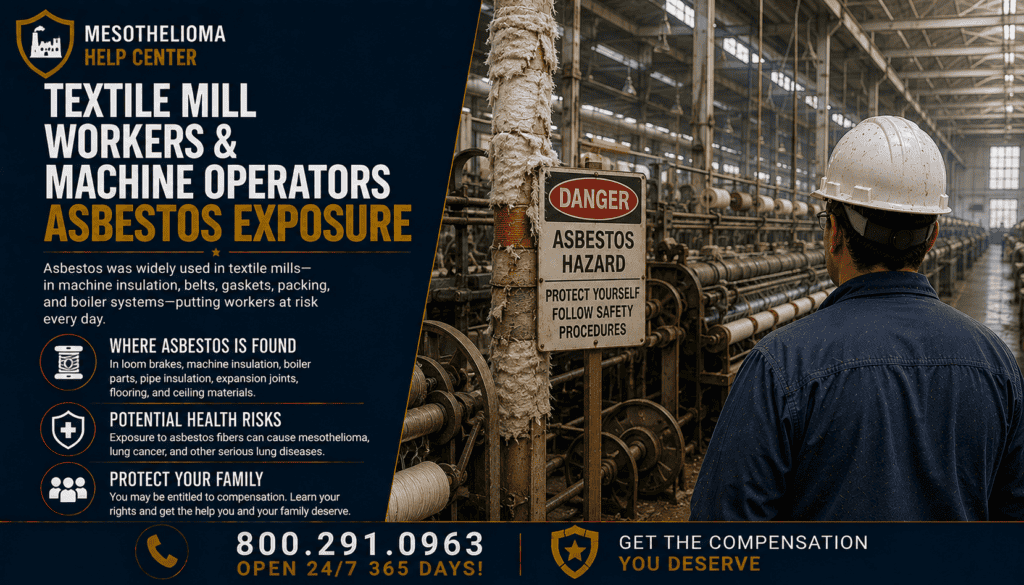
Textile Mill Workers & Machine Operators Asbestos Exposure
Textile mill workers and machine operators could have substantial occupational asbestos exposure when they worked in plants that manufactured asbestos textiles. Historical U.S. Public Health Service and NIOSH surveys documented asbestos fiber preparation, carding, spinning, twisting, winding and weaving, with some machine operators and production jobs exceeding asbestos exposure standards in effect at the time.
That evidence applies to confirmed asbestos textile manufacturing and should not be generalized to ordinary cotton, wool, rayon, polyester or other non-asbestos mills. An accurate exposure history identifies the plant, fiber, product, department, machine and time period rather than assuming asbestos exposure from the words “textile worker” or “machine operator.”
Textile Mill Workers and Machine Operators Asbestos Exposure
OSHA’s historical asbestos-products classification specifically identifies establishments manufacturing asbestos textiles. Listed products include carded asbestos fiber, asbestos cloth, cord, rope, tape, thread, wick, yarn, woven amosite felt and woven asbestos friction materials.
Government industrial-hygiene surveys provide direct evidence of the machinery and jobs used to make these products. At the Raybestos-Manhattan plant in Manheim, Pennsylvania, investigators collected hundreds of personal air samples in textile, friction and packing areas and reported excessive historical exposures for several jobs, including a waste-machine operator, fiber-preparation stocker, carding stocker and ring spinner.
Machine operators in a confirmed asbestos textile plant could encounter fibers while raw asbestos was opened and mixed, carded into roving, spun into yarn, twisted, wound or woven into finished material.
Related resources include textile, apparel and consumer goods manufacturing workers asbestos exposure, textile workers asbestos exposure, weaving and loom operations asbestos exposure and machine operators asbestos exposure.
Asbestos Textile Manufacturing Process
A government survey of the Manheim Raybestos-Manhattan plant described the asbestos textile process as fiber preparation, carding, spinning, twisting, winding and weaving. Fiber preparation included crushing, opening and mixing asbestos. Carding combed fibers into a web and separated the web into strands or roving, while spinning converted roving into yarn.
Historical Asbestos Textile Operations
- Opening and preparing raw asbestos fiber
- Mixing asbestos with carrier fibers
- Carding fibers into a web and roving
- Spinning roving into asbestos yarn
- Twisting yarn into multi-ply material
- Winding yarn onto spools or packages
- Weaving asbestos yarn into cloth, tape or other products
The survey noted that twisting, winding and weaving were located close to one another. This means a worker’s exposure history may need to consider both the machine personally operated and adjacent asbestos textile processes.
Production records, plant diagrams, department assignments and industrial-hygiene surveys can help determine where an employee worked relative to these operations.
Machine Operators and High-Exposure Operations
Historical government sampling demonstrates that asbestos exposure varied substantially by machine and task. The Manheim survey reported that the waste-machine operator and several fiber-preparation, carding and spinning jobs exceeded the OSHA eight-hour standard then in effect. Peak exposures were also reported at specific stations.
NIOSH’s early asbestos criteria document reported high historical fiber concentrations in textile operations and concluded that control methods then practiced in the textile industry were inadequate for its proposed standard. The document identified elevated operation means in fiber preparation, carding, spinning and twisting and reported very high individual samples in carding and weaving.
Machine and Production Jobs Worth Investigating
- Waste-machine operators
- Fiber-preparation and mixing workers
- Carding-machine workers
- Spinners and ring spinners
- Twisting-machine operators
- Winding-machine operators
- Weavers and loom operators
- Machine fixers and maintenance mechanics
These historical measurements should not be treated as the exposure level of every worker. Exposure depended on plant, department, year, ventilation, enclosure, work practice, machine condition and time spent near the process.
Related pages include production workers asbestos exposure and factory workers asbestos exposure.
Asbestos Textile Products and Materials
OSHA’s industry classification confirms that asbestos textile manufacturing included multiple woven and spun products. Identifying the product can help connect a worker’s machine assignment to the asbestos material being processed.
Documented Asbestos Textile Products
- Carded asbestos fiber
- Asbestos cloth
- Asbestos cord and rope
- Asbestos tape
- Asbestos thread and yarn
- Asbestos wick
- Woven amosite felt
- Woven asbestos friction materials
A machine operator who worked in an ordinary textile mill should not be assigned an asbestos exposure history simply because similar equipment was used. Cotton, wool and synthetic textile production can involve serious dust hazards, but those fibers are not asbestos.
NIOSH’s textile research identifies cotton dust and endotoxin as separate respiratory hazards. NIOSH also distinguishes asbestosis, caused by inhaling asbestos fibers, from byssinosis associated with cotton dust.
Need help now? Call 800.291.0963
Live chat available 24/7, 365 days a year.
Submit Your Case
Machine Maintenance, Cleaning and Dust
Machine fixers, millwrights, mechanics and cleanup workers may have had exposure patterns different from production operators. In asbestos textile plants, maintenance could place workers close to contaminated machinery, settled dust, ductwork and production residues.
Activities Worth Reviewing
- Repairing carding, spinning, twisting or winding machines
- Servicing looms used for asbestos textile production
- Clearing jams or broken asbestos yarn
- Cleaning asbestos dust from machinery and floors
- Maintaining local exhaust or dust-control equipment
- Handling scrap, waste or discarded asbestos textiles
- Working near fiber preparation and mixing equipment
The Manheim survey reported inadequate ventilation in parts of the plant and recommended improvements in fiber-preparation, carding, spinning and machine-branding areas. These findings demonstrate why ventilation and dust-control records can be important when reconstructing historical machine-operator exposure.
Related resources include millwrights asbestos exposure, maintenance workers asbestos exposure and maintenance mechanics asbestos exposure.
Mesothelioma and Other Asbestos-Related Health Risks
NIOSH’s scientific review recognizes occupational asbestos exposure as a carcinogenic hazard. Historical epidemiologic research on a South Carolina chrysotile textile plant found excess respiratory-cancer mortality among workers many years after first employment, and later follow-up research found exposure-response relationships for lung cancer and pneumoconiosis.
Follow-up research preserved by NIOSH reported two mesothelioma deaths in the textile-worker cohort and found that spinning and twisting employment was associated with significantly increased lung-cancer risk compared with other facility operations. These findings concern a studied asbestos textile workforce and should not be generalized to non-asbestos textile workers.
Diseases associated with asbestos exposure include malignant mesothelioma, lung cancer and asbestosis. Asbestos-related disease can develop after long latency periods, making historical employment, department and exposure records important.
Medical questions concerning prior occupational asbestos exposure, symptoms, screening or diagnosis should be discussed with a qualified healthcare professional.
Documenting Textile Mill and Machine Operator Exposure
A strong occupational history connects the worker’s textile machinery duties to a confirmed asbestos fiber, product and plant process.
- Employment: company, mill, years, department and job title
- Fiber: chrysotile, amosite or another documented asbestos fiber
- Products: asbestos cloth, tape, yarn, thread, rope, wick or other textiles
- Machine: waste, mixing, carding, spinning, twisting, winding or weaving equipment
- Tasks: operation, setup, repair, cleaning, waste handling and material transfer
- Industrial hygiene: historical air sampling, ventilation studies and government surveys
- Records: production files, catalogs, purchase records, union records and safety documents
- Witnesses: coworkers, machine fixers, supervisors, mechanics and union members
Questions That Can Strengthen an Exposure History
Which textile mill and years? Did the plant manufacture asbestos textiles? Which asbestos fiber and products? Which machine did the worker operate? Was the employee in fiber preparation, carding, spinning, twisting, winding or weaving? Were dusty machines cleaned or repaired? Are government surveys, air samples, production records, union records or coworkers available?
Secondary or Take-Home Exposure
Take-home exposure may be relevant when asbestos fibers from a confirmed asbestos textile plant contaminated work clothing, shoes, hair or personal items. The history should establish that asbestos was processed in the employee’s work area and that a credible contamination pathway existed.
Lawsuits, Trust Funds and Compensation
A textile mill worker or machine operator diagnosed with mesothelioma or another asbestos-related disease may have potential legal or compensation options when evidence supports occupational asbestos exposure and applicable requirements are met.
Textile or machine-operator employment alone does not establish exposure, causation, liability, trust eligibility or compensation. Stronger evidence connects the worker to a known asbestos textile manufacturer, product, machine, department, facility or qualifying period.
Trust eligibility generally requires satisfying the individual trust’s medical and exposure criteria and connecting the claimant’s history to a covered company, product, facility or qualifying period. Compensation is not guaranteed.
Related Textile and Machine Operator Resources
Textile work: Textile Workers Asbestos Exposure · Weaving & Loom Operations Asbestos Exposure
Machine work: Machine Operators Asbestos Exposure · Production Workers Asbestos Exposure
Maintenance: Millwrights Asbestos Exposure · Maintenance Mechanics Asbestos Exposure
Authoritative Sources
This page is supported by direct government industrial-hygiene and epidemiologic evidence. U.S. Public Health Service and NIOSH records document asbestos textile machinery and operations, measured historical worker exposures, and long-term health outcomes among asbestos textile workers. OSHA independently identifies asbestos textile products including cloth, tape, yarn, thread and rope.
- NIOSH — Raybestos-Manhattan Manheim Asbestos Dust and Industrial Hygiene Survey
- NIOSH — Raybestos-Manhattan Manheim Survey PDF
- OSHA — SIC 3292 Asbestos Products
- NIOSH — Criteria for a Recommended Standard: Occupational Exposure to Asbestos
- NIOSH — Workplace Exposure to Asbestos: Review and Recommendations
- NIOSH — Follow-Up Study of Chrysotile Asbestos Textile Workers
Textile Mill Workers and Machine Operators FAQ
Were all textile mill machine operators exposed to asbestos?
No. Exposure depended on the fiber and products manufactured. Workers in ordinary cotton, wool or synthetic textile mills should not be labeled asbestos-exposed without separate evidence.
What machines were used in asbestos textile manufacturing?
Government surveys document fiber-preparation, mixing, carding, spinning, twisting, winding, weaving and waste-handling equipment in asbestos textile plants.
Did NIOSH measure asbestos exposure among machine operators?
Yes. A government survey at Raybestos-Manhattan reported historical exposures above the OSHA standard then in effect for several jobs, including a waste-machine operator and workers in fiber preparation, carding and spinning.
What asbestos textile products were manufactured?
OSHA lists products including asbestos cloth, tape, yarn, thread, rope, cord, wick, woven felt and woven friction materials.
Could machine maintenance create asbestos exposure?
Potentially. Repairing or cleaning machines used in confirmed asbestos textile production could disturb fibers or settled asbestos dust. The plant, machine and task should be documented.
Is cotton textile dust the same as asbestos?
No. NIOSH identifies cotton dust and endotoxin as separate respiratory hazards. Byssinosis associated with cotton dust is distinct from asbestosis caused by asbestos fibers.
What records can help document a textile machine operator’s exposure?
Employment and union records, government plant surveys, air-sampling data, production specifications, product catalogs, machine assignments, safety records and coworker statements can help reconstruct exposure.
Can textile machine operators qualify for asbestos trust claims?
Some may qualify if they meet a trust’s medical and exposure requirements and connect their work to a covered asbestos company, product, facility or qualifying period. Machine-operator employment alone does not establish eligibility.
Get Help Reviewing Textile Mill Asbestos Exposure
Call 800.291.0963
Live chat is available 24/7, 365 days a year.
Prior employment as a textile mill worker or machine operator does not automatically prove asbestos exposure, disease causation, liability, claim eligibility or compensation. Each situation depends on the employer, mill, fiber, products, machine, department, work tasks, exposure evidence, medical evidence and applicable legal requirements. Compensation is not guaranteed.
⚕️ Legal & Medical Information Disclaimer
This page provides general educational information and is not medical or legal advice. The information does not establish asbestos exposure, diagnosis, causation, liability, claim eligibility or compensation. Medical concerns should be discussed with a qualified healthcare professional, and legal questions should be reviewed with a qualified attorney.