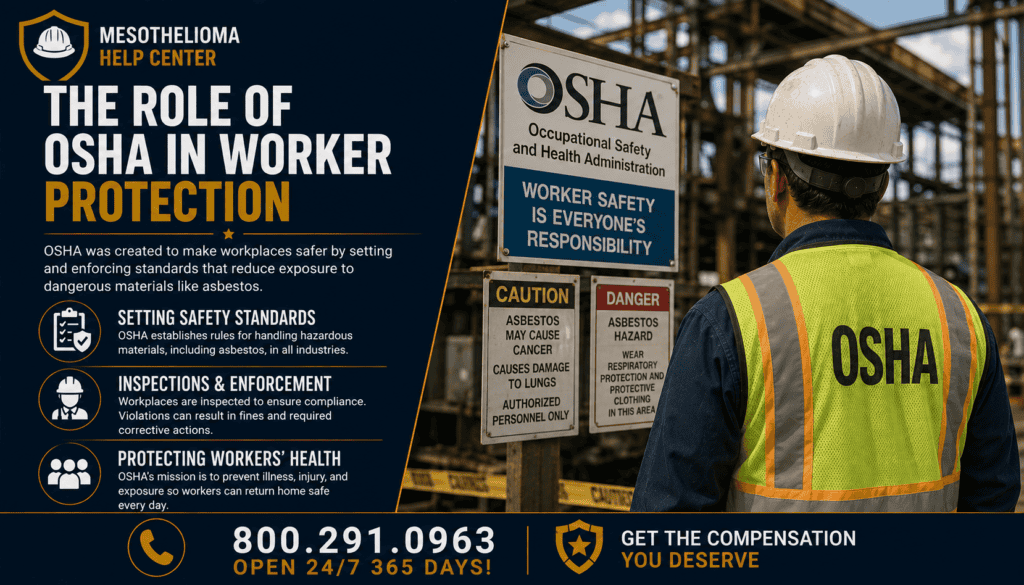
The Role of OSHA in Worker Protection
The Occupational Safety and Health Administration establishes and enforces federal workplace safety standards designed to reduce occupational asbestos exposure. OSHA maintains separate asbestos standards for general industry, construction and shipyard employment, with requirements addressing exposure limits, monitoring, regulated areas, engineering controls, work practices, respiratory protection, training, medical surveillance and recordkeeping.
OSHA protections do not establish that a particular worker was exposed to asbestos or that an illness was caused by a workplace. Exposure must still be evaluated using the worker’s job, materials, tasks, location, time period and available records. State-plan coverage and other jurisdictional rules can also affect which agency administers workplace protections.
OSHA’s Role in Asbestos Worker Protection
OSHA’s asbestos rules are designed to limit worker exposure to airborne asbestos and establish protective practices when asbestos work occurs. The federal standards address different industries because asbestos exposure can occur in settings ranging from factories and commercial buildings to construction projects and shipyards.
OSHA’s general-industry asbestos standard covers occupational asbestos exposure except construction and shipyard work governed by their own standards. OSHA specifically identifies possible exposure in asbestos-product manufacturing, automotive brake and clutch repair, industrial housekeeping and housekeeping in public or commercial buildings containing installed asbestos materials.
Construction rules cover demolition, removal, alteration, repair, maintenance and renovation involving asbestos. Shipyard rules similarly address asbestos work involving vessels and shipyard structures, including repair, maintenance, cleanup, transportation, storage and housekeeping.
Related resources include worker safety, documentation and occupational resources, hidden occupational asbestos risks and asbestos exposure in high-risk jobs.
Asbestos Exposure Limits and Monitoring
OSHA’s current construction asbestos standard requires employers to ensure that employee exposure does not exceed 0.1 fiber per cubic centimeter of air as an eight-hour time-weighted average. It also establishes an excursion limit of 1.0 fiber per cubic centimeter averaged over 30 minutes.
Exposure monitoring helps determine airborne concentrations and whether additional protective requirements apply. The specific monitoring obligations depend on the asbestos standard, work classification and exposure circumstances.
Exposure Monitoring Can Help Document
- The operation or task being monitored
- The date and duration of sampling
- Sampling and analytical methods
- Airborne asbestos concentrations
- Employees represented by the measurements
- Respiratory protection in use
- Changes in workplace conditions
OSHA’s general-industry asbestos standard requires accurate exposure-measurement records when monitoring is performed under the rule. These records can later be useful when reconstructing historical workplace conditions.
An exposure limit should not be interpreted as a line below which asbestos becomes harmless. OSHA’s standards establish enforceable occupational limits and required controls; individual health risk depends on exposure circumstances and other factors.
Regulated Areas and Engineering Controls
Regulated areas are used to restrict access and reduce the number of workers who may be exposed during covered asbestos operations. OSHA’s construction standard requires regulated areas for asbestos work and requires demarcation that minimizes the number of people within the area and protects people outside it.
OSHA requires engineering controls and work practices to reduce asbestos exposure. Depending on the operation, controls can include local exhaust ventilation with HEPA filtration, enclosure or isolation, wet methods, glove bags and other methods specified by the applicable standard.
Important Protective Measures
- Establishing and clearly demarcating regulated areas
- Limiting access to authorized personnel
- Using required engineering controls
- Applying wet methods where required
- Using appropriate respiratory protection
- Providing protective clothing when required
- Using required hygiene and decontamination procedures
- Preventing uncontrolled migration of asbestos fibers
OSHA prohibits practices such as dry sweeping, shoveling or other dry cleanup of dust and debris containing ACM or presumed ACM in covered construction asbestos work. Employee rotation cannot be used simply as a method of reducing asbestos exposure.
For Class I asbestos construction work, a competent person has specific supervisory duties involving regulated areas, containment, exposure monitoring, protective equipment, hygiene facilities, decontamination and engineering controls.
Training, Warning Signs and Hazard Communication
Worker protection depends on employees knowing where asbestos may be present, which tasks can release fibers and what controls are required. OSHA asbestos standards therefore contain training, communication, sign and labeling requirements.
Under the construction standard, training requirements vary according to the class of asbestos work and employee exposure. OSHA’s guidance states that competent-person training for Class I and II work includes asbestos identification, removal and handling, the requirements of the standard and practices for reducing hazards.
Training Can Address
- Health effects associated with asbestos exposure
- Locations and uses of asbestos-containing materials
- Work activities that may disturb asbestos
- Engineering controls and safe work practices
- Respiratory and protective-equipment requirements
- Hygiene and decontamination procedures
- Warning signs and regulated areas
- Emergency and cleanup procedures
Training does not replace exposure controls. Employers must comply with the applicable engineering, work-practice, respiratory-protection and other requirements of the asbestos standard.
Need help now? Call 800.291.0963
Live chat available 24/7, 365 days a year.
Submit Your Case
Medical Surveillance and Exposure Records
OSHA asbestos standards require medical surveillance for certain covered employees. Coverage differs by industry and exposure circumstances. Under the general-industry asbestos standard, employers must institute medical surveillance for employees who are or will be exposed at or above the applicable time-weighted-average or excursion limit.
Under the construction standard, medical surveillance applies to employees meeting specified work-duration or exposure criteria, including certain employees engaged in Class I, II and III asbestos work or exposed at or above a permissible exposure limit.
Records That May Be Created Under OSHA Requirements
- Exposure-monitoring measurements
- Medical-surveillance records
- Respirator-related documentation
- Employee training records
- Records concerning presumed asbestos-containing materials
- Work classifications and regulated-area information
These records can become important decades later when a worker is trying to identify where and when exposure may have occurred. The related occupational exposure identification resource explains how employment, exposure and jobsite records can be organized into a work history.
The preventive health screenings for at-risk workers resource explains medical surveillance and screening limitations. Medical concerns should be discussed with a qualified healthcare professional.
Construction, General Industry and Shipyard Standards
OSHA does not regulate every occupational asbestos activity through one identical rule. Three major federal standards address different categories of work.
General Industry — 29 CFR 1910.1001
The general-industry standard covers occupational asbestos exposure in industries under the Occupational Safety and Health Act except construction and shipyard work governed by their separate standards. Examples include manufacturing, automotive brake and clutch repair and certain housekeeping activities.
Construction — 29 CFR 1926.1101
The construction standard covers demolition, removal, alteration, repair, maintenance, renovation and other construction work involving asbestos. OSHA divides asbestos construction work into Classes I through IV, with protective requirements tied to the type of work.
Shipyards — 29 CFR 1915.1001
The shipyard standard covers asbestos work involving ship repair, shipbuilding and shipbreaking, including demolition or salvage, removal, repair, maintenance, renovation, spill cleanup, transportation, storage and housekeeping involving asbestos at covered locations.
Workers should evaluate the standard applicable to the actual work rather than assuming requirements from one industry apply unchanged to another.
Related occupational pages include construction workers asbestos exposure, factory workers asbestos exposure and shipyard workers asbestos exposure.
Worker Rights, Complaints and Documentation
OSHA states that workers or their representatives have the right to file a confidential safety and health complaint and request an OSHA inspection when they believe a serious workplace hazard exists or an employer is not following OSHA standards. Complaints may be submitted in any language, and OSHA provides an option to file anonymously.
Separate whistleblower protections can apply when a worker reports retaliation or threats after raising safety or health concerns. Filing deadlines can be short and vary depending on the law involved.
Documentation Workers May Want to Preserve
- Employer, facility and jobsite information
- Dates, job titles and work assignments
- Exposure-monitoring results
- Training and asbestos-awareness records
- Photographs and work orders
- Asbestos surveys and abatement records
- Medical-surveillance documentation
- Coworker and supervisor information
OSHA enforcement or a workplace citation does not automatically establish an individual asbestos disease claim. Likewise, the absence of a known citation does not prove that exposure did not occur. Occupational exposure, medical causation and legal liability require their own evidence.
Related Worker Safety Resources
Documentation: Worker Safety, Documentation & Occupational Resources
Exposure reconstruction: Occupational Exposure: Identifying Where & When You Were Exposed
Hidden exposure: Asbestos Exposure at Work: Hidden Occupational Risks
Authoritative Sources
This page relies on OSHA’s primary federal asbestos standards and worker-protection guidance. The standards establish industry-specific requirements for asbestos exposure limits, regulated areas, controls, training, medical surveillance and records.
OSHA Asbestos Worker Protection FAQ
What does OSHA do to protect workers from asbestos?
OSHA establishes and enforces asbestos standards addressing exposure limits, monitoring, regulated areas, engineering controls, work practices, respiratory protection, training, medical surveillance and recordkeeping.
Does OSHA have one asbestos standard for every workplace?
No. OSHA maintains separate asbestos standards for general industry, construction and shipyard employment.
What is OSHA’s asbestos permissible exposure limit?
OSHA’s asbestos standards establish an eight-hour time-weighted-average limit of 0.1 fiber per cubic centimeter of air and an excursion limit of 1.0 fiber per cubic centimeter averaged over 30 minutes.
What is a regulated asbestos area?
It is a demarcated work area established under applicable OSHA requirements to control access and help protect workers from airborne asbestos exposure.
Does OSHA require asbestos worker training?
Yes, in covered circumstances. Training requirements depend on the applicable standard, work classification and exposure conditions.
Does OSHA require medical surveillance for asbestos workers?
OSHA requires medical surveillance for certain covered employees who meet the exposure or work criteria in the applicable asbestos standard.
Can a worker file an OSHA complaint about an asbestos hazard?
Yes. OSHA states that workers or their representatives may file a confidential safety and health complaint and request an inspection when they believe a serious hazard exists or OSHA standards are not being followed.
Does an OSHA violation automatically prove an asbestos compensation claim?
No. OSHA findings can be relevant evidence, but exposure, medical causation, liability and claim eligibility must be established under the requirements applicable to the individual matter. Compensation is not guaranteed.
Get Help Reviewing Occupational Asbestos Exposure
Call 800.291.0963
Live chat is available 24/7, 365 days a year.
OSHA standards, monitoring records, citations or safety documentation do not automatically prove an individual’s asbestos exposure, disease causation, liability, claim eligibility or compensation. Each situation depends on the employer, jobsite, asbestos source, tasks, exposure evidence, medical evidence and applicable legal requirements. Compensation is not guaranteed.
⚕️ Legal & Medical Information Disclaimer
This page provides general educational information and is not medical or legal advice. The information does not establish asbestos exposure, diagnosis, causation, liability, claim eligibility or compensation. Medical concerns should be discussed with a qualified healthcare professional, and legal questions should be reviewed with a qualified attorney.