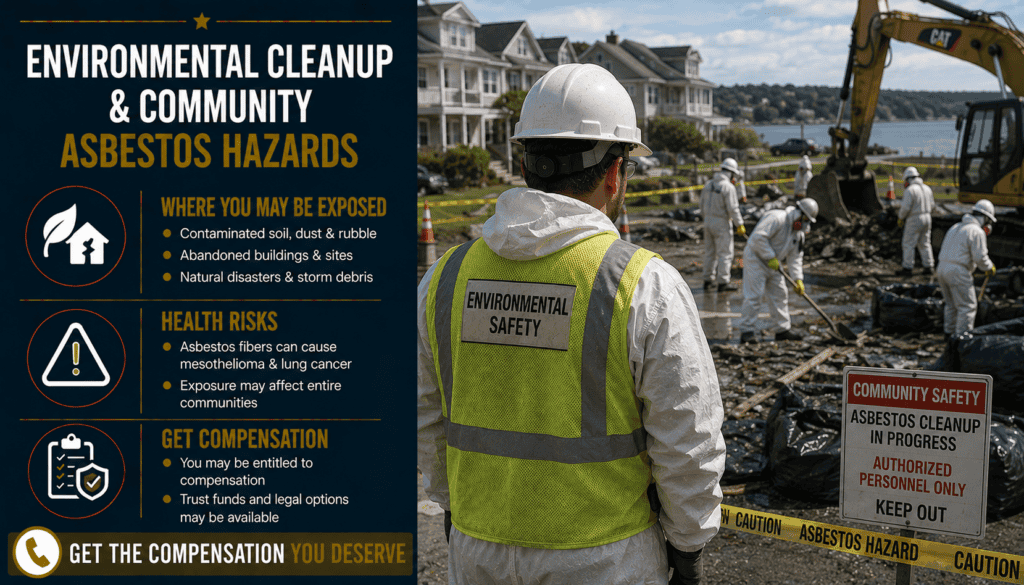
Environmental Cleanup & Community Asbestos Hazards
Contaminated Sites, Safe Cleanup Oversight, Community Records, and Exposure Evidence
Environmental asbestos concerns can arise around older industrial properties, demolition work, contaminated debris, and cleanup sites. A suspected hazard calls for careful investigation; living nearby does not automatically establish exposure or illness.
This article explains how agencies investigate possible contamination, manage cleanup and air monitoring, communicate with residents, and document historical conditions. It also outlines medical and legal evidence without promising a particular result.
Environmental Asbestos Contamination and Community Risks
Environmental asbestos concerns arise when fibers from asbestos-containing materials may enter places where people live, work, attend school, or recreate. Former factories, demolition projects, discarded insulation, and improperly managed construction waste can warrant investigation. A suspicious site does not establish that asbestos is present, that fibers became airborne, or that a particular resident inhaled them. Each question requires its own evidence.
Community exposure differs from work directly removing asbestos. A resident might report dust crossing a property line, debris near a sidewalk, or recurring truck traffic from a cleanup operation. Investigators should identify the source material, its condition, how it was handled, the route of possible migration, and the dates people could have encountered it. Wind direction, access barriers, and work practices may matter, but observations alone cannot determine fiber concentration.
Asbestos-containing material that remains intact and undisturbed does not present the same circumstances as material being cut, crushed, swept, or demolished. Public health decisions therefore depend on site-specific conditions and professional assessments. Residents should avoid touching suspect debris, keep children away from visibly disturbed material, and seek guidance from the appropriate local environmental or public health agency rather than collecting samples themselves.
Begin with the broader context of asbestos exposure in homes and residential and community asbestos exposure. These topics help separate an indoor household source from an environmental release associated with a neighboring property.
Related background: building asbestos exposure can help distinguish this site-specific issue from other potential sources.
Industrial Sites, Demolition Areas, and Contaminated Soil
Industrial facilities sometimes used asbestos insulation on piping, boilers, ovens, and process equipment. Demolition or renovation of older structures can create questions about insulation, flooring, roofing, siding, and other products. Whether a particular property contains asbestos depends on its actual materials and history, not merely its construction date or former industrial use.
Soil may contain fragments of asbestos-containing construction debris after dumping, building removal, or historical fill placement. A report identifying asbestos in soil must be read alongside the sample location, analytical method, depth, and distribution. A single positive sample cannot establish that all surrounding yards are contaminated. Likewise, a limited negative sample cannot rule out contamination elsewhere on a large property.
Debris can also move through truck loading, uncovered waste handling, vehicle tracking, drainage, or unauthorized disposal. These are potential pathways to investigate rather than proof of neighborhood exposure. Historical aerial photographs, permits, waste manifests, property ownership files, and dated resident observations can help establish what activities actually occurred.
For property-specific questions, review testing for asbestos and choosing a qualified asbestos inspector. Do not excavate suspect soil, sweep debris, or carry questionable materials indoors to obtain a sample.
Related background: job-site asbestos exposure can help distinguish this site-specific issue from other potential sources.
Environmental Investigations and Asbestos Sampling
An environmental investigation generally begins with a clear question: what material might contain asbestos, where is it located, and what activity could release fibers? Qualified professionals may review site history, inspect accessible areas, identify likely source materials, and develop a sampling plan appropriate to the concern. A plan for bulk building material is not interchangeable with a plan for soil, settled dust, or outdoor air.
Laboratory reports should identify the sample medium, collection date, location, method, detection limits where applicable, and laboratory qualifications. Maps and chain-of-custody records can show whether the reported result corresponds to the area residents are concerned about. Ask investigators to explain what their data can establish and what remains uncertain. Sampling results without context are easy to overinterpret.
Air measurements reflect conditions at the monitored places and times. They may not reconstruct an unmonitored demolition event months earlier. Some analytical methods count fibers without identifying every fiber as asbestos; other methods provide more specific information. An environmental professional should explain the method selected and how the results relate to the site-specific investigation.
When public records are available, compare initial findings with follow-up sampling and any independent agency review. If the question concerns material inside a residence rather than a community site, qualified asbestos abatement professionals may be the appropriate starting point.
Related background: asbestos in machinery can help distinguish this site-specific issue from other potential sources.
Cleanup Planning, Containment, and Waste Disposal
A cleanup plan should describe the confirmed problem, the area to be addressed, the responsible parties, applicable oversight, and how the work will be controlled. Depending on the site, qualified contractors may use restricted access, containment, wet methods, carefully selected removal techniques, regulated packaging, and documented transport. The correct approach depends on the material and the governing federal, state, and local requirements.
Work sequencing matters. Before demolition or excavation, responsible professionals may need surveys, permits, notifications, worker protections, and plans for protecting adjacent properties. Community members can ask when activities are scheduled, whether work will occur during school hours, who is monitoring the perimeter, and how complaints will be handled. These are oversight questions, not instructions for residents to perform hazardous work.
Waste documentation may include load tickets, manifests, transport information, and records identifying an authorized disposal facility. Residents should not assume every truck contains asbestos waste, but documented waste movement can help establish whether suspect materials left a site. Photographs of vehicles and work areas can support a timeline without approaching active operations.
After work, agencies may require inspections, confirmation sampling, or other closeout documentation. A statement that cleanup is complete should be considered alongside the scope of work: it may address a defined parcel or material rather than every possible historical exposure. See community exposure legal remedies for why accurate cleanup records can also matter in later investigations.
Related background: high-risk occupational settings can help distinguish this site-specific issue from other potential sources.
Air Monitoring and Community Protection
Air monitoring is one tool for evaluating possible airborne fibers during selected site activities. A monitoring plan may specify upwind or background locations, downwind perimeter stations, sampling intervals, laboratory methods, and actions to take if a site-specific threshold is reached. The significance of a reported number depends on these design choices and on the applicable standard or project criteria.
Not every fiber detected in an air sample is asbestos, and not every monitoring method identifies fiber type with the same specificity. Residents should request an explanation of what was measured rather than comparing unrelated results. Monitoring is also a snapshot: conditions may change with weather, activity, equipment, and the location of the sampler.
Public protection can include barriers, traffic controls, work stoppages under defined conditions, dust suppression by trained crews, and communication with nearby schools or households. The existence of controls does not prove exposure occurred before they were installed, nor does it guarantee that every potential pathway has been eliminated. Agencies should explain both protective measures and their limitations.
If visible dust crosses a boundary, residents can record the time, location, wind conditions, and responsible agency contact without entering the work zone. Seek professional guidance rather than sweeping or vacuuming suspected asbestos debris with ordinary household equipment. For indoor concerns, review home exposure information where applicable.
Related background: equipment-related exposure can help distinguish this site-specific issue from other potential sources.
Public Notices, Environmental Records, and Reporting
Public notices may identify a proposed investigation, cleanup schedule, comment deadline, or community meeting. The agency overseeing a project may maintain site maps, inspection reports, sampling data, enforcement correspondence, permits, and final decisions. Federal, state, county, and municipal agencies can have different responsibilities, so the correct records office depends on the site.
Ask for the project name, address or parcel number, agency case identifier, responsible party, and document repository. EPA site records may be relevant for certain federally overseen locations; state environmental departments or local air districts may oversee other projects. A public meeting summary can be useful, but original reports and dated correspondence often provide more precise evidence.
Keep copies of notices and record the date received. Preserve photographs taken from lawful public locations, notes about unusual dust events, and names of officials contacted. Distinguish what you directly observed from what neighbors reported or what an agency confirmed. This separation helps investigators evaluate the timeline without treating rumors as findings.
For households concerned about nearby demolition, community exposure information and inspection guidance provide complementary context. Do not publish another resident’s private medical information when sharing community records.
Related background: shipyard asbestos exposure can help distinguish this site-specific issue from other potential sources.
Health Risks and Documenting Community Exposure
Asbestos exposure is associated with mesothelioma, lung cancer, asbestosis, and certain other diseases. Mesothelioma can develop decades after exposure, which makes historical reconstruction difficult. A diagnosis does not by itself identify which product, property, or company contributed to exposure. Clinical questions should be evaluated by qualified health professionals using medical history and appropriate diagnostic testing.
A useful personal timeline lists addresses and dates of residence, work and school locations, known renovation or demolition activity, unusual dust events, and any direct handling of suspect materials. Record whether each entry is based on memory, a photograph, a public report, or another source. Household, occupational, and community pathways should be kept separate so investigators can consider all plausible sources.
Medical records may include pathology reports, imaging, specialist assessments, and treatment history. These records establish health information, not necessarily the origin of a past exposure. A clinician may ask about employment, military service, home renovation, and environmental concerns. Individuals with symptoms or a diagnosis should seek medical advice rather than relying on an environmental report to interpret their health.
For families gathering evidence, residential exposure resources and community legal information may help organize questions. Avoid assuming that living near a contaminated parcel automatically caused a particular illness.
Related background: military asbestos exposure can help distinguish this site-specific issue from other potential sources.
Legal Claims, Responsible Parties, and Compensation
Potential legal options depend on the diagnosis, exposure history, applicable law, and evidence connecting an individual to a responsible source. A property owner, industrial operator, demolition contractor, waste handler, or product manufacturer may be relevant in a particular investigation, but responsibility cannot be assigned from proximity alone. Different legal theories and filing deadlines may apply.
Asbestos bankruptcy trusts generally address claims associated with specified companies and their qualifying products or operations. A trust does not necessarily compensate everyone living near an environmental cleanup site. Claim requirements may include medical proof, exposure details, work or residence history, and other documentation. An attorney can assess whether a trust, lawsuit, or other remedy fits the facts.
Preserve environmental records and medical documents separately, then build a dated chronology showing how they may connect. Identify what the reports actually say about asbestos, where samples were taken, and whether any documented release coincided with the person’s presence. Avoid naming a manufacturer or defendant solely because a product was common in the era.
Families can review legal remedies for community asbestos exposure, the broader home exposure overview, and abatement qualifications. A case review cannot guarantee eligibility, liability, or an award, and timely individualized advice matters because deadlines vary.
Related background: asbestos trust funds can help distinguish this site-specific issue from other potential sources.
Frequently Asked Questions
Does every abandoned industrial site contain asbestos?
No. Older industrial buildings sometimes used asbestos-containing materials, but a site’s age or past use does not establish contamination. Agency files, qualified inspection findings, and material-specific testing can help determine what is present. The extent of any problem also depends on where the material is and whether it has been disturbed.
Can asbestos in contaminated soil affect neighbors?
It is a potential concern when asbestos-containing debris is present and activities could release respirable fibers. The risk cannot be established from soil appearance alone. Investigators should assess the material, location, disturbance, possible migration, and exposure conditions. Residents should avoid digging or collecting suspected contaminated soil themselves.
Who should collect asbestos samples at a cleanup site?
Qualified professionals using an appropriate site-specific sampling plan should handle suspected asbestos materials. Different methods are needed for building products, soil, dust, and air. Contact the agency responsible for the site to learn who is authorized to investigate and how findings will be reported to the public.
Does a clean air sample prove there was no earlier exposure?
No. An air sample describes conditions at a particular place and time under the method used. It cannot automatically reconstruct an earlier demolition, spill, or dust event. Historical photographs, work logs, agency reports, and witness observations may be needed to evaluate past conditions.
Where can residents obtain cleanup reports?
Start with the responsible environmental agency and request the site name, case number, sampling reports, cleanup plan, permits, notices, and closeout documents. EPA, state environmental departments, and local agencies may each hold different records. Preserve dated copies and ask for explanations of technical findings.
Should residents remove suspected asbestos debris?
No. Do not sweep, excavate, bag, or transport material suspected of containing asbestos. Keep people away from disturbed debris where practical and contact the responsible local environmental or public health authority. Qualified professionals can determine whether investigation or controlled removal is appropriate.
Can community exposure be linked to mesothelioma?
Asbestos is an established cause of mesothelioma, but determining whether a particular community source contributed to an individual case requires medical and historical evidence. Residence dates, site records, potential exposure pathways, and other occupational or household exposures all matter. A diagnosis alone does not identify a responsible site.
Does documented contamination guarantee compensation?
No. A viable claim generally requires evidence of injury, legally relevant exposure, responsibility, and compliance with applicable deadlines. Bankruptcy trust criteria differ from lawsuit requirements. A qualified legal professional can assess an individual’s circumstances without assuming that every nearby resident has the same claim.
📞 Get the Mesothelioma Help & Compensation You Deserve — Contact Us Today!
Discuss your history, diagnosis, and possible next steps. Eligibility and outcomes are not guaranteed.
This information is not be considered as legal or medical advice. Mesothelioma Help Center is not a law firm or medical provider and does not determine legal or VA eligibility.