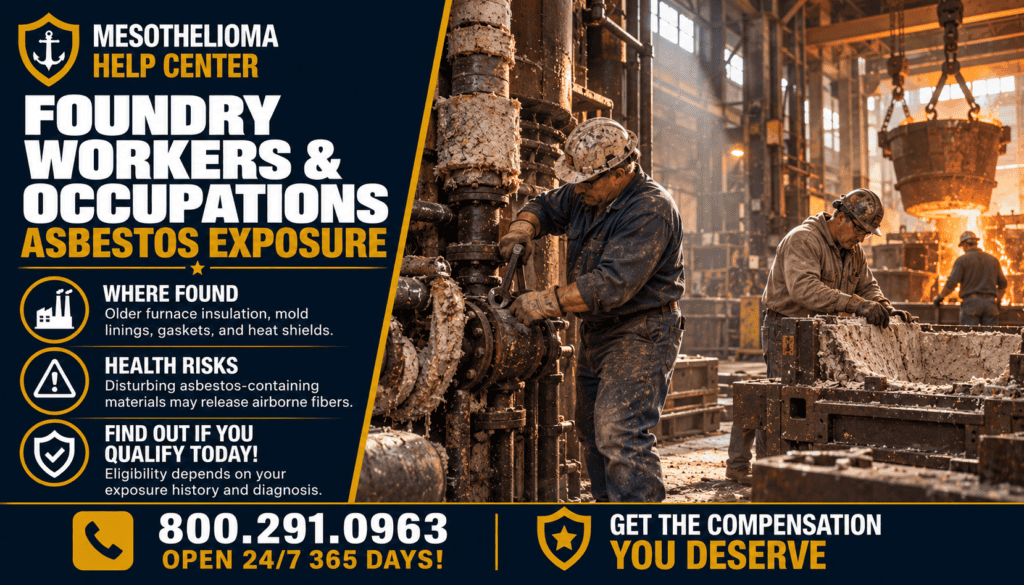
🏭 Foundry Workers & Occupations Asbestos Exposure
Foundry Workers & Occupations Asbestos Exposure addresses historical asbestos questions in metal casting and associated industrial work. Some older thermal and mechanical products contained asbestos. Product use varied by facility and time period.
This guide explains relevant tasks, materials and records without assuming every foundry had identical conditions. Individual work histories require site-specific evidence. Historical product identification should be supported by reliable records.
🔎 Foundry Occupations Overview
Foundries employed molders, coremakers, furnace crews, casting workers, maintenance trades and support staff. Their duties and potential material contact differed.
A job title alone does not establish asbestos exposure. Record the foundry, department, dates and particular activities.
🔥 Furnace and Melting Crews
Melting and furnace personnel operated high-temperature equipment and worked near heat-resistant assemblies.
Some historical insulation and related products contained asbestos. Identify the exact furnace, material and whether a worker handled or worked near its disturbance.
| Review Area | Potential Evidence |
|---|---|
| Work area and assignment | Personnel files, site plans and dates |
| Equipment and material | Specifications, invoices and repair records |
| Work activity | Job tickets and firsthand accounts |
⚙️ Molders and Coremakers
Molders and coremakers prepared casting forms and related production materials. Processes and formulations differed among foundries.
Do not assume molding sand or every heat-resistant item contained asbestos. Product specifications and dated purchasing records can clarify materials.
🧱 Casting and Finishing Workers
Casting, shakeout, grinding and finishing personnel worked in distinct production areas. Industrial dust could arise from many non-asbestos sources.
Describe the precise tasks and any concurrent insulation or equipment maintenance. Visible dust alone does not identify asbestos.
🛠️ Maintenance Mechanics and Millwrights
Maintenance crews serviced furnaces, conveyors, pumps, piping and mechanical systems. Some older gaskets, packing and thermal products used asbestos.
Repair tickets and parts lists may show what was removed or replaced. Distinguish direct servicing from ordinary operation.
🌡️ Electricians and Utility Personnel
Electricians, boiler personnel and utility mechanics worked in electrical rooms, powerhouse spaces and service corridors.
Specific historical insulation or fire-resistant materials require verification by product and period. Proximity and duration should be recorded accurately.
📁 Cleaners, Laborers and Nearby Trades
Support workers could enter areas after equipment repairs, refractory work or building renovations. Actual conditions varied by shift and assignment.
Document the activity, location, ventilation and cleanup. Do not personally disturb suspected asbestos to investigate.
⚖️ Work History and Health Considerations
Employment records, union files, photographs, job cards and coworker accounts can help reconstruct a dated occupational timeline.
Share exposure concerns with a qualified clinician. Legal questions require separate review of specific products and applicable law.
❓ Frequently Asked Questions
❔ Did every foundry use asbestos?
No. Products, equipment and periods varied by facility.
❔ Does a foundry job establish exposure?
No. Specific materials and tasks require review.
❔ Which records are useful?
Employment files, invoices, equipment manuals and repair logs.
❔ Were all furnace materials asbestos-containing?
No. Product composition varied.
❔ Is foundry dust always asbestos?
No. Foundry operations generate many kinds of dust.
❔ Can nearby maintenance matter?
Potentially, depending on verified materials and work conditions.
❔ Should I sample suspected asbestos?
No. Use qualified professionals and avoid disturbance.
❔ What should I tell a clinician?
Provide an accurate occupational history and any symptoms.
❔ Is compensation guaranteed?
No. Eligibility and outcomes depend on individual facts and law.
📝 Summary
Foundry asbestos questions require a specific material, task, location and time period. Preserve available records, avoid disturbing suspected asbestos and seek qualified medical or legal advice as appropriate.
📚 Confirmed General Sources
- EPA — Learn About Asbestos
- OSHA — Asbestos
- National Cancer Institute — Asbestos Exposure and Cancer Risk
📞 Review Your Foundry Work History
Call 800.291.0963 to request general information about possible resources. Mesothelioma Help Center is not a law firm or medical provider and does not determine eligibility.
Disclaimer: General information only—not legal or medical advice. Exposure, liability and deadlines vary by case and jurisdiction. Do not disturb suspected asbestos. Past results do not guarantee future outcomes.