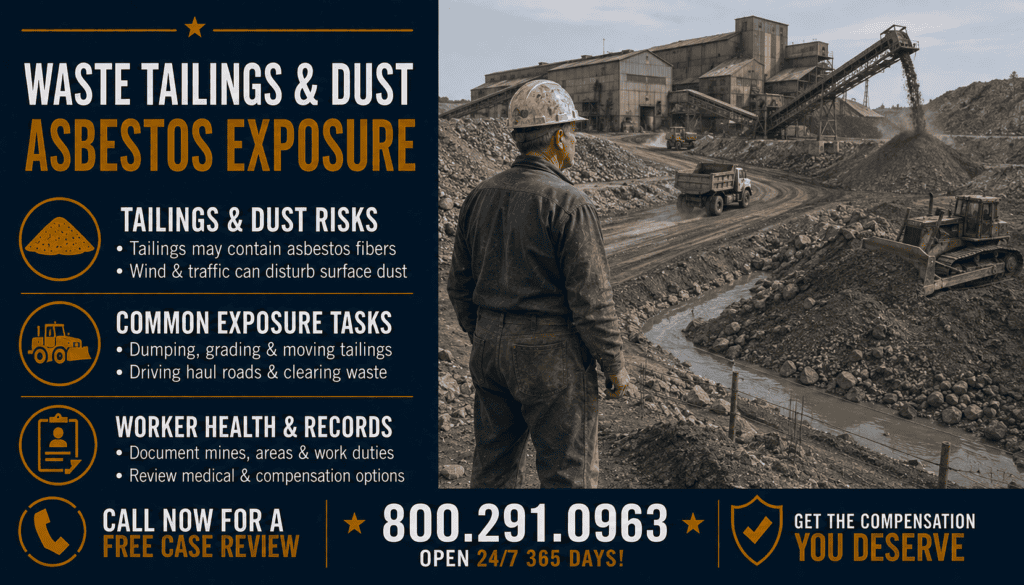
Waste Tailings Dust Asbestos Exposure
Waste piles and tailings can release respirable dust when dry material is moved, crushed by vehicles, or disturbed by wind. Asbestos exposure is a concern where the ore body or waste actually contained asbestos or asbestos-bearing minerals; not every tailings pile contains asbestos.
People diagnosed with mesothelioma or asbestos-related lung cancer deserve accurate information about mining waste, tailings and dust. Workers should identify the mine, ore type, waste disposal area, dust-generating task, and the period of employment. The facts of a specific worksite, medical history and applicable law determine what options may be available.
What This Claim Or Exposure Involves
Understanding The Specific Issue
Why The Details Matter
Mining Waste, Tailings And Dust depends on the particular worksite and facts. Workers should identify the mine, ore type, waste disposal area, dust-generating task, and the period of employment. Historical mine and mill conditions differed by location, mineral deposit, equipment and era. A careful account avoids treating every mining operation as identical.
Reclamation And Cleanup
Later cleanup or reclamation crews may encounter disturbed legacy material even after mining has stopped. Exposure assessment should distinguish contaminated waste from ordinary soil, and note whether sampling, containment or respiratory protection measures were used.
Worksites And Exposure Circumstances
Tailings Versus Processed Waste
Tailings are residues left after separating valuable material from mined ore. Their composition reflects the original geology and processing methods, so an asbestos concern must be established for the particular deposit. Historic mine maps, mineral analyses and environmental sampling can be more informative than the word “tailings” alone.
Dry Surfaces And Windblown Dust
Fine waste can become airborne during dry or windy conditions. Whether that dust contained asbestos depends on the source material. Workers who graded, hauled, dumped, reclaimed or monitored tailings may remember specific dust events, but visible dust alone cannot identify asbestos fibers.
Vehicle Traffic And Regrading
Trucks and earthmoving equipment may repeatedly disturb waste piles and haul roads. Records of traffic patterns, surface treatments and water-suppression systems help place an employee near the relevant activities. A documented asbestos-bearing deposit is important before drawing conclusions about fiber exposure.
The relevant settings include waste handling, tailings piles, haul roads, stockpiles, reclamation and cleanup. Related occupational histories may involve Asbestos Mining , Vermiculite Mining and Talc Mining ; each is a separate exposure question requiring its own supporting evidence.
Historical Conditions Can Change Over Time
The same facility may have changed mineral sources, machinery, suppliers and dust controls over its operating life. A statement about one decade should not be projected onto another without evidence. Mine inspection records, industrial hygiene sampling and contemporaneous equipment documents may clarify the relevant period.
Workers, Families And Records
Who May Have Relevant Information
Workers, supervisors, maintenance crews, contractors, laboratory personnel and family members may each hold a different part of the record. A firsthand witness can identify a location, a product label or a recurring task; that does not by itself prove the mineral content of airborne dust.
Employment And Coworker Records
A useful timeline lists employers, mine or mill locations, years worked, job titles, shifts, and major equipment or material changes. Payroll records and coworker accounts may fill gaps. Separate confirmed dates from approximate recollections.
For comparison with other jobsite histories, review Crushing And Milling , Bagging And Loading and Railroad Work . These links are context, not evidence that the same materials were used at a particular mine.
Mesothelioma And Medical Documentation
Mesothelioma Diagnosis And Latency
Mesothelioma can develop long after asbestos exposure. Pathology and specialist records are important for treatment and may also be relevant to a legal evaluation. Patients should follow their treating team’s guidance rather than infer diagnosis from exposure history.
Treatment Records And Occupational History
A clinician may ask about mining, milling, maintenance and other jobs across a lifetime. Record the work chronologically, including military or industrial jobs outside mining. The purpose is to give the medical team an accurate exposure history, not to determine a legal conclusion.
Patients may benefit from a specialist discussion of pathology, staging and treatment choices. Keep copies of test results and visit summaries because they may be needed for future medical opinions.
Asbestos-Related Lung Cancer
Lung Cancer And Asbestos Exposure
Asbestos exposure is an established cause of lung cancer. Smoking also raises lung cancer risk, and combined exposures can increase risk substantially. A clinician should evaluate the person’s full history; smoking does not automatically rule out occupational exposure.
Why Individual Medical Review Matters
Lung cancer has several possible causes and risk factors. A treating clinician can consider imaging, pathology, tobacco history and occupational exposure together. An asbestos-related diagnosis or attribution should not be made from a job title or a webpage alone.
If a former miner is receiving lung cancer treatment, a dated employment chronology can help the care team assess relevant workplace exposures and guide questions about occupational health.
Evidence And Work History
Mine And Mill Records
Not every dusty job involved asbestos. Mine geology, ore testing, equipment specifications and historical product records help distinguish asbestos-containing materials from other dusts. Where evidence is incomplete, the uncertainty should remain explicit.
Witnesses And Documentation
Witnesses may remember who operated crushers, maintained conveyors, cleaned work areas, handled bags or worked near insulation removal. Specific descriptions of location and tasks are more reliable than broad statements that an entire mine was hazardous.
Keeping The Evidence Organized
Keep copies of medical records, employment histories, photographs, correspondence, union records and any available environmental reports. Do not alter originals or coach witnesses. An organized record makes a professional review more efficient.
Additional worksite context is available in Railroad Repair Shops , Power Plant Pipefitters and Power Plant Welders . These are editorial connections; they are not substitutes for site-specific proof.
How To Handle Uncertain Details
Decades may have passed since the work occurred, and memory can be incomplete. Preserve the original recollection, then compare it with dated records rather than replacing it with a more confident account. Product labels, equipment manuals, mineral analyses and maintenance orders can be especially useful when available.
Legal Options And Filing Considerations
Legal Options And Eligibility
Potential lawsuits, workers’ compensation, bankruptcy trust claims and veterans benefits have different requirements. Availability depends on the facts and governing rules, and not every route applies to every person.
Claim Timing And Jurisdiction
State law may set different deadlines for a personal injury lawsuit and a wrongful death claim. The place of employment, residence, diagnosis and other facts can affect the analysis. Trust procedures are separate and should not be confused with court filing periods.
Avoiding Unsupported Compensation Estimates
Neither a disease diagnosis nor an industry label guarantees compensation. Any legal assessment should identify the evidence, relevant parties, available claims and potential defenses. Publicly reported awards do not establish a standard payout.
Related occupational and legal background includes Power Plant Supervisors , Auto Plant Maintenance Workers and Mesothelioma Lawsuit .
Different Claims May Follow Different Rules
A civil lawsuit, a bankruptcy trust submission and a benefit application are separate processes. Their evidentiary standards, forms and deadlines are not interchangeable. The fact that one route is unavailable does not automatically answer whether another may be considered.
Practical Next Steps
Organize A Work And Health Timeline
Workers should identify the mine, ore type, waste disposal area, dust-generating task, and the period of employment.
Write down what is known first: dates, employers, duties, materials, locations and witnesses. Mark uncertain dates as approximate. Keep a copy of any relevant records and a short list of questions for treating clinicians or qualified counsel.
Ask For Case-Specific Advice
Patients and families may be managing treatment, finances and legal questions simultaneously. Asking a trusted person to help organize documents can reduce the burden while preserving accurate details.
For adjacent work settings, see Auto Plant Machinists , Auto Plant Welders and Auto Plant Production Workers . These comparisons should never replace the facts of the individual worksite.
Dust Migration Beyond The Work Area
Material can move from a disposal area into nearby workspaces through wind, vehicles and clothing. Investigating a specific worker’s exposure requires site-specific facts rather than assuming everyone at a mine encountered the same mineral dust.
Frequently Asked Questions
Does Every Mine Or Mill Contain Asbestos?
No. The answer depends on the geology, installed products and specific tasks. Mineral dust is not automatically asbestos dust.
Does A Diagnosis Automatically Establish A Legal Claim?
No. A medical diagnosis is important, but legal eligibility depends on additional evidence, governing law and the parties involved.
Are Old Employment Records Still Useful?
Yes. Pay records, union files, employer histories and coworker accounts may help reconstruct the worksite and exposure period.
Can Family Members Seek Help After A Death?
Potentially. Wrongful death and estate claims depend on state law, authorized claimants, deadlines and supporting evidence.
Is There A Guaranteed Settlement Amount?
No. Outcomes depend on the evidence, law and parties, and many settlements are confidential.
Should A Person Wait Until Every Record Is Found?
No. Prompt medical and legal advice can be important, especially when filing deadlines may apply.
Summary
Waste Tailings Dust Asbestos Exposure requires attention to specific evidence rather than assumptions about an entire industry. Workers should identify the mine, ore type, waste disposal area, dust-generating task, and the period of employment. Qualified medical and legal professionals can assess the information in the context of the individual case.
Confirmed Sources
- National Cancer Institute — Asbestos Exposure And Cancer Risk
- OSHA — Asbestos
- EPA — Asbestos Information
- ATSDR — Asbestos
Find Out If You May Qualify For Asbestos Compensation Today
Call 800.291.0963 . Help is available 24/7/365. 25+ years of experience.
Mesothelioma Help Center is not a law firm or medical provider and does not determine legal or VA eligibility. This information is not individualized medical or legal advice.