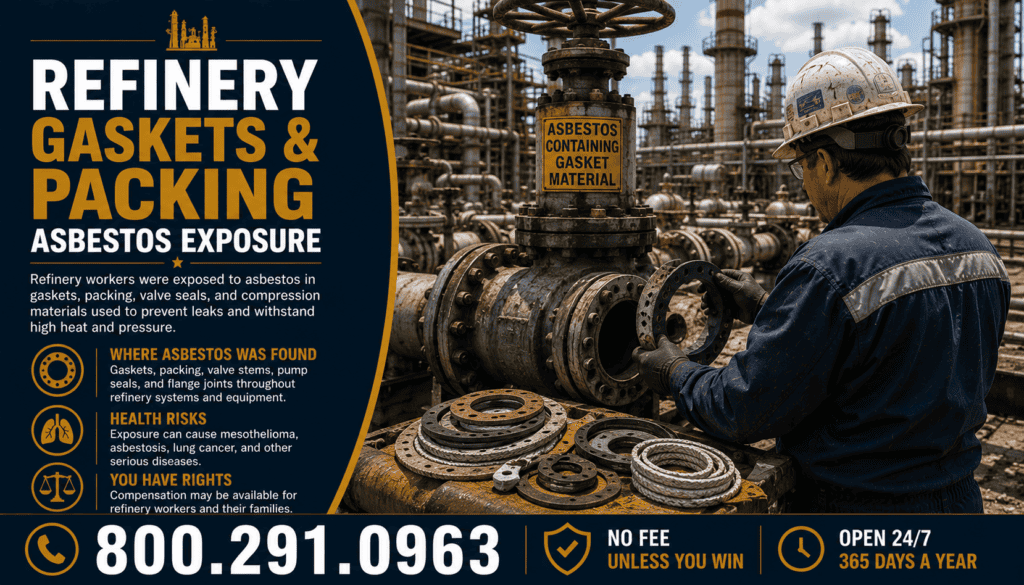
Refinery Gaskets & Packing Asbestos Exposure
Refinery Gaskets & Packing Asbestos Exposure concerns possible historical contact with specific asbestos-containing products during refinery work. The equipment, materials, duties and dates must be established for the individual facility; a refinery job title alone cannot prove asbestos exposure.
For a person diagnosed with mesothelioma or asbestos-related lung cancer, a detailed work history can help medical professionals and qualified counsel understand relevant conditions. List the equipment repaired, gasket or packing brand when known, work dates and methods used to remove old material. Preserve packaging photographs and purchase records.
Understanding This Exposure
Why Historical Equipment Details Matter
Refineries contain many systems operating at different temperatures and pressures. Materials used on one unit may differ from those installed elsewhere or replaced decades later. Worksite evidence should identify the unit, specific component, supplier if known, and date of the task.
What Exposure Evidence Can And Cannot Show
Visible dust is not a laboratory identification of asbestos. Product labels, contemporaneous specifications, industrial hygiene reports and credible firsthand accounts can clarify whether a relevant material contained asbestos and how it was handled. Avoid describing an entire facility as uniformly contaminated.
Equipment, Materials And Work Areas
Reviewing A Specific Repair Event
Consider one documented repair rather than an entire department. Some historic gasket sheet materials used asbestos fibers for resistance to heat and pressure. Maintenance personnel might cut replacement shapes from sheets, punch bolt holes or trim edges. Brand, grade and purchase dates matter because many other gasket compositions also existed. For the repair to be meaningful in an exposure chronology, identify the date, the equipment number, who was assigned, whether the system was opened, the material removed and how waste was handled. A job description alone usually does not establish these details. If a witness remembers a label or product package, preserve the wording exactly and avoid reconstructing an uncertain brand.
Material Changes Across The Operating Life
Long-running refineries may have rebuilt the same equipment more than once. Braided packing can seal shafts in pumps and other machinery. Certain older packing products contained asbestos. Pulling used rings, cleaning stuffing boxes and installing new packing could disturb material if it was asbestos-containing. Specifications and product formulations can change between repairs. A later replacement part is not proof that the same part was present twenty years earlier. Compare dated work orders, storeroom requisitions and manufacturers’ revisions. Where records conflict, identify the disagreement rather than selecting the most convenient version.
Understanding Dust Generation And Work Position
The possibility of inhalation depends on more than whether a material contained asbestos. Valve stem packing is adjusted or replaced during maintenance. Repair work may involve removing old rings with picks or hooks and cleaning residue. The valve service and parts specification are more reliable identifiers than the mere presence of a valve. Relevant observations include how a component was cut, scraped, removed or cleaned; how close a person stood; whether dust was visible; and whether local exhaust or containment was used. These details can inform an occupational history but do not substitute for industrial hygiene analysis or establish a precise fiber dose.
Questions For A Former Coworker
A former coworker may remember the crew leader, repair contractor, unit location, equipment tag, or the sequence of tasks. Ask open-ended questions and retain the answers in the witness’s own words. It is important to distinguish direct participation from seeing another crew work nearby. If the coworker cannot remember the product composition, that limitation should be documented. List the equipment repaired, gasket or packing brand when known, work dates and methods used to remove old material. Preserve packaging photographs and purchase records.
Sheet Gaskets And Cut-To-Fit Material
Some historic gasket sheet materials used asbestos fibers for resistance to heat and pressure. Maintenance personnel might cut replacement shapes from sheets, punch bolt holes or trim edges. Brand, grade and purchase dates matter because many other gasket compositions also existed.
To assess sheet gaskets and cut-to-fit material, a useful record identifies the unit number, work order, crew, repair method and any material removed. A witness should describe what was actually observed, including the duration and whether barriers or ventilation were used. When product composition is uncertain, that uncertainty should remain clear.
Compression Packing In Rotating Equipment
Braided packing can seal shafts in pumps and other machinery. Certain older packing products contained asbestos. Pulling used rings, cleaning stuffing boxes and installing new packing could disturb material if it was asbestos-containing.
To assess compression packing in rotating equipment, a useful record identifies the unit number, work order, crew, repair method and any material removed. A witness should describe what was actually observed, including the duration and whether barriers or ventilation were used. When product composition is uncertain, that uncertainty should remain clear.
Valve Stem Packing And Repairs
Valve stem packing is adjusted or replaced during maintenance. Repair work may involve removing old rings with picks or hooks and cleaning residue. The valve service and parts specification are more reliable identifiers than the mere presence of a valve.
To assess valve stem packing and repairs, a useful record identifies the unit number, work order, crew, repair method and any material removed. A witness should describe what was actually observed, including the duration and whether barriers or ventilation were used. When product composition is uncertain, that uncertainty should remain clear.
Flange Face Cleaning And Residue
When a flanged connection is opened, workers may scrape remnants of a gasket from the mating faces. The presence of dust during scraping does not prove asbestos; the material removed must be identified through records or other reliable evidence.
To assess flange face cleaning and residue, a useful record identifies the unit number, work order, crew, repair method and any material removed. A witness should describe what was actually observed, including the duration and whether barriers or ventilation were used. When product composition is uncertain, that uncertainty should remain clear.
Replacement Parts And Changing Formulations
Refineries operated across periods when gasket and packing formulations changed. A plant may have used asbestos-containing and non-asbestos parts in different units or years. Work orders and storeroom inventories can help narrow the relevant period.
To assess replacement parts and changing formulations, a useful record identifies the unit number, work order, crew, repair method and any material removed. A witness should describe what was actually observed, including the duration and whether barriers or ventilation were used. When product composition is uncertain, that uncertainty should remain clear.
Workers And Nearby Occupations
Maintenance Mechanics And Pipe Trades
Mechanical workers may open equipment, replace seals or remove nearby insulation during shutdowns. Their duties vary among contractors, shifts and units. A maintenance record is more useful than assuming that every mechanic performed the same asbestos-related task.
Operators And Inspection Personnel
Operators and inspectors may work around repairs without handling the material themselves. Proximity, frequency, airflow and the activity taking place matter. Coworker statements should identify the specific job and not simply repeat that a refinery was dusty.
Electricians And Instrument Technicians
Electrical and instrument crews may work near process equipment or on older electrical components. An electrician repairing a panel has a different exposure history from a control room operator monitoring gauges. Keep those distinctions clear.
Contractors And Turnaround Crews
For a refinery-specific overview, review the linked refinery resources and the duties of pipefitters working around insulated lines and process equipment. These sources provide industry context, not proof of exposure at a particular facility. Related pages: Oil Refineries Asbestos Exposure ; Oil Refinery And Chemical Plant Exposure Risks ; Refinery Pipefitters Asbestos Exposure .
Mesothelioma And Medical Evidence
Mesothelioma And Long Latency
Mesothelioma is a cancer associated with asbestos exposure and may be diagnosed many years after the relevant work. A clinician must interpret imaging, pathology and other findings; a website cannot determine a diagnosis or attribute an individual case to a particular product.
Medical Records To Preserve
Patients may wish to retain pathology reports, treatment summaries, imaging results, consultation notes and a dated occupational history. Keeping the original reports intact makes it easier for treating clinicians and other professionals to review the evidence.
Describing The Work To A Clinician
List employers, refinery locations, years, units, trades, shutdowns and specific material-handling tasks. Include other jobs and possible exposures outside refining. An accurate history is more useful than a confident but unsupported reconstruction.
Asbestos-Related Lung Cancer
Asbestos And Lung Cancer Risk
Asbestos exposure can cause lung cancer. Smoking is another important risk factor, and combined exposures can increase risk. A history of smoking does not automatically eliminate the possibility of an occupational contribution; clinicians assess individual medical and exposure information.
Medical Evaluation Is Individual
Lung cancer can have multiple causes. Diagnostic imaging, biopsy results and medical judgment are required to assess disease. A job title or a remembered dust event is not a substitute for medical evaluation.
How Work History May Help
A dated description of tasks and products may help the care team understand occupational hazards. Workers can note whether they handled materials directly, worked nearby or were present during renovations, without claiming knowledge they do not have.
Records And Exposure Evidence
Equipment Manuals And Parts Lists
Equipment model numbers, historical maintenance instructions, bills of material and purchasing files may help identify what was installed during the relevant years. A modern specification should not be assumed to describe an earlier configuration.
Shutdown And Work Order Records
Industrial and chemical-processing comparisons can help distinguish thermal insulation, mechanical sealing materials and maintenance work. The materials present depended on the refinery, equipment, supplier and service period. Related pages: Mining, Oil, Gas And Refinery Workers ; Chemical Processing Units In Chemical Plants ; Valve Products Asbestos Exposure .
Witness Statements And Uncertainty
Coworkers may recall brands, packaging, dust-generating tasks and who was present. Ask witnesses to distinguish direct observation from later assumptions. An uncertain date should be marked approximate rather than silently changed.
Preserve Original Documents
Save photographs, payroll records, union files, safety reports and medical documents without altering the originals. Keep a simple index showing where each item came from. Evidence quality matters more than volume.
Legal Options And Compensation
Personal Injury And Wrongful Death Claims
Potential legal options depend on diagnosis, exposure evidence, responsible parties and applicable state law. Families may have different rights after a death than a living patient has in a personal injury claim. No single rule applies to every refinery or state.
Bankruptcy Trust Claims
Some asbestos bankruptcy trusts have their own medical and exposure criteria. Working in a refinery does not establish eligibility for a specific trust. Trust filings and lawsuits may interact, so coordinated professional review can matter.
Statutes Of Limitations
Filing periods depend on jurisdiction, claim type and facts such as diagnosis or death. A long time since employment does not provide a reliable answer about a deadline. Seek prompt case-specific advice rather than relying on a nationwide estimate.
Settlements And Verdicts
There is no standard refinery asbestos settlement. Case outcomes depend on evidence, defendants, law and other circumstances; many settlements are confidential and public verdicts may be appealed or modified. Never assume another case predicts an individual recovery.
Product-level records may help identify asbestos-containing gaskets, packing, pump components and valve seals. A metal pump or valve does not automatically contain asbestos; the specific replacement material matters. Related pages: Pump Products Asbestos Exposure ; Boiler Products Asbestos Exposure ; Power Plant Pumps And Valves .
Comparable utility systems can clarify how pumps, valves, insulated piping and boilers were serviced. These examples are relevant to mechanical systems, but each refinery requires its own evidence. Related pages: Power Plant Piping And Insulation .
Practical Next Steps
Create A Worksite Timeline
List the equipment repaired, gasket or packing brand when known, work dates and methods used to remove old material. Preserve packaging photographs and purchase records.
Record dates, departments, unit numbers, supervisors, equipment types, specific products and any firsthand witnesses. If a period is uncertain, mark it as approximate. Include the dates of medical evaluation and diagnosis separately from dates of employment.
Prepare Questions For Medical And Legal Professionals
Ask a treating clinician which medical documents best describe the diagnosis. A qualified asbestos attorney can discuss possible claim types, deadlines and whether the available records connect an identified defendant or trust to the work history.
Distinguish This Exposure From Other Industries
Other industrial workers and supervisors may have been near maintenance activities, insulation removal and equipment overhauls. Their experience cannot establish the conditions at a particular refinery without supporting records. Related pages: Power Plant Insulators ; Power Plant Equipment And Systems ; Power Plant Supervisors ; Municipal And Industrial Power Plants ; Asbestos Exposure On Job Sites .
Do Not Wait For Perfect Records
Old records can take time to locate. Prompt professional advice can be important while witnesses and documents are still available and filing deadlines remain open. A preliminary timeline can be useful even when some details are unresolved.
Frequently Asked Questions
Does Every Refinery Component Contain Asbestos?
No. Product composition varied by equipment, location, supplier and era. Specific identification is needed.
Does Dust During Maintenance Prove Asbestos Exposure?
No. Dust alone does not establish asbestos content; records or reliable product evidence are important.
Can Nearby Workers Have Relevant Exposure Histories?
Possibly, depending on the task, distance, duration, barriers and materials involved.
What If The Manufacturer Is Unknown?
Work orders, labels, old manuals and coworker accounts may help identify the material. Do not guess.
Does A Mesothelioma Diagnosis Guarantee Compensation?
No. Legal eligibility and recovery depend on exposure evidence, parties and applicable law.
Can Families Explore Claims After A Death?
Potentially, subject to state-specific rules about claimants, evidence and deadlines.
Should A Worker Wait To Find Every Record?
No. Timely medical and legal guidance may be useful even while records are being collected.
Summary
A reliable assessment of refinery gaskets & packing asbestos exposure depends on the particular equipment, product composition, task, work period and medical history. Accurate records can support professional medical and legal evaluation without assuming that all refinery materials contained asbestos.
Confirmed Sources
Find Out If You May Qualify For Asbestos Compensation Today
Call 800.291.0963 . Help is available 24/7/365. 25+ years of experience.
Mesothelioma Help Center is not a law firm or medical provider and does not determine legal or VA eligibility. This information is not individualized medical or legal advice.