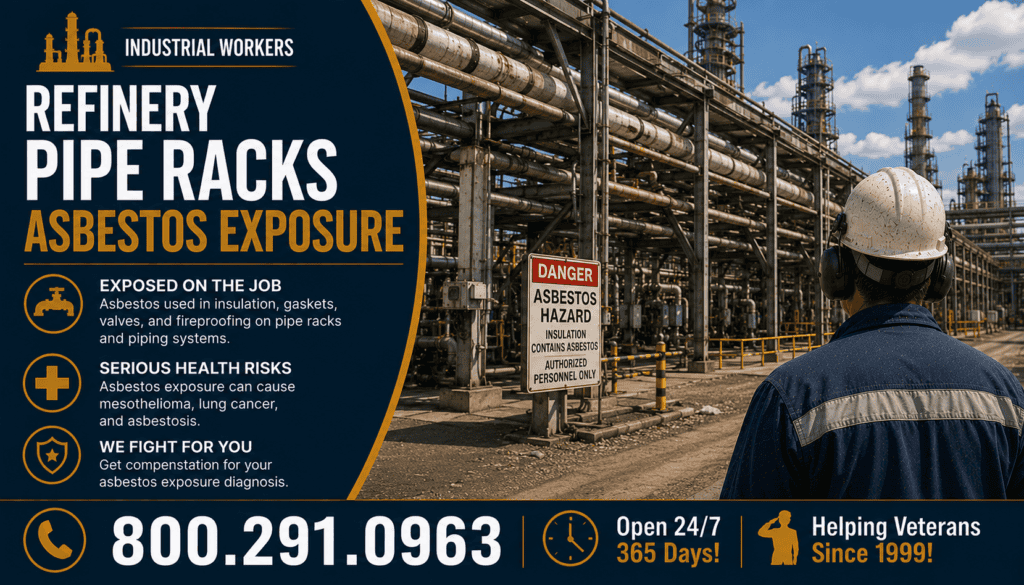
Refinery Pipe Racks Asbestos Exposure
Pipe racks carry multiple process and utility lines between refinery units. Historically, some piping and associated components used asbestos-containing insulation, gaskets, or packing; a particular rack or line cannot be assumed to have contained asbestos without supporting evidence.
Workers and families dealing with mesothelioma or asbestos-related lung cancer may need help understanding pipe racks in oil refineries. The specific equipment, materials, employer, location and period of work matter. Neither a diagnosis nor a job title proves that a particular asbestos-containing product was present.
Understanding This Exposure Or Claim
What Matters Most
Avoiding Assumptions
Asbestos-containing insulation, sealing products, and other materials were not used uniformly across every facility or decade. A responsible assessment identifies the material, the work performed, and whether disturbance could have released fibers. The evidence should be described accurately even when records are incomplete.
Work Areas And Historical Materials
How Pipe Racks Were Used
Overhead and elevated racks routed steam, fuel, process fluids, and other services. The mix of hot and ambient-temperature lines changed from site to site. A worker’s location and duties are essential to identifying which pipes or equipment were nearby.
Insulation On Hot Service Lines
Some older thermal insulation systems used asbestos-containing materials. Pipe insulation could be cut, removed, or damaged during maintenance, modifications, and line replacement. The material specification, year, and maintenance history should be verified rather than inferred from the presence of insulation.
Gaskets And Valve Work
Flanged connections and valves on pipe racks may have required periodic maintenance. Certain historical gaskets and packing materials contained asbestos, but others did not. Parts lists, purchase records, and witness recollections can help identify the actual material.
Scaffolding And Nearby Trades
Insulators, pipefitters, welders, electricians, and scaffold crews may have worked near the same rack at different times. Proximity to disturbed material matters more than a broad job title. Coworker descriptions should specify what was being removed or installed.
Turnaround And Retrofit Work
Scheduled shutdowns can concentrate multiple crews around lines being opened, inspected, and replaced. A dated turnaround schedule or permit may help connect a worker to a specific unit and activity. It does not, by itself, establish that asbestos was present.
The worksite setting can be compared with other historical industries without assuming identical exposure conditions. Related site topics include Asbestos Mining , Vermiculite Mining and Talc Mining .
Workers And Families
Employees And Contractors
Different trades performed different tasks. Operations employees, mechanics, insulators, pipefitters, electricians, inspectors, laborers, and outside contractors should not be grouped as though they had the same exposure. An accurate history records where each person worked, what was being repaired or removed, and which materials were handled.
Family Members And Witnesses
A family may know the employer and years of service but not the specific equipment. Coworkers may remember a maintenance job or product packaging. Those accounts should be preserved in the witnesses’ own words. A person should never be asked to guess about an asbestos product that they did not identify firsthand.
Changes In Work Practices
Historical material specifications and safety practices changed over time. A plant or mine could have used different suppliers and methods in different decades. A document from one period should not automatically be applied to another without confirming the dates.
Related occupational contexts are useful for comparing duties, but not for substituting for site-specific facts. Related site topics include Crushing And Milling , Bagging And Loading and Railroad Work .
Mesothelioma And Medical Evidence
Mesothelioma Diagnosis And Latency
Mesothelioma can develop decades after asbestos exposure. A pathology-confirmed diagnosis and specialist records are important for treatment and may be relevant to legal review. Patients should share a complete work history with their treating clinicians, including employment outside the facility under discussion.
Treatment And Documentation
Medical records may include pathology, imaging, oncology notes, and records of treatment decisions. A patient can ask the treating team whether an occupational exposure history is relevant to the diagnosis and what documentation should be retained. Legal decisions should not replace timely clinical care.
Describing Past Exposure To A Clinician
A useful description identifies the workplace, time period, job tasks, dust-generating activities, and known products, while acknowledging uncertain details. Work at other industrial facilities or during military service should also be mentioned where relevant.
Asbestos-Related Lung Cancer
Asbestos And Lung Cancer
Asbestos is an established cause of lung cancer. Smoking is also a major risk factor, and combined exposure can increase risk. A clinician must evaluate the individual medical and occupational history; a job title alone cannot diagnose asbestos-related disease.
Individual Medical Assessment
A lung cancer diagnosis has to be assessed in its full clinical context. Imaging and pathology help clinicians identify disease, while occupational histories may help evaluate potential contributing exposures. An internet article cannot determine whether a particular person’s cancer was caused by asbestos.
Why Timing Matters
Asbestos-related diseases may emerge long after the period of employment. The absence of recent exposure does not automatically rule out an older occupational history. Patients should not delay medical evaluation while attempting to locate decades-old employment records.
Documents And Exposure Evidence
Records Worth Preserving
Work histories can be reconstructed using payroll and union records, Social Security earnings information, contractor rosters, equipment specifications, dated photographs, and coworker accounts. Keep original documents and distinguish confirmed dates from estimates.
Differentiating Routine Operation From Disturbance
A pipe rack in normal operation is not equivalent to insulation removal. Potential fiber release is particularly relevant when asbestos-containing material was disturbed. Exposure assessment should distinguish intact material from damaged or actively removed insulation.
Documents To Look For
Useful evidence may include isometric drawings, line lists, insulation specifications, maintenance work orders, contractor records, job hazard analyses, and photographs identifying the rack or unit.
How To Check A Product Identification
Equipment drawings, manufacturer literature, purchase orders, insulation schedules, and contemporaneous work orders may clarify whether a material contained asbestos. A photograph of an insulated pipe or a gasket does not establish its mineral content without corroboration.
Other asbestos-exposure articles provide background on maintenance and industrial settings. Related site topics include Railroad Repair Shops , Power Plant Pipefitters and Power Plant Welders .
Legal Options And Compensation
Lawsuits And Trust Fund Claims
A civil lawsuit, bankruptcy trust claim, workers’ compensation application, and veterans benefit claim can have different eligibility rules. Some may not apply to a particular worker. Legal responsibility and trust eligibility depend on the facts, the identified companies, and governing rules rather than a generalized industry description.
Filing Deadlines
Personal injury and wrongful death deadlines differ by state and type of action. Where the person worked, lived, or was diagnosed may be relevant to the analysis. A bankruptcy trust may have separate procedures. Anyone considering a claim should obtain timely, jurisdiction-specific advice.
Settlements And Verdicts
Published verdicts and settlements cannot establish an expected payout for a new case. Many settlements are confidential, and verdicts may be altered after trial. No specific recovery is guaranteed, and no dollar figure should be inferred from a diagnosis or job title.
Additional context about claims and occupations is available through these related site pages. Related site topics include Power Plant Supervisors , Auto Plant Maintenance Workers and Auto Plant Production Workers .
Practical Next Steps
Build A Dated Timeline
List employers, sites, departments, job duties, supervisors, coworkers, and approximate dates. Add the dates of diagnosis and any prior legal claims. Mark uncertainties clearly rather than filling them with assumed facts. Keep digital and paper copies of records in a secure location.
Ask Focused Questions
Ask medical professionals about the diagnosis, treatment choices, and whether an occupational history is clinically relevant. A qualified asbestos attorney can review potential defendants, trust criteria, filing deadlines, and whether the available evidence supports a claim.
Protect Original Records
Preserve original medical records, work papers, and photographs without editing them. Keep a simple index explaining where each item came from and who supplied it. This helps prevent confusion when several people contribute information about events decades in the past.
These additional pages may help identify adjacent job types or equipment histories. Related site topics include Mesothelioma Lawsuit , Auto Plant Machinists and Auto Plant Welders .
Frequently Asked Questions
Does This Job Title Prove Asbestos Exposure?
No. The particular product, material, work activity, and dates must be assessed.
Can A Family Seek Help After A Death?
Potentially. State law governs who may file, what damages may be available, and applicable deadlines.
What If Records Are Missing?
Coworker accounts, union records, historical equipment files, and earnings records may help reconstruct a work history.
Is There A Standard Compensation Amount?
No. Every claim depends on evidence, parties, law, and the resolution process.
Can A Medical Diagnosis Establish Legal Liability?
Not by itself. Legal responsibility requires separate proof under the applicable law.
Should A Worker Wait To Gather Every Document?
No. Medical care and timely legal advice should not be postponed while searching for older records.
Summary
Refinery Pipe Racks Asbestos Exposure is best evaluated through specific evidence about the facility, work, materials, and medical diagnosis. Overhead and elevated racks routed steam, fuel, process fluids, and other services. The mix of hot and ambient-temperature lines changed from site to site. A worker’s location and duties are essential to identifying which pipes or equipment were nearby. People facing a serious illness deserve careful information and advice tailored to their circumstances.
Confirmed Sources
- OSHA — Asbestos
- EPA — Asbestos
- National Cancer Institute — Asbestos Exposure And Cancer Risk
- OSHA — Petroleum Refinery Technical Manual
Find Out If You May Qualify For Asbestos Compensation Today
Call 800.291.0963 . Help is available 24/7/365. 25+ years of experience.
Mesothelioma Help Center is not a law firm or medical provider and does not determine legal or VA eligibility. This information is not individualized medical or legal advice.