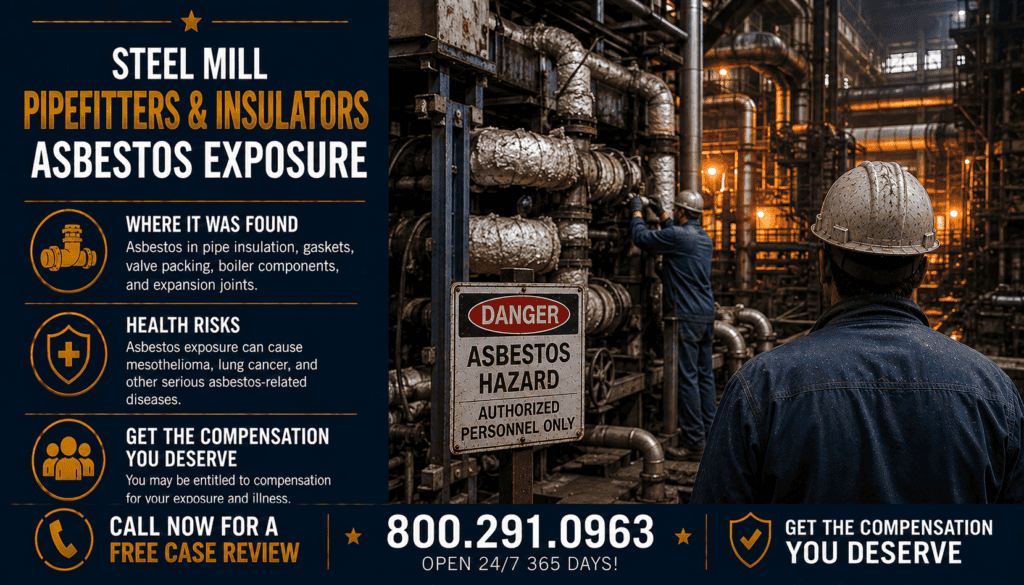
Steel Mill Pipefitters & Insulators Asbestos Exposure
Pipefitters and insulators in older steel mills sometimes worked around pipe coverings, valve packing, gaskets and thermal systems that historically could contain asbestos. The critical questions are what materials were installed, which tasks disturbed them and when the worker was present.
This guide explains steel-mill pipefitting and insulation duties, possible dust-release tasks, health concerns, records and compensation questions for workers diagnosed with mesothelioma or asbestos-related lung cancer.
🏭 Steel Mill Work Areas And Systems
Steel mill pipefitters maintained the networks that moved steam, water, compressed air, fuel and process fluids between production and utility areas. The highest-value exposure history identifies a particular line, pump, boiler or valve and the job performed there. A worker who replaced a flange gasket has a different potential exposure pathway from a worker who only inspected the same line from a distance. To place this task within the wider plant, compare the specific work area with the Steel Mill Asbestos Exposure discussion; the equipment and maintenance dates still need to match the individual worker.
Insulators often worked alongside pipefitters when crews opened insulated lines or removed lagging to reach leaking joints. Historic insulation may have included asbestos-containing block, cloth, cement or molded pipe covering; later replacements may have been asbestos-free. The material specification and the dates of installation and removal are therefore more useful than the general statement that a mill was old. The related Mini-Mills & Electric Arc Furnace Plants Asbestos Exposure article describes another part of mill operations that may intersect with this crew’s assignment, especially during shutdowns. Powerhouses, boiler rooms, finishing departments and maintenance shops could have very different insulation inventories. A steam header in a boiler house is not the same as a water line in a cold rolling bay. Locate the work by building, elevation, equipment tag and approximate year before assigning a possible product source. For a closer look at the components or work practices involved, see Steel Mill Powerhouses & Boiler Rooms Asbestos Exposure; product composition must still be established from reliable evidence.
Contractors frequently performed shutdown insulation removal while mill employees repaired pipe or valves. A contractor roster, job authorization and scaffolding record may help establish who was present when a covering was disturbed. These records can also distinguish direct handling from nearby exposure. When reconstructing who was present, Steelworkers & Millwrights Asbestos Exposure provides occupational context without replacing shift records or firsthand accounts.
👷 Pipefitter And Insulator Duties
Pipefitters cut out worn pipe, separated flanges, fitted replacement spools, serviced valves and assisted with pressure testing. During removal, old gaskets or packing could be scraped, wire-brushed or mechanically cleaned from metal surfaces. The key issue is whether the specific gasket or packing contained asbestos and whether the task released respirable fibers. To place this task within the wider plant, compare the specific work area with the Steel Mill Piping, Valves & Gaskets Asbestos Exposure discussion; the equipment and maintenance dates still need to match the individual worker.
Insulators measured and installed new covering but also stripped damaged insulation, removed jacket bands, patched elbows and prepared surfaces for re-covering. Disturbance during demolition of old lagging can produce a different dust profile from handling intact, encapsulated insulation. Ask whether wet methods, enclosures or local exhaust were used, rather than assuming every historical job was performed the same way. The related Steel Mill Maintenance & Repair Workers Asbestos Exposure article describes another part of mill operations that may intersect with this crew’s assignment, especially during shutdowns. Journeymen, apprentices, laborers and maintenance helpers may have shared work platforms. A helper who bagged debris or swept an area after stripping could have a relevant history even without installing the original insulation. Conversely, a worker assigned elsewhere on a shutdown should not be presumed exposed solely because the project involved asbestos. For a closer look at the components or work practices involved, see Steel Mill Wrongful Death Lawsuit; product composition must still be established from reliable evidence.
Shift patterns matter. A mill employee may have worked routine rounds for months and joined only a few major outages each year. Reconstruct the particular outages, crew assignments and work orders instead of treating all employment years as continuous asbestos contact. When reconstructing who was present, Steel Mill Mesothelioma Lawsuit provides occupational context without replacing shift records or firsthand accounts.
⚙️ Pipe Coverings, Gaskets And Heat Systems
Potential historic sources include molded pipe covering, insulating cement, boiler insulation, valve packing and sheet gaskets. Not every high-temperature material contained asbestos. Manufacturer catalogs, purchase orders and retained samples may distinguish asbestos-containing products from mineral wool, fiberglass, graphite and later substitutes. To place this task within the wider plant, compare the specific work area with the Steel Mill Demolition Asbestos Exposure discussion; the equipment and maintenance dates still need to match the individual worker.
A flanged connection may involve several distinct materials: the gasket between faces, packing around a valve stem, insulation on the adjacent line and refractory near a furnace. Identifying one material does not establish the composition of the others. Separate each material and task in a work-history account. The related Steel Mill Renovation & Upgrade Asbestos Exposure article describes another part of mill operations that may intersect with this crew’s assignment, especially during shutdowns. Piping insulation could be damaged by leaks, vibration or routine maintenance. Repairs often involved cutting back jackets and removing a limited section of covering, while full replacement projects generated larger volumes of waste. The scope and duration of each job can help evaluate the plausibility of airborne exposure. For a closer look at the components or work practices involved, see Steel Mill Boilers & Steam Systems Asbestos Exposure; product composition must still be established from reliable evidence.
Photographs showing insulation jackets or pipe runs can help identify locations but generally cannot establish fiber composition. Reliable identification requires material records or appropriate laboratory analysis where available. When reconstructing who was present, Integrated Steel Mills Asbestos Exposure provides occupational context without replacing shift records or firsthand accounts.
🌫️ How Dust Reached Workers
Asbestos exposure occurs when fibers become airborne and are inhaled. For pipefitters, plausible disturbance tasks include gasket scraping and removal of adjacent insulation. For insulators, stripping friable covering and handling contaminated waste are more direct pathways. An exposure history should identify the worker’s distance from the activity, time spent there and ventilation conditions. To place this task within the wider plant, compare the specific work area with the Steel Mill Mesothelioma Lawsuits & Compensation discussion; the equipment and maintenance dates still need to match the individual worker.
Dust on clothing, platforms or nearby equipment may be relevant, but visible dust is not proof of asbestos. Steelmaking produces many non-asbestos dusts. The material being disturbed must be identified before attributing a particular dust cloud to asbestos. The related Steel Mill Workers & Occupations Asbestos Exposure article describes another part of mill operations that may intersect with this crew’s assignment, especially during shutdowns. Older accounts sometimes describe dry sweeping, compressed-air cleanup or shaking contaminated clothing. These practices could redistribute settled dust. The date, product source and proximity still matter; descriptions should reflect what witnesses actually saw. For a closer look at the components or work practices involved, see Steel Mill Equipment & Systems Asbestos Exposure; product composition must still be established from reliable evidence.
If a worker developed mesothelioma years after leaving the mill, the diagnosis warrants careful review of past exposure rather than an assumption that any single task caused the disease. When reconstructing who was present, Steel Mill Facilities & Production Areas Asbestos Exposure provides occupational context without replacing shift records or firsthand accounts.
🩺 Mesothelioma After Occupational Exposure
Mesothelioma is a cancer associated with asbestos exposure that can affect the lining of the lungs or abdomen. It often appears many years after the relevant exposure. A diagnosis does not by itself identify which workplace product was involved; a specialist can evaluate the medical findings while employment and product records are reviewed separately.
Workers with unexplained pleural fluid, persistent chest discomfort, shortness of breath or concerning imaging should discuss symptoms with a qualified clinician. Diagnosis may require imaging, pathology and specialist review. Keep pathology reports, imaging interpretations and treatment summaries together, since they may be requested for benefits or legal evaluations. Exposure histories should include previous jobs, military service, home renovation and any secondary contact with contaminated work clothing. A thorough history is more useful than assuming the most recent employer was responsible. Families can help assemble a timeline when the patient cannot recall every work assignment.
🫁 Asbestos-Related Lung Cancer
Asbestos exposure can also contribute to lung cancer risk, and smoking can further increase that risk. Lung cancer has multiple causes; the diagnosis alone cannot establish occupational causation. Medical professionals consider imaging, pathology, smoking history, work history and other relevant factors.
Someone who worked around suspect materials should provide their care team with the job dates, work tasks and any known asbestos products. A person should not delay medical evaluation while trying to reconstruct decades-old employment records. For legal or benefit review, preserve the precise diagnosis and treatment records. An asbestos-related lung cancer claim can have different evidentiary and eligibility requirements from a mesothelioma claim.
📋 Work History And Exposure Evidence
Start with a chronological work history: employer, site address, department, job title, dates, shift and the equipment or building area involved. Include contractor names and coworkers who can describe the same tasks. A dated description of a specific repair or demolition activity is more informative than a general statement that the site was dusty.
Useful documents can include union records, Social Security employment histories, payroll records, purchase orders, product manuals, safety surveys, asbestos inspection reports, work permits, maintenance tickets and witness statements. Availability varies by site and era. If a product label or part number is remembered, preserve the exact wording rather than replacing it with a guess. Distinguish firsthand recollections from conclusions drawn later. An employee may remember stripping a white covering but not know its composition. That uncertainty should be recorded openly and evaluated against reliable material evidence.
For a deceased worker, relatives may be able to obtain job histories, service records and medical records through appropriate procedures. Keep copies of documents and note where each record originated.
For the separate legal question covered by Mesothelioma Lawsuits, compare the applicable eligibility and evidence requirements with the individual case; no outcome is guaranteed.
For the separate legal question covered by What Are Asbestos Trust Funds?, compare the applicable eligibility and evidence requirements with the individual case; no outcome is guaranteed.
For the separate legal question covered by Mesothelioma Filing Deadlines, compare the applicable eligibility and evidence requirements with the individual case; no outcome is guaranteed.
⚖️ Compensation And Legal Options
People diagnosed with mesothelioma or asbestos-related lung cancer may wish to ask a qualified asbestos attorney about lawsuits, bankruptcy trust claims and other possible compensation. Eligibility depends on the diagnosis, evidence of exposure, responsible entities, applicable law and filing deadlines. A particular job title does not guarantee a claim.
Some asbestos manufacturers established bankruptcy trusts with their own proof requirements and payment procedures. A trust claim is not automatically available merely because a worker was employed at a plant or demolition site. The product, manufacturer, exposure history and trust criteria must align. Deadlines vary by jurisdiction and claim type, and the relevant event for calculating a deadline can differ between personal injury and wrongful death. Prompt legal advice matters because waiting to collect every document may create deadline risks.
Veterans may have separate VA benefit options if service-related asbestos exposure is supported. Civilian employment and military exposure should be documented distinctly. An attorney or accredited VA representative can explain how the relevant processes interact.
❓ Frequently Asked Questions
Did every worker in this industry encounter asbestos?
No. Exposure depends on a particular asbestos-containing material, work activity, location and period. Industry employment alone does not establish exposure.
Can a person have been exposed without handling insulation directly?
Potentially. Nearby disturbance and cleanup can matter, but proximity, timing, material identity and airflow need to be evaluated.
Does visible dust prove asbestos exposure?
No. Industrial and demolition sites contain many dust types. Material identification and task evidence are necessary.
What if the employer has closed?
Payroll, union, contractor, product and archival records may still help reconstruct work history, although availability varies.
Can family members seek help after a worker dies?
Depending on the circumstances and applicable law, survivors may have options. Deadlines and eligible parties vary by jurisdiction.
🧭 Summary
Steel Mill Pipefitters & Insulators Asbestos Exposure requires a careful distinction between documented asbestos-containing materials and other industrial dust or ordinary equipment. Worksite dates, tasks, component specifications and witness accounts can help explain possible exposure. A mesothelioma or lung cancer diagnosis should prompt medical care and timely advice about available legal options, not assumptions about causation or compensation.
📚 Confirmed Sources
These government sources provide general health, occupational and regulatory context; they do not establish the asbestos content of a particular worksite product.
Get The Compensation You Deserve
Find out if you may qualify for asbestos compensation today. Call 800.291.0963. Help is available 24/7/365. 25+ years of experience.
Mesothelioma Help Center is not a law firm or medical provider and does not determine legal or VA eligibility.