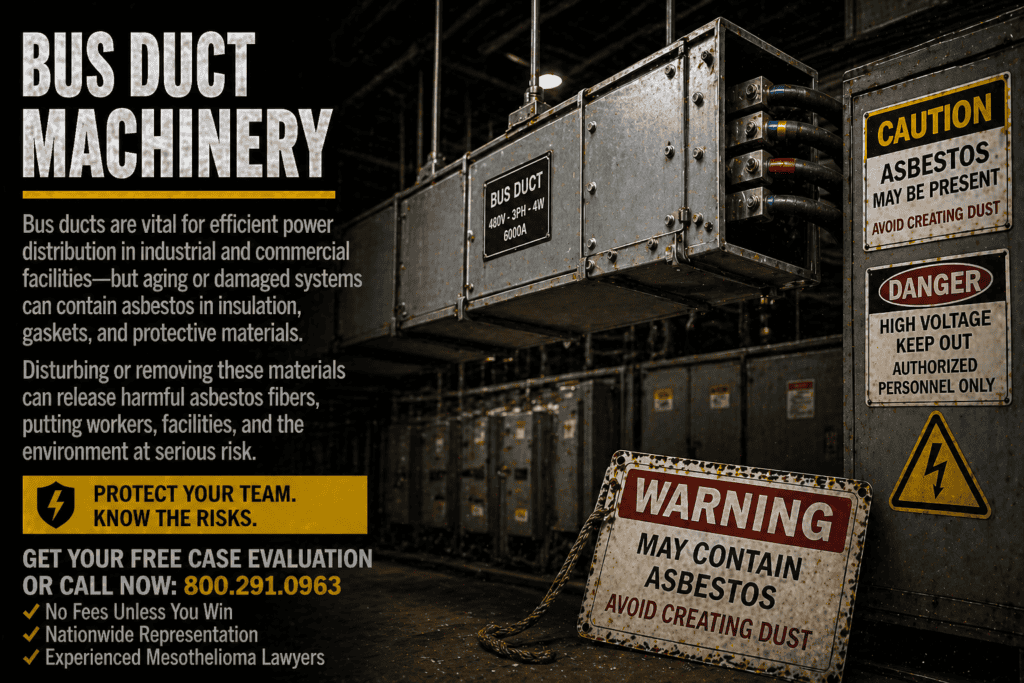
Bus Duct Machinery Asbestos Exposure
Exposure, Evidence and Claims
Bus duct or busway systems carry substantial electrical current through enclosed conductors. Certain older insulation and fire-protection components may have contained asbestos, while many busway products did not. Identifying exposure requires attention to actual equipment, repair practices and the period in which work occurred.
For people diagnosed with mesothelioma, a careful reconstruction of machinery-related work may clarify potential exposure sources and help families understand available medical and legal resources.
Where Asbestos May Have Been Present
Possible historical materials associated with this equipment include older busway insulating barriers, enclosure liners, fire-stop assemblies, cable penetrations and adjacent building insulation. These are areas to examine, not a claim that every unit or installation contained asbestos.
Asbestos was used in selected industrial products for heat resistance, durability and electrical or thermal insulation. Manufacturers used different formulations, and many products were redesigned or replaced over time. The precise model and manufacturing date therefore matter more than a broad machinery label.
Workers may also have encountered asbestos from nearby pipes, boilers, structural fireproofing or other equipment while servicing a machine. Distinguishing a machine component from surrounding building materials helps avoid incorrectly attributing exposure to a particular manufacturer.
Intact and undisturbed materials present a different situation from damaged, abraded or aggressively removed insulation. Only appropriate documentation, professional evaluation or testing can determine whether a suspect historical material actually contained asbestos.
Asbestos Exposure in Machinery — See how equipment service histories can identify additional possible exposure settings.
Power Generation and Electrical Machinery — Compare the electrical systems and maintenance environments that may have shared insulating materials.
When assessing bus duct machinery asbestos exposure, separate direct handling of older busway insulating barriers, enclosure liners, fire-stop assemblies, cable penetrations and adjacent building insulation from ambient dust generated by nearby work. Records should identify the precise work step, whether the material was cut or scraped, and whether protective controls were in place. Those details are more useful than a broad statement that asbestos was common in industry.
Maintenance Tasks and Fiber Disturbance
Activities worth documenting include opening bus duct housings, replacing supports, drilling penetrations, dismantling sections and repairing connections. The exposure potential depends on the material being handled, how it was disturbed, ventilation, controls and duration of the job.
Maintenance sometimes required removing panels or coverings, brushing away residue, scraping old sealing material and sweeping debris. When asbestos-containing material was present, these methods could release respirable fibers, particularly before modern controls became routine.
Outage and shutdown work may bring several trades into the same space. A person who never directly removed an asbestos component could still have been nearby while another crew disturbed insulation. Work assignments and distances should be described accurately rather than presumed.
Electrical and industrial machinery can be hazardous for reasons unrelated to asbestos. Current inspection, sampling and abatement should be performed by qualified personnel following applicable safety procedures, never through unsupervised opening or scraping of suspect components.
Process Pump, Valve and Refinery Machinery — Review repair work involving seals, packing, and adjacent industrial insulation.
Construction, Demolition and Mining Machinery — Explore dust-producing machinery work and the importance of identifying individual components.
For industrial electricians, power plant crews, electrical installers and maintenance contractors, exposure opportunities may have changed over the course of a career as equipment was upgraded and workplace procedures evolved. A timeline that connects job duties to specific machine components can help clinicians understand reported exposure and can help legal professionals evaluate supporting evidence without presuming liability.
Workers and Potential Exposure Pathways
Potentially affected trades include industrial electricians, power plant crews, electrical installers and maintenance contractors. Apprentices, cleanup staff, supervisors and nearby subcontractors may also have been present during equipment servicing.
A worker’s exposure history is more useful when it identifies a particular room or production area, the machine or assembly, specific repair tasks and the coworkers involved. Job titles alone do not establish contact with asbestos.
Contaminated clothing and equipment can sometimes transfer dust away from a worksite. Family exposure questions require separate evidence about actual take-home dust practices, laundering arrangements and dates, rather than assumptions based on a relative’s occupation.
Shift patterns, shutdown schedules and shared maintenance spaces may explain why different crews encountered the same materials. Interviews with former colleagues can supply leads, but recollections should be checked against contemporary records wherever possible.
Electric Motor Machinery — Examine motor maintenance tasks, replacement parts, and nearby insulating materials.
Transformer Machinery — Review historical transformer insulation and equipment maintenance records.
Consider whether the equipment was serviced in a dedicated shop, at an operating production line, or during a plant-wide shutdown. Different settings affect the likely number of nearby workers, the presence of other dust sources and the availability of maintenance documentation. Keep these scenarios distinct when interviewing witnesses.
Equipment Age and Work History
Begin with a year-by-year account of employers, contractors, facilities and job assignments. Include transfers, temporary outages, apprenticeship periods and the dates when older equipment was retired or rebuilt.
The date a machine was installed is not necessarily the date a worker encountered a particular component. Replacement insulation, later repairs and manufacturer-supplied service kits may differ from the original equipment specifications.
Useful identifiers include equipment nameplates, serial numbers, electrical drawings, piping diagrams, purchase orders and photographs. Even partial information may help locate a relevant manual or archived parts catalog.
Long latency between asbestos exposure and mesothelioma diagnosis makes earlier decades especially important to document. Latency does not, by itself, identify which product or worksite caused an individual illness.
Reactor Vessel Machinery — Compare vessel service, gasket replacement, and shutdown records.
A product name found in an old catalog should be treated as a research lead, not definitive proof of the material installed at a particular facility. Procurement changes, replacement parts, equipment retrofits and regional suppliers can alter the components present during the worker’s actual employment.
Records That May Identify Asbestos Products
Potential records include maintenance logs, equipment specifications, parts invoices, work permits, shutdown schedules, contractor rosters, union records, safety surveys and material sampling reports.
Original drawings may show where insulation or fire barriers were installed. However, a drawing label is not laboratory confirmation, and a modern manual may not accurately describe older versions of the same model.
Photographs can help identify locations and machinery. Witness statements are strongest when they specify what the witness personally observed, such as the appearance of a removed component and the task that generated dust.
Preserve originals where possible and keep a dated list of where each record came from. Avoid altering documents, entering unsafe work areas or collecting suspected asbestos samples without qualified assistance.
Electrical Switchgear Mesothelioma Lawsuit — Review evidence considerations specific to switchgear service and mesothelioma claims.
Oil Refineries Asbestos Exposure — See how refinery shutdowns and contractor work may affect exposure histories.
For families collecting records after a diagnosis, it is helpful to create a simple chronology with dates, places, job tasks and the source supporting each entry. Label uncertainties clearly and preserve copies of medical and employment documents. This approach supports accurate conversations with clinicians and qualified legal advisers.
For bus duct and busway systems, note whether maintenance involved joints, insulating barriers, fire stops at wall penetrations, or adjacent building materials. An installation may include components from different suppliers and dates, particularly after extensions or electrical upgrades. The route through ceilings and service rooms may matter because unrelated insulation or fireproofing could have been disturbed during the same project. Electrical drawings, installation specifications, and work orders can help identify the exact section serviced. Do not infer asbestos content solely from the age or industrial use of the busway.
Mesothelioma and Medical Evidence
Mesothelioma is a cancer associated with asbestos exposure. Diagnosis typically relies on specialist evaluation, imaging and tissue or fluid analysis when clinically appropriate; symptoms alone cannot confirm the disease.
Patients should share their occupational and household exposure histories with their clinical team, including older industrial machinery work and any known asbestos-containing products. This information can inform the medical record.
Symptoms can include breathlessness, chest or abdominal discomfort, fatigue and weight changes, but they overlap with other conditions. Prompt medical evaluation is important for persistent or worsening symptoms.
Treatment decisions depend on the type and stage of mesothelioma, general health and specialist recommendations. Legal documentation should never delay medical care, symptom management or an urgent clinical assessment.
Maintenance Workers Asbestos Exposure — Connect equipment servicing to broader maintenance trade exposure histories.
Asbestos Exposure in Buildings — Distinguish machinery components from nearby building insulation and fireproofing.
Legal Options and Compensation
A mesothelioma diagnosis and a credible exposure history may justify reviewing potential legal options. Possible routes can include personal-injury litigation, applicable asbestos bankruptcy trust claims and, for eligible survivors, wrongful-death claims.
A claim depends on jurisdiction-specific law, identification of responsible products or entities, evidence of exposure and medical documentation. No machinery category automatically creates eligibility or guarantees a settlement.
Statutes of limitations and trust deadlines vary. A qualified asbestos attorney can assess the relevant dates, work locations and available defendants or trusts without treating a generic machinery description as proof.
Workers may have encountered materials from several manufacturers over a career. Careful product identification helps distinguish possible sources and avoids naming a company merely because its equipment was present at the site.
Asbestos Exposure in Equipment — Review other equipment categories that may be relevant to a work history.
Mesothelioma Symptoms — Learn which symptoms warrant medical assessment and specialist follow-up.
Practical Steps for Workers and Families
Write down the facilities, years, employers, equipment names and specific tasks while details are available. Record names of coworkers and supervisors who may recall maintenance practices.
Gather employment records, union records, equipment documents and relevant medical reports. Keep copies organized by date and distinguish confirmed facts from possibilities that still need verification.
For suspected materials still present at a workplace or property, contact the responsible safety professional or an appropriately licensed asbestos specialist. Do not disturb material to collect evidence yourself.
Patients and families may benefit from coordinating medical care, symptom support and legal questions in parallel. The immediate priority remains appropriate medical evaluation and safe handling of any suspected asbestos material.
Mesothelioma Prognosis — Understand why individual prognosis requires a specialist assessment.
Mesothelioma Lawsuit — Learn what medical and exposure records may be relevant to potential claims.
❓ Frequently Asked Questions
Did every older machine contain asbestos?
No. Historical use varied by manufacturer, component, model and year. An older installation alone does not prove asbestos content.
Can nearby maintenance work matter?
Potentially. Exposure histories should describe proximity, materials disturbed, duration and ventilation rather than assuming that nearby work necessarily caused exposure.
What if the equipment manufacturer is unknown?
Worksite records, nameplates, archived manuals and coworkers may help narrow the possibilities. Do not guess at product identity.
How long after exposure can mesothelioma appear?
Mesothelioma commonly has a long latency period, often measured in decades. Individual medical evaluation is essential.
Can family members have been exposed?
Take-home dust may have been a pathway in some circumstances, but actual work and household practices must be documented.
Does a diagnosis automatically qualify for compensation?
No. Eligibility depends on medical evidence, exposure details, applicable law, deadlines and the requirements of any trust or claim.
Authoritative Safety and Health Resources
For information on asbestos exposure controls and health effects, consult OSHA asbestos guidance, EPA asbestos resources, and the National Cancer Institute mesothelioma information. These references provide general guidance and do not establish the composition of a specific machine.
📞 Get the Mesothelioma Help & Compensation You Deserve — Contact Us Today!
If you or someone you love has been diagnosed with mesothelioma, help is available to discuss possible asbestos exposure and compensation questions.
Our team draws on 25+ years of experience helping veterans, workers and families find information and connect with appropriate resources.
📲 Contact Us Today — Three Easy Ways!
CALL: 800.291.0963 for a free case review.
LIVE CHAT: Available 24/7/365.
CONTACT FORM: Use the form below to request contact.
Disclaimer: This information is not be considered as legal or medical advice. Mesothelioma Help Center is not a law firm or medical provider and does not determine legal or VA eligibility.