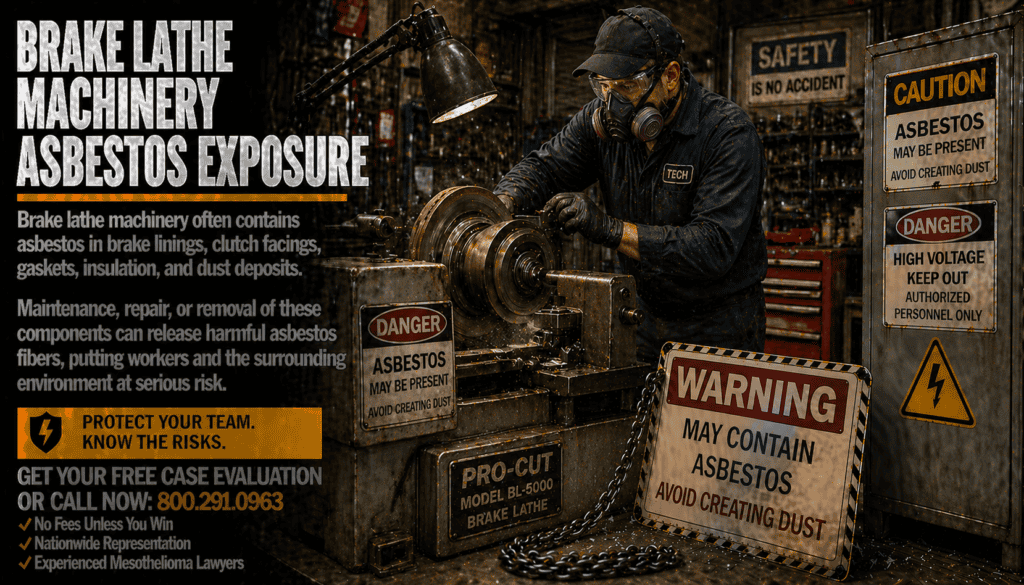
⚙️ Brake Lathe Machinery Asbestos Exposure
Brake Lathe Machinery Asbestos Exposure concerns potential historical exposure involving brake lathe equipment in automotive service shops. A review should identify historical brake linings, accumulated brake dust, turning drums and rotors, and shop cleaning practices. Neither the presence of machinery nor ordinary industrial dust establishes asbestos exposure without product-specific evidence.
People diagnosed with mesothelioma or asbestos-related lung cancer may need a detailed occupational history. Relevant workers include brake technicians, mechanics, parts handlers and shop cleanup staff. The key questions are what material was handled, whether it contained asbestos, how it was disturbed, and when the work occurred.
📑 On This Page
- Machinery Exposure Overview
- Where Exposure May Have Occurred
- Workers & Occupations
- Components & Exposure Pathways
- Records & Evidence
- Mesothelioma & Asbestos-Related Lung Cancer
- Lawsuits, Trust Funds & Compensation
- Frequently Asked Questions
- Summary & Confirmed Sources
⚙️ Machinery Exposure Overview
Historically, some industrial friction, insulation, and heat-resistant materials contained asbestos. In brake lathe equipment in automotive service shops, relevant products can differ by manufacturer, model, era, and repair history. No reliable assessment should assume that all equipments of the same category used identical components.
Asbestos fibers can become airborne when confirmed asbestos-containing material is scraped, cut, drilled, removed, or otherwise disturbed. Normal production of industrial scale, welding fume, or ordinary shop dust is not proof of asbestos exposure. Different workplace contaminants require different evidence.
Machinery was often upgraded over decades. Original parts may have been replaced, buildings renovated, and work practices changed. Records showing the equipment’s construction date are useful but cannot establish which components were installed throughout an employee’s entire career.
A sound history identifies who performed a repair, the work area, materials removed, tools used, dust-control practices, nearby coworkers, and frequency of the activity. Compare equipment specifications with purchase orders and actual maintenance logs.
Start with the broader Transportation, Automotive & Mobile Machinery overview and the Liner Products Asbestos Exposure parent page. These help readers understand the equipment family without confusing exposure in one process with exposure in another.
📍 Where Exposure May Have Occurred
Work areas associated with brake lathe equipment in automotive service shops warrant review only when the relevant asbestos-containing materials can be identified. The following table distinguishes equipmentry components from nearby facility systems.
| Area or Component | Evidence to Review |
|---|---|
| Brake lathe workstations | Manufacturer specifications, part numbers and dates of installation |
| Brake shoe and drum servicing bays | Maintenance orders and evidence of heat-resistant or insulated products |
| Dust collection and cleanup areas | Repair methods, replacement components and cleanup practices |
| Parts storage and replacement counters | Facility plans, contractors and work performed nearby |
| Vehicle service and inspection pits | Worker location, frequency and duration of potential contact |
An employee may have worked directly on a component or merely passed through the same department. Those histories should not be described as equivalent. For potential bystander exposure, document the actual disturbed material, distance, duration, and ventilation.
A nearby furnace or steam line may have contained historical thermal insulation even if the production equipment did not. When that is the alleged source, identify it separately. Mixing equipment-based and building-based exposure can make a case harder to evaluate accurately.
For comparisons, see Asbestos-Lined Molds & Refractory Materials Exposure, Shipyard Boiler & Heating Equipment Asbestos Exposure, and Shipyard Electrical Equipment Asbestos Exposure. Their work processes and materials are not interchangeable.
👷 Workers & Occupations
Relevant occupations may include brake technicians, mechanics, parts handlers and shop cleanup staff. Work duties vary substantially: operators may remain at controls while maintenance personnel disturb components during repairs. Establish the employee’s actual tasks and the materials involved rather than relying on job titles.
Shift schedules, contractor records, and firsthand accounts may show who was present during a particular overhaul. A witness who remembers a dusty task may not know the dust composition, so technical records are needed to identify asbestos rather than infer it.
Exposure histories should include the entire career, not just one equipment. Some employees transferred between departments or worked in other plants with boilers, piping, foundries, or construction activities. Separate each job and period on the timeline.
For occupation-specific context, review Asbestos Exposure in Machinery, Asbestos Exposure in Products, Asbestos Exposure in Job Sites, and Industrial Equipment Manufacturers. These pages distinguish machining and industrial production hazards from exposure to confirmed asbestos-containing products.
🛠️ Components & Exposure Pathways
Original Components and Product Identification
For brake lathe equipment in automotive service shops, possible sources to examine include historical brake linings, accumulated brake dust, turning drums and rotors, and shop cleaning practices. Identify the exact supplier, installation date, product type, and any documentation showing that asbestos was present. Similar-looking replacements may have different compositions.
Parts catalogs, supplier invoices, engineering drawings, and worker accounts may corroborate one another. However, a catalog listing does not prove a specific employee worked on the listed part, and a coworker memory does not automatically prove its chemical composition. State the evidence limits clearly.
Repair, Adjustment, and Replacement
During repairs involving brake lathe equipment in automotive service shops, distinguish routine operation from removal, scraping, drilling or replacement of confirmed asbestos-containing material. Determine who performed the work and whether others were nearby.
A useful description identifies the exact work sequence: when a cover was opened, what was removed, whether surfaces were scraped or abraded, and who handled the debris. Ventilation and cleanup methods matter because the same component can present different circumstances during operation and demolition.
Parts catalogs, supplier invoices, engineering drawings, and worker accounts may corroborate one another. However, a catalog listing does not prove a specific employee worked on the listed part, and a coworker memory does not automatically prove its chemical composition. State the evidence limits clearly.
Nearby Heat and Utility Systems
In facilities supporting brake lathe equipment in automotive service shops, steam piping, boilers, fire barriers or other surrounding systems may present separate historical sources. Record these as distinct exposure pathways rather than attributing them automatically to the equipment.
A useful description identifies the exact work sequence: when a cover was opened, what was removed, whether surfaces were scraped or abraded, and who handled the debris. Ventilation and cleanup methods matter because the same component can present different circumstances during operation and demolition.
Parts catalogs, supplier invoices, engineering drawings, and worker accounts may corroborate one another. However, a catalog listing does not prove a specific employee worked on the listed part, and a coworker memory does not automatically prove its chemical composition. State the evidence limits clearly.
Production Dust Versus Asbestos Fibers
Ordinary emissions from brake lathe equipment in automotive service shops are not automatically asbestos fibers. Material analysis, supplier records and credible work histories are needed to identify the substance involved.
A useful description identifies the exact work sequence: when a cover was opened, what was removed, whether surfaces were scraped or abraded, and who handled the debris. Ventilation and cleanup methods matter because the same component can present different circumstances during operation and demolition.
Parts catalogs, supplier invoices, engineering drawings, and worker accounts may corroborate one another. However, a catalog listing does not prove a specific employee worked on the listed part, and a coworker memory does not automatically prove its chemical composition. State the evidence limits clearly.
Bystander Work and Cleanup
For coworkers around brake lathe equipment in automotive service shops, assess the specific task, distance, duration, airflow and cleanup practices. Working in the same building is not itself sufficient proof of asbestos exposure.
A useful description identifies the exact work sequence: when a cover was opened, what was removed, whether surfaces were scraped or abraded, and who handled the debris. Ventilation and cleanup methods matter because the same component can present different circumstances during operation and demolition.
Parts catalogs, supplier invoices, engineering drawings, and worker accounts may corroborate one another. However, a catalog listing does not prove a specific employee worked on the listed part, and a coworker memory does not automatically prove its chemical composition. State the evidence limits clearly.
Additional equipment examples include Asbestos Exposure in Equipment, Industrial and Factory Workers, Machine Operators, Factory Workers, and Grinding Machine Machinery. They illustrate different potential friction, heat, and facility exposure pathways.
📁 Records & Evidence
A dated employment and maintenance history helps distinguish a plausible lead from documented exposure. Collect records showing the plant, department, equipment model, work performed, component supplier, and medical diagnosis. Keep original document dates and identify where each record came from.
| Record | What It Can Establish |
|---|---|
| Employment and payroll records | Plant, department, job title and dates |
| Machine manuals and equipment drawings | Machine model, configuration and component identifiers |
| Maintenance logs and work orders | Repair events, tasks and replacement dates |
| Supplier invoices and purchase orders | Potential manufacturer and material identification |
| Plant renovation and contractor files | Nearby building or utility disturbance |
| Coworker accounts and photographs | Task location, frequency and corroborating details |
| Medical and pathology records | Diagnosis and clinical timeline |
An old equipment may have changed ownership or been moved between facilities. Track each location and repair period when possible. A later specification may not describe the product used decades earlier, and missing records should not be filled with unsupported assumptions.
The Industrial Pump Machinery page provides background on suppliers and equipment categories. The broader Welding Bench & Heat Shield Machinery page helps compare components used in different industrial systems.
🫁 Mesothelioma & Asbestos-Related Lung Cancer
Mesothelioma
Mesothelioma is a cancer of the mesothelium, often affecting the lining around the lungs. Asbestos is its principal established cause, and diagnosis may occur decades after exposure. Medical evaluation can include imaging, pathology, and specialist review. A diagnosis alone does not identify the responsible equipment or product.
Asbestos-Related Lung Cancer
Asbestos exposure increases lung cancer risk. Smoking and asbestos can have combined effects, but smoking does not eliminate the importance of an accurate occupational history. Not every lung cancer in a brake lathe equipment in automotive service shops employee is attributable to asbestos. Medical causation requires individualized assessment.
Workers should preserve pathology reports, treatment summaries, and a complete history of relevant employment. Medical proof and product-specific exposure evidence answer different questions and should be documented separately.
⚖️ Lawsuits, Trust Funds & Compensation
Civil Asbestos Lawsuits
Some people with asbestos-related diseases may have legal claims against responsible manufacturers, suppliers, or other entities. Such claims depend on the applicable law, diagnosis, actionable exposure, product identification, and deadlines. Neither a equipment assignment nor a diagnosis guarantees compensation.
Asbestos Bankruptcy Trusts
Certain asbestos companies established bankruptcy trusts with distinct medical and exposure criteria. Eligibility must be assessed separately for each trust. A trust submission should not be assumed to extend a deadline for a civil lawsuit.
Family and Wrongful-Death Claims
Eligible family members may have claims after a worker’s death under applicable law. Who may file, available damages, and filing deadlines vary. Death certificates, estate documents, medical records, and occupational evidence can be important.
Legal options and filing periods vary by jurisdiction. Anyone facing a new diagnosis or a death in the family should obtain qualified case-specific guidance rather than rely on a generalized online deadline.
❓ Frequently Asked Questions
Did all equipment used for brake lathe equipment in automotive service shops contain asbestos?
No. Asbestos content varied by manufacturer, equipment design, materials, and time period. Specific evidence is required.
Which historical materials could be relevant to brake lathe equipment in automotive service shops?
Potential sources must be identified by component and date; relevant historical parts may include friction, insulation, or nearby building products.
Could maintenance workers encounter asbestos during repairs?
Possibly, if a confirmed asbestos-containing product was disturbed nearby. Frequency, proximity, and ventilation matter.
Is ordinary dust from brake lathe equipment in automotive service shops proof of asbestos?
No. Ordinary brake lathe equipment in automotive service shops dust, scale, or welding fume is not proof of asbestos fibers.
Which product and maintenance records should be collected?
Manuals, supplier invoices, work orders, photographs, and firsthand accounts can help establish materials and tasks.
Can coworkers have exposure without handling the material?
A nearby worker’s history requires evidence of a dust-generating task involving asbestos and meaningful proximity.
What must be established for a potential asbestos claim?
A claim generally requires a qualifying injury, exposure evidence, responsible party or trust criteria, and compliance with deadlines.
How can families reconstruct historical workplace exposure?
Families can collect employment, equipment, medical, and witness records; eligibility and deadlines need individualized review.
📌 Summary & Confirmed Sources
Rolling Mill Machinery Asbestos Exposure requires a fact-specific review of the actual equipment, component materials, repairs, worker proximity, and diagnosis. Historical asbestos use does not establish that every equipment or workplace contained asbestos. Preserve records and distinguish confirmed facts from possibilities.
Further reading includes Circuit Breaker Machinery and Elevator Machinery, which involve different equipmentry systems and maintenance practices.
Confirmed Sources
OSHA — Asbestos in General Industry
National Cancer Institute — Asbestos Exposure and Cancer Risk
Find Out If You May Qualify for Asbestos Compensation Today
Call 800.291.0963 — help is available 24/7/365. 25+ years of experience.
Disclaimer: Mesothelioma Help Center is not a law firm or medical provider and does not determine legal or VA eligibility. This page provides general information and is not legal or medical advice.