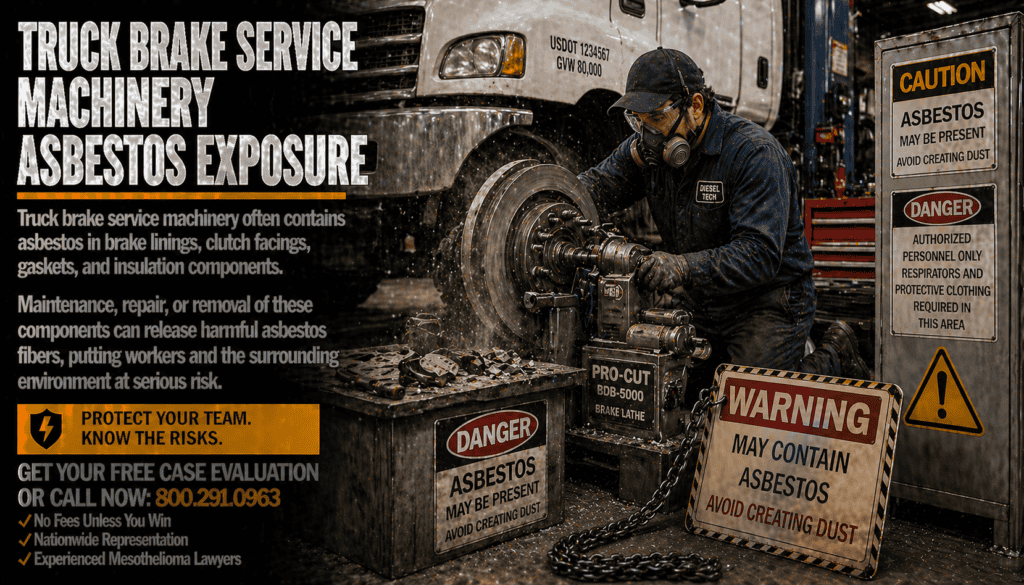
Truck Brake Service Machinery Asbestos Exposure
Exposure, Evidence and Claims
Truck Brake Service Machinery Asbestos Exposure concerns possible historical exposure in commercial truck garages, fleet depots, and heavy-vehicle service bays. Relevant sources may include older drum brake linings, brake shoes, clutch facings, and some replacement friction products. The presence of asbestos depends on the specific product, its manufacture date, and the tasks performed; the machinery name alone does not establish exposure.
Workers evaluating a mesothelioma diagnosis may need to reconstruct equipment models, repair methods, and the products handled decades earlier. This article focuses on practical exposure questions, useful records, medical follow-up, and potential legal options without assuming that any particular workplace or manufacturer caused an illness.
Where Asbestos May Have Been Present
Potential sources associated with truck brake service machinery include older drum brake linings, brake shoes, clutch facings, and some replacement friction products. These categories describe products that warrant checking, not a finding that every example contained asbestos. Older machinery could have undergone many repairs, leaving replacement parts made by different suppliers than the original equipment maker.
The distinction between a machine and its consumable components is particularly important. A metal housing, frame, shaft, or motor does not become an asbestos product merely because a gasket, lining, or adjacent insulation once incorporated asbestos. Conversely, an ordinary-looking repair part may deserve close attention when historical documentation identifies its composition.
Heavy-truck brake assemblies can produce substantial accumulated debris during service. The important question is whether the particular friction material contained asbestos and how it was disturbed. Product manuals, part numbers, historical catalogs, safety documentation, and surviving purchase records may help narrow the possibilities. When the part is unknown, it is more accurate to describe a suspected source than to label the entire machine asbestos-containing.
Age alone is an unreliable test. Asbestos-containing and non-asbestos materials overlapped in some markets, and the transition varied by component, supplier, and application. Even equipment installed after a changeover may have received older stock or a different replacement product. Each potential source needs its own timeline.
Maintenance Tasks and Dust Release
Work activities can be more informative than the equipment label. Examples relevant to truck brake service machinery include removing brake drums, changing shoes, machining friction surfaces, cleaning brake assemblies, and servicing clutches. Removing, cutting, abrading, scraping, or cleaning certain asbestos-containing materials could release respirable fibers. Operating intact equipment is not automatically equivalent to performing dusty repair work.
An exposure account should specify the work sequence: what was opened or removed, whether the material was dry or wet, which tools were used, how debris was collected, and who was nearby. Compressed air, dry brushing, grinding, and uncontrolled sweeping can disperse contaminated dust when asbestos is actually present.
Duration, repetition, and proximity matter. Someone who handled a suspect component daily may have a different work history from a person who passed through the area occasionally. Neither pattern should be converted into a numerical dose without reliable measurements or a qualified assessment.
Repairs performed during shutdowns may bring several trades into the same space. A mechanic might have been exposed while another crew stripped insulation, replaced gaskets, or cleaned a nearby assembly. Record neighboring tasks, ventilation conditions, and the timing of the work rather than focusing only on direct handling.
Workers and Work Settings
People potentially involved include fleet mechanics, diesel technicians, brake specialists, owner-operators who performed repairs, and shop helpers. Job titles vary between employers and periods, so the description of duties is more useful than a label on a payroll record. Contractors, temporary workers, helpers, and self-employed repairers may also have participated in the same tasks.
Truck brake service machinery could be encountered in commercial truck garages, fleet depots, and heavy-vehicle service bays. A person who worked at multiple sites should build a separate entry for each location, with approximate dates, equipment names, supervisors, and other trades present. This can help distinguish a plausible pathway from a broad industry association.
Work clothes, vehicles, break areas, and shared facilities may also be relevant to a historical account if contaminated dust was carried outside the immediate task. However, a secondary-exposure claim requires specific facts about the material and transfer pathway, not merely a family relationship to an industrial worker.
For veterans, civilian employees, and contractors, records may reside in different systems. Service histories, employer archives, union files, Social Security earnings records, and personal photographs can complement one another. A missing formal record does not justify inventing a product identification.
Historical Equipment and Product Differences
The history of truck brake service machinery is not a single nationwide asbestos timeline. Manufacturers, aftermarket suppliers, and employers made different choices, and equipment could remain in service for decades. Production year, overhaul date, and replacement-part date should be recorded separately.
Product evidence can include maintenance manuals, bills of materials, technical bulletins, supplier catalogs, photographs of labels, and old invoices. A model designation may identify the original configuration but not a replacement fitted years later. Likewise, the existence of an asbestos product in a catalog does not prove it was installed at a particular site.
Heavy-truck brake assemblies can produce substantial accumulated debris during service. The important question is whether the particular friction material contained asbestos and how it was disturbed. This distinction can also prevent unrelated exposures from being merged. An individual may have encountered insulation, building materials, friction products, or industrial dust in the same workplace, but these require separate source descriptions.
Documenting a Possible Exposure
Useful evidence may include fleet maintenance records, truck make and model, parts purchasing files, mechanic logs, and former coworkers. Start with a chronology showing employers, job locations, dates, equipment, recurring tasks, and the names of people who observed the work. Approximate dates should be labeled approximate, and uncertain product names should remain uncertain.
A detailed personal account often records how a part looked, where it was installed, the packaging it came in, the dust created during removal, and the cleaning method used. Contemporaneous documents may support or correct memories. Coworker statements are most useful when they describe firsthand observations rather than conclusions about product chemistry.
Preserve copies of employment documents, union records, purchase invoices, photographs, training records, and any existing medical reports. Avoid disturbing old suspect materials to collect samples. Sampling and identification should be handled by qualified professionals using appropriate safety procedures.
For a legal review, distinguish evidence of a possible asbestos-containing product from evidence of personal exposure and from medical evidence of disease. Each is a different question. A strong narrative can be accurate and useful even where some records are unavailable.
Mesothelioma and Other Health Considerations
Asbestos exposure can increase the risk of mesothelioma, lung cancer, and certain other diseases. Mesothelioma may develop many years after exposure, but symptoms such as persistent shortness of breath, chest discomfort, abdominal swelling, or unexplained weight loss have numerous possible causes. A clinician must evaluate them; they do not establish an asbestos-related diagnosis.
A clinician may consider occupational and environmental history alongside imaging, pathology, and other tests. For suspected mesothelioma, tissue examination and specialist interpretation are often important. Patients should not assume that an exposure history by itself confirms disease or that one test establishes a final diagnosis.
People who believe they had substantial past exposure can discuss their work history with a healthcare professional, including whether any follow-up is appropriate. Screening and treatment choices depend on individual medical factors and should not be directed by a legal or marketing article.
If mesothelioma has been diagnosed, keeping the pathology report, imaging summaries, treatment records, and a written work chronology in one place may make later consultations easier. Medical decisions should remain with the patient and treating team.
Legal Claims and Compensation Considerations
A mesothelioma diagnosis and a documented exposure history may justify discussing legal options with an attorney experienced in asbestos matters. Possible pathways can include lawsuits, certain bankruptcy trust claims, and benefits in qualifying circumstances. Availability and requirements vary, and no result or amount of compensation can be promised.
An attorney may examine the employer, worksite, equipment manufacturer, component supplier, dates, and jurisdiction. Some cases involve products installed or replaced by a separate company. Identifying who supplied a particular asbestos-containing material is often more important than identifying the machine frame alone.
Filing deadlines differ by state and claim type and can be affected by diagnosis, death, or other circumstances. Workers’ compensation, railroad-related rules, maritime law, military service, and other specialized issues may require distinct analysis. Do not rely on a general article to determine which law applies.
A consultation should distinguish confirmed facts from open questions, explain potential fees and deadlines, and allow the family to decide whether to proceed. Avoid assuming that all people with similar occupations have identical exposure histories or legal eligibility.
Practical Safety and Next Steps
For machinery still in use, do not dry-sweep, grind, blow out, or remove suspect asbestos-containing materials without an appropriate professional assessment and compliant controls. Follow applicable workplace rules and involve trained asbestos personnel where required. Visual inspection cannot reliably establish whether a material contains asbestos.
Employers and property owners should use available product records and competent evaluations to identify suspect materials before disturbance. Safe work planning may require containment, appropriate respiratory protection, regulated disposal, and monitoring depending on the activity and governing rules. A household vacuum or ordinary dust mask is not a substitute for proper controls.
For a historical exposure question, the most useful first steps are writing down the work chronology, preserving available records, discussing medical concerns with a clinician, and obtaining qualified legal advice when a diagnosis or other circumstances warrant it. Do not attempt to recreate dusty tasks to prove what happened.
Authoritative safety and medical resources include the Occupational Safety and Health Administration asbestos information, Environmental Protection Agency asbestos resources, and National Cancer Institute asbestos fact sheet. These resources provide general context; they do not identify the composition of a particular machine part.
❓ Frequently Asked Questions
Did every older truck brake service machinery contain asbestos?
No. Composition varied by equipment model, component, replacement supplier, and year. Confirm the particular material rather than assuming asbestos from age or machinery type.
Which tasks might matter most for truck brake service machinery?
Tasks such as removing brake drums, changing shoes, machining friction surfaces, cleaning brake assemblies, and servicing clutches may warrant review if the disturbed material actually contained asbestos. Frequency, work methods, and nearby activity also matter.
Can someone have exposure without personally replacing a part?
Potentially. Workers nearby during disturbance of asbestos-containing materials may have inhaled airborne fibers, depending on proximity, ventilation, and the specific task.
How can a family identify an old product?
Start with parts invoices, equipment manuals, employer records, photographs, and firsthand coworker accounts. A qualified specialist may help interpret technical records.
Does an asbestos exposure history prove mesothelioma?
No. Mesothelioma requires appropriate medical evaluation and diagnosis. Exposure history is relevant but does not replace pathology or specialist care.
Can compensation be guaranteed?
No. Legal eligibility, defendants, evidence, deadlines, and claim type vary. A qualified attorney can evaluate the specific facts without promising a result.
📞 Get the Mesothelioma Help & Compensation You Deserve — Contact Us Today!
If you or someone in your family has been diagnosed with mesothelioma, you can ask about available resources and whether your work history may warrant a legal review. No particular outcome or eligibility is guaranteed.
Our team brings 25+ years of experience helping workers, veterans, and families seek information about asbestos exposure and potential compensation options.
📲 Contact Us Today — Three Easy Ways!
CALL: 800.291.0963
LIVE CHAT: Available 24/7/365.
CONTACT FORM: Complete the form below.