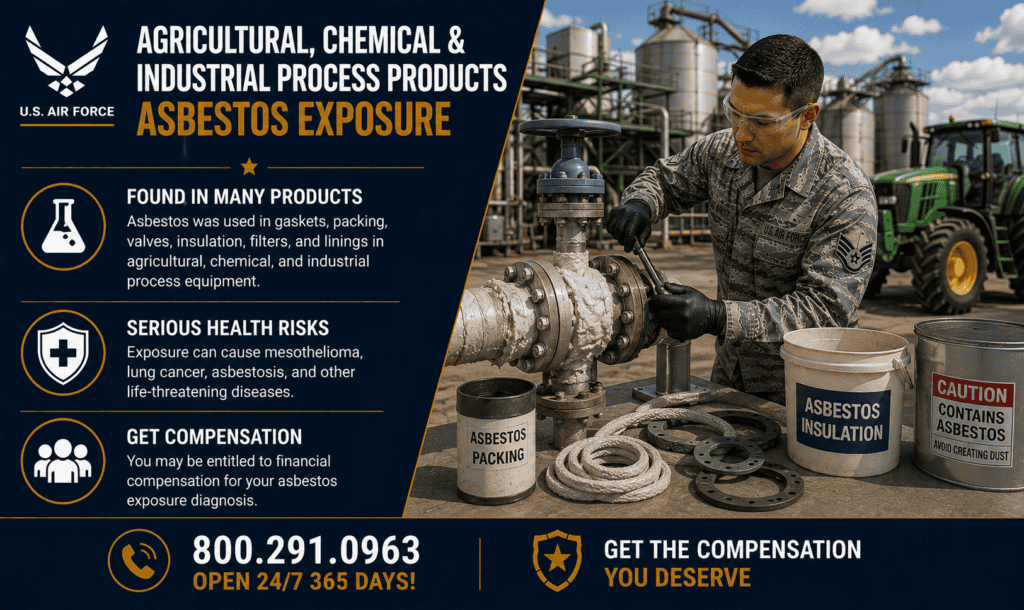
Agricultural, Chemical & Industrial Process Products Asbestos Exposure
Asbestos was historically used in chemical manufacturing, industrial processing and some agricultural operations because it could withstand heat, pressure, friction and many corrosive environments. Relevant products included gaskets, packing, seals, coatings, insulation, friction materials and specialized process components.
Working in agriculture, chemical manufacturing or another industrial operation does not by itself prove asbestos exposure. Exposure reconstruction requires evidence that asbestos-containing materials were present and that work activities disturbed those materials or otherwise created an inhalation pathway.
Agricultural, Chemical and Industrial Asbestos Products
Industrial facilities historically used asbestos-containing materials where equipment had to tolerate high temperatures, pressure, vibration, friction or aggressive chemicals. EPA and OSHA records document asbestos uses in gaskets, packing, coatings, friction materials, insulation and chemical-process applications.
The asbestos-containing material was often a replaceable component rather than the entire machine or processing system. A pump, valve, tank, reactor, compressor or other piece of equipment should not automatically be described as containing asbestos without evidence identifying the gasket, packing, insulation, coating or other component involved.
Asbestos Products Used in Industrial Processes
Depending on manufacturer, process and year, historically relevant materials may include:
- compressed asbestos sheet gaskets and flange gaskets;
- braided asbestos packing for pumps and valves;
- asbestos-containing seals and washers;
- thermal insulation around piping and process equipment;
- asphalt- and tar-based coatings reinforced with asbestos fibers;
- protective pipeline coatings and wraps;
- industrial friction products and brake blocks;
- asbestos-reinforced plastic molding compounds;
- heat-resistant textiles and process barriers; and
- specialized components used in high-temperature or corrosive service.
These categories varied over time, and modern replacements frequently use non-asbestos materials.
Chemical Manufacturing and Process Equipment
Chemical manufacturing is a particularly important historical setting because asbestos was valued for heat resistance and chemical durability. Sheet gaskets could seal flanges and equipment connections, while packing could control leakage around moving valve stems and pump shafts.
EPA has also documented chrysotile asbestos diaphragms in chlor-alkali production, where diaphragms separated process chemicals during production of chlorine and sodium hydroxide. This is a specialized industrial use and should not be generalized to other chemical processes.
Maintenance activities could involve opening flanges, removing old gaskets, repacking valves, servicing pumps, stripping insulation, cleaning sealing surfaces and replacing process components. Whether those tasks caused exposure depends on the asbestos content and how the material was handled.
Agricultural Equipment and Processing Exposure
Agricultural asbestos exposure may overlap with industrial maintenance rather than arise from crops or ordinary farm products themselves. Older tractors, trucks, processing machinery, pumps, boilers, piping and other equipment could use friction materials, gaskets, packing or heat-resistant components that warrant investigation.
Potentially relevant work could include brake and clutch service, pump repair, gasket replacement, valve maintenance, boiler work and repair of processing or irrigation equipment. Agricultural processing facilities may also have used insulated piping, boilers and industrial machinery similar to equipment found in other manufacturing settings.
The presence of older machinery alone does not establish asbestos exposure. Manufacturer, model, component, replacement history, date and work performed are important.
How Asbestos Fibers Could Be Released
Potential fiber release is more plausible when asbestos-containing components were cut, scraped, ground, drilled, brushed, broken, removed or deteriorated.
Examples include:
- scraping adhered gasket residue from flanges;
- cutting replacement gaskets from asbestos sheet material;
- pulling old packing from pumps or valves;
- grinding or wire-brushing sealing surfaces;
- removing deteriorated pipe or equipment insulation;
- disturbing asbestos-reinforced coatings or pipeline materials;
- servicing asbestos-containing brakes or friction components;
- handling damaged heat-resistant textiles; and
- cleaning dust or debris after maintenance work.
Actual exposure depends on asbestos content, material condition, work method, frequency, duration, proximity, ventilation and cleanup practices.
Worked around older chemical-process, agricultural or industrial equipment? If you are trying to identify gaskets, packing, insulation, coatings or other components involved in possible asbestos exposure, Call 800.291.0963. Live chat available 24/7, 365 days a year. Submit Your Case.
Workers and Industrial Settings at Risk
Potentially relevant workers may include chemical-plant operators, maintenance mechanics, pipefitters, millwrights, pump and valve technicians, boiler workers, insulators, machinists, refinery workers, agricultural mechanics, equipment repair workers and industrial cleanup crews.
Relevant settings may include chemical plants, refineries, fertilizer or agricultural processing facilities, power plants, factories, pumping stations, industrial maintenance shops, food-processing operations and large agricultural facilities.
Nearby workers may also be relevant when maintenance generated asbestos-containing dust in shared work areas, but proximity alone does not establish exposure.
Evidence That May Identify Product Exposure
Strong exposure reconstruction attempts to identify the actual product or component rather than relying only on a job title or facility name.
Useful evidence may include:
- equipment manufacturer, model and serial number;
- gasket, packing, seal or friction-product manufacturer;
- maintenance manuals and parts lists;
- plant engineering specifications and piping diagrams;
- purchase orders and invoices;
- maintenance, shutdown and turnaround records;
- material safety data sheets or historical product literature;
- photographs of equipment and components;
- asbestos surveys and abatement records;
- employment, union or military records;
- coworker or supervisor statements; and
- laboratory analysis of surviving materials where appropriate.
Medical and pathology records may document an asbestos-related diagnosis but do not establish which industrial product was an exposure source.
Health, Legal and Compensation Considerations
Asbestos exposure is associated with mesothelioma, asbestos-related lung cancer, asbestosis and other asbestos-related disease. Employment in an industrial or agricultural setting does not diagnose disease or establish individual medical causation.
Depending on the evidence and circumstances, legal options may be available after a documented exposure to a specific asbestos-containing industrial product. A legal review may consider product identification, manufacturer or supplier, worksite, tasks, frequency and duration, diagnosis, jurisdiction and filing deadlines.
Identifying an equipment maker, chemical company, agricultural employer or facility does not automatically establish liability. Legal responsibility is case-specific and depends on the evidence and governing law.
Some matters may involve asbestos trust funds, but each trust has its own exposure and medical documentation requirements. Eligibility is not automatic, and compensation is not guaranteed. Anyone with medical concerns should consult a qualified healthcare professional.
Industrial Process Asbestos Exposure FAQs
Why was asbestos used in industrial process equipment?
Asbestos offered heat resistance, strength and chemical durability, making it useful historically in gaskets, packing, insulation, coatings and other specialized components.
Were asbestos gaskets used in chemical manufacturing?
Yes. Historical records document asbestos-containing sheet gaskets in chemical-process applications, although not every gasket contained asbestos.
What was asbestos packing used for?
Asbestos packing was historically used around moving components such as pump shafts and valve stems to control leakage.
Was asbestos used in chlor-alkali manufacturing?
Yes. Chrysotile asbestos was used in specialized diaphragms in some chlor-alkali production facilities.
Could agricultural mechanics encounter asbestos?
Potentially. Older brakes, clutches, gaskets, packing, boilers and processing equipment could contain asbestos components depending on manufacturer and year.
Can gasket removal release asbestos fibers?
Potentially, particularly when an asbestos-containing gasket is scraped, ground or otherwise aggressively disturbed.
What evidence can identify industrial asbestos exposure?
Equipment records, parts lists, invoices, maintenance records, product literature, photographs, asbestos surveys and witness statements may help.
Does working at a chemical or industrial facility automatically qualify someone for compensation?
No. Eligibility depends on product and exposure evidence, diagnosis, jurisdiction and other case-specific circumstances. Compensation is not guaranteed.
For related product information, see Asbestos Exposure in Products, Gasket Products Asbestos Exposure, Packing Products Asbestos Exposure, Valve Products Asbestos Exposure, Pump Products Asbestos Exposure, Coating Products Asbestos Exposure, Filter Products Asbestos Exposure, Sealing Products Asbestos Exposure, Plastic Products Asbestos Exposure, and Machinery Products Asbestos Exposure.
Get Help Reviewing Industrial Product Exposure
If you or a family member has been diagnosed with mesothelioma, asbestos-related lung cancer or another asbestos-related disease and you are trying to identify older agricultural, chemical or industrial process products, we can help organize the equipment, product and work history that may be relevant.
Call 800.291.0963 to discuss what you remember about the facility, equipment, gaskets, packing, coatings, insulation or maintenance work. Live chat is available 24/7, 365 days a year. Submit Your Case using the form below.
Prior exposure does not automatically establish a legal claim. Eligibility depends on the evidence, diagnosis, jurisdiction and other circumstances, and compensation is not guaranteed.
⚕️ Legal & Medical Information Disclaimer
This page provides general educational information and is not medical or legal advice. The information does not establish asbestos exposure, diagnosis, causation, liability, claim eligibility or compensation. Medical concerns should be discussed with a qualified healthcare professional, and legal questions should be reviewed with a qualified attorney.