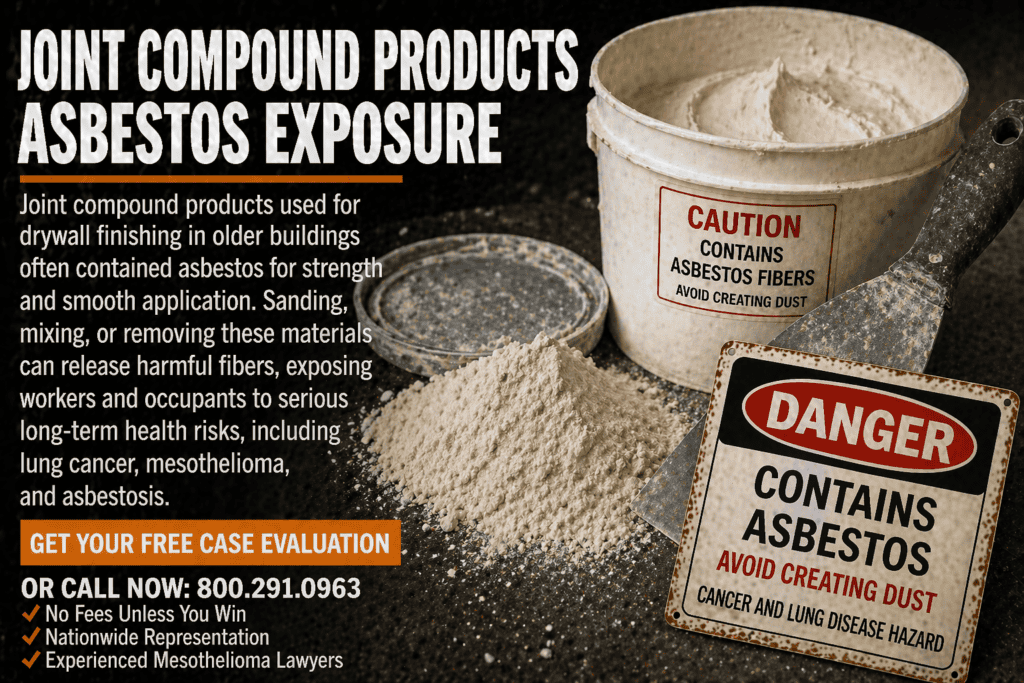
Joint Compound Products Asbestos Exposure
Some older drywall joint compounds, patching compounds and finishing materials were manufactured with asbestos, while many others were not. Historical asbestos use varied by manufacturer, formulation, product type and year. Working with drywall mud or joint compound does not by itself establish asbestos exposure.
Joint compound was commonly used to finish seams between gypsum wallboard panels, cover fasteners, embed joint tape, smooth surface imperfections and repair walls or ceilings. When an asbestos-containing formulation was present, dust-generating work such as sanding, scraping, cutting or demolition could create a potential exposure pathway.
This guide explains how historical joint compounds were used, how asbestos-containing material could be disturbed, which workers may have encountered it, and what evidence can help identify a product decades later. For a broader overview of product-related exposure, see Asbestos Exposure in Products.
Joint Compound and Historical Asbestos Use
Joint compound is a finishing material applied over seams, fastener heads, corner treatments and repairs in wallboard systems. Certain historical formulations used asbestos as a filler or reinforcing ingredient, while later and alternative formulations did not.
The asbestos question therefore depends on the exact product involved. Manufacturer, brand, product line, packaging, formulation and date of manufacture or installation can all matter. A worker’s memory that a product was sold as “joint compound,” “drywall mud,” “spackle,” “patching compound” or “finishing compound” is useful, but it may not be enough by itself to establish asbestos content.
When joint compound was wet, the asbestos fibers—if present—were bound in the mixture. The potential for airborne fibers generally became more relevant after the compound dried and was sanded, scraped, ground, cut, broken or disturbed during renovation or demolition.
Where Asbestos-Containing Joint Compound May Have Been Used
Depending on manufacturer, formulation and year, some historical asbestos-containing joint compounds may have been used for:
- finishing seams between gypsum wallboard panels;
- embedding and covering drywall tape;
- covering screw or nail heads;
- finishing inside and outside corners;
- patching holes, cracks or damaged surfaces;
- skim coating or smoothing wall and ceiling surfaces;
- repairing existing plaster or wallboard assemblies; and
- finishing transitions around openings, fixtures or penetrations.
Joint compound could also be used in ceiling work, especially around wallboard seams and repairs. For that reason, historical drywall finishing may overlap with some ceiling products and overhead construction materials. These products should still be identified separately so one material is not mistaken for another.
At joints around windows, doors, panels or penetrations, workers could also encounter caulking and sealant products. The fact that multiple materials were used in the same area does not mean each contained asbestos.
How Asbestos Exposure Could Occur
A potential exposure pathway exists when asbestos-containing joint compound is disturbed in a way that releases respirable fibers into the air. The most significant historical concern involved dust-producing finishing and renovation work after the compound had dried.
Potential disturbance could occur during tasks such as:
- dry sanding cured joint compound between finish coats;
- power sanding large wall or ceiling areas;
- scraping old compound from seams or patches;
- cutting through finished wallboard during remodeling;
- drilling or sawing through jointed wall or ceiling surfaces;
- removing wallboard with dried compound still attached;
- demolishing interior partitions or ceilings;
- cleaning accumulated sanding dust; and
- dry sweeping or blowing dust from finishing work.
Actual exposure can depend on asbestos content, dust generation, frequency and duration of work, proximity, room size, ventilation, respiratory protection, cleanup practices and nearby coworker activity.
Worked with older drywall mud, patching compound or joint compound? If you are trying to identify a historical product or reconstruct a possible asbestos exposure, Call 800.291.0963. Live chat available 24/7, 365 days a year. Submit Your Case.
Workers and Job Sites That May Have Encountered Joint Compound
Workers who mixed, applied, sanded, repaired or removed historical joint compounds may have encountered asbestos-containing formulations. Occupation alone does not prove exposure; the product and work performed are critical.
Potentially relevant occupations may include drywall finishers, tapers, plasterers, carpenters, painters, construction laborers, maintenance workers, electricians, HVAC workers, plumbers, remodelers and demolition crews.
Possible settings include residential construction, office buildings, schools, hospitals, factories, warehouses, military facilities, commercial properties and older structures undergoing renovation.
Workers who did not personally apply the compound could still have been near sanding or demolition work. In those cases, an exposure history should consider whether visible dust was generated, how close the worker was, how long the activity lasted and whether the work occurred repeatedly.
Application, Sanding, Repair and Removal Risks
Mixing and application
Some historical joint compounds were sold as dry powder and mixed with water at the job site, while others were sold premixed. If a dry product contained asbestos, pouring, mixing or handling the powder could potentially release dust before the material was applied.
Sanding
Drywall finishing often involved sanding dried compound to create a smooth surface between coats. If asbestos was present, sanding could generate fine airborne dust. Power sanding or repeated large-area finishing could create different exposure conditions than a small hand repair.
Repair work
Maintenance or remodeling can disturb old compound when workers open walls, enlarge electrical boxes, repair cracks, remove trim or patch damaged areas. The presence of joint compound may not be obvious until a wall or ceiling surface is cut or scraped.
Renovation and demolition
Demolition can break wallboard and cured compound into debris. When asbestos-containing compound was present, repeated breakage, sawing and dry cleanup could potentially spread fibers. Suspect materials in older structures should be evaluated before aggressive disturbance whenever current asbestos requirements apply.
Evidence That May Identify Historical Joint Compound
Joint compound is often covered by paint or removed during renovation, so historical product identification can be difficult. The strongest reconstruction usually combines worker memory with documentary evidence tied to the right job site and time period.
Useful evidence may include:
- bags, pails, cartons or labels from the product;
- manufacturer and trade names;
- product catalogs and technical literature;
- construction specifications and finish schedules;
- purchase orders, invoices and supplier records;
- contractor or subcontractor records;
- job-site photographs showing packaging or application;
- maintenance, remodeling or demolition records;
- asbestos surveys, bulk-sample reports or abatement records;
- employer, union or military records documenting assignments;
- coworker or supervisor statements identifying the product;
- records establishing when the wallboard system was installed; and
- surviving material suitable for professional laboratory analysis.
Medical and pathology records may document an asbestos-related diagnosis, but they do not identify which historical joint compound was used. Product evidence and medical evidence serve different purposes.
Secondhand Exposure and Health Risks
If sanding or demolition of asbestos-containing joint compound generated dust that settled on clothing, shoes, tools or personal belongings, fibers could potentially have been carried away from the job site. This is a possible secondhand exposure pathway, but family relationship alone does not prove exposure.
Asbestos exposure is associated with mesothelioma, asbestos-related lung cancer, asbestosis and other asbestos-related disease. Working with old drywall compound does not diagnose disease and does not establish individual causation.
Anyone concerned about past asbestos exposure or symptoms should discuss their work history and health with a qualified healthcare professional.
Legal and Compensation Considerations
Depending on the evidence and circumstances, legal options may be available to a person diagnosed with an asbestos-related disease after documented exposure to a specific asbestos-containing joint compound or drywall finishing product.
A legal review may consider the product manufacturer, brand, formulation, date of use, job site, contractor, actual work performed, frequency and duration of exposure, diagnosis, jurisdiction and applicable filing deadlines.
Manufacturer identification is not the same as establishing legal responsibility. Historical records may identify who made or supplied a product, but liability is case-specific and depends on the evidence and governing law.
Some claims may involve asbestos trust funds. Each trust has its own product, exposure and medical documentation requirements. Eligibility is not automatic, and compensation is not guaranteed.
Exposure that occurred decades ago does not by itself determine whether a claim is timely. Statutes of limitation and other deadlines vary by jurisdiction and circumstances and should be reviewed individually.
Joint Compound Asbestos Exposure FAQs
Did all old joint compounds contain asbestos?
No. Some historical formulations contained asbestos, while many others did not. Manufacturer, product line, formulation and year matter.
Could drywall sanding release asbestos fibers?
If the dried joint compound contained asbestos, sanding could potentially release fibers in the resulting dust. The extent depends on the product and work method.
Was asbestos used in premixed and dry joint compounds?
Historical formulations varied. Product identification is necessary because asbestos content cannot be assumed from whether a compound was premixed or sold as powder.
Can joint compound on ceilings contain asbestos?
Some historical joint compounds used on wallboard seams and repairs may have contained asbestos. This can include ceiling applications, but the specific product must be identified.
Can you tell by appearance whether joint compound contains asbestos?
No. Color, texture and hardness are not reliable indicators. Historical records or qualified laboratory analysis may be needed.
What evidence can identify old joint compound?
Useful evidence can include bags, pails, labels, catalogs, specifications, invoices, contractor records, asbestos surveys, photographs and coworker testimony.
Can nearby workers have been exposed during sanding?
Potentially, if asbestos-containing compound was sanded and airborne dust reached nearby workers. Proximity, ventilation, frequency and duration matter.
Does working with old drywall mud automatically qualify someone for compensation?
No. Legal eligibility depends on product identification, exposure evidence, diagnosis, jurisdiction and other facts. Compensation is not guaranteed.
Get Help Reviewing Historical Joint Compound Exposure
If you or a family member has been diagnosed with mesothelioma, asbestos-related lung cancer or another asbestos-related disease and you are trying to identify old drywall mud, patching compound or joint compound from a workplace, construction project or military facility, we can help organize the product and exposure history that may be relevant.
Call 800.291.0963 to discuss what you remember about the product, packaging, job site and work performed. Live chat is available 24/7, 365 days a year. Submit Your Case using the form below.
Prior exposure does not automatically establish a legal claim. Eligibility depends on the evidence, diagnosis, jurisdiction and other circumstances, and compensation is not guaranteed.
⚕️ Legal & Medical Information Disclaimer
This page provides general educational information and is not medical or legal advice. The information does not establish asbestos exposure, diagnosis, causation, liability, claim eligibility or compensation. Medical concerns should be discussed with a qualified healthcare professional, and legal questions should be reviewed with a qualified attorney.