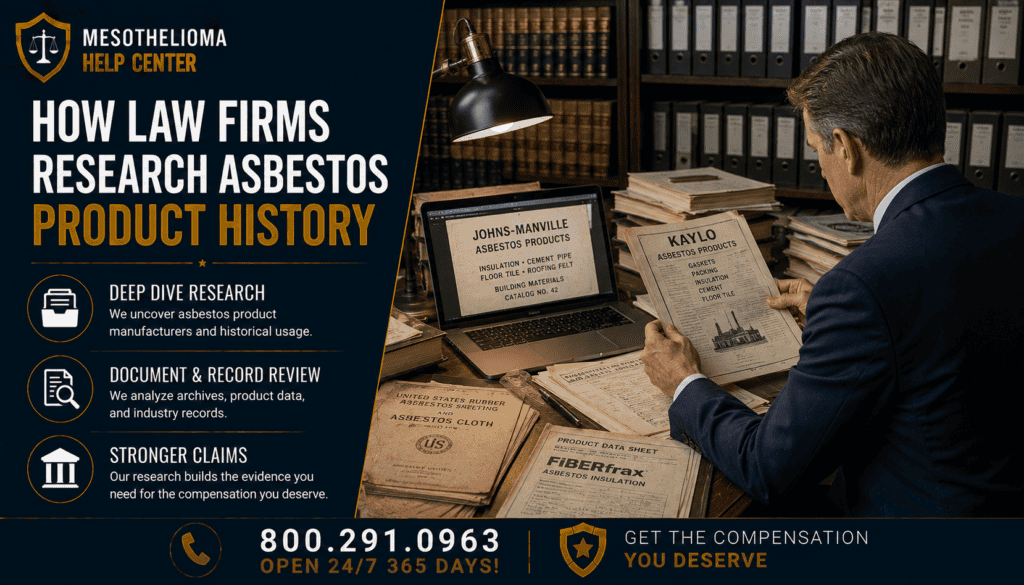
How Law Firms Research Asbestos Product History
Asbestos product research often involves reconstructing events that occurred decades ago. Law firms investigating a potential asbestos case may compare a person’s work or military history with historical product records, equipment documents, manufacturer information, witness testimony and other evidence.
The goal is not simply to find a company that once made an asbestos product. A useful investigation asks whether a specific asbestos-containing product or component can be connected to the person’s workplace, time period and actual work activities.
For broader guidance, see Product Research, Identification & Legal Resources for Asbestos Exposure, Identifying Asbestos Product Manufacturers from Service Records, and the main Asbestos Exposure in Products guide.
How Asbestos Product-History Research Begins
A product-history investigation often begins with an interview about jobs, military service, workplaces, equipment, maintenance duties and remembered products. Dates matter because manufacturers could change formulations, product names or components over time.
Researchers may create a timeline showing employers, facilities, ships or units, job duties and the products or equipment encountered at each location.
A remembered brand name can be useful, but uncertainty should be documented rather than converted into an unsupported identification.
Building a Detailed Work and Service History
Employment and service records can help establish where a person worked and what duties were performed. Useful records may include personnel files, Social Security work history, union records, military assignments, occupational specialties, ship or facility assignments, training records, payroll records and maintenance histories.
Researchers may then compare those duties with the equipment and materials historically used at the location. For military or employment-record research, see Identifying Asbestos Product Manufacturers from Service Records.
A job title or assignment alone does not prove that a particular asbestos product was present or disturbed.
Researching Products, Brands and Manufacturers
Once likely product categories are identified, research may focus on manufacturers, brands, models and components used during the relevant years.
Depending on the work, investigators may examine insulation products, machinery products, industrial components and sealing products, transportation and automotive products, or electrical and communications products.
Manufacturer identification is only one step. Some companies produced asbestos-containing and non-asbestos versions, so the product formulation and time period can be critical.
Catalogs, Invoices, Manuals and Historical Records
Historical documents can help connect a product to a manufacturer, facility or piece of equipment. Potential sources include:
- manufacturer catalogs and brochures;
- product data sheets and specifications;
- purchase orders and invoices;
- equipment manuals and illustrated parts lists;
- maintenance and repair records;
- construction specifications and blueprints;
- procurement and supplier records;
- asbestos surveys and abatement documents;
- historical photographs and packaging; and
- prior testimony or records that can be evaluated for relevance to the same product and period.
Documents need context. A catalog showing that a manufacturer sold an asbestos-containing product does not by itself establish that the product was present at a particular worksite.
Coworker, Family and Witness Evidence
Witnesses can help fill gaps when written records are incomplete. Coworkers may remember brands, packaging, machinery, maintenance practices, work areas or the frequency of particular tasks.
Family members may have relevant information about work clothes, tools or other materials brought home, but a family relationship alone does not establish secondhand exposure.
Witness accounts are more useful when details can be compared with contemporaneous records, product descriptions and documented workplace conditions.
Connecting a Product to an Exposure Pathway
After identifying a possible asbestos-containing product, investigators examine how it was used and whether the material could have been disturbed.
Relevant activities may include cutting insulation, scraping gaskets, pulling packing, sanding friction materials, drilling boards, removing old flooring, tearing out fireproofing or cleaning dusty maintenance debris.
Frequency, duration, proximity, ventilation, material condition and coworker activity can also be important. Product identification without a plausible exposure pathway may be insufficient to establish an individual exposure.
Need help organizing an asbestos product and work-history investigation? Call 800.291.0963. Live chat available 24/7, 365 days a year. Submit Your Case.
How Product Research Supports Legal Analysis
Product-history research can help an attorney evaluate whether evidence connects a specific asbestos-containing product to a person’s work and alleged exposure. Courts and jurisdictions can apply different legal standards, so the required proof is case-specific.
Legal analysis may consider product identity, manufacturer or supplier, location, dates, work tasks, witness evidence, frequency and duration of exposure, medical evidence and applicable filing deadlines.
Historical product evidence does not automatically establish causation or liability. Identifying a manufacturer also does not mean that company is legally responsible for an illness.
Depending on the evidence and circumstances, an attorney may also investigate whether an asbestos trust or another legal option is relevant. Each trust has its own exposure and documentation requirements, and compensation is not guaranteed.
Where Product Research May Continue
When the exact product remains uncertain, research can continue through records tied to the person’s duties and equipment. Useful starting points include:
- service-record manufacturer research;
- historical insulation products;
- machinery and equipment products;
- gaskets, packing, pumps, valves and sealing products;
- automotive and transportation products; and
- electrical and communications products.
The broader Product Research, Identification & Legal Resources for Asbestos Exposure guide can help organize the next research step.
Asbestos Product-History Research FAQs
How do law firms identify old asbestos products?
They may compare work histories, testimony, catalogs, invoices, manuals, equipment records, photographs and other evidence to identify products used during the relevant period.
Can a product catalog prove exposure?
No. A catalog may show what a manufacturer sold, but additional evidence is generally needed to connect the product to a specific workplace and person.
Can coworker testimony help identify asbestos products?
Yes. Coworkers may remember brands, equipment, packaging and work practices that help corroborate historical records.
Do law firms research military service records?
They may. Service records can identify assignments, duties, ships, facilities and equipment that guide further product research.
Does identifying an asbestos manufacturer prove liability?
No. Manufacturer identification does not by itself establish exposure, causation or legal responsibility.
Why are equipment manuals important?
Manuals and parts lists can identify equipment models, component types and replacement parts used during particular periods.
Can historical records establish that every version of a product contained asbestos?
No. Formulations can change over time, and some manufacturers sold both asbestos-containing and non-asbestos products.
Does product research guarantee a legal claim or compensation?
No. Claim eligibility and compensation depend on the evidence, diagnosis, jurisdiction, deadlines and other case-specific circumstances.
Get Help Reviewing Asbestos Product History
If you or a family member has been diagnosed with mesothelioma, asbestos-related lung cancer or another asbestos-related disease and you are trying to identify historical products, manufacturers, equipment or workplaces, we can help organize the information that may be relevant for review.
Call 800.291.0963 to discuss what you remember about the product, employer, military service, equipment, work duties and years of possible exposure. Live chat is available 24/7, 365 days a year. Submit Your Case using the form below.
Prior exposure does not automatically establish a legal claim. Eligibility depends on the evidence, diagnosis, jurisdiction and other circumstances, and compensation is not guaranteed.
⚕️ Legal & Medical Information Disclaimer
This page provides general educational information and is not medical or legal advice. The information does not establish asbestos exposure, diagnosis, causation, liability, claim eligibility or compensation. Medical concerns should be discussed with a qualified healthcare professional, and legal questions should be reviewed with a qualified attorney.