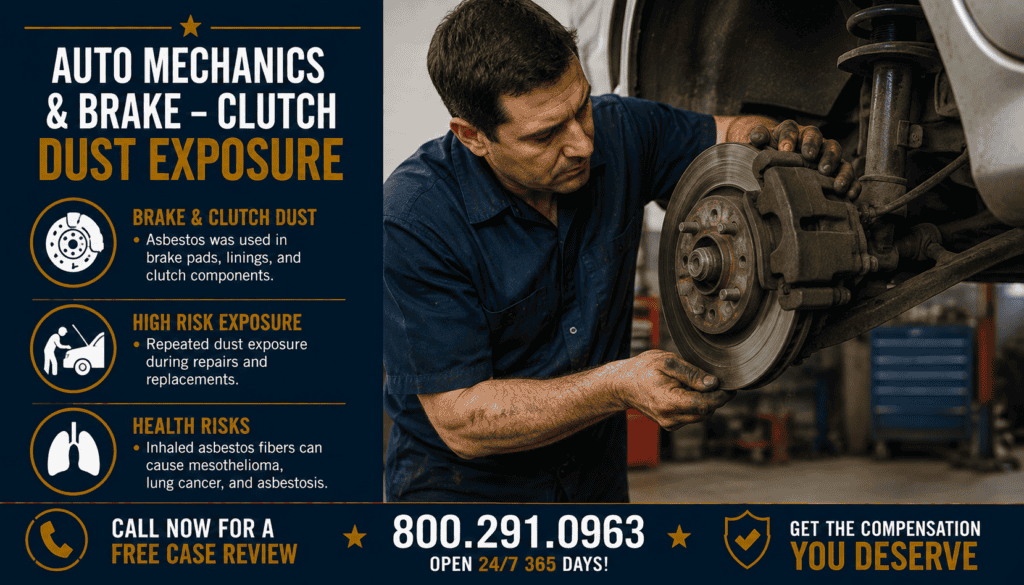
Auto Mechanics Brake & Clutch Dust Exposure
Auto mechanics who inspect, repair or replace brakes and clutches may encounter dust inside drums, around brake assemblies and within clutch housings. EPA states that some, but not all, automotive brakes and clutches may contain asbestos; when an asbestos-containing component is present, the dust can contain fibers that may be inhaled.
OSHA’s asbestos standard includes mandatory engineering controls and work practices specifically for automotive brake and clutch inspection, disassembly, repair and assembly. NIOSH has also published dedicated research on controlling asbestos exposure during brake-drum service. A credible exposure history should identify the component, vehicle, time period and repair method rather than assuming all brake or clutch dust contained asbestos.
Auto Mechanics Brake and Clutch Asbestos Dust Exposure
Brake and clutch servicing is one of the most specifically regulated potential asbestos exposures in automotive repair. OSHA requires employers to use defined engineering controls and work practices during covered brake and clutch inspection, disassembly, repair and assembly operations.
EPA explains that brake and clutch dust can become visible when a brake disk, drum, clutch cover or wheel is removed from a car, truck or other equipment. If the component contains asbestos, that dust may contain inhalable asbestos fibers.
NIOSH’s 1989 publication Control of Asbestos Exposure During Brake Drum Service evaluated methods for reducing mechanics’ asbestos exposure during brake maintenance. The research compared HEPA-vacuum, enclosure, wet-cleaning and other controlled approaches.
Not every mechanic, vehicle or brake job involved asbestos. EPA specifically cautions that some, but not all, brakes and clutches may contain asbestos, and older components can be difficult to identify by appearance alone.
Related resources include automotive mechanics and heavy equipment workers asbestos exposure, truck mechanics asbestos exposure, bus mechanics asbestos exposure and mechanics mesothelioma and asbestos exposure lawsuits.
Asbestos in Brake and Clutch Components
Potential automotive asbestos sources can include older friction components where asbestos content is documented:
- Asbestos-containing drum brake linings and brake shoes
- Asbestos-containing clutch facings
- Residue generated by wear of asbestos-containing friction material
- Older replacement friction components whose manufacturer records identify asbestos
- Dust accumulated inside assemblies after asbestos-containing components were used
EPA states that mechanics cannot reliably determine whether a brake or clutch component contains asbestos simply by looking at it. Manufacturer information, parts packaging, labels, safety data and product records may help identify newer components, while older replacement parts can be harder to verify.
The presence of visible dust is not enough to prove asbestos. Non-asbestos friction components also generate dust. Product identification, vehicle history and component evidence are therefore central to reconstructing an occupational exposure.
Repair Tasks That Can Release Asbestos Dust
When a brake or clutch component actually contains asbestos, disturbance of accumulated residue or friction material can create an exposure pathway.
- Removing brake drums: disturbing dust accumulated inside a drum and brake assembly
- Brake inspection: handling assemblies containing asbestos-bearing residue
- Brake replacement: removing older asbestos-containing shoes or linings
- Compressed-air cleaning: blowing dust into the surrounding work area
- Dry cleaning: brushing or wiping residue without appropriate controls
- Grinding or fitting: mechanically altering asbestos-containing friction material
- Clutch repair: opening housings and removing asbestos-containing clutch facings
- Nearby shop work: working near uncontrolled asbestos-containing brake or clutch servicing
EPA specifically advises against compressed-air cleaning because it blows dust into the air. It also advises against dry rags or brushes and recommends practices that minimize dust release when asbestos may be present.
NIOSH’s brake-drum research found that controlled methods could substantially reduce exposure. In the evaluated brake-service operations, methods using HEPA filtration, enclosures or wet approaches produced much lower exposures than historical uncontrolled practices reported in the literature.
OSHA and NIOSH Brake and Clutch Exposure Controls
OSHA Appendix F to 29 CFR 1910.1001 is mandatory for covered automotive brake and clutch operations. It specifies engineering controls and work practices intended to reduce asbestos exposure.
Negative-Pressure Enclosure and HEPA Vacuum
OSHA’s method encloses the brake or clutch assembly and uses a HEPA-filtered vacuum to maintain negative pressure, loosen asbestos-containing residue and capture the material.
Low-Pressure Wet Cleaning
This method gently floods the brake assembly with a controlled liquid flow so asbestos-containing brake dust is suppressed rather than allowed to become airborne.
Wet Method for Qualifying Low-Volume Facilities
For facilities meeting OSHA’s specified low-volume conditions, Appendix F provides a wet method using a fine mist followed by wiping. Dry brushing is prohibited under this method.
NIOSH Brake Drum Controls
NIOSH evaluated multiple engineering-control methods for brake servicing, including HEPA-filtered vacuum systems, enclosure systems, wet cleaning and aerosol wetting. The research demonstrated that properly used controls could keep exposure substantially below historical uncontrolled brake-service levels.
These federal controls are important evidence that brake and clutch asbestos exposure is a recognized occupational issue, but they do not establish that a particular mechanic was exposed. The actual component and work history still matter.
Need help now? Call 800.291.0963
Live chat available 24/7, 365 days a year.
Submit Your Case
Mesothelioma and Other Asbestos Health Risks
Asbestos exposure is associated with serious diseases including mesothelioma, lung cancer and asbestosis. EPA notes that disease symptoms can take many years to develop following asbestos exposure.
For auto mechanics, an asbestos-related health history should be tied to actual or reasonably documented asbestos-containing brakes, clutches or other components. A history of brake work alone does not establish asbestos exposure because non-asbestos friction products also exist.
Exposure frequency, duration, work practices, component composition and proximity to dust-generating tasks can all help characterize a mechanic’s occupational history. Medical causation and diagnosis must be evaluated by qualified healthcare professionals.
Mechanics can also encounter solvents, fuels, exhaust, welding fumes, noise and other workplace hazards. These are separate from asbestos and should not be treated as proof of asbestos exposure.
Documenting Brake and Clutch Dust Exposure
A useful investigation reconstructs the mechanic’s employers, vehicles, components, repair methods and time periods.
- Employment evidence: repair shops, dealerships, fleets, payroll, W-2, union and Social Security records
- Vehicle evidence: makes, models, years, trucks, buses or other equipment serviced
- Part evidence: brake shoes, linings, clutch facings, manufacturers, brands, part numbers and packaging
- Task evidence: drum removal, compressed-air cleaning, grinding, fitting, brake replacement and clutch repair
- Shop evidence: written procedures, ventilation, HEPA systems, wet-cleaning equipment and industrial-hygiene monitoring
- Product evidence: catalogs, service manuals, invoices, labels, safety data and laboratory analysis
- Witness evidence: mechanics, service managers, parts workers, fleet supervisors and coworkers
Historical parts invoices and catalogs can be especially valuable because a mechanic may clearly remember brake or clutch work but not know whether a particular friction component contained asbestos.
Questions That Can Strengthen an Exposure History
Which shops and years? What vehicles were serviced? Were drum brakes common? How was dust cleaned from assemblies? Was compressed air used? Were linings ground, cut or fitted? What brands or part numbers were installed? Were HEPA or wet-control methods used? Are invoices, catalogs or coworker statements available?
Asbestos Lawsuits, Trust Funds and Compensation
An auto mechanic diagnosed with mesothelioma or another asbestos-related disease may have potential legal or compensation options when evidence supports occupational asbestos exposure and applicable requirements are met. Possible avenues can include claims involving legally responsible companies and asbestos bankruptcy trusts.
Brake or clutch work alone does not establish liability or asbestos trust eligibility. Each claim has separate medical, exposure, company, product and filing requirements. Evidence connecting a worker to a covered asbestos-containing friction product, company or qualifying exposure may be necessary.
Potential evidence includes employment and Social Security records, union records, parts invoices, manufacturer catalogs, packaging, service manuals, industrial-hygiene studies, shop procedures, photographs, coworker statements and medical documentation. Applicable law and filing deadlines should be reviewed individually.
Related Automotive Mechanic Resources
Automotive mechanics: Automotive Mechanics & Heavy Equipment Workers Asbestos Exposure
Heavy-duty vehicles: Truck Mechanics Asbestos Exposure · Bus Mechanics Asbestos Exposure
Mechanic claims: Mechanics Mesothelioma, Asbestos Exposure & Lawsuits · Maintenance Mechanics Asbestos Exposure
Authoritative Sources
This page was researched using OSHA, NIOSH and EPA government sources. These sources directly address asbestos exposure during automotive brake and clutch servicing and the controls used to reduce airborne asbestos-containing dust.
- OSHA — Mandatory Appendix F for Automotive Brake and Clutch Work
- OSHA — 29 CFR 1910.1001 Asbestos Standard
- NIOSH — Control of Asbestos Exposure During Brake Drum Service
- NIOSH — Brake Drum Service Exposure-Control Study
- EPA — Current Best Practices for Brake and Clutch Repair Workers
- OSHA — Evaluating and Controlling Asbestos Exposure
Brake and Clutch Asbestos Dust Exposure FAQ
Did all automotive brakes and clutches contain asbestos?
No. EPA states that some, but not all, automotive brakes and clutches may contain asbestos. Product identification is important.
Can brake dust contain asbestos fibers?
Yes, if the brake component contains asbestos. EPA explains that dust released during brake servicing may contain asbestos fibers that can be inhaled.
Can you identify asbestos brakes by looking at them?
Not reliably. EPA states that asbestos-containing and non-asbestos components cannot necessarily be distinguished by appearance alone.
Why is compressed-air cleaning a concern?
Compressed air can blow accumulated brake dust into the air. EPA advises against this practice, and historical research documented substantially higher exposures during uncontrolled cleaning methods.
What methods does OSHA require for covered brake and clutch work?
OSHA Appendix F specifies engineering controls and work practices, including negative-pressure/HEPA and low-pressure/wet-cleaning methods, with a specified wet method available for qualifying low-volume facilities.
Did NIOSH study asbestos exposure during brake repair?
Yes. NIOSH published dedicated research evaluating asbestos exposure and engineering controls during brake-drum maintenance.
What records can document a mechanic’s brake and clutch exposure?
Employment records, parts invoices, manufacturer catalogs, service manuals, product packaging, shop procedures, industrial-hygiene reports and coworker statements can help reconstruct exposure.
Can auto mechanics qualify for asbestos trust fund claims?
Some may qualify if they meet a trust’s medical and exposure requirements and can connect their work to a covered asbestos product, company or qualifying exposure period. Mechanic employment alone does not establish eligibility.
Get Help Reviewing Brake and Clutch Dust Exposure
Call 800.291.0963
Live chat is available 24/7, 365 days a year.
Prior brake, clutch or automotive repair work does not automatically prove asbestos exposure, disease causation, liability, claim eligibility or compensation. Each situation depends on the employer, dates, vehicles, friction components, repair methods, asbestos-content evidence, medical evidence and applicable legal requirements. Compensation is not guaranteed.
⚕️ Legal & Medical Information Disclaimer
This page provides general educational information and is not medical or legal advice. The information does not establish asbestos exposure, diagnosis, causation, liability, claim eligibility or compensation. Medical concerns should be discussed with a qualified healthcare professional, and legal questions should be reviewed with a qualified attorney.