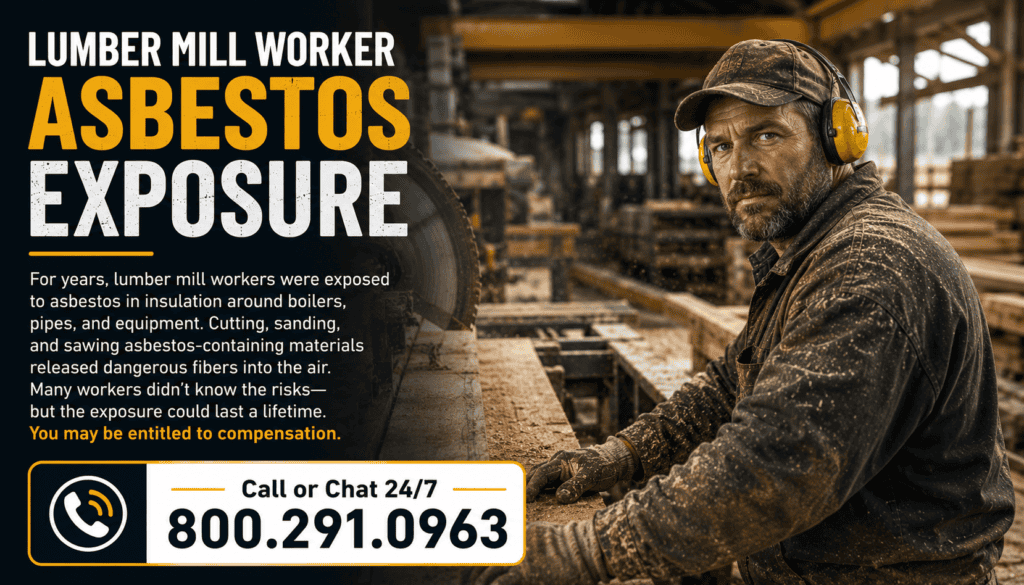
Lumber Mill Workers Mesothelioma Lawsuits
Lumber and wood-products mills can contain saws, planers, kilns, boilers, steam lines, conveyors and maintenance shops. Lumber-mill employment itself does not prove asbestos exposure, but workers in older facilities may have encountered asbestos when documented asbestos-containing insulation, gaskets, packing or other heat-resistant materials were repaired, removed or disturbed.
A mesothelioma lawsuit requires more than a history of wood dust. NIOSH documents substantial wood-dust exposure in sawmill and wood-products operations, while asbestos is a separate occupational carcinogen. A strong case therefore identifies the mill, years, department, equipment, asbestos-containing product, responsible company and work activity that created the alleged asbestos exposure.
Lumber Mill Workers and Asbestos Exposure
Lumber mills and diversified wood-products facilities can employ sawyers, planer operators, millwrights, maintenance mechanics, electricians, boiler operators, pipefitters, welders and other trades. NIOSH research on wood-products operations documents work areas such as shake mills, planer mills, bark plants and plywood plants.
The ordinary dust generated by sawing and processing wood is not asbestos. Potential asbestos exposure should instead be tied to a documented asbestos-containing material associated with the facility or equipment.
Possible historical sources worth investigating include older boiler or pipe insulation, gaskets, packing and other industrial materials where reliable records establish asbestos content. The presence of a boiler, pipe, machine or old building does not by itself establish asbestos.
Workers who repaired equipment or removed insulation may have had different potential exposure from employees who primarily handled lumber. Department, craft and hands-on maintenance duties therefore matter when reconstructing an individual case.
Related resources include agricultural, forestry and natural resource workers asbestos exposure, paper mill workers asbestos exposure, millwrights asbestos exposure and maintenance workers asbestos exposure.
Boilers, Steam Systems and Mill Equipment
Wood-products facilities may use boilers, steam systems, kilns, dryers and mechanical equipment. In an older mill, these systems can be important places to investigate for historical asbestos-containing thermal and mechanical materials.
Boilers and Steam Lines
Federal occupational-health investigations have documented asbestos-containing pipe and boiler insulation in industrial workplaces. Those findings establish a recognized exposure mechanism, but asbestos content must still be demonstrated for the particular lumber mill involved in a claim.
Pumps and Valves
Maintenance on pumps and valves can require removing gaskets or packing. These components should be called asbestos-containing only when manufacturer, specification, purchasing, product or other reliable evidence supports that conclusion.
Kilns and Heat-Related Systems
Drying and heat systems can require insulation and high-temperature materials. A historical investigation should identify the exact material rather than assuming that every heat-resistant product contained asbestos.
Machine and Maintenance Shops
Mill shops may perform welding, machining, equipment repair and component replacement. Maintenance records and coworker testimony can help determine whether asbestos-containing products were handled there.
Related mechanical resources include boiler room operators asbestos exposure, boilermakers asbestos exposure, pipefitters asbestos exposure and insulators and laggers asbestos exposure.
Maintenance and Repair Exposure Pathways
Potential exposure is generally most plausible when work disturbed a confirmed asbestos-containing material and released fibers into the breathing zone.
- Pipe work: cutting or removing documented asbestos-containing insulation or lagging
- Boiler repair: disturbing confirmed asbestos thermal insulation, gaskets or related materials
- Pump and valve repair: scraping or replacing documented asbestos gaskets or packing
- Millwright work: dismantling or repairing equipment containing identified asbestos products
- Shutdown maintenance: working near several trades while insulated equipment was opened or repaired
- Renovation or demolition: disturbing confirmed asbestos-containing building or mechanical materials
- Cleanup: handling residue created by previous asbestos work
NIOSH workplace investigations demonstrate why material condition and work activity matter. In one federal evaluation, insulation contained substantial percentages of asbestos, yet airborne asbestos was not detected during normal occupancy; NIOSH warned that maintenance or remodeling that disturbed the material could create a potential health hazard.
This distinction is useful for lumber-mill cases: the existence of asbestos-containing material and a worker’s actual opportunity for fiber exposure are related but separate facts that should both be documented.
Need help now? Call 800.291.0963
Live chat available 24/7, 365 days a year.
Submit Your Case
Wood Dust Is Different From Asbestos
NIOSH has measured substantial wood-dust concentrations in diversified wood-products operations, including shake mills, planer mills, bark plants and plywood plants. Wood dust can cause its own occupational health problems.
NIOSH states that workers exposed to wood dust have experienced eye and skin irritation, allergy, reduced lung function, asthma and nasal cancer. These hazards are important, but wood dust is not asbestos.
A lumber worker who spent decades around sawdust cannot establish asbestos exposure merely by showing dusty working conditions. The asbestos investigation should identify a separate asbestos-containing product, contaminated area or maintenance activity.
This distinction also helps avoid confusing mesothelioma evidence with evidence of other occupational respiratory disease. Medical and legal evaluations should consider each exposure independently.
Mesothelioma and Asbestos-Related Disease
NIOSH’s review of workplace asbestos exposure recognizes the carcinogenic hazards of asbestos and supports preventing occupational exposure. Asbestos exposure is associated with malignant mesothelioma, lung cancer and asbestosis.
Mesothelioma can develop long after exposure, making historical mill records important. A worker diagnosed decades after retirement may need old personnel files, union records, maintenance documents, equipment specifications, product invoices and coworker statements to reconstruct exposure.
A diagnosis does not identify which company or product caused an exposure. The legal investigation must separately address exposure, product or premises identification, responsible parties, causation and applicable law.
Medical concerns about asbestos exposure, mesothelioma, lung cancer or other respiratory disease should be discussed with a qualified healthcare professional.
Evidence for a Lumber Mill Mesothelioma Lawsuit
A useful lawsuit investigation builds a detailed timeline of the worker’s employment and possible asbestos exposure.
- Employment records: mill employer, dates, departments, job titles, payroll, pension and Social Security records
- Union records: membership, craft, seniority, referrals and work assignments when available
- Equipment records: boilers, steam lines, pumps, valves, kilns, dryers and process machinery
- Product records: insulation, gaskets, packing, manufacturers, brands, specifications and invoices
- Maintenance evidence: shutdown schedules, work orders, repair logs and contractor records
- Facility evidence: asbestos surveys, abatement records, engineering drawings and renovation files
- Witness evidence: millwrights, mechanics, operators, pipefitters, electricians, supervisors and coworkers
- Medical evidence: pathology, imaging, physician records and occupational histories relevant to the claimed disease
Product Identification Matters
Records identifying a manufacturer, brand, specification or supplier can help distinguish a documented asbestos product from ordinary mill materials.
Work Practices Matter
A worker who removed deteriorated insulation may have a different exposure history from someone who worked in another department without disturbing that material. Frequency, duration, proximity and the condition of the product can all be relevant.
Coworker Evidence Can Reconstruct Old Mills
When records are incomplete, former coworkers may remember boiler rooms, insulation work, shutdowns, contractors, product packaging or maintenance practices. Witness accounts should be as specific as possible.
Lawsuits, Trust Funds and Compensation
A lumber-mill worker diagnosed with mesothelioma or another asbestos-related disease may have potential legal or compensation options when evidence supports occupational asbestos exposure and applicable requirements are met.
Potential claims can depend on the responsible company and legal theory. Evidence may point to an asbestos-product manufacturer or supplier, a contractor, a premises-related defendant under applicable law, or a company that later established an asbestos bankruptcy trust.
Trust funds have their own medical, exposure and product or site requirements. Working at a lumber mill does not automatically qualify a person for a trust claim, and compensation is never guaranteed.
Filing deadlines vary by jurisdiction, claim type and facts. A recent diagnosis does not automatically make every potential lawsuit timely, while an exposure that occurred decades ago does not by itself establish that every claim is barred.
Related Industrial and Mechanical Resources
Industrial work: Industrial & Manufacturing Factory Workers Asbestos Exposure · Industrial Workers Asbestos Exposure Lawsuit
Maintenance: Millwrights Asbestos Exposure · Maintenance Mechanics Asbestos Exposure
Boilers and steam: Boilers & Steam Lines Asbestos Exposure · Boilers & Heaters Asbestos Exposure
Authoritative Sources
This page uses NIOSH occupational-health evidence to distinguish ordinary lumber and wood dust from asbestos exposure. Federal research documents wood-dust hazards in sawmill and wood-products operations, while separate NIOSH investigations and asbestos guidance document the hazards of asbestos-containing insulation and occupational asbestos fibers.
- NIOSH — Health Effects of Exposure to Wood Dust: Summary of the Literature
- NIOSH — Control of Wood Dust From Table Saws
- NIOSH — Workplace Exposure to Asbestos: Review and Recommendations
- NIOSH — HHE 83-450-1468, Asbestos-Containing Insulation Evaluation
- NIOSH — Pocket Guide to Chemical Hazards: Asbestos
- OSHA — 29 CFR 1910.1001 Asbestos
Lumber Mill Workers Mesothelioma Lawsuits FAQ
Were all lumber mill workers exposed to asbestos?
No. Lumber-mill employment alone does not establish asbestos exposure. The facility, equipment, product, task and time period should be investigated.
Is sawdust or wood dust asbestos?
No. Wood dust is a separate occupational hazard with its own health effects. It does not prove asbestos exposure.
Where might asbestos have been encountered in an older lumber mill?
Potential sources can include documented asbestos-containing boiler or pipe insulation, gaskets, packing and other industrial materials. Each material must be supported by reliable evidence.
Which lumber mill workers may have had greater opportunity to disturb asbestos materials?
Depending on the facility, millwrights, maintenance mechanics, boilermakers, pipefitters, insulators and other trades may have repaired equipment or disturbed thermal and mechanical materials.
Can a lumber mill worker file a mesothelioma lawsuit?
Potentially, when the required medical, exposure, causation, defendant and legal elements can be established. A diagnosis or mill job alone does not guarantee a valid lawsuit.
What evidence can help prove historical lumber mill asbestos exposure?
Employment and union records, maintenance files, product invoices, equipment specifications, asbestos surveys, photographs, contractor records and coworker statements can be useful.
Can lumber mill workers qualify for asbestos trust fund claims?
Some may qualify if they satisfy a trust’s medical and exposure requirements and can connect their work to a covered company, product, site or qualifying exposure period.
Is compensation guaranteed in a lumber mill mesothelioma case?
No. Compensation is not guaranteed. Each case depends on medical evidence, asbestos exposure proof, responsible parties, applicable law, deadlines and other facts.
Get Help Reviewing a Lumber Mill Asbestos Case
Call 800.291.0963
Live chat is available 24/7, 365 days a year.
Prior lumber-mill, sawmill or wood-products work does not automatically prove asbestos exposure, disease causation, liability, claim eligibility or compensation. Each situation depends on the employer, dates, department, equipment, products, maintenance tasks, asbestos-content evidence, medical evidence, responsible parties and applicable legal requirements. Compensation is not guaranteed.
⚕️ Legal & Medical Information Disclaimer
This page provides general educational information and is not medical or legal advice. The information does not establish asbestos exposure, diagnosis, causation, liability, claim eligibility or compensation. Medical concerns should be discussed with a qualified healthcare professional, and legal questions should be reviewed with a qualified attorney.