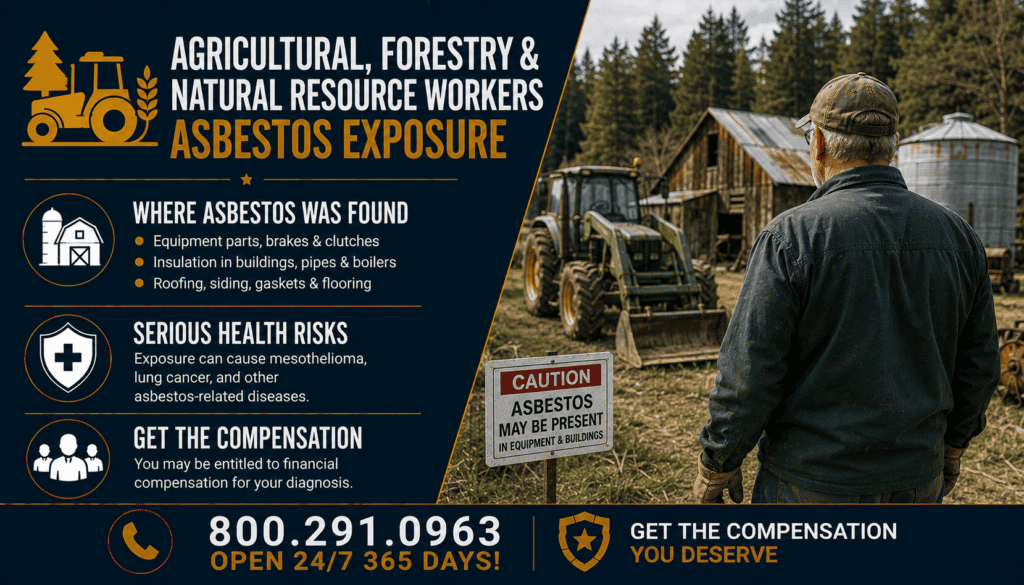
Agricultural, Forestry & Natural Resource Workers Asbestos Exposure
Agricultural, forestry, ranching, logging, conservation, irrigation, and natural resource workers have managed America’s farms, forests, ranches, parks, orchards, timber operations, and natural landscapes for generations. Their work has supported food production, timber harvesting, livestock operations, irrigation systems, land management, conservation programs, and the operation of heavy agricultural and forestry equipment throughout rural communities.
Throughout much of the twentieth century, asbestos was incorporated into many of the machines, buildings, processing systems, and industrial equipment used throughout agriculture and natural resource industries. Tractors, combines, harvesters, irrigation pumps, grain dryers, logging equipment, sawmills, forestry machinery, utility vehicles, diesel engines, brake systems, clutch assemblies, electrical equipment, boilers, and mechanical processing systems frequently contained asbestos because of its resistance to heat, friction, fire, and mechanical wear.
Unlike many industrial occupations centered around one manufacturing facility, agricultural and forestry workers often performed a wide variety of maintenance responsibilities throughout the year. Equipment was routinely repaired between planting and harvest seasons, irrigation systems were rebuilt, logging machinery was overhauled, sawmill equipment was modernized, grain handling systems were serviced, and farm shops repaired tractors, trucks, pumps, generators, and numerous other machines. During these maintenance activities, workers frequently encountered asbestos-containing brakes, clutches, gaskets, insulation, exhaust components, and high-temperature sealing products.
Many agricultural and forestry operations also maintained equipment for decades. Tractors, combines, logging skidders, bulldozers, irrigation pumps, grain dryers, forklifts, trucks, and sawmill machinery were commonly rebuilt rather than replaced. As a result, mechanics, operators, farm workers, logging crews, maintenance personnel, and equipment technicians often worked around original asbestos-containing components long after the machinery was first manufactured.
This authority hub explains why asbestos became integrated throughout agricultural, forestry, and natural resource industries, how these operations were engineered, the occupations most frequently exposed during maintenance and rebuilding projects, and the major work environments explored throughout the related child pages.
📚 What You’ll Learn in This Guide
This authority hub provides a comprehensive introduction to occupational asbestos exposure associated with agricultural, forestry, ranching, logging, and natural resource occupations.
Throughout this guide you’ll learn:
- Why asbestos became widely used throughout agricultural and forestry equipment
- How farms, ranches, sawmills, and natural resource operations relied upon insulated mechanical systems
- The importance of brakes, clutches, engines, pumps, and irrigation equipment
- Why seasonal maintenance and rebuilding created exposure opportunities
- The major categories of agricultural and natural resource operations
- Which industries relied upon asbestos-containing machinery
- Where asbestos-containing components were commonly installed
- Which agricultural and forestry workers most frequently encountered asbestos during equipment maintenance
- How specialized agricultural and forestry environments are explored throughout the associated child pages
- Why older farm equipment often remained in service for many decades
Rather than focusing on one type of machinery, this guide introduces the broader agricultural and natural resource work environment where asbestos-containing equipment was historically maintained and repaired.
🚜 Why Agricultural & Forestry Equipment Relied on Asbestos
Agricultural and forestry equipment operates under demanding conditions involving heavy loads, continuous vibration, heat, dust, moisture, and seasonal operation.
Typical equipment includes:
- Tractors
- Combines
- Harvesters
- Irrigation pumps
- Diesel engines
- Logging skidders
- Bulldozers
- Forestry trucks
- Grain dryers
- Sawmill machinery
- Utility vehicles
- Portable generators
Manufacturers required materials capable of resisting heat, reducing fire hazards, providing dependable friction performance, and maintaining reliable operation under severe working conditions.
Throughout much of the twentieth century, asbestos appeared to satisfy many of these engineering requirements.
Manufacturers valued asbestos because it provided:
- Excellent heat resistance
- Reliable friction performance
- Fire resistance
- Mechanical durability
- Electrical insulation
- Long service life
- Resistance to vibration
- Chemical stability
- Dependable sealing performance
Rather than appearing in one component, asbestos could be incorporated throughout numerous agricultural and forestry machines.
Common asbestos-containing products included:
- Brake linings
- Brake shoes
- Clutch facings
- Engine gaskets
- Exhaust insulation
- Heat shields
- Electrical insulation
- Fire-resistant barriers
- Pump packing
- High-temperature seals
- Thermal insulation
- Protective panels
These products helped equipment withstand years of demanding seasonal use.
⚙️ Engineering and Design of Agricultural & Natural Resource Operations
Agricultural and forestry operations combine mechanical engineering, diesel engine technology, hydraulic engineering, irrigation systems, electrical engineering, material handling, and industrial processing equipment.
Major engineering objectives include:
- Reliable operation
- Continuous seasonal productivity
- Efficient harvesting
- Equipment durability
- Heat management
- Ease of maintenance
- Worker safety
- Fuel efficiency
- Long service life
- Mechanical reliability
Typical operations rely upon:
- Farm tractors
- Combines
- Harvesters
- Irrigation systems
- Pumps
- Diesel engines
- Hydraulic equipment
- Logging machinery
- Sawmill equipment
- Grain handling systems
- Electrical systems
- Utility equipment
Historically, asbestos-containing materials were incorporated into many of these interconnected systems.
🔥 Heat Management and Mechanical Systems
Agricultural and forestry equipment generates significant heat during normal operation.
Major heat-producing systems include:
- Diesel engines
- Exhaust manifolds
- Turbochargers
- Grain dryers
- Sawmill boilers
- Irrigation engines
- Hydraulic systems
- Logging equipment
- Power take-off systems
- Industrial processing equipment
Manufacturers installed heat-resistant products to improve reliability and reduce fire hazards.
Common applications included:
- Exhaust insulation
- Heat shields
- Engine gaskets
- Fire-resistant barriers
- Electrical insulation
- Thermal blankets
- Pump packing
- High-temperature seals
- Protective panels
- Mechanical insulation
Historically, asbestos-containing materials frequently formed part of these systems because they maintained dependable performance under demanding operating conditions.
🌲 Major Agricultural & Natural Resource Work Environments
Agricultural and natural resource workers historically performed duties throughout:
- Crop farms
- Ranches
- Orchards
- Vineyards
- Dairy farms
- Grain elevators
- Feed mills
- Logging operations
- Sawmills
- Lumber yards
- Forestry maintenance facilities
- Conservation operations
Although work varied by industry, many operations relied upon similar mechanical equipment and maintenance practices.
👷 Workers Most Frequently Exposed
Agricultural and natural resource occupations historically associated with asbestos exposure included:
- Farm equipment mechanics
- Agricultural equipment operators
- Tractor mechanics
- Diesel mechanics
- Irrigation technicians
- Logging equipment mechanics
- Forestry maintenance workers
- Sawmill maintenance mechanics
- Grain elevator maintenance workers
- Ranch maintenance personnel
- Equipment rebuild technicians
- Utility mechanics
- Welders
- Industrial maintenance workers
- Agricultural contractors
Most occupational exposure occurred during equipment maintenance, rebuilding, restoration, seasonal repairs, and modernization rather than routine field operations.
🚜 Farm Equipment & Tractor Mechanics
Agricultural equipment mechanics maintain the tractors, combines, harvesters, balers, sprayers, loaders, utility vehicles, and supporting machinery used throughout modern farming operations.
Unlike passenger vehicles, agricultural equipment often remained in service for decades and was routinely rebuilt between planting and harvest seasons.
Typical Equipment
Farm machinery commonly included:
- Row-crop tractors
- Utility tractors
- Four-wheel-drive tractors
- Combines
- Cotton pickers
- Forage harvesters
- Hay balers
- Grain drills
- Planters
- Sprayers
- Utility vehicles
- Front-end loaders
Historical Asbestos Applications
Historically, asbestos-containing materials could appear within:
- Brake linings
- Brake shoes
- Clutch facings
- Engine gaskets
- Exhaust insulation
- Heat shields
- Electrical insulation
- Fire-resistant barriers
- High-temperature seals
- Thermal insulation
Many older tractors remained in service long after asbestos-containing components were originally installed.
Maintenance Procedures
Routine servicing commonly included:
- Brake replacement
- Clutch rebuilding
- Engine overhauls
- Cooling system repairs
- Hydraulic servicing
- Transmission rebuilding
- Steering repairs
- Electrical troubleshooting
- Exhaust repairs
- Complete equipment overhauls
Representative Manufacturers
Major manufacturers included:
- John Deere
- International Harvester
- Case
- Massey Ferguson
- Ford Tractor
- New Holland
- Allis-Chalmers
- Oliver
- Minneapolis-Moline
- Kubota
🌾 Grain Elevators & Agricultural Processing Facilities
Grain elevators and agricultural processing facilities store, dry, clean, transport, and prepare harvested crops before shipment or processing.
These facilities frequently operated throughout harvest seasons and depended upon extensive mechanical equipment.
Typical systems included:
- Grain dryers
- Bucket elevators
- Conveyors
- Augers
- Storage bins
- Dust collection systems
- Boilers
- Pumps
- Compressors
- Electrical distribution systems
Historical Asbestos Applications
Historically, asbestos-containing materials could appear within:
- Boiler insulation
- Steam pipe insulation
- Dryer insulation
- Pump packing
- Valve packing
- Electrical insulation
- Fireproofing
- Expansion joints
- High-temperature gaskets
- Thermal barriers
Maintenance departments routinely repaired these systems throughout the operating life of the facility.
Maintenance Procedures
Routine servicing commonly included:
- Grain dryer maintenance
- Conveyor repairs
- Pump rebuilding
- Boiler servicing
- Electrical upgrades
- Auger repairs
- Bearing replacement
- Valve servicing
- Structural maintenance
- Equipment modernization
Representative Companies
Examples included:
- Cargill
- Archer Daniels Midland
- Continental Grain
- Bunge
- Cenex
- Land O’Lakes
- CHS
- Farmers Cooperative Elevator
- Riceland Foods
- ConAgra
🌲 Logging & Timber Equipment Workers
Logging operations rely upon specialized machinery capable of harvesting, transporting, and processing timber under demanding outdoor conditions.
Equipment commonly included:
- Logging skidders
- Feller bunchers
- Log loaders
- Forwarders
- Bulldozers
- Chain saw support equipment
- Logging trucks
- Yarders
- Knuckleboom loaders
- Mobile cranes
Historical Asbestos Applications
Historically, asbestos-containing materials could appear within:
- Brake systems
- Clutch assemblies
- Engine gaskets
- Exhaust insulation
- Heat shields
- Electrical insulation
- Fire-resistant barriers
- High-temperature seals
- Thermal insulation
Heavy logging equipment often remained in service for many years through repeated rebuilding.
Maintenance Procedures
Routine maintenance commonly included:
- Brake replacement
- Clutch rebuilding
- Engine overhauls
- Hydraulic repairs
- Transmission servicing
- Cooling system maintenance
- Electrical repairs
- Exhaust replacement
- Structural inspections
- Complete equipment rebuilding
Representative Manufacturers
Examples included:
- Caterpillar
- John Deere Forestry
- Timberjack
- Tigercat
- Franklin
- Barko
- Prentice
- Komatsu Forest
- Case
- Clark Equipment
🪵 Sawmills & Wood Processing Facilities
Sawmills transform harvested logs into lumber, plywood, wood products, and construction materials.
Large mills relied upon interconnected machinery operating continuously throughout production shifts.
Typical equipment included:
- Debarkers
- Head saws
- Band saws
- Conveyors
- Kilns
- Boilers
- Compressors
- Pumps
- Electrical systems
- Material handling equipment
Historical Asbestos Applications
Historically, asbestos-containing materials could appear within:
- Boiler insulation
- Steam piping
- Kiln insulation
- Pump packing
- Valve packing
- Electrical insulation
- Fireproofing
- High-temperature gaskets
- Thermal blankets
- Expansion joints
Maintenance Procedures
Routine servicing commonly included:
- Boiler maintenance
- Kiln repairs
- Pump rebuilding
- Conveyor maintenance
- Electrical modernization
- Steam system repairs
- Valve servicing
- Structural maintenance
- Equipment rebuilding
- Utility system repairs
Representative Companies
Examples included:
- Weyerhaeuser
- Georgia-Pacific
- Boise Cascade
- International Paper
- Potlatch
- Champion International
- Louisiana-Pacific
- Sierra Pacific Industries
- Plum Creek Timber
- Rayonier
💧 Irrigation, Water Management & Pumping Systems
Agricultural production depends heavily upon irrigation systems capable of delivering reliable water supplies across large farming operations.
Typical irrigation equipment included:
- Irrigation pumps
- Pump stations
- Diesel engines
- Electric motors
- Pipelines
- Valves
- Control systems
- Booster pumps
- Reservoir equipment
- Filtration systems
Historical Asbestos Applications
Historically, asbestos-containing materials could appear within:
- Pump packing
- Valve packing
- Engine gaskets
- Boiler insulation
- Electrical insulation
- Fire-resistant barriers
- Thermal insulation
- High-temperature seals
- Heat shields
- Expansion joints
Maintenance Procedures
Routine servicing commonly included:
- Pump rebuilding
- Valve servicing
- Engine maintenance
- Pipeline repairs
- Electrical troubleshooting
- Motor servicing
- Cooling system repairs
- Gasket replacement
- Equipment modernization
- Seasonal inspections
Representative Manufacturers
Examples included:
- Fairbanks Morse
- Goulds Pumps
- Worthington
- Berkeley Pumps
- Peerless Pump
- John Deere
- Case
- Caterpillar
- International Harvester
- Cornell Pump
🌳 Parks, Conservation & Natural Resource Operations
Government agencies, timber companies, conservation organizations, and park systems maintain extensive fleets of specialized equipment supporting natural resource management.
Examples included:
- Utility tractors
- Bulldozers
- Backhoes
- Forestry trucks
- Brush cutters
- Mobile generators
- Water pumps
- Chainsaw support equipment
- Maintenance vehicles
- Material handling equipment
Older equipment frequently incorporated the same asbestos-containing brake systems, clutch assemblies, gaskets, insulation, and exhaust components found throughout agricultural and industrial machinery.
Many maintenance shops servicing these fleets also contained boilers, electrical equipment, compressors, and other mechanical systems historically insulated with asbestos-containing materials.
👷 Worker Exposure Scenarios
Agricultural, forestry, and natural resource workers were generally not exposed to asbestos simply because they operated tractors, harvesters, logging equipment, or irrigation systems. The greatest opportunity for occupational exposure usually occurred during seasonal equipment maintenance, machinery rebuilding, brake replacement, clutch repairs, engine overhauls, irrigation system servicing, sawmill maintenance, and renovation of older agricultural facilities.
Unlike many manufacturing occupations, agricultural work followed seasonal cycles. Farm equipment was often inspected and rebuilt before planting, repaired during harvest, and overhauled after the growing season. Logging equipment, sawmill machinery, irrigation pumps, and utility vehicles were similarly repaired during scheduled maintenance periods before returning to service.
Many agricultural machines remained operational for decades, increasing the likelihood that mechanics and maintenance personnel would encounter original asbestos-containing components installed when the equipment was first manufactured.
Common work activities that historically disturbed asbestos-containing materials included:
- Removing brake linings
- Replacing brake shoes
- Rebuilding clutch assemblies
- Removing engine gaskets
- Repairing exhaust systems
- Servicing irrigation pumps
- Repacking valves
- Rebuilding hydraulic systems
- Repairing grain dryers
- Servicing boilers
- Modernizing sawmill machinery
- Installing replacement equipment
- Demolishing obsolete agricultural buildings
- Renovating maintenance shops
- Rebuilding logging equipment
Workers could also encounter asbestos while repairing older barns, grain elevators, pump houses, maintenance buildings, and processing facilities containing insulated mechanical systems.
🌾 Seasonal Maintenance & Equipment Rebuilding
Agricultural operations depended upon careful maintenance between planting, harvesting, irrigation, and livestock production cycles.
Rather than purchasing new machinery every season, farm owners and agricultural businesses commonly rebuilt existing equipment to extend its service life.
Typical seasonal maintenance included:
- Brake replacement
- Clutch rebuilding
- Engine overhauls
- Hydraulic servicing
- Cooling system repairs
- Transmission maintenance
- Irrigation pump rebuilding
- Electrical repairs
- Exhaust replacement
- Steering repairs
- Bearing replacement
- Preventive inspections
Agricultural repair shops often serviced numerous machines during short periods before planting or harvest seasons.
Mechanics commonly worked on multiple generations of equipment, including older machinery that retained original asbestos-containing components.
🌲 Forestry Operations & Logging Equipment Maintenance
Logging companies, timber operations, and forestry contractors routinely maintained specialized equipment operating in rugged environments.
Major maintenance activities included:
- Skidder rebuilding
- Loader repairs
- Bulldozer maintenance
- Logging truck servicing
- Hydraulic repairs
- Brake replacement
- Clutch replacement
- Engine rebuilding
- Electrical repairs
- Cooling system maintenance
- Structural repairs
- Equipment modernization
Forestry maintenance shops often rebuilt equipment repeatedly rather than replacing expensive machinery.
Many logging operations also maintained welding shops, machine shops, and equipment garages containing boilers, compressors, electrical systems, and insulated mechanical equipment.
🏗️ Agricultural Facility Modernization
Farms, grain elevators, dairies, feed mills, sawmills, orchards, and agricultural processing facilities frequently expanded and modernized existing operations rather than constructing entirely new facilities.
Examples included:
- Installing larger grain dryers
- Expanding storage facilities
- Replacing irrigation systems
- Modernizing sawmill equipment
- Upgrading electrical systems
- Installing computerized controls
- Expanding feed processing operations
- Improving ventilation systems
- Replacing utility boilers
- Upgrading maintenance shops
Many modernization projects required removal of original insulation, gaskets, thermal barriers, fireproofing, and mechanical components before replacement equipment could be installed.
Although newer materials generally no longer contained asbestos, portions of older facilities often remained in operation for many years.
📁 Farm, Forestry & Equipment Records
Historical records frequently provide valuable information regarding agricultural equipment, forestry machinery, and natural resource operations long after machinery has been retired.
Farm businesses, cooperatives, timber companies, conservation agencies, and agricultural organizations commonly maintained documentation regarding equipment purchases and maintenance.
Useful records may include:
- Equipment purchase records
- Tractor service histories
- Maintenance logs
- Irrigation system records
- Repair invoices
- Parts catalogs
- Equipment manuals
- Farm inventories
- Logging equipment records
- Sawmill maintenance reports
- Historical photographs
- Asset management records
- Cooperative maintenance documentation
- Warranty records
These records frequently identify machinery manufacturers, maintenance history, equipment assignments, and rebuilding projects.
🏷️ Identifying Agricultural & Forestry Equipment Manufacturers
Identifying equipment manufacturers can help reconstruct a worker’s occupational history and document the machinery maintained throughout employment.
Most tractors, combines, logging equipment, irrigation systems, and industrial farm machinery originally carried permanent identification plates listing:
- Manufacturer
- Model number
- Serial number
- Engine model
- Horsepower
- Capacity
- Manufacturing date
Additional information may be available through:
- Equipment manuals
- Service records
- Parts catalogs
- Farm maintenance records
- Cooperative purchasing records
- Dealer documentation
- Historical photographs
- Equipment inventories
A typical farming or forestry operation often maintained equipment from numerous manufacturers.
Examples included:
- John Deere tractors
- International Harvester combines
- Caterpillar bulldozers
- Case agricultural equipment
- New Holland harvesting equipment
- Timberjack logging machinery
- Goulds irrigation pumps
- Fairbanks Morse engines
- Hyster forklifts
- Cornell irrigation pumps
Identifying these manufacturers helps document the machinery maintained throughout a worker’s career.
🩺 Diseases Associated with Asbestos Exposure
Workers who repeatedly disturbed asbestos-containing brake linings, clutch facings, engine gaskets, exhaust insulation, pump packing, valve packing, thermal insulation, fire-resistant materials, and other agricultural or forestry equipment components over many years may have inhaled microscopic asbestos fibers released during maintenance and rebuilding activities.
These fibers can remain within the lungs and surrounding tissues for decades before disease develops.
Medical conditions associated with occupational asbestos exposure include:
- Mesothelioma
- Asbestos-related lung cancer
- Asbestosis
- Pleural plaques
- Pleural thickening
- Benign pleural effusions
Many asbestos-related diseases develop only after latency periods extending twenty to fifty years following occupational exposure.
Agricultural mechanics, logging equipment technicians, irrigation workers, sawmill maintenance personnel, and natural resource workers with long careers maintaining older equipment should discuss their occupational history with healthcare providers if respiratory symptoms develop.
⚖️ Legal Options
Individuals diagnosed with asbestos-related diseases after occupational exposure involving farms, ranches, grain elevators, sawmills, logging operations, irrigation systems, forestry facilities, or agricultural machinery may have several potential legal and financial options depending upon their individual work history.
Potential sources of compensation may include:
- Asbestos trust fund claims
- Personal injury lawsuits
- Wrongful death claims
- Veterans benefits for eligible military personnel
- Workers’ compensation where applicable
Available legal options depend upon employment history, facilities worked at, equipment maintained, manufacturers involved, work locations, and applicable state law.
Reviewing employment records, maintenance documentation, equipment manufacturers, repair histories, and agricultural business records often helps establish an occupational exposure history.
❓ Frequently Asked Questions
Did agricultural equipment contain asbestos?
Yes. Many older tractors, combines, harvesters, irrigation pumps, grain dryers, logging machines, forklifts, and utility vehicles incorporated asbestos-containing brake systems, clutch facings, engine gaskets, exhaust insulation, and heat-resistant materials.
Why was asbestos used in farm and forestry equipment?
Manufacturers selected asbestos because it resisted heat, provided dependable friction performance, reduced fire hazards, insulated high-temperature components, and remained durable under demanding operating conditions.
Which agricultural equipment most commonly contained asbestos?
Brake linings, brake shoes, clutch facings, engine gaskets, exhaust insulation, heat shields, pump packing, valve packing, electrical insulation, and high-temperature sealing products were among the components most likely to contain asbestos.
Which agricultural and forestry workers experienced the greatest exposure?
Farm equipment mechanics, tractor mechanics, diesel mechanics, logging equipment mechanics, irrigation technicians, sawmill maintenance workers, grain elevator maintenance personnel, utility mechanics, welders, and industrial maintenance workers were among those most likely to encounter asbestos-containing equipment.
Were sawmills and grain elevators also sources of asbestos exposure?
Yes. Sawmills, grain elevators, feed mills, and agricultural processing facilities frequently contained insulated boilers, steam piping, pumps, valves, electrical equipment, grain dryers, compressors, and other industrial systems that historically incorporated asbestos-containing materials.
Could seasonal maintenance increase exposure opportunities?
Yes. Many agricultural operations concentrated major repairs between planting and harvest seasons. During these maintenance periods, mechanics often rebuilt older machinery and replaced worn asbestos-containing components before equipment returned to service.
Is modern agricultural equipment still manufactured with asbestos?
Modern U.S. agricultural and forestry equipment generally uses alternative friction materials, insulation products, and sealing systems. However, older machinery, imported replacement components, vintage tractors, and legacy processing equipment may still require careful evaluation before maintenance or restoration.
🔗 Related Worker Authority Hubs
Continue exploring additional high-risk occupational asbestos exposure hubs, including:
- Mining, Oil, Gas & Refinery Workers Asbestos Exposure
- Automotive, Mechanics & Heavy Equipment Workers Asbestos Exposure
- Transportation, Railroad & Vehicle Workers Asbestos Exposure
- Industrial Manufacturing & Factory Workers Asbestos Exposure
- Electrical, Utility & Power Workers Asbestos Exposure
- Construction Trades Asbestos Exposure
- Mechanical Trades, Pipe Trades & HVAC Asbestos Exposure
- Shipyard, Maritime & Dock Workers Asbestos Exposure
Together, these authority hubs provide comprehensive information about occupational asbestos exposure across agriculture, forestry, manufacturing, transportation, petroleum production, construction, utilities, and heavy industry.
📞 Learn More About Your Occupational Exposure History
If you or a loved one worked on a farm, ranch, logging operation, sawmill, grain elevator, irrigation system, orchard, forestry operation, or natural resource facility and later developed an asbestos-related disease, documenting your occupational history may help identify potential workplace exposure sources.
Employment records, equipment assignments, maintenance responsibilities, machinery manufacturers, repair histories, cooperative records, and agricultural business documentation can all help reconstruct historical occupational exposure.
For more information or to discuss your work history, call:
📞 800.291.0963
Our experienced asbestos case specialists can help review your occupational history, identify potential asbestos-containing agricultural and forestry equipment, and explain available resources.