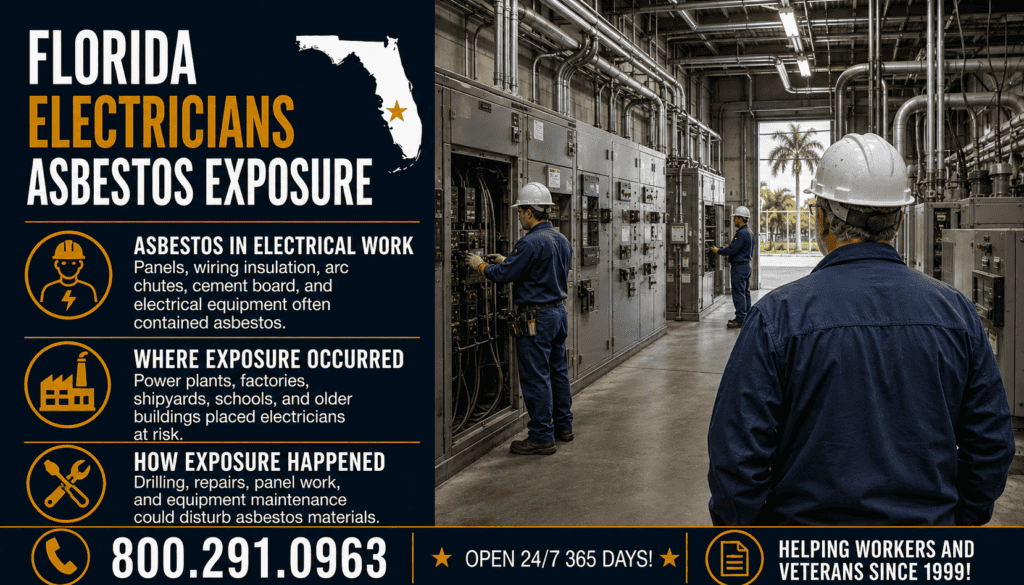
Florida Electricians Asbestos Exposure
Florida electrician asbestos exposure research should connect a worker’s employer, project or facility, electrical duties, work areas and dates to specific building materials or equipment. An electrician job title alone does not prove asbestos exposure.
Electrical work can take place during construction, renovation, industrial maintenance and equipment repair. The surrounding building systems and the worker’s actual tasks therefore matter as much as the trade name.
Florida Electricians Asbestos Exposure Overview
This page focuses on electricians within Florida Workers & Occupational Asbestos Exposure. Research should identify the worker’s assignment, facility or project and the systems accessed.
Electrical work may require entry into ceilings, walls, equipment rooms, industrial areas or other spaces containing older materials. Whether those materials contained asbestos and were disturbed requires evidence.
Electrical Tasks & Work Areas
Research can examine installation, repair, rewiring, panel work, conduit work, equipment maintenance and renovation activities. The key question is what the electrician actually did and what materials or systems were affected.
Separate routine electrical service from demolition or renovation work that may have disturbed surrounding building materials.
| Research Area | Potential Supporting Evidence |
|---|---|
| Employment or assignment | Personnel, union, contractor, department or project records |
| Tasks and locations | Work orders, plans, maintenance files, photographs and firsthand testimony |
| Materials or equipment | Specifications, purchase records, manuals, invoices and product documentation |
Electrical & Building Materials
Historical research may examine electrical equipment, heat-resistant components, panels, wiring systems and surrounding insulation, fireproofing or building materials when supported by records.
Product research is organized under Florida Asbestos Products, while construction-material research is available through Florida Asbestos Products Used in Construction.
Florida Electrical Worksites
Electricians may work in factories, power facilities, commercial buildings, public buildings, construction projects and other settings. A worksite name provides context but not proof of exposure.
Florida site research is organized under Florida Asbestos Exposure Sites & Industries.
Electrical Work Around Machinery
Industrial electricians may work near motors, generators, switchgear, controls and other machinery. Equipment identity, maintenance history and nearby mechanical systems can help narrow historical research.
Equipment-focused research is organized under Florida Equipment & Machinery Asbestos Exposure.
| Evidence Question | Why It Matters |
|---|---|
| Where and when did the work occur? | Connects records to the correct property, project, department or facility period |
| What task was performed? | Distinguishes direct handling from nearby or general workplace presence |
| What material or equipment is supported? | Prevents unsupported assumptions about asbestos content or product identity |
Records for Electrician Exposure Research
Employment records, contractor files, project specifications, electrical drawings, work orders, equipment records, purchase documents, photographs and credible firsthand testimony can help reconstruct electrical work.
Records should be matched to the worker’s dates and assignments rather than assuming that every material documented at a facility was encountered.
Building an Electrician Exposure & Claim History
Create a chronology identifying employer, project or facility, electrical task, work area, equipment or material when supported, coworkers and dates. Record the source behind each connection.
Florida claim topics are organized under Florida Mesothelioma Lawsuits & Claims, with statewide context through the Florida mesothelioma and asbestos exposure section.
No lawsuit or compensation outcome is guaranteed.
Frequently Asked Questions
Does electrician work automatically establish asbestos exposure?
No. The worksite, electrical task, surrounding materials and dates require supporting evidence.
Why examine surrounding building materials?
Electrical work can require access through walls, ceilings and equipment spaces where other materials may be disturbed.
Does a job or building name prove asbestos exposure?
No. Specific tasks, materials, equipment, location and dates require supporting evidence.
Can coworker testimony help?
Yes. Credible firsthand testimony can help describe shared tasks, work areas, equipment and materials.
Should uncertain product information be stated as fact?
No. Preserve uncertainty until reliable evidence supports a specific identification.
What records should be preserved?
Preserve employment, project or facility, equipment, product, medical and witness records when available.
Do modern asbestos records prove older conditions?
Not necessarily. Later surveys or abatement records can be useful leads but must be matched carefully to the earlier period.
Is compensation guaranteed?
No. Evidence, eligibility, applicable law and the particular claim route affect each matter.
Confirmed Sources & Summary
OSHA provides authoritative occupational and regulatory context for asbestos. These sources do not establish that a particular Florida worker, building, project, factory, product or piece of equipment involved asbestos; person- and site-specific conclusions require supporting evidence.
Confirmed Sources
Review Your Florida Work & Exposure History
Call 800.291.0963 or submit the form below to discuss informational resources and possible next steps.
Disclaimer: This page provides general educational information and is not individualized legal or medical advice. Exposure histories, evidence, laws and individual circumstances vary, and no claim or compensation outcome is guaranteed.