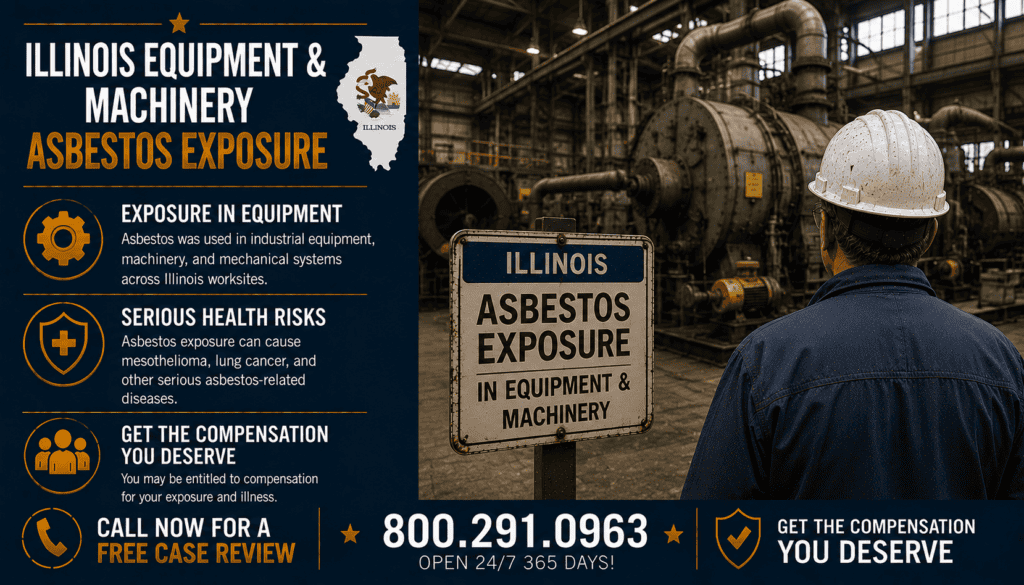
⚙️ Illinois Equipment & Machinery Asbestos Exposure
Illinois power plants, factories, steel mills, refineries, chemical plants, rail facilities, construction sites, utilities, and other industrial workplaces relied on equipment designed to withstand heat, pressure, friction, vibration, and continuous operation.
Historically, some industrial machinery incorporated asbestos-containing insulation, gaskets, packing, seals, friction materials, electrical components, refractory products, and heat-resistant coverings. Workers could encounter these materials while operating, maintaining, repairing, rebuilding, dismantling, or working near older machinery.
Equipment exposure should not be assumed simply because a worker operated an older machine. A stronger exposure history connects:
Illinois Worksite → Equipment → Component → Product → Task → Manufacturer → Exposure Period
That distinction matters because replacement gaskets, packing, insulation, seals, and refractory products could have been manufactured by companies other than the company that built the equipment.
Workers researching the broader Illinois exposure history can also review Illinois Asbestos Exposure Sites & Industries and Illinois Workers & Occupational Asbestos Exposure.
🔥 Why Asbestos Was Used in Industrial Equipment
Industrial equipment frequently operated under conditions requiring materials resistant to heat and fire.
Historically, asbestos could provide:
- Heat resistance
- Fire resistance
- Thermal insulation
- Friction resistance
- Durability
- Reinforcement for some gaskets and seals
- Resistance to deterioration in high-temperature applications
These characteristics made asbestos useful in certain historical boilers, furnaces, turbines, piping systems, pumps, valves, brakes, clutches, electrical systems, and other industrial applications.
Not every machine or component contained asbestos.
The manufacturer, model, replacement parts, product formulation, installation date, and maintenance history can all matter when determining whether asbestos-containing materials were actually present.
🔥 Illinois Boiler Equipment Asbestos Exposure
Boilers were used extensively in Illinois power plants, manufacturing plants, refineries, chemical facilities, hospitals, schools, commercial buildings, and institutional facilities.
Potential historical asbestos-containing materials could include certain:
- Boiler insulation
- Block insulation
- Insulating cement
- Refractory materials
- Door gaskets
- Rope seals
- Steam-pipe insulation
- Valve and flange gaskets
Workers potentially exposed included boilermakers, boiler operators, maintenance mechanics, pipefitters, insulators, welders, stationary engineers, and utility workers.
Repairs and overhauls could be especially important because insulation, gaskets, refractory materials, and other components sometimes had to be removed before the boiler could be serviced.
See Illinois Boiler Equipment Asbestos Exposure.
⚡ Illinois Power Generation Equipment Asbestos Exposure
Power-generation facilities contained interconnected mechanical, electrical, and steam systems.
Equipment could include:
- Boilers
- Turbines
- Generators
- Pumps
- Valves
- Steam piping
- Compressors
- Electrical equipment
- Control systems
- Auxiliary machinery
Potential historical asbestos exposure could involve turbine insulation, insulating blankets, gaskets, packing, steam-line insulation, electrical insulation, insulating boards, fireproofing, and heat-resistant coverings.
Maintenance and scheduled outages are particularly useful periods to investigate because equipment could be opened, dismantled, repaired, reinsulated, and rebuilt.
See Illinois Power Generation Equipment Asbestos Exposure.
Workers can also review Illinois Power Plant Asbestos Exposure and Illinois Power Plant Workers Asbestos Exposure & Mesothelioma.
⚙️ Illinois Industrial Machinery Asbestos Exposure
Factories and industrial facilities throughout Illinois used pumps, valves, compressors, motors, presses, conveyors, furnaces, ovens, machine tools, and other production machinery.
Potential asbestos-containing components varied by equipment and period but could include:
- Gaskets
- Packing
- Seals
- Thermal insulation
- Friction components
- Electrical insulation
- Heat-resistant barriers
- Refractory materials
Maintenance workers often had greater direct contact with these components than workers who simply operated the machinery.
A mechanic rebuilding a pump, for example, might remove old packing and scrape a flange gasket. A millwright dismantling production equipment might encounter insulation, seals, friction materials, or other replacement components.
See Illinois Industrial Machinery Asbestos Exposure.
💧 Illinois Pumps Asbestos Exposure
Industrial pumps moved water, steam condensate, petroleum products, chemicals, cooling fluids, and other materials through Illinois facilities.
Potential historical asbestos-containing components included certain:
- Pump gaskets
- Packing
- Flange gaskets
- Seals
- Insulation on connected piping
Exposure could occur during pump rebuilding, gasket replacement, packing removal, shaft maintenance, and flange work.
Mechanics, millwrights, pipefitters, maintenance employees, refinery workers, chemical-plant workers, and power plant personnel could perform this work repeatedly during their careers.
🔩 Illinois Valves Asbestos Exposure
Valves regulated steam, water, chemicals, fuel, and process fluids.
Potential historical asbestos-containing materials included certain:
- Valve-stem packing
- Bonnet gaskets
- Flange gaskets
- Valve insulation
- Insulating cement
Repairing older valves could involve removing packing, scraping gaskets, opening flanges, or removing surrounding insulation.
For workers who serviced hundreds or thousands of valves during long industrial careers, identifying the valve manufacturer, packing, gaskets, facility, department, and maintenance period can help narrow the exposure history.
♨️ Illinois Industrial Piping Asbestos Exposure
Industrial piping connected boilers, turbines, pumps, valves, furnaces, heat exchangers, and other equipment.
Potential historical materials included:
- Pipe covering
- Lagging
- Insulating cement
- Fitting insulation
- Flange gaskets
- Valve packing
Leak repairs, pipe replacement, valve maintenance, insulation removal, system retrofits, and shutdown work could disturb these materials.
Pipefitters, steamfitters, insulators, welders, mechanics, and maintenance workers were among the trades frequently working around these systems.
See Illinois Pipefitters Asbestos Exposure & Mesothelioma.
🔥 Illinois Furnaces, Ovens & Kilns Asbestos Exposure
Illinois steel mills, foundries, manufacturing plants, heat-treatment operations, and other industrial facilities used high-temperature equipment.
Potential historical asbestos-related materials could include certain:
- Furnace insulation
- Insulating cement
- Refractory materials
- Door seals
- Gaskets
- Heat-resistant panels
- Heat shields
- Electrical insulation
- Protective coverings
Workers could encounter these materials while replacing insulation, rebuilding doors, repairing heating systems, maintaining equipment, or dismantling older machinery.
⚙️ Illinois Compressors Asbestos Exposure
Compressors were common in Illinois refineries, chemical plants, manufacturing facilities, power plants, refrigeration systems, and industrial shops.
Potential historical asbestos-containing components could include certain:
- Gaskets
- Packing
- Seals
- Insulated piping
- Heat-resistant materials
Repeated compressor rebuilding and gasket replacement can be important maintenance tasks when reconstructing an exposure history.
⚡ Illinois Electric Motors & Electrical Equipment Asbestos Exposure
Electric motors powered pumps, fans, compressors, conveyors, production machinery, and auxiliary systems.
Potential historical asbestos-related materials could involve certain:
- Electrical insulation
- Heat-resistant barriers
- Motor-control components
- Insulating boards
- Arc barriers
- Specialized wiring
- Nearby fireproofing
Older switchgear, circuit breakers, motor-control centers, electrical panels, and generator control equipment could also contain heat- or fire-resistant materials.
Not every motor, panel, breaker, transformer, or wire contained asbestos.
Electricians can also review Illinois Electricians Asbestos Exposure & Mesothelioma.
🌬️ Illinois HVAC & Air-Handling Equipment Asbestos Exposure
Older industrial, commercial, institutional, and public buildings could contain asbestos-containing materials associated with heating and ventilation systems.
Potential sources included:
- Duct insulation
- Mechanical insulation
- Gaskets
- Boiler insulation
- Pipe insulation
- Fire-resistant coverings
HVAC mechanics, sheet-metal workers, maintenance employees, pipefitters, insulators, and building engineers could encounter these materials during repair and replacement work.
🚧 Illinois Cranes & Material-Handling Equipment Asbestos Exposure
Illinois steel mills, foundries, factories, warehouses, construction projects, and other industrial facilities relied on cranes and material-handling equipment.
Some historical equipment could contain certain:
- Brake linings
- Friction components
- Electrical insulation
- Gaskets
- Heat-resistant components
Mechanics repairing older braking systems could have more direct contact with these materials than equipment operators.
This illustrates why the maintenance task may matter more than simply identifying the machine.
🚜 Illinois Heavy Equipment Asbestos Exposure
Construction, mining, agriculture, manufacturing, transportation, and industrial operations used equipment such as:
- Excavators
- Loaders
- Bulldozers
- Cranes
- Forklifts
- Tractors
- Earthmoving machinery
Potential historical asbestos-containing components could include certain brakes, clutches, gaskets, heat shields, and seals.
Heavy-equipment mechanics who removed and replaced worn friction and sealing components could have different exposure histories from operators who primarily operated the equipment.
🚗 Illinois Automotive & Brake Equipment Asbestos Exposure
Automotive and fleet maintenance historically involved asbestos-containing friction products.
Potential sources included certain:
- Brake linings
- Brake shoes
- Clutch components
- Gaskets
- Heat-resistant components
Potentially exposed workers included auto mechanics, brake mechanics, fleet mechanics, truck mechanics, municipal mechanics, and heavy-equipment mechanics.
Repair procedures that created dust can be particularly important when reconstructing historical friction-product exposure.
See Illinois Automotive & Brake Equipment Asbestos Exposure and Illinois Automotive Asbestos Products.
🚂 Illinois Railroad Equipment Asbestos Exposure
Illinois railroad facilities used locomotives, rolling stock, mechanical equipment, and repair-shop machinery.
Potential historical asbestos-containing materials could include certain:
- Boiler insulation
- Steam-pipe insulation
- Brake materials
- Gaskets
- Packing
- Electrical insulation
- Engine-room insulation
Potentially exposed workers included machinists, boilermakers, electricians, car repair workers, mechanics, pipefitters, and maintenance employees.
See Illinois Railroad Workers Asbestos Exposure & Mesothelioma and Illinois Railroad Asbestos Exposure.
🏭 Illinois Machine Tools, Presses & Production Equipment
Illinois manufacturing plants used:
- Lathes
- Milling machines
- Grinders
- Presses
- Drills
- Cutting machinery
- Fabrication equipment
- Mechanical presses
- Hydraulic presses
These machines were not universally asbestos-containing.
Potential exposure could instead involve brake components, clutch components, electrical insulation, heat-resistant materials, or asbestos-containing materials associated with nearby boilers, furnaces, piping, and building systems.
Maintenance personnel who replaced worn components could have substantially different exposure histories from production operators.
🔥 Illinois Refractory Equipment Asbestos Exposure
Boilers, furnaces, kilns, ovens, foundry equipment, and industrial heaters relied on refractory systems to withstand high temperatures.
Some historical refractory products contained asbestos; others did not.
Potentially exposed workers included:
- Refractory installers
- Boilermakers
- Furnace workers
- Maintenance crews
- Insulators
- Demolition workers
The specific product and manufacturer should be identified whenever possible rather than assuming that all refractory material contained asbestos.
🧱 Illinois Equipment Insulation Asbestos Exposure
Thermal insulation could be installed around:
- Boilers
- Turbines
- Steam lines
- Furnaces
- Tanks
- Valves
- Ductwork
- Industrial process equipment
Historical insulation products included molded insulation, block insulation, insulating cement, cloth, blankets, and lagging.
Insulators and maintenance workers could have direct contact while installing, repairing, or removing these materials.
See Illinois Asbestos Insulation Products.
🔩 Illinois Gaskets & Packing Asbestos Exposure
Gaskets and packing are especially important when researching machinery-related asbestos exposure.
These components were used in equipment including:
- Pumps
- Valves
- Compressors
- Boilers
- Flanges
- Turbines
- Industrial piping
Workers could encounter them when opening equipment, scraping gaskets, pulling packing, cleaning sealing surfaces, and installing replacement components.
Mechanics, pipefitters, millwrights, steamfitters, and maintenance personnel frequently performed these tasks.
👷 Illinois Workers Who Repaired Industrial Equipment
Equipment exposure frequently depended more on the worker’s task than simply being near machinery.
Potentially exposed occupations included:
- Millwrights
- Mechanics
- Machinists
- Pipefitters
- Steamfitters
- Boilermakers
- Insulators
- Electricians
- Welders
- Maintenance workers
- HVAC technicians
- Equipment operators
- Heavy-equipment mechanics
A worker who repeatedly dismantled and rebuilt machinery could have a very different exposure history from someone who only operated it.
Explore occupation-specific exposure at Illinois Workers & Occupational Asbestos Exposure.
🛠️ Equipment Maintenance & Asbestos Exposure
Maintenance tasks provide some of the most useful clues when reconstructing historical exposure.
Potential tasks included:
- Removing insulation
- Scraping gaskets
- Pulling packing
- Replacing brakes
- Replacing clutches
- Opening boilers
- Rebuilding pumps
- Repacking valves
- Repairing turbines
- Cutting piping
- Removing refractory
These tasks can help identify the specific component and product that should be researched.
🛑 Illinois Plant Shutdowns & Equipment Overhauls
Industrial shutdowns and scheduled outages could concentrate large amounts of maintenance activity into a short period.
Workers might simultaneously:
- Open boilers
- Rebuild turbines
- Remove piping
- Repair pumps
- Replace valves
- Remove insulation
- Replace refractory
- Upgrade electrical systems
Workers who participated in repeated Illinois shutdowns should document the facility, year, equipment, contractor, trade, department, work area, and coworkers involved.
🏚️ Machinery Removal, Renovation & Industrial Demolition
Asbestos exposure could also occur when older machinery was dismantled or removed.
Potential activities included:
- Cutting equipment apart
- Removing insulation
- Disconnecting piping
- Removing gaskets
- Breaking refractory
- Dismantling electrical systems
- Removing structural components
Historical removal practices may have differed significantly from modern asbestos-control procedures.
This makes the date and circumstances of equipment removal or demolition important parts of the exposure history.
🏭 Illinois Industries Where Asbestos-Containing Equipment Was Used
Equipment-related exposure could occur across numerous Illinois industries, including:
- Power generation
- Steel production
- Foundries
- Oil refining
- Chemical manufacturing
- Machinery manufacturing
- Automotive manufacturing
- Railroads
- Construction
- Mining
- Agriculture
- Utilities
- Food processing
- Public infrastructure
The same type of pump, boiler, valve, compressor, motor, or industrial machinery could appear in many industries.
This is why equipment information should be connected to the actual Illinois facility where the worker encountered it.
Research facility-specific exposure through Illinois Asbestos Exposure Sites & Industries.
🗺️ Match Illinois Equipment to the Worksite
Equipment research becomes considerably more useful when connected to a specific facility.
Document:
- Facility name
- City
- County
- Employer
- Department
- Occupation
- Equipment manufacturer
- Equipment model
- Years worked
- Maintenance responsibilities
- Contractors
- Coworkers
Geographic research can also begin with Illinois Counties Asbestos Exposure & Lawsuits.
🏷️ Equipment Manufacturer vs. Asbestos Product Manufacturer
This distinction is especially important.
A worker may clearly remember the manufacturer of a:
- Boiler
- Pump
- Turbine
- Valve
- Compressor
- Motor
- Industrial machine
That does not automatically mean that equipment manufacturer produced the asbestos-containing material involved in the worker’s exposure.
Replacement gaskets, packing, insulation, seals, and refractory materials could have come from separate manufacturers.
📁 How to Research Illinois Equipment & Machinery Exposure
Workers and families can begin with information they already know:
- Illinois employer
- Facility
- Employment dates
- Occupation
- Department
- Equipment
- Equipment manufacturer
- Model
- Repair tasks
- Replacement components
- Contractors
- Coworkers
Historical records may include:
- Equipment manuals
- Maintenance logs
- Work orders
- Engineering drawings
- Procurement records
- Plant photographs
- Union records
- Contractor records
- Coworker statements
Even remembering the equipment manufacturer or department can provide a useful starting point.
👨👩👧 Secondhand Exposure From Equipment Maintenance
Workers who disturbed asbestos-containing machinery components could potentially carry fibers away from the facility on:
- Work clothing
- Boots
- Hair
- Gloves
- Tools
Family members handling contaminated work clothing could potentially experience secondary exposure.
For take-home exposure research, first reconstruct the original worker’s occupation, facility, equipment, components, and maintenance duties.
🫁 Diseases Associated With Equipment-Related Asbestos Exposure
Asbestos exposure is associated with diseases that may develop many years after exposure, including:
- Mesothelioma
- Asbestos-related lung cancer
- Asbestosis
- Pleural plaques and pleural thickening
A diagnosis does not by itself identify which machine or component was responsible for exposure. The occupational and equipment history needs to be reconstructed separately.
Workers diagnosed with asbestos-related lung cancer can also review Illinois Asbestos Lung Cancer Lawsuits.
⚖️ Illinois Equipment & Machinery Asbestos Lawsuits
A potential asbestos claim involving machinery may require evidence connecting several elements:
Worker → Worksite → Equipment → Component → Asbestos Product → Manufacturer/Supplier → Exposure → Disease
Relevant evidence may include:
- Employment history
- Facility records
- Equipment records
- Maintenance duties
- Product identification
- Coworker testimony
- Medical diagnosis
- Applicable Illinois law
The presence of old machinery alone does not establish asbestos exposure or legal responsibility.
For Illinois legal information, see Illinois Mesothelioma Lawsuits & Claims.
💰 Illinois Equipment & Machinery Asbestos Trust Fund Claims
Some companies that historically manufactured asbestos-containing industrial products later entered bankruptcy and established asbestos trusts.
Potential historical products associated with machinery could include:
- Insulation
- Gaskets
- Packing
- Refractory materials
- Other asbestos-containing components
Eligibility depends on the requirements of the individual trust and the evidence connecting the worker to qualifying products or exposure.
See Illinois Asbestos Trust Fund Claims.
⏱️ Illinois Equipment Asbestos Filing Deadlines
Asbestos-related lawsuits are subject to filing deadlines.
The applicable period can depend on:
- Diagnosis
- Date of death
- Type of claim
- Applicable law
- Jurisdiction
- Exposure history
- Prior proceedings
Workers and families should not assume the filing period began when the equipment was originally installed or when the worker first operated it.
See Illinois Mesothelioma Statute of Limitations.
❓ Frequently Asked Questions About Illinois Equipment & Machinery Asbestos Exposure
Did all old Illinois industrial machinery contain asbestos?
No. Some historical machinery incorporated asbestos-containing components, while other equipment did not. The machine, component, manufacturer, product formulation, replacement parts, and time period should be investigated.
Which types of industrial equipment could have asbestos-containing components?
Potential historical applications included boilers, turbines, pumps, valves, compressors, furnaces, industrial ovens, electrical equipment, brakes, clutches, and associated piping systems.
Were gaskets an important potential exposure source?
Some historical industrial gaskets contained asbestos. Mechanics, pipefitters, millwrights, and maintenance workers could encounter gasket material while opening equipment, removing old gaskets, scraping sealing surfaces, and installing replacements.
Did all valve packing contain asbestos?
No. Packing materials varied by manufacturer, application, and time period.
Could workers be exposed while repairing pumps?
Potentially. Some historical pump gaskets and packing contained asbestos. Exposure depends on the actual component and work performed.
Could electrical equipment contain asbestos?
Some older electrical components used asbestos-containing insulating or fire-resistant materials, but not all electrical equipment contained asbestos.
Does remembering an equipment manufacturer prove asbestos exposure?
No. The equipment manufacturer’s name can provide an important research lead, but it does not automatically identify the manufacturer of a gasket, packing material, insulation product, or other asbestos-containing component.
Can equipment exposure be reconstructed decades later?
Potentially. Maintenance records, manuals, work orders, engineering drawings, historical photographs, contractor records, union records, and coworker statements can help reconstruct equipment and maintenance history.
🔗 Related Illinois Asbestos Exposure Resources
- Illinois Asbestos Exposure & Mesothelioma
- Illinois Counties Asbestos Exposure & Lawsuits
- Illinois Asbestos Exposure Sites & Industries
- Illinois Workers & Occupational Asbestos Exposure
- Illinois Asbestos Products
- Illinois Mesothelioma Lawsuits & Claims
☎️ Call 800.291.0963 — Open 24/7, 365 Days
If you or a family member worked around industrial equipment or machinery in Illinois and later developed mesothelioma or another asbestos-related disease, documenting the worksite, occupation, equipment, manufacturer, components, maintenance tasks, contractors, coworkers, and employment years can help reconstruct historical exposure.
MesotheliomaHelp.Center provides legal and medical information about asbestos exposure, mesothelioma, asbestos claims, trust funds, filing deadlines, and related options.