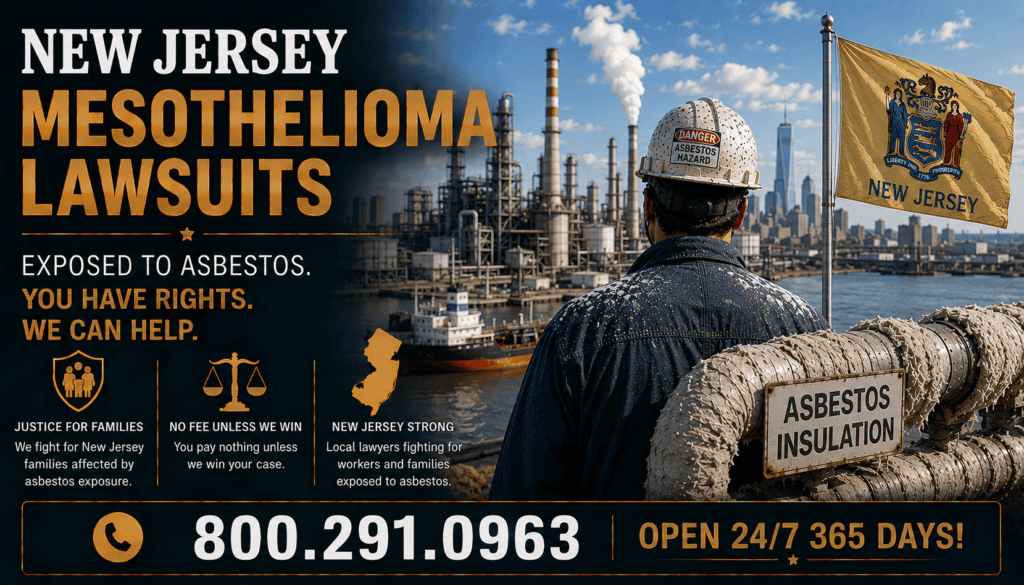
New Jersey Mesothelioma Lawsuits
New Jersey Mesothelioma Lawsuits and asbestos lung cancer claims can involve exposure histories developed over decades. Historical work in shipyards and maritime work, oil refining and chemical processing, manufacturing, power generation, construction, transportation and industrial maintenance can provide useful research leads, but a state, employer, industry or job title alone does not prove that a particular person encountered asbestos.
This statewide resource connects New Jersey exposure research with verified local and topic-specific pages, medical and work-history evidence, claim routes and filing considerations. The goal is to move from broad historical leads to person-specific documentation without unsupported exposure totals, generic payout figures or guaranteed outcomes.
New Jersey Mesothelioma Lawsuit Overview
A useful New Jersey investigation starts with a chronology: employers, job sites, military assignments, residences, dates, departments and recurring tasks. Employment files, Social Security work histories, union records, military records, building documents, purchasing records, photographs and coworker information may each answer different parts of the exposure question.
Diagnosis and exposure-source evidence should be evaluated separately. Medical records can establish diagnosis and treatment, while work, product and witness evidence can help identify where exposure may have occurred. A diagnosis does not automatically establish a particular job site, product, manufacturer or responsible entity.
For broader geographic research, see Mesothelioma Lawsuits in All 50 States.
Asbestos Exposure History in New Jersey
Historical New Jersey exposure research may include shipyards and maritime work, oil refining and chemical processing, manufacturing, power generation, construction, transportation and industrial maintenance. Older insulation, gaskets, packing, cement products, floor tile, roofing, fireproofing, joint compounds and friction materials can be relevant depending on the site, product, dates and work performed.
The key question is not simply whether asbestos existed in an industry, but whether actual tasks could have disturbed a particular material. Repair, cutting, grinding, removal, demolition and equipment overhaul can be important research points. Original equipment and later replacement components should be investigated separately because manufacturers and suppliers may differ.
New Jersey Counties, Cities & State Resources
A strong state resource should lead users to narrower evidence rather than repeat a generic statewide introduction. Verified local and statewide pages below provide more specific research paths. Geographic presence remains a lead, not proof of individual exposure.
Verified New Jersey Local Research Pages
- Bergen County Asbestos Exposure Lawsuits
- Essex County Asbestos Exposure Lawsuits
- Hudson County Asbestos Exposure Lawsuits
- Middlesex County Asbestos Exposure Lawsuits
- Monmouth County Asbestos Exposure Lawsuits
- Union County Asbestos Exposure Lawsuits
Statewide New Jersey Research Pages
| Research Layer | Purpose |
|---|---|
| State exposure history | Identifies industries and work settings worth researching. |
| County and city research | Narrows employers, projects and local work histories. |
| Occupation and product research | Connects tasks, equipment and materials to the chronology. |
| Asbestos lung cancer | Routes users to diagnosis-specific medical and exposure information. |
| Claims and deadlines | Separates lawsuits, trusts, benefits and timing questions. |
Industries, Jobs & Asbestos Products
Trades that can warrant closer historical review include pipefitters, boilermakers, electricians, millwrights, machinists, mechanics, insulators, construction workers, maintenance employees, power-plant workers, railroad workers and custodial personnel. Job title alone is not proof; actual duties, work areas and materials matter. See High-Risk Jobs Asbestos Exposure.
Product catalogs can show market availability but not site-specific use. Purchase orders, invoices, specifications, photographs, testimony and maintenance records may provide stronger evidence that a particular product or replacement component was present at a particular location.
Veterans may need a separate service-history review through Military & Veterans Asbestos Exposure.
Building a New Jersey Exposure Evidence File
Build the evidence file year by year. Record employers, facilities, departments, supervisors, coworkers, contractors, equipment and maintenance tasks. Then identify documents or witnesses that may corroborate each entry. This method can reveal gaps, overlapping exposures and work performed in more than one state.
Secondhand exposure can also be investigated by documenting the household worker’s employer, duties, work clothing or tools, dates and the circumstances in which fibers may have been carried home. It should not be presumed merely from a family relationship.
| Evidence Question | Why It Matters |
|---|---|
| Where was the person physically working? | Separates corporate addresses from actual work locations. |
| What tasks were performed? | Helps determine whether materials may have been disturbed. |
| Which products or equipment were present? | Provides manufacturer, supplier and contractor leads. |
| Who can corroborate the history? | Coworkers and family members may help confirm tasks or conditions. |
| What records remain? | Guides requests for employment, military, building and purchasing documents. |
New Jersey Mesothelioma & Asbestos Lung Cancer Claims
Mesothelioma and asbestos-related lung cancer are distinct diagnoses and should not be treated as interchangeable. The dedicated New Jersey Asbestos Lung Cancer Lawsuits page addresses lung-cancer-specific medical evidence, work histories, products, exposure research and filing considerations. Smoking history may be medically relevant to lung cancer, while asbestos remains an independent occupational hazard; those issues should be documented separately.
Potential routes can include civil litigation, asbestos trust fund claims, and in appropriate circumstances veterans or other benefit programs. These are separate processes with different requirements. Compensation is not guaranteed, and another person’s settlement or verdict does not establish the value or validity of a different claim.
See Mesothelioma Legal Options & Rights for general background.
Filing Deadlines & Jurisdiction in New Jersey
There is no single deadline statement that can safely resolve every New Jersey asbestos matter. Claim type, diagnosis or death date, jurisdiction, trust procedures and other facts may affect timing. Exposure in multiple states can also create jurisdiction and choice-of-law questions.
Use Mesothelioma Filing Deadlines as general educational background and evaluate current law against the individual facts before relying on a deadline.
Frequently Asked Questions
Does a mesothelioma diagnosis prove where exposure occurred?
No. Diagnosis and exposure-source evidence are separate.
Does living or working in New Jersey prove asbestos exposure?
No. Geography is a research lead; tasks, materials, locations and dates still need support.
Does a product catalog prove use at a New Jersey site?
No. It may show availability, while site-specific records or testimony are stronger evidence of actual use.
Can secondhand exposure be investigated?
Yes. The worker’s job, tasks, clothing practices, household contact and dates can be reconstructed.
Are asbestos trust claims the same as lawsuits?
No. They are separate processes with different procedures and proof requirements.
Does another asbestos lawsuit prove my exposure?
No. Another claim can be a research lead, but each person’s history needs independent support.
Is there one filing deadline for every New Jersey case?
No. Timing depends on claim type, jurisdiction and individual facts.
Is compensation guaranteed?
No. Eligibility and outcomes depend on evidence, applicable law, responsible parties and individual circumstances.
Confirmed Sources & Summary
OSHA identifies asbestos as a recognized occupational hazard and describes historical uses including pipe insulation, floor tiles, building materials, vehicle brakes and clutches. OSHA also identifies construction and ship repair as settings where heavy exposure can occur, particularly during removal, renovation, repair or demolition. This general source does not prove an individual New Jersey exposure history or legal claim.
Confirmed source: OSHA — Asbestos.
Summary: Start with the person’s chronology, move into verified local and state resources, corroborate jobs and tasks, identify products carefully, distinguish original from replacement components, and evaluate each claim route separately.
Review Your New Jersey Exposure & Claim History
Call 800.291.0963 or submit the form below to discuss informational resources and possible next steps.
Disclaimer: This page provides general educational information and is not individualized legal or medical advice. Exposure histories, evidence, laws and individual circumstances vary, and no claim, settlement, verdict or compensation outcome is guaranteed.