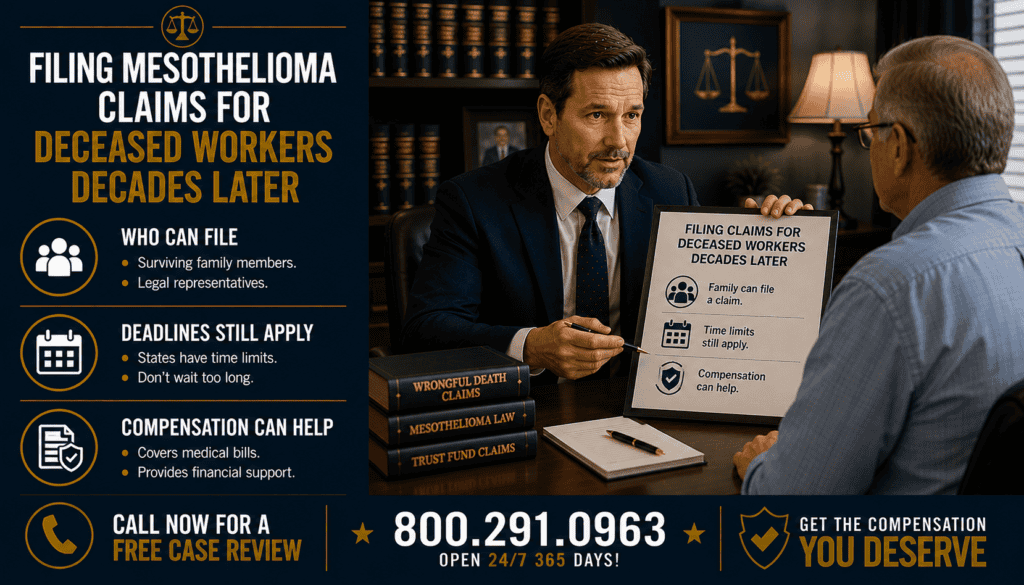
Filing Mesothelioma Claims for Deceased Workers Decades Later
Families sometimes discover years—or even decades—after a worker’s death that the person’s illness may have been connected to occupational asbestos exposure. Old employment records, ship or military records, union files, coworkers and historical product information may still help reconstruct what happened. But the age of the exposure and the availability of evidence are only part of the analysis.
The first legal question is usually whether any claim remains timely and legally available. Wrongful-death claims, survival or estate claims, pending lawsuits and asbestos bankruptcy trust claims follow different rules. A worker’s death decades ago does not automatically mean a claim is available today, and finding new exposure evidence does not necessarily restart an expired statute of limitations.
🕊️ Can a Claim Be Filed Decades After a Worker Died?
Possibly in some circumstances, but there is no universal rule allowing a new mesothelioma claim simply because historical evidence has recently been found. State law determines who may file wrongful-death and survival claims, what deadlines apply, when those periods begin, and whether any exception or tolling rule is available.
The worker’s exposure itself may have occurred many decades before disease developed. That long asbestos latency is different from waiting decades after the worker’s death to bring a claim. The relevant diagnosis, death, prior filing and discovery dates should be separated carefully.
Start with the Mesothelioma Wrongful Death Lawsuits hub.
1️⃣ First Determine What Claim Is Being Considered
Post-death asbestos matters can involve different legal rights. A wrongful-death claim generally concerns losses recognized by the governing statute because of the death. A survival action preserves a qualifying claim belonging to the deceased person. A pending lawsuit may require substitution of an authorized representative. Bankruptcy trust claims follow the procedures of individual trusts.
| Possible route | Core question | Important distinction |
|---|---|---|
| Wrongful death | Who may seek losses resulting from the death? | Created and limited by applicable state law. |
| Survival or estate claim | Did a qualifying claim belonging to the worker survive death? | Different from survivors’ own wrongful-death losses. |
| Pending lawsuit | Can an authorized person continue the existing action? | Procedural substitution rules can apply. |
| Asbestos trust claim | Does evidence satisfy a particular trust’s requirements? | Governed by trust documents, not ordinary civil pleading rules. |
See Filing After Death: Mesothelioma Lawsuits and Filing a Wrongful Death Claim for Asbestos Exposure.
2️⃣ Check the Deadline Before Reconstructing the Entire Case
Families should not spend months rebuilding a historical exposure record before checking whether a legally viable filing route may remain. Wrongful-death, survival, substitution, probate and trust deadlines can run on separate tracks.
An online article cannot determine whether a decades-old claim is timely. The governing state, date of death, diagnosis history, prior claims, identity of the claimant and any legally recognized exception can matter. Newly locating a coworker or product record should not be assumed to restart a civil filing period.
Use the site’s State-by-State Mesothelioma Filing Deadlines only as a research starting point.
3️⃣ Why an Old Death Does Not Create One Simple Answer
The phrase “decades later” can describe several different situations. A worker may have been exposed 40 years ago but died recently. Another worker may have died 20 years ago. A third may have filed a lawsuit before death that was never fully resolved. Those situations should not be treated as legally equivalent.
| Situation | Question to investigate |
|---|---|
| Exposure decades ago, recent death | Current wrongful-death, survival and limitations rules. |
| Death occurred many years ago | Whether any filing period remains open or a recognized exception applies. |
| Lawsuit pending at death | Survival and substitution procedure. |
| Old settlement or release | Which claims and defendants were resolved. |
| Prior trust submission | Which trust, exposure history and disposition. |
4️⃣ Confirm the Diagnosis and Cause-of-Death Record
Locate pathology reports, hospital records, oncology records, death certificate and any autopsy or occupational-medicine records that still exist. The objective is to establish what condition was diagnosed, when it was diagnosed and what medical evidence survives.
A death certificate can be important but should not be treated as the sole proof of occupational exposure or defendant responsibility. Medical evidence and exposure evidence answer different questions.
5️⃣ Reconstruct the Worker’s Employment History
Start with a chronological list of employers, occupations, work locations and approximate dates. Social Security earnings information, personnel files, union records, pension files, military service records, tax documents, pay records and family papers may help reconstruct missing periods.
When exact dates are unavailable, label estimates as estimates. Avoid converting a family recollection into an exact date unless another record supports it.
6️⃣ Rebuild the Asbestos Exposure Timeline
For each job, identify the physical site and the worker’s actual tasks. Record nearby trades, equipment, insulation, piping, boilers, gaskets, construction materials or other potential asbestos sources remembered by family or coworkers.
Historical research can supplement memory, but it should not replace proof that connects the particular worker to the relevant location, period and activity.
7️⃣ Identify Products, Equipment and Companies Carefully
Old catalogs, invoices, specifications, maintenance manuals, photographs and facility records can help identify products or manufacturers associated with a job site. Corporate-successor research may also be necessary when companies changed names, merged or entered bankruptcy.
Do not identify a defendant solely because a company sold asbestos products during the same era. Evidence should connect the company or product to the worker’s actual exposure history under the governing legal standard.
8️⃣ Locate Coworkers and Other Witnesses
Former coworkers may provide firsthand information about job duties, materials, equipment and work areas. Family members may also have relevant knowledge about work clothes, employment locations, illness history or documents kept at home.
Record what each witness personally remembers and how the witness knows it. Avoid supplying product names or dates for a witness to adopt when the witness does not independently remember them.
9️⃣ Find Historical Records When the Job Site Is Gone
A closed factory, demolished shipyard or defunct employer does not necessarily mean all records disappeared. Potential sources can include archives, libraries, unions, government agencies, military repositories, successor companies, court records, bankruptcy files, historical societies and former employees.
| Record source | What it may help establish | Limitation |
|---|---|---|
| Employment/payroll record | Employer and work period | May not identify asbestos product. |
| Ship/base/facility record | Location and equipment | Does not prove personal exposure by itself. |
| Invoice/specification | Product or manufacturer at site | Must be connected to worker and time period. |
| Historical photograph | Layout, equipment or work conditions | Appearance alone does not prove asbestos content. |
| Coworker statement | Tasks and firsthand observations | Memory should be checked against dates and records. |
🔟 Determine Who Has Authority to Act
The person gathering records is not automatically the person legally authorized to file. State wrongful-death statutes determine eligible claimants, while survival claims often involve an estate representative or recognized successor.
Probate may be necessary to appoint an executor or administrator for certain claims or assets, but probate and wrongful-death procedures should not be treated as identical. See How Probate Affects Mesothelioma Lawsuits, What Executors Should Know About Asbestos Claims, and Probate and Asbestos Claims: Executor Responsibilities.
📂 Check Whether a Lawsuit or Claim Was Ever Filed
Before treating the matter as a new claim, search family records for attorney correspondence, complaints, settlement papers, releases, trust claim forms, court case numbers and payment records. A prior settlement or judgment can materially affect what remains available.
If a worker died while a federal lawsuit was pending and the claim was not extinguished, Federal Rule of Civil Procedure 25 provides a substitution procedure. The rule states that a substitution motion may be made by a party or the decedent’s successor or representative and sets a 90-day period after service of a statement noting the death, subject to the rule and potential extensions under Rule 6. That federal procedural rule should not be confused with a state wrongful-death filing period.
🏦 Investigate Asbestos Bankruptcy Trust Claims Separately
A company responsible for historical asbestos exposure may have entered bankruptcy and established a trust. Trust claims are governed by each trust’s eligibility criteria, exposure requirements, medical standards and filing procedures.
The existence of a trust does not prove that the deceased worker qualifies. Conversely, the disappearance of the original company does not necessarily mean that no trust-related route exists. Identify the company, successor history, trust documents and worker-specific exposure evidence.
🧾 What Older Evidence Can—and Cannot—Prove
Decades-old evidence often works cumulatively. An employment record may place the worker at a plant. An invoice may place a product there. A coworker may remember the worker performing a particular task. None should automatically be treated as proving every element by itself.
Preserve originals and document where copies came from. If a source is uncertain, say so. Building a credible historical record is more useful than filling gaps with assumptions.
✅ Step-by-Step Review for an Older Deceased-Worker Claim
- Record the worker’s full name, diagnosis date and date of death.
- Determine whether a lawsuit, trust claim or settlement already existed.
- Identify the potentially applicable state or states.
- Check wrongful-death, survival and other relevant deadlines immediately.
- Determine who has legal authority to act.
- Collect pathology, treatment and death records.
- Build a chronological employment history.
- Map each important asbestos exposure location.
- Identify products and companies only when supported by evidence.
- Locate coworkers and other firsthand witnesses.
- Search historical facility, union, military and corporate records.
- Investigate potentially relevant bankruptcy trusts separately.
- Preserve prior releases, settlements and claim submissions.
- Keep a source note for every historical document.
- Obtain a case-specific deadline and viability review before assuming an old claim can be filed.
❓ Frequently Asked Questions
Can a family file a mesothelioma claim 20 or 30 years after a worker died?
Possibly only in limited circumstances depending on the claim, jurisdiction, prior filings and applicable deadlines. The passage of decades makes a case-specific limitations review essential.
Does finding new asbestos evidence restart the statute of limitations?
Do not assume so. Discovery and tolling doctrines vary by jurisdiction, and newly locating evidence is not a universal restart rule.
What if the worker was exposed 40 years ago but died recently?
That is different from a worker who died 40 years ago. Mesothelioma can have a long latency, and state law determines the accrual and wrongful-death rules that apply.
What if no lawsuit was filed before death?
A wrongful-death or survival route may still need to be evaluated under applicable state law, facts and deadlines. Lack of a prior lawsuit does not by itself answer whether a current claim exists.
What if a lawsuit was already pending?
Applicable survival law and court procedure determine whether it continues and who may be substituted. Federal Rule 25 contains a substitution procedure for federal cases when the claim is not extinguished.
Who can file for a deceased worker?
That depends on the claim and state law. It may involve an estate representative, specified survivors or another authorized person.
Can an old death certificate prove an asbestos case?
No single document usually proves the entire case. A death certificate may help establish medical and timing facts, while separate evidence is needed for exposure and defendant responsibility.
What if the employer no longer exists?
Historical records, successor companies, bankruptcy trusts, archives and former coworkers may still provide relevant information. The legal route depends on the specific company and evidence.
Can family members reconstruct exposure without the worker’s testimony?
Potentially. Employment records, coworkers, facility documents, product evidence and other historical sources can help, but the absence of firsthand worker testimony can affect what can be proven.
Does probate have to be opened?
Sometimes an estate representative must be appointed, particularly for an estate or survival claim. Wrongful-death standing and probate requirements vary by state.
Can asbestos trust claims still be investigated after death?
Yes, potential trust eligibility can be investigated, but each trust’s current procedures, deadlines and evidence requirements must be checked.
Should a family assume a decades-old case is too late?
No conclusion should be based on age alone. The correct approach is to identify the claim and jurisdiction, review the governing deadline and prior filing history, and then determine whether a legally available route remains.
📞 Request a Case Evaluation
If a worker in your family died after a mesothelioma diagnosis and you are now investigating occupational asbestos exposure, gather the death certificate, pathology or medical records, employers, job sites, military service if applicable, coworker names, prior attorney correspondence and any old settlement or trust documents.
Call 800.291.0963 for a no-obligation case evaluation. Talk to a real person 24/7, 365 days a year. There are no out-of-pocket legal fees for a contingency-fee claim unless compensation is recovered. Submit your case here.
📝 Summary
Mesothelioma claims involving deceased workers decades later require two separate investigations: whether a legal claim remains available and whether enough reliable evidence exists to prove it. Families should first identify the type of claim, governing jurisdiction, filing deadlines, prior lawsuits or settlements and the person authorized to act. Historical employment, medical, facility, product and witness evidence can then be assembled carefully. The fact that exposure occurred decades ago is common in mesothelioma cases; the fact that a worker died decades ago raises a separate limitations question that must be evaluated under current applicable law.
🔗 Confirmed Sources
- Cornell LII — Survival Statute
- Cornell LII — Federal Rule of Civil Procedure 25, Substitution of Parties
- Cornell LII — Federal Rule of Civil Procedure 6, Computing and Extending Time
Disclaimer: General information only—not legal advice. This website is not a law firm. Wrongful-death, survival, probate, substitution and asbestos trust rules vary by jurisdiction and can change. The age of an exposure or death does not by itself establish whether a claim is timely. Do not rely on this page to calculate a filing deadline or determine legal eligibility. No prior result guarantees a future outcome.