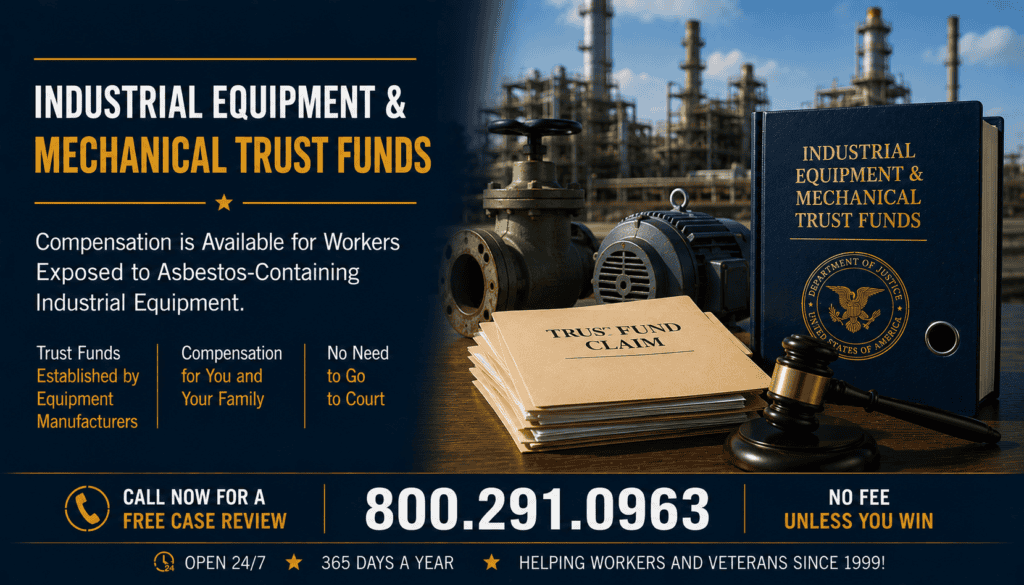
⚖️ Industrial Equipment & Mechanical Trust Funds
Industrial equipment and mechanical asbestos trust claims may be available to people with qualifying asbestos-related diseases and documented exposure to covered products or entities. Eligibility is determined by each trust’s governing procedures.
Older pumps, valves, boilers, turbines, compressors, and mechanical systems sometimes contained asbestos in insulation, gaskets, packing, or other components. Identifying the correct company and the materials handled is central to evaluating a claim.
On This Page
⚖️ How Industrial Equipment Asbestos Trusts Work
Industrial equipment and mechanical asbestos trusts are not a single compensation program. They are separate trusts associated with particular bankruptcy proceedings, covered entities, and asbestos liabilities. Each trust applies its own Trust Distribution Procedures, medical criteria, exposure rules, documentation standards, and payment percentage. A company name appearing on an equipment list does not, by itself, establish an available trust or eligibility.
Asbestos was used historically in certain machinery insulation, seals, gaskets, valve packing, boiler components, and other heat-resistant products. Workers servicing older machinery sometimes disturbed these materials during routine shutdowns, emergency repairs, and overhauls. The responsible company may be an equipment maker, replacement-part supplier, insulation manufacturer, contractor, or a combination of businesses.
Claims are generally evaluated by connecting a qualifying diagnosis to exposure attributable to a covered company or product during relevant years. A worker may have operated a machine without ever disturbing asbestos; another worker may have removed deteriorated packing repeatedly. The actual tasks and materials matter more than a job title alone. Start with the broader asbestos trust funds overview for the underlying legal framework.
⚙️ Equipment and Mechanical Components
Boilers, steam turbines, pumps, valves, compressors, generators, industrial furnaces, and heat exchangers were common in older industrial facilities. Some installations used asbestos-containing insulation or replaceable parts, but not every machine or component contained asbestos. Equipment model, manufacturing period, replacement history, and site specifications can change the exposure assessment.
Pump and valve maintenance often involved opening housings, removing flange gaskets, scraping sealing surfaces, and replacing packing. Boiler and turbine work could involve insulation removal, access-panel opening, refractory repairs, and adjacent pipe work. These tasks differ in frequency and dust potential, so employment descriptions should identify the specific operation rather than simply naming the machine.
The Yarway trust article and Leslie Controls article provide starting points for researching valve-related companies and their trust documentation. The Skinner Engine article covers another equipment-related name. These are links to topic pages, not confirmation that a specific product or claimant is covered.
🏭 Industrial and Mechanical Trust Article Directory
The articles below are grouped by historical business context to make navigation easier. Company names and article titles are not substitutes for official trust documentation. Some entities may be associated with reorganizations, successors, or differently named trusts; confirm the current administering trust, covered entities, and claim requirements before filing.
Boiler and power-generation readers can review Babcock & Wilcox Co. Asbestos Trust and Combustion Engineering, Inc. Asbestos Trust. Engineering and project work may involve Stone & Webster Engineering Asbestos Trust, Burns and Roe Enterprises, Inc. Asbestos Trust, and ABB Lummus Global, Inc. Asbestos Trust. These articles help distinguish equipment manufacture from engineering, installation, and contracting activities.
For sealing and component questions, review Garlock Co. Asbestos Trust, Flexitallic, Inc. Asbestos Trust Fund, Durabla Asbestos Trust Fund, and Hercules Chemical Co., Inc. Asbestos Trust. Their relevance depends on actual products, covered liabilities, and documented work history, rather than the general fact that a person maintained pumps or pipes.
Additional company-specific topics include Utex Industries, Inc. Asbestos Trust, H.K. Porter Co. Ltd. Asbestos Trust, Halliburton Energy Services, Inc. Asbestos Trust Fund, and DII Industries LLC Asbestos Trust. Workers should verify which corporate entity or trust is responsible for the product at issue and avoid assuming that similarly named businesses share liabilities.
Contractor and industrial-service research may also involve C.E. Thurston & Sons, Inc. Asbestos Trust, Bartells Asbestos Settlement Trust Fund, API, Inc. Asbestos Settlement Trust, A.P.I. Group, Inc. Asbestos Trust, A.B.B. Global Inc. Asbestos Trust. Separate article titles do not necessarily mean separate currently operating funds; duplicate or overlapping company names should be reconciled against primary records.
📍 Where Exposure May Have Occurred
Workplace conditions can clarify how mechanical asbestos exposure occurred. The strongest descriptions identify the location, equipment, material disturbed, dates, and whether work took place nearby. An operator who stayed in a control room may have a different history from a mechanic who removed worn gaskets during every plant shutdown.
Equipment installed at a shipyard, refinery, power station, paper mill, chemical facility, or military base may have been serviced by multiple trades. Contractors and maintenance crews sometimes worked on adjacent systems while asbestos insulation or sealing products were disturbed. Worksite and coworker information can help connect these activities to a specific employer and time period.
| Work Area | Potential Exposure Activity |
|---|---|
| Power plants and boiler rooms | Boiler insulation, turbine seals, valve packing, and steam-line maintenance |
| Refineries and chemical plants | Pump overhauls, compressor servicing, flange-gasket removal, and shutdown work |
| Shipyards and engine rooms | Pump and valve repairs near insulated steam and propulsion systems |
| Manufacturing plants | Production-line maintenance involving heated equipment and mechanical seals |
| Commercial and institutional buildings | Older heating plants, mechanical rooms, and boiler-system servicing |
👷 Occupations and Exposure Circumstances
Millwrights, pipefitters, steamfitters, boilermakers, industrial mechanics, machinists, electricians, and maintenance personnel may have handled older asbestos-containing components. The occupational label alone does not prove exposure. Tasks such as scraping old gaskets, removing thermal insulation, cleaning machinery, and replacing valve packing provide more meaningful evidence.
Power plant and refinery personnel may have worked through scheduled shutdowns involving many pieces of machinery at once. Shipyard trades could service engine-room pumps, boilers, and piping in enclosed spaces. Construction and engineering contractors might install equipment without touching the asbestos products later used for servicing. Distinguishing installation from subsequent maintenance is therefore important.
Workers who moved between employers should reconstruct a year-by-year timeline, including union assignments, contractor names, jobsite addresses, and major equipment overhauls. A careful timeline can help separate possible exposures involving different companies and prevent claims from relying on an inaccurate or overly broad employment narrative.
📁 Records and Evidence for Trust Claims
Useful evidence often comes from several sources rather than one definitive document. Employment and Social Security records establish dates and employers, while maintenance logs, parts lists, engineering drawings, and vendor invoices may identify machinery or replacement materials. Coworker statements can help explain which tasks were performed and how frequently.
Equipment nameplates and serial numbers may identify an original manufacturer, but a replacement gasket or insulation blanket could have come from another company. Product identification should therefore distinguish original equipment from aftermarket parts and materials installed during later repairs. Trust rules can address these distinctions differently.
Medical documentation is a separate requirement. Pathology, imaging, physician reports, and other records may support a diagnosed disease, but they do not independently identify a responsible manufacturer. The medical and exposure portions of a claim should be supported without exaggerating either.
| Record | What It Can Establish |
|---|---|
| Employment and union records | Dates, employers, trades, and project assignments |
| Equipment drawings and nameplates | Equipment make, model, and installed location |
| Parts catalogs and vendor invoices | Potential replacement gasket, packing, and insulation suppliers |
| Maintenance and shutdown logs | Specific repair activities and periods of disturbance |
| Medical and pathology records | Documented diagnosis and disease category |
| Coworker statements | Firsthand descriptions of equipment, tasks, and working conditions |
🫁 Mesothelioma and Asbestos-Related Lung Cancer
Mesothelioma is a cancer strongly associated with asbestos exposure, often diagnosed decades after exposure. A diagnosis should be evaluated by qualified medical professionals using appropriate clinical tests. Evidence of disease and evidence tying exposure to a covered company are separate components of a potential trust claim.
Asbestos-related lung cancer may also qualify under certain trust procedures, depending on medical and exposure criteria. Not every lung cancer is caused by asbestos, and smoking history or other factors may be relevant to clinical and claims evaluations. Trusts may use different documentation standards for mesothelioma, lung cancer, and nonmalignant conditions.
Pleural plaques, asbestosis, and other asbestos-related findings have different clinical meanings and may be treated differently in a trust disease schedule. A person should not assume that a radiology finding automatically establishes a compensable disease category or that every trust recognizes the same criteria.
📝 Eligibility, Filing, and Compensation
A potential claimant generally needs to identify the appropriate trust, confirm a covered diagnosis, and document qualifying exposure under that trust’s rules. Filing may require specific forms, medical reports, exposure affidavits, and supporting employment records. Missing dates or inaccurate company identification can delay review or result in a request for additional evidence.
Payment percentages, scheduled disease values, and review procedures can change. A scheduled value is not a guaranteed payment, and one person’s result does not predict another’s. The amount payable, if any, depends on the trust’s current documents, disease category, review outcome, and applicable payment percentage.
Claims against bankruptcy trusts may interact with lawsuits against other defendants, disclosure obligations, and state-specific deadlines. An experienced asbestos attorney can help evaluate filing order, evidence preservation, and applicable requirements. Eligible veterans may also have separate VA benefits questions; trust claims and VA eligibility are not interchangeable.
❓ Frequently Asked Questions
Does every equipment manufacturer have an asbestos trust? No. Only particular bankruptcy-related trusts cover defined liabilities. The presence of a company on this page is not proof of a current trust or eligibility.
Can a mechanic qualify without knowing the brand? Sometimes other records can help identify a manufacturer, but the applicable trust still requires sufficient evidence under its procedures.
Can one person file with multiple trusts? Potentially, when evidence independently satisfies each trust’s criteria. Multiple claims must be accurate and consistent with applicable disclosure rules.
Do gaskets and packing matter if the machine itself was asbestos-free? They may. Replacement parts can be distinct products made by different companies, so the part’s identity and use history matter.
Are trust payment amounts fixed? No. Current governing documents and payment percentages control, and individual claim values can vary.
What should families preserve? Medical records, work histories, union documents, photographs, old equipment records, and contact information for coworkers can all be useful.
🔎 How to Compare Trust Documents
Before choosing which claim forms to prepare, compare the current Trust Distribution Procedures for each potentially relevant trust. Look for the defined covered entity, the accepted exposure sites or products, the medical documentation requirements, the applicable disease level, and any provisions governing expedited or individual review. An article about a historical company is only a starting point for that document review.
It can also be useful to build a simple evidence matrix with one row per possible trust. Record the manufacturer or covered entity, worksite, employment dates, relevant product, supporting witness or document, and any missing evidence. This helps identify gaps early and prevents a generic work-history statement from being copied into claims involving unrelated products.
When different trusts use similar company names, check whether they refer to the same reorganization or separate covered liabilities. Do not submit duplicative claims based solely on differently worded article titles. A qualified professional can review how the official trust documents apply to the specific facts and whether other legal proceedings create additional disclosure requirements.
📌 Summary
Industrial equipment asbestos claims depend on more than a job title or equipment brand. The most useful next step is to identify the actual products disturbed, the companies associated with those products, the years and worksites involved, and the relevant trust’s current rules. The company articles above provide related starting points, while official trust documents determine eligibility and payments.
📚 Confirmed Sources
For general background on asbestos bankruptcy trusts, consult the U.S. Government Accountability Office’s asbestos trust report and 11 U.S.C. § 524(g). For any particular claim, check the relevant trust’s current Trust Distribution Procedures and official administrator materials rather than relying on article titles or historical payment figures.
Find out if you may qualify for asbestos compensation today.
Call 800.291.0963 — Help is available 24/7/365. 25+ years of experience.
This information is educational, not medical or legal advice. Mesothelioma Help Center is not a law firm or medical provider and does not determine legal or VA eligibility.