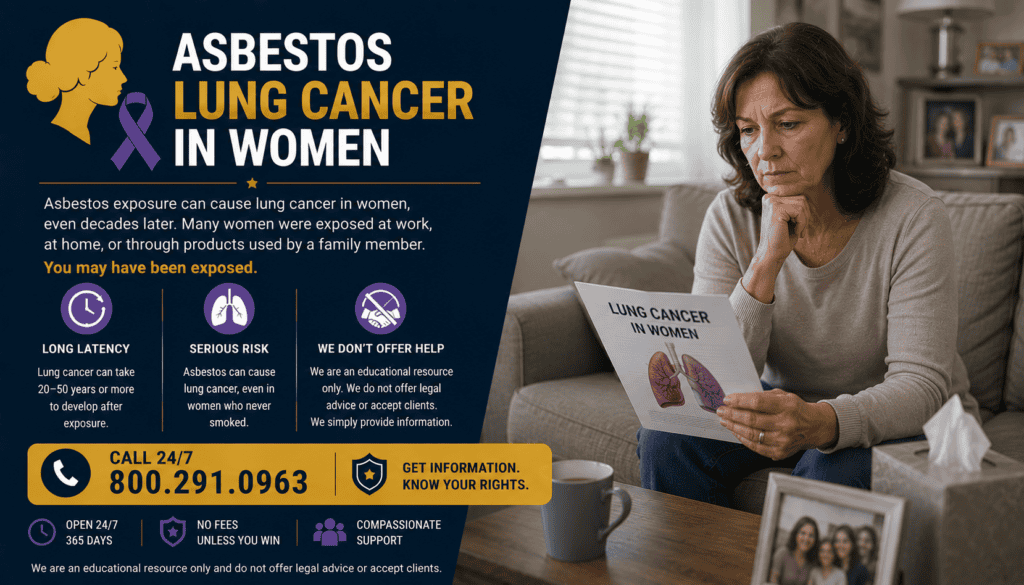
Asbestos Lung Cancer in Women
Asbestos lung cancer in women can develop after fibers were inhaled during occupational, household, military-family, or building-related exposure. Because disease may appear many years after contact, identifying a possible source often requires looking well beyond a recent job or residence. Medical records establish the diagnosis, while historical records help reconstruct where and how exposure may have occurred.
Asbestos is an established cause of lung cancer, but an individual diagnosis does not identify asbestos as its cause by itself. Smoking is also a major lung-cancer risk factor, and the combination of smoking and asbestos exposure raises risk substantially. A careful review therefore separates the medical diagnosis, smoking history, asbestos-exposure evidence, and any potential legal claim instead of treating them as interchangeable facts.
How Asbestos Is Connected to Lung Cancer
The National Cancer Institute identifies asbestos as a known human carcinogen and states that asbestos exposure can cause lung cancer. When asbestos-containing material is disturbed, microscopic fibers can become airborne and be inhaled. Fibers that remain in the lungs can contribute to inflammation and other tissue changes over time.
Lung cancer is different from mesothelioma. Lung cancer begins in lung tissue, while mesothelioma develops in the lining around the lungs or other organs. See mesothelioma in women and the broader women’s asbestos diseases hub for those distinctions.
| Condition | Where it begins | Key asbestos point |
|---|---|---|
| Lung cancer | Lung tissue | Asbestos is an established cause. |
| Pleural mesothelioma | Pleural lining around the lungs | Strongly associated with asbestos exposure. |
| Pleural disease | Pleural lining | May include plaques, thickening, or effusion and is not itself lung cancer. |
How Women May Have Been Exposed
Women’s asbestos exposure histories can include direct workplace contact, employment in older buildings, work near maintenance or renovation, and fibers carried home by a household member. Historically relevant settings can include factories, schools, hospitals, laboratories, offices, shipyards, military facilities, and homes containing older asbestos materials.
The women’s occupations and workplace exposure hub and military and secondary exposure hub organize these pathways. A job title, building age, or family relationship is not proof of exposure; stronger documentation connects a person to a specific place, time period, activity, material, or exposed household member.
Asbestos, Smoking, and Lung Cancer Risk
NCI reports that smoking and asbestos together are particularly hazardous: the combined lung-cancer risk is greater than the individual risks simply added together. Smoking history therefore matters medically, but it does not erase a documented history of asbestos exposure.
Women who never smoked can also develop lung cancer. NCI identifies occupational asbestos exposure as a lung-cancer risk even among people who have never smoked. Questions about the cause of an individual cancer require medical assessment rather than assumptions based on smoking status alone.
Symptoms and Medical Evaluation
Possible lung-cancer symptoms can include a persistent or worsening cough, shortness of breath, chest discomfort, coughing up blood, unexplained weight loss, or fatigue. These symptoms can have many causes and cannot determine whether asbestos is involved.
Anyone with concerning symptoms should seek medical care. A person with known or suspected past asbestos exposure should tell the clinician when and where that exposure may have occurred, including workplace and household exposure that happened decades earlier.
Diagnosis and Determining the Cancer Type
Imaging may identify a suspicious lung abnormality, but pathology is commonly used to determine the cancer type. Medical records may include CT reports, pathology reports, biopsy results, oncology notes, staging information, and treatment records.
A lung-cancer diagnosis does not automatically establish the source of exposure or legal responsibility. Medical documentation and exposure documentation answer different questions and are usually evaluated together.
| Record | What it may establish |
|---|---|
| Pathology report | Histologic diagnosis and tumor type |
| Imaging report | Location and extent of abnormalities |
| Oncology records | Diagnosis, staging, treatment, and clinical history |
| Exposure history | Reported workplaces, household pathways, and time periods |
Latency and Reconstructing Earlier Exposure
Asbestos-related disease can emerge long after exposure. That makes an accurate timeline important. Start with years, employers, job sites, buildings, departments, household members’ occupations, military assignments, and major renovation or maintenance periods rather than relying only on recent events.
See latency periods of asbestos diseases in women for more detail. A long latency period can make an earlier exposure biologically plausible, but latency alone does not prove that asbestos caused a particular cancer.
Evidence That Can Help Document Exposure
Useful evidence can come from multiple independent sources. Employment and Social Security records may establish where someone worked; union records, coworker statements, maintenance documents, product records, photographs, and building surveys may help identify tasks or materials. For household exposure, records concerning the exposed worker’s job and work clothing practices may be relevant.
| Evidence category | Examples | Question it helps answer |
|---|---|---|
| Employment | Pay records, personnel files, union records | Where and when did the person work? |
| Site | Maintenance logs, surveys, renovation records | What materials or activities were present? |
| Witness | Coworker or family statements | What tasks and routines were observed? |
| Product | Invoices, catalogs, specifications | Can a particular product be tied to the site? |
| Medical | Pathology and oncology records | What disease was diagnosed? |
Lung Cancer Claims and Legal Options
A potential asbestos-related lung-cancer claim may depend on diagnosis, exposure evidence, responsible parties, jurisdiction, filing deadlines, and other facts. Depending on the circumstances, possible routes can include a personal-injury lawsuit, asbestos trust claim, workers’ compensation, or another claim authorized by applicable law.
The women’s asbestos legal options hub explains these routes. Eligibility is not automatic simply because a person has lung cancer and a history of working in an older building; the evidence must support the elements required for the particular claim.
Records to Gather
Preserving records early can make it easier to reconstruct an exposure history. Keep originals intact when possible and make working copies for organization. Do not disturb or collect suspected asbestos-containing material yourself.
| Medical | Exposure and work history | Household or site evidence |
|---|---|---|
| Pathology and biopsy reports | Employer and job-site list | Household member work history |
| CT and imaging reports | Pay, union, or personnel records | Building or renovation records |
| Oncology treatment records | Coworker names and statements | Photos, invoices, or product records |
Questions to Ask
For a medical appointment, consider asking what type of lung cancer was diagnosed, whether additional testing is needed, and whether the clinician should document a known or suspected asbestos-exposure history. For an exposure review, ask which jobs, buildings, household contacts, products, and records should be investigated first.
For legal information, ask which jurisdiction may apply, what deadline may govern, what evidence is still missing, and whether more than one compensation route could be relevant. Avoid delaying a deadline review while waiting to assemble every historical record.
Frequently Asked Questions
Can asbestos cause lung cancer in women?
Yes. Asbestos is an established cause of lung cancer. The medical and factual question in an individual case is whether the person’s exposure history contributed to that diagnosis.
Is asbestos lung cancer the same as mesothelioma?
No. Lung cancer begins in lung tissue; mesothelioma arises from mesothelial lining. They are distinct cancers.
Can a woman who never smoked develop asbestos-related lung cancer?
Yes. Asbestos can increase lung-cancer risk independently of smoking, and occupational lung carcinogens can cause lung cancer in people who never smoked.
What if a woman smoked and was also exposed to asbestos?
Smoking and asbestos together greatly increase lung-cancer risk. Smoking history does not by itself determine whether asbestos exposure was relevant to an individual case.
Does an old workplace prove asbestos exposure?
No. Stronger evidence identifies asbestos-containing materials, tasks, disturbance, location, time period, or witnesses connected to the person.
Can household exposure matter?
Potentially. Historical take-home exposure can involve fibers carried from a workplace on clothing or other items. The facts should be documented rather than assumed.
What medical records are most useful?
Pathology, imaging, oncology, staging, and treatment records can help document the diagnosis and clinical history.
Is there one filing deadline for every asbestos lung-cancer claim?
No. Deadlines and accrual rules vary by jurisdiction and claim type, so the applicable deadline should be evaluated using the specific facts.
Summary and Next Steps
Asbestos is an established cause of lung cancer, including in people who never smoked. For women with a diagnosis and a possible historical exposure, the strongest next step is to keep the medical diagnosis separate from the exposure investigation: preserve pathology and oncology records, build a detailed work and household timeline, and identify documents or witnesses that can connect specific activities or materials to the exposure period.
For information about evaluating a potential claim, use the no-obligation case evaluation or Call 800.291.0963. Live help is available 24/7, 365 days a year.