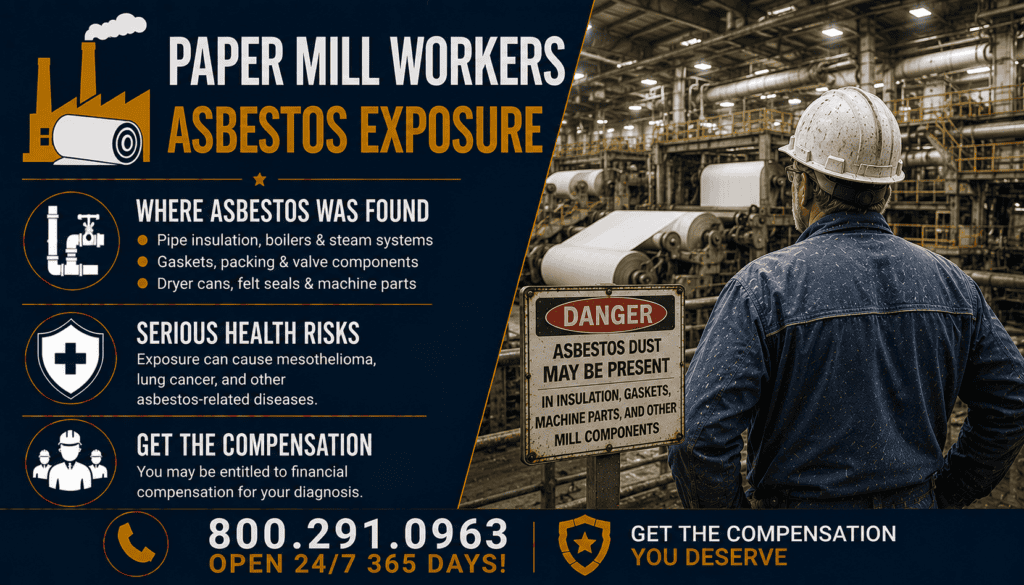
Paper Mill Workers Asbestos Exposure
Paper and pulp mills are large industrial facilities with boilers, steam systems, piping, pumps, process equipment and extensive maintenance operations. Workers employed in older mills may have encountered asbestos when documented asbestos-containing insulation, gaskets, packing or other heat-resistant materials were installed, repaired or removed.
Paper-mill employment alone does not prove asbestos exposure. NIOSH evaluations confirm that paper mills can include boiler and power-plant operations and complex processing facilities, while federal asbestos research establishes the hazards of disturbing asbestos-containing thermal and industrial materials. A strong exposure history identifies the mill, department, equipment, product, task and time period involved.
Paper Mill Workers and Occupational Asbestos Exposure
Paper mills employ production workers, millwrights, maintenance mechanics, pipefitters, electricians, boilermakers, instrument workers, operators and other trades. A recent NIOSH evaluation of a large pulp and paper mill described a complex operating continuously with hundreds of employees and contractors and multiple unions.
NIOSH paper-mill evaluations also document boiler operations used to support mill processes. Historical asbestos exposure becomes plausible when workers repaired or worked close to equipment containing actual asbestos insulation, gaskets, packing or other documented asbestos products.
Maintenance workers can have different exposure histories from production employees who did not disturb asbestos-containing material. Job title, department, equipment assignment and hands-on tasks therefore matter.
NIOSH has determined that exposure to asbestos fibers causes cancer and asbestosis in humans. The agency’s asbestos recommendations emphasize preventing occupational exposure to airborne asbestos fibers.
Related resources include agricultural, forestry and natural resource workers asbestos exposure, industrial and manufacturing factory workers asbestos exposure, millwrights asbestos exposure and maintenance workers asbestos exposure.
Boilers, Steam Systems and Mill Equipment
Pulp and paper production can require substantial heat, steam, mechanical power and process piping. NIOSH evaluated boiler areas at a Montana paper mill where waste fuel and hog fuel boilers supplied power for mill operations.
Boilers and Steam Equipment
Older industrial boilers and associated steam systems should be investigated for documented asbestos-containing thermal insulation, gaskets and related materials. The presence of a boiler alone does not establish asbestos exposure.
Process Piping
Paper mills can contain extensive networks of pipes carrying steam, water, chemicals and process materials. Older thermal insulation may be relevant when asbestos content is established and maintenance work disturbed it.
Pumps and Valves
Maintenance on pumps and valves can involve removal of gaskets or packing. These components should be described as asbestos-containing only when product, manufacturer, specification or other reliable evidence supports that conclusion.
Power and Utility Areas
Mill power plants, boiler rooms and utility spaces can create distinct maintenance environments. Workers assigned to those areas may have different potential exposures from employees working primarily in paper-processing departments.
Related mechanical resources include boilermakers asbestos exposure, pipefitters asbestos exposure, valve workers asbestos exposure and boiler room operators asbestos exposure.
Potential Asbestos-Containing Materials
Potential historical asbestos sources in an older paper mill should be investigated individually. Depending on the facility and era, relevant materials may include:
- Documented asbestos-containing boiler and thermal insulation
- Pipe insulation and lagging confirmed to contain asbestos
- Asbestos-containing gaskets or packing identified through reliable product records
- Heat-resistant materials around industrial equipment when asbestos content is documented
- Asbestos-containing building materials disturbed during renovation or demolition
NIOSH’s general asbestos research identifies insulation and other industrial products as historical sources of occupational exposure. Its current scientific guidance states that exposure to asbestos fibers causes cancer and asbestosis.
Not every paper-mill dust is asbestos. Wood dust, paper fiber, lime, chemical residues, boiler ash, mold and other workplace contaminants are separate hazards. A 2023 NIOSH paper-mill investigation, for example, focused on a blastomycosis outbreak associated with a fungal hazard—not asbestos.
This distinction is important because a worker can have substantial respiratory exposures in a mill without those exposures establishing asbestos contact.
Maintenance, Repair and Shutdown Work
Potential asbestos exposure is often most plausible during work that disturbed a confirmed asbestos-containing material.
- Insulation removal: cutting or stripping documented asbestos insulation from pipes or equipment
- Boiler repair: disturbing confirmed asbestos-containing thermal materials, gaskets or insulation
- Valve and pump work: scraping or removing documented asbestos gaskets or packing
- Shutdown maintenance: working around multiple trades while insulated systems were opened or repaired
- Renovation: disturbing asbestos-containing building or mechanical-system materials
- Cleanup: handling residue produced by prior asbestos work
- Nearby exposure: working close to another trade disturbing asbestos-containing material
Workers such as millwrights, pipefitters, boilermakers and maintenance mechanics may have performed these tasks directly. Production workers could have a different exposure pathway if they remained near maintenance activity that released fibers.
OSHA’s asbestos standards require controls for occupational asbestos exposure. Historical practices should be evaluated based on the era, material condition and actual work performed rather than judged solely by modern procedures.
Need help now? Call 800.291.0963
Live chat available 24/7, 365 days a year.
Submit Your Case
Mesothelioma and Other Occupational Health Risks
NIOSH states that exposure to asbestos fibers causes cancer and asbestosis in humans. Asbestos exposure is associated with malignant mesothelioma and lung cancer as well as nonmalignant asbestos-related disease.
Asbestos-related disease can appear long after occupational exposure. For retired paper-mill workers, historical employment, department, maintenance and product records can therefore be important when reconstructing work performed decades earlier.
Paper mills also present respiratory hazards unrelated to asbestos. NIOSH has investigated fungal disease at a modern pulp and paper mill and has separately discussed wood-dust-related respiratory disease among paper-mill workers. Those hazards should not be described as asbestos exposure.
Medical questions about prior occupational exposure, symptoms, screening or diagnosis should be discussed with a qualified healthcare professional.
Documenting a Paper Mill Exposure History
A useful investigation identifies the mill, department, occupation, equipment, products and maintenance tasks associated with possible asbestos exposure.
- Employment evidence: mill employer, payroll, union, pension and Social Security records
- Department evidence: pulp processing, paper production, maintenance, boiler house, power plant, utilities or machine shop
- Equipment evidence: boilers, steam lines, pumps, valves, turbines and process machinery
- Product evidence: insulation, gaskets, packing, manufacturers, brands, specifications and purchasing records
- Task evidence: insulation removal, boiler repair, pipe work, gasket scraping, packing replacement and shutdown maintenance
- Facility evidence: asbestos surveys, abatement records, engineering drawings and renovation documents
- Witness evidence: millwrights, operators, mechanics, pipefitters, electricians, supervisors and union coworkers
Union records can be especially useful in mills with organized trades. NIOSH’s 2023 paper-mill evaluation documented employees represented by the United Steelworkers, International Brotherhood of Electrical Workers and Teamsters at the investigated facility, illustrating the range of occupational groups that can work within one mill.
Questions That Can Strengthen an Exposure History
Which mill and years? Which department and job title? Were boilers, steam lines, pumps or valves maintained? Was insulation removed? Were gaskets or packing scraped? Which contractors performed shutdown work? Are purchasing records, asbestos surveys, maintenance documents, photographs or coworker statements available?
Asbestos Lawsuits, Trust Funds and Compensation
A paper-mill worker diagnosed with mesothelioma or another asbestos-related disease may have potential legal or compensation options when evidence supports occupational asbestos exposure and applicable requirements are met.
Paper-mill employment alone does not establish liability, asbestos trust eligibility or compensation. A claim may require evidence connecting the worker to a specific asbestos-containing insulation product, gasket, packing material, equipment component, manufacturer, supplier, contractor or other legally relevant source.
Potential evidence includes employment and Social Security records, union files, mill maintenance records, equipment specifications, purchasing documents, product catalogs, asbestos surveys, abatement records, photographs, coworker statements and medical documentation.
Related Industrial and Mechanical Resources
Industrial work: Industrial & Manufacturing Factory Workers Asbestos Exposure · Industrial Workers Asbestos Exposure Lawsuit
Mill maintenance: Millwrights Asbestos Exposure · Maintenance Mechanics Asbestos Exposure
Boilers and piping: Boilers & Steam Lines Asbestos Exposure · Insulators & Laggers Asbestos Exposure
Authoritative Sources
This page was researched using NIOSH occupational-health evidence and federal asbestos guidance. NIOSH evaluations confirm the industrial complexity and boiler operations of paper mills, while its asbestos research establishes the health risks of occupational asbestos fibers. The page does not assume that every mill, boiler, pipe or paper-mill worker involved asbestos.
- NIOSH — HHE 85-455-1724, Champion International Paper Mill
- NIOSH — HHE 2023-0065-3414, Pulp and Paper Mill
- NIOSH — Workplace Exposure to Asbestos: Review and Recommendations
- NIOSH — Pocket Guide to Chemical Hazards: Asbestos
- NIOSH — Asbestos Fibers and Other Elongate Mineral Particles
- OSHA — 29 CFR 1910.1001 Asbestos Standard
Paper Mill Workers Asbestos Exposure FAQ
Were all paper mill workers exposed to asbestos?
No. Paper-mill employment alone does not prove asbestos exposure. The mill, department, equipment, product, task and time period should be investigated.
Why are boilers and steam systems relevant in older paper mills?
Paper mills can use boilers and steam systems for power and processing. Older equipment may have used asbestos-containing thermal materials, but asbestos content must be documented rather than assumed.
Could paper mill pipe insulation contain asbestos?
Some historical industrial pipe insulation contained asbestos. A specific mill’s insulation should be identified through product records, surveys, testing or other reliable evidence.
Which paper mill workers may have disturbed asbestos materials?
Depending on the facility, millwrights, boilermakers, pipefitters, maintenance mechanics, insulators and other trades may have repaired equipment or disturbed insulation, gaskets or packing.
Is paper or wood dust asbestos?
No. Paper fiber and wood dust are separate workplace exposures. They should not be described as asbestos without evidence of asbestos contamination.
What records can document paper mill asbestos exposure?
Employment and union records, department assignments, maintenance files, purchasing records, equipment specifications, asbestos surveys, abatement documents, photographs and coworker statements can help.
Could a production worker be exposed during nearby maintenance?
Potentially, if nearby work disturbed confirmed asbestos-containing material and created a plausible airborne exposure pathway. Proximity alone does not prove exposure.
Can paper mill workers qualify for asbestos trust fund claims?
Some may qualify if they meet a trust’s medical and exposure requirements and can connect their work to a covered asbestos product, company or qualifying exposure period. Paper-mill employment alone does not establish eligibility.
Get Help Reviewing Paper Mill Asbestos Exposure
Call 800.291.0963
Live chat is available 24/7, 365 days a year.
Prior paper-mill or pulp-mill work does not automatically prove asbestos exposure, disease causation, liability, claim eligibility or compensation. Each situation depends on the employer, dates, department, equipment, products, maintenance tasks, asbestos-content evidence, medical evidence and applicable legal requirements. Compensation is not guaranteed.
⚕️ Legal & Medical Information Disclaimer
This page provides general educational information and is not medical or legal advice. The information does not establish asbestos exposure, diagnosis, causation, liability, claim eligibility or compensation. Medical concerns should be discussed with a qualified healthcare professional, and legal questions should be reviewed with a qualified attorney.