🏭 Pennsylvania Factory Workers Asbestos Exposure
⚠️ Pennsylvania Factory Workers and Asbestos Exposure
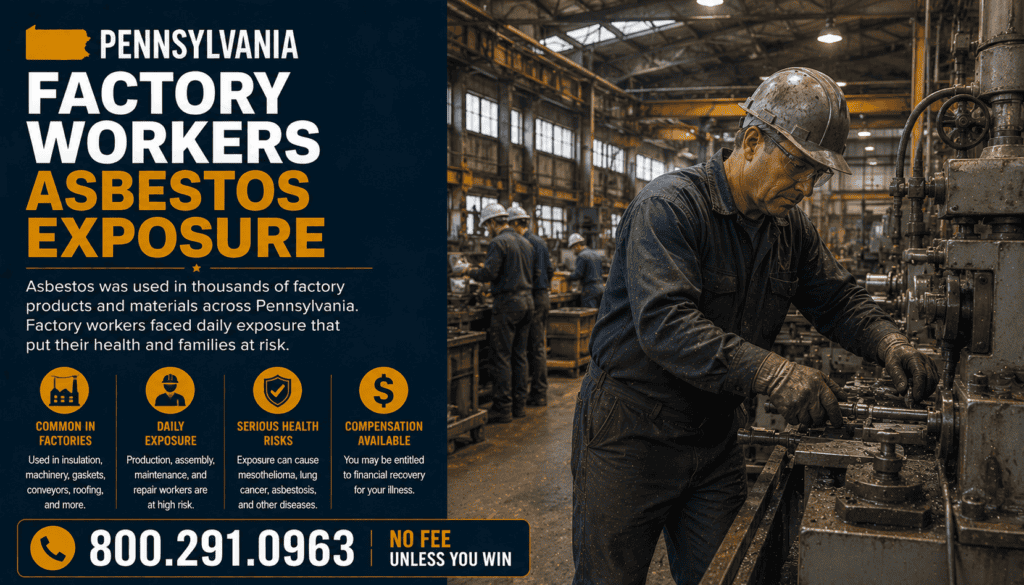
For more than a century, Pennsylvania has been one of America’s leading manufacturing states. Thousands of factories operated throughout Philadelphia, Pittsburgh, Bethlehem, Erie, Allentown, Reading, Lancaster, York, Scranton, Harrisburg, and many smaller communities. These facilities manufactured steel, machinery, electrical equipment, automotive parts, chemicals, textiles, paper products, food products, industrial equipment, and countless consumer goods.
Many Pennsylvania factories relied heavily on asbestos-containing products because asbestos was inexpensive, durable, fire-resistant, and an effective insulator. Boilers, steam systems, production equipment, industrial machinery, furnaces, electrical systems, and factory buildings often contained asbestos materials.
As a result, thousands of Pennsylvania factory workers may have unknowingly inhaled microscopic asbestos fibers while performing their daily jobs. Unlike an accident that causes an immediate injury, asbestos exposure often occurred gradually over many years. Workers frequently breathed asbestos dust released during equipment maintenance, machinery repairs, insulation replacement, plant renovations, and routine cleanup.
Today, former Pennsylvania factory workers continue to receive diagnoses of mesothelioma and other asbestos-related diseases because these illnesses may take decades to develop.
Learn more about asbestos exposure throughout the state on our Pennsylvania Asbestos Exposure page.
🩺 What Is Mesothelioma?
Mesothelioma is a rare and aggressive cancer that develops in the thin lining surrounding certain organs. The disease most commonly affects the lining surrounding the lungs, which is known as pleural mesothelioma. It may also develop in the lining of the abdomen, heart, or testes.
Asbestos exposure is the primary known cause of mesothelioma. When microscopic asbestos fibers are inhaled, some may become trapped inside the body. Over many years, these fibers can cause inflammation, tissue scarring, and cellular damage that may eventually lead to cancer.
Factory workers often experienced repeated exposure throughout their careers rather than from one single event. Daily contact with asbestos-containing insulation, machinery, boilers, steam systems, electrical equipment, and industrial materials could gradually increase a worker’s cumulative exposure.
Workers diagnosed with an asbestos-related lung disease can learn more on our Pennsylvania Asbestos Lung Cancer Lawsuits page.
🏭 Why Asbestos Was Used in Pennsylvania Factories
For decades, asbestos was considered an ideal industrial material because it could withstand heat, fire, friction, steam, and chemical exposure. Factory owners and equipment manufacturers used asbestos to protect machinery, reduce heat loss, prevent fires, and improve the durability of industrial products.
Pennsylvania manufacturers commonly used asbestos because it provided:
- Heat resistance
- Fire protection
- Steam insulation
- Electrical insulation
- Chemical resistance
- Friction resistance
- Strength and durability
- Long service life
- Low manufacturing cost
Because of these qualities, asbestos became incorporated into thousands of factory products, machines, utility systems, and building materials.
Entire manufacturing facilities often contained asbestos insulation surrounding steam pipes, boilers, furnaces, pumps, valves, turbines, electrical equipment, industrial ovens, production machinery, and ventilation systems.
Factory buildings could also contain asbestos roofing, floor tiles, ceiling tiles, wall panels, fireproof doors, pipe coverings, adhesives, cement boards, insulating cement, and spray-applied fireproofing.
Many of these materials remained in place for decades. When workers cut, drilled, scraped, sanded, repaired, or removed them, asbestos fibers could be released into the air.
Learn more about materials commonly found in industrial facilities on our Pennsylvania Industrial Asbestos Products page.
🏗️ Pennsylvania Industries That Employed Factory Workers
Pennsylvania’s manufacturing economy supported hundreds of thousands of workers across many industries where asbestos-containing materials were commonly used.
Industries that may have exposed factory workers to asbestos include:
- Steel manufacturing
- Iron production
- Metal fabrication
- Industrial machinery manufacturing
- Electrical equipment manufacturing
- Automotive parts manufacturing
- Heavy equipment manufacturing
- Glass manufacturing
- Chemical manufacturing
- Paper manufacturing
- Textile manufacturing
- Food processing
- Rubber manufacturing
- Cement manufacturing
- Boiler manufacturing
- Pump manufacturing
- Valve manufacturing
- Railroad equipment manufacturing
- Construction materials manufacturing
- Industrial insulation manufacturing
- Aluminum processing
- Appliance manufacturing
- Foundries
- Machine shops
- Fabrication plants
Many manufacturing plants combined several production operations under one roof. Maintenance shops, boiler rooms, machine departments, warehouses, loading docks, electrical rooms, and assembly areas could all be located inside the same factory.
Asbestos fibers released in one department could move into neighboring work areas through ventilation systems, open doors, employee traffic, overhead cranes, and air movement.
Learn more about asbestos hazards in manufacturing facilities on our Pennsylvania Manufacturing Asbestos Exposure page.
👷 Factory Occupations That May Have Experienced Asbestos Exposure
Factory employees performed many different jobs that placed them near asbestos-containing machinery, insulation, and industrial products. Exposure was not limited to workers who installed or removed insulation.
Occupations that may have experienced asbestos exposure include:
- Production workers
- Assembly line workers
- Machine operators
- Industrial mechanics
- Maintenance mechanics
- Millwrights
- Pipefitters
- Steamfitters
- Electricians
- Welders
- Machinists
- Tool and die makers
- Boiler operators
- Furnace operators
- Kiln operators
- Plant engineers
- Utility workers
- Warehouse workers
- Shipping employees
- Receiving personnel
- Forklift operators
- Crane operators
- Material handlers
- Janitorial workers
- Industrial cleaners
- Production supervisors
- Maintenance supervisors
- Plant laborers
- Quality control inspectors
- Equipment installers
- Outside contractors
Even workers who never directly touched asbestos insulation could have inhaled airborne fibers released during repairs or maintenance performed nearby.
Workers who repaired electrical panels, motors, wiring, switchgear, or other factory electrical systems may also benefit from reading our Pennsylvania Electricians Asbestos Exposure page.
⚙️ Factory Machinery and Equipment That Frequently Contained Asbestos
Pennsylvania factories depended on industrial machines that operated under intense heat, pressure, steam, and friction. Asbestos insulation and asbestos-containing components were commonly used to protect equipment and reduce the risk of fire.
Factory machinery and equipment associated with asbestos may have included:
- Industrial boilers
- Steam generators
- Steam turbines
- Industrial furnaces
- Kilns
- Industrial ovens
- Heat exchangers
- Compressors
- Pumps
- Valves
- Steam traps
- Hydraulic equipment
- Manufacturing presses
- Industrial mixers
- Crushers
- Conveyor systems
- Electrical switchgear
- Motor control centers
- Transformers
- Industrial motors
- Cooling towers
- Air handling systems
- Dust collection systems
- Pressure vessels
- Steam piping
- Process piping
- Drying equipment
- Generators
- Braking systems
- Clutch assemblies
Routine maintenance frequently disturbed asbestos insulation, gaskets, packing, friction materials, and thermal coverings installed on or around this equipment.
Learn more about asbestos-containing machines and equipment on our Pennsylvania Industrial Machinery Asbestos Exposure page.
🧱 Asbestos Products Commonly Found Inside Pennsylvania Factories
Many Pennsylvania factories contained asbestos products throughout production areas, utility rooms, maintenance departments, and building systems.
Products that may have contained asbestos included:
- Pipe insulation
- Boiler insulation
- Block insulation
- Spray-applied fireproofing
- Thermal blankets
- Pipe covering
- Valve insulation
- Pump insulation
- Furnace insulation
- Turbine insulation
- Gaskets
- Packing materials
- Rope packing
- High-temperature cloth
- Fire blankets
- Electrical insulation
- Brake linings
- Clutch facings
- Roofing materials
- Floor tiles
- Ceiling tiles
- Cement boards
- Joint compound
- Adhesives
- Expansion joints
- Fire-rated doors
- Wall panels
- Steam pipe insulation
- Insulating cement
- Asbestos paper
- Protective sleeves
- Heat shields
Many of these materials became brittle or deteriorated as they aged. Workers could release fibers while removing old insulation, scraping gaskets, replacing packing, cutting cement products, sanding flooring, or repairing factory walls and ceilings.
Additional information about insulation hazards is available on our Pennsylvania Asbestos Insulation Products page.
💨 How Factory Workers Inhaled Asbestos Fibers
Factory workers often encountered asbestos during ordinary production, maintenance, and repair activities.
Exposure may have occurred while:
- Operating production machinery
- Repairing industrial equipment
- Removing pipe insulation
- Replacing boiler insulation
- Scraping worn gaskets
- Replacing valve packing
- Servicing pumps
- Repairing steam lines
- Maintaining boilers
- Cleaning furnaces
- Grinding friction components
- Installing new equipment
- Sweeping factory floors
- Cleaning machinery with compressed air
- Assisting during shutdowns
- Working near insulation contractors
- Removing damaged building materials
- Handling dusty replacement parts
- Cleaning maintenance shops
- Moving equipment through contaminated areas
These activities could release microscopic fibers that remained suspended in the air. Workers could inhale the fibers without seeing or smelling them.
Dust could also settle on machines, tools, floors, work benches, clothing, and equipment. Later activity could disturb the settled dust and place the fibers back into the air.
🔧 Direct Occupational Asbestos Exposure
Direct exposure occurred when factory employees personally handled asbestos-containing materials or equipment.
Maintenance mechanics often removed old insulation before repairing boilers, pumps, valves, furnaces, steam lines, and production machinery. Millwrights dismantled machines containing asbestos gaskets, packing, brake linings, clutch components, and heat-resistant insulation.
Pipefitters and steamfitters cut through insulation to reach pipes, valves, flanges, and steam connections. Electricians worked around heat-resistant electrical insulation, arc shields, panels, wiring systems, and asbestos materials used near high-temperature equipment.
Boiler operators and maintenance crews could encounter insulation, refractory materials, gaskets, rope packing, and cement products during routine servicing.
Workers maintaining boilers and steam systems can learn more on our Pennsylvania Boiler Equipment Asbestos Exposure page.
👥 Nearby and Bystander Exposure Inside Factories
Not every factory worker diagnosed with an asbestos-related disease personally handled asbestos products.
Production workers, supervisors, quality control inspectors, warehouse employees, forklift operators, office staff, shipping personnel, and other employees often worked near maintenance crews disturbing asbestos insulation.
For example, a worker operating a production machine could have been exposed while pipefitters removed insulation from a steam line overhead. A warehouse employee could have inhaled dust released during repairs to a nearby boiler room. A supervisor could have walked through areas where insulation removal or machinery rebuilding was underway.
Airborne fibers could circulate through:
- Factory ventilation systems
- Open production floors
- Doorways and hallways
- Utility tunnels
- Boiler rooms
- Maintenance shops
- Employee locker rooms
- Loading docks
- Shared work areas
Large manufacturing facilities often created conditions similar to those described on our Pennsylvania Industrial Asbestos Exposure page.
🛠️ Maintenance and Repair Exposure
Routine maintenance was one of the most common sources of asbestos exposure inside Pennsylvania factories.
Industrial machinery required frequent repairs because of constant heat, pressure, vibration, and wear. Mechanics often opened pumps, valves, boilers, compressors, furnaces, and other machines to replace worn internal components.
Asbestos-containing gaskets could stick to metal surfaces and require scraping, brushing, sanding, or grinding before a replacement gasket could be installed. Packing material around pump shafts and valve stems could become brittle and release dust when removed.
Maintenance workers also repaired insulated pipes, steam systems, electrical equipment, ovens, kilns, and air-handling systems. These tasks could release fibers into the immediate work area and expose employees working nearby.
Factory shutdowns could create especially dusty conditions because many machines and utility systems were repaired at the same time.
🧹 Cleanup Exposure Inside Pennsylvania Factories
Factory cleanup practices sometimes increased asbestos exposure rather than reducing it.
Workers may have been instructed to sweep insulation debris, gasket dust, broken cement products, and other materials from production floors. Dry sweeping could push settled asbestos fibers back into the air.
Some factories used compressed air to clean machinery, work benches, floors, and equipment. Compressed air could scatter dust across a large area and expose workers who had no direct involvement in the original maintenance project.
Janitors, laborers, production workers, and industrial cleaners could have been exposed while:
- Sweeping maintenance areas
- Emptying waste containers
- Cleaning boiler rooms
- Removing insulation debris
- Dusting machinery
- Cleaning ventilation equipment
- Washing work clothing
- Clearing shutdown debris
- Cleaning employee locker rooms
- Moving contaminated tools
Workers may not have known that ordinary factory dust contained dangerous asbestos fibers.
🏗️ Renovation and Demolition Exposure
Older Pennsylvania factory buildings often underwent expansions, renovations, equipment upgrades, and demolition projects.
These projects could disturb asbestos-containing materials installed decades earlier, including:
- Pipe insulation
- Boiler insulation
- Floor tile
- Ceiling tile
- Wall panels
- Roofing materials
- Fireproofing
- Cement boards
- Joint compound
- Adhesives
- Electrical insulation
- Furnace materials
Factory workers sometimes continued working while contractors removed walls, ceilings, insulation, piping, or old machinery nearby. Dust from these projects could enter occupied production areas through open doors, ventilation systems, or shared hallways.
Employees assigned to help move equipment, clear debris, or prepare work areas could also experience direct exposure.
Learn more about these risks on our Pennsylvania Construction Asbestos Exposure page.
🏠 Secondary Household Asbestos Exposure
Pennsylvania factory workers could unknowingly carry asbestos fibers home on their clothing, boots, gloves, hair, tools, lunch boxes, and vehicles.
Family members may have been exposed while:
- Washing dusty work clothes
- Shaking out uniforms before laundering
- Cleaning work boots
- Vacuuming personal vehicles
- Handling contaminated tools
- Cleaning garages
- Hugging a worker returning home
- Handling work jackets or gloves
This type of exposure is often called secondary, household, or take-home asbestos exposure.
Spouses who regularly laundered contaminated work clothing may have experienced repeated exposure over many years. Children and other household members could also have encountered fibers brought into the home.
🩺 Diseases Connected to Factory Asbestos Exposure
Factory asbestos exposure has been associated with several serious diseases.
These may include:
- Mesothelioma
- Asbestos-related lung cancer
- Asbestosis
- Pleural plaques
- Pleural thickening
- Pleural effusions
- Other asbestos-related respiratory conditions
Not every person exposed to asbestos develops an illness. The risk depends on many factors, including the intensity of exposure, length of exposure, type of asbestos fibers, age, smoking history, and individual health factors.
However, workers with a history of factory employment should inform their doctors about possible occupational asbestos exposure, especially if they develop unexplained breathing problems, chest pain, persistent coughing, fatigue, or fluid around the lungs.
⏳ The Long Latency Period of Asbestos-Related Diseases
Asbestos-related diseases often have a long latency period. This means many years may pass between the original exposure and the appearance of symptoms.
Pennsylvania factory workers exposed during the 1950s, 1960s, 1970s, or 1980s may not have developed symptoms until decades later. Some workers are diagnosed 20 to 50 years after their last exposure.
This long delay can make it difficult to remember every factory, department, machine, product, contractor, and coworker connected to the exposure.
A diagnosis today may be connected to work performed many years ago, even if the factory has closed, changed ownership, or demolished its original buildings.
🔍 How Pennsylvania Factory Asbestos Exposure Is Investigated
Investigating factory asbestos exposure often requires rebuilding a worker’s employment history from decades earlier. Many Pennsylvania factories have closed, changed ownership, removed old equipment, or demolished original buildings. Even so, an investigation may identify the jobsites, departments, machines, products, contractors, and work practices connected to a worker’s exposure.
A factory exposure investigation commonly begins by reviewing:
- Every Pennsylvania factory where the person worked
- Employment dates
- Job titles
- Departments and production areas
- Daily job duties
- Machinery used or repaired
- Steam and utility systems
- Maintenance shutdowns
- Renovation and demolition projects
- Coworkers and supervisors
- Contractors working inside the plant
- Asbestos-containing products used at the facility
- Dust carried home on work clothing
The investigation is not limited to products the worker personally handled. Nearby insulation work, machinery rebuilding, boiler repairs, electrical maintenance, and cleanup practices may also have released asbestos fibers into the worker’s breathing area.
Learn more about the types of factories and production environments commonly reviewed on our Pennsylvania Manufacturing Asbestos Exposure page.
🏭 Pennsylvania Factories and Industries Commonly Investigated
Pennsylvania’s long industrial history included thousands of factories, mills, fabrication shops, processing plants, and equipment manufacturers. Investigations may examine facilities in both major industrial cities and smaller communities built around one large employer.
Industries commonly reviewed may include:
- Steel and iron manufacturing
- Metal fabrication
- Foundries
- Machine manufacturing
- Electrical equipment plants
- Boiler and pump manufacturing
- Automotive parts factories
- Railroad equipment plants
- Glass factories
- Paper mills
- Textile mills
- Chemical plants
- Rubber product factories
- Cement product plants
- Food processing facilities
- Appliance manufacturing
- Aluminum processing
- Construction material plants
- Heavy equipment manufacturing
- Industrial insulation manufacturing
The physical layout of the facility may be important. Investigators may examine whether production workers were located near boiler rooms, pipe tunnels, furnace areas, maintenance shops, machine rebuild departments, electrical rooms, or renovation work.
A factory worker may have experienced exposure in more than one building, department, or employer location during a career.
Additional jobsite information may be available on our Pennsylvania Asbestos Exposure Sites page.
👷 Reviewing Specific Factory Job Duties
Job titles alone rarely provide the full exposure history. Two employees with the same title may have performed very different tasks depending on the factory, department, shift, and time period.
An investigation may review whether the worker:
- Operated production machinery
- Repaired industrial equipment
- Rebuilt pumps or valves
- Changed gaskets
- Removed packing materials
- Maintained boilers
- Worked around steam pipes
- Repaired furnaces or ovens
- Installed electrical equipment
- Cleaned production areas
- Swept insulation debris
- Assisted outside contractors
- Entered boiler rooms or utility tunnels
- Worked during plant shutdowns
- Helped remove old machinery
- Participated in renovations
- Worked near insulators or pipefitters
- Transported dusty equipment or replacement parts
Investigators may also examine how often these tasks occurred. A repair performed once may have created exposure, but recurring weekly or monthly maintenance could have produced repeated exposure over many years.
Workers sometimes changed positions during their careers. A person may have started as a laborer, moved into production, and later worked in maintenance or supervision. Each position may have created a different exposure pathway.
⚙️ Investigating Factory Machinery and Equipment
Factory machinery is often central to an asbestos exposure investigation. Many machines contained asbestos components that were not visible from the outside.
Equipment commonly reviewed may include:
- Boilers
- Pumps
- Valves
- Compressors
- Turbines
- Furnaces
- Kilns
- Industrial ovens
- Heat exchangers
- Dryers
- Generators
- Motors
- Presses
- Conveyors
- Mixers
- Crushers
- Dust collectors
- Air handling units
- Electrical switchgear
- Transformers
- Braking systems
- Clutch assemblies
- Steam traps
- Process piping
- Pressure vessels
The investigation may consider who manufactured the equipment, when it was installed, what replacement parts were used, and how employees serviced it.
A machine itself may not have been made primarily from asbestos, but it may have required asbestos insulation, gaskets, packing, brake linings, electrical components, or heat shields to operate.
Learn more about equipment that may be involved in a factory exposure history on our Pennsylvania Industrial Machinery Asbestos Exposure page.
🧱 Identifying Asbestos-Containing Factory Products
A factory investigation may identify asbestos-containing materials installed in the building, used in production, or supplied as replacement parts.
Products commonly examined include:
- Pipe insulation
- Boiler insulation
- Block insulation
- Insulating cement
- Spray-on fireproofing
- Gaskets
- Packing materials
- Rope packing
- Electrical insulation
- Asbestos cloth
- Heat shields
- Brake linings
- Clutch facings
- Cement board
- Floor tile
- Ceiling tile
- Roofing materials
- Wall panels
- Joint compound
- Adhesives
- Fireproof doors
- Expansion joints
- Thermal blankets
- Furnace insulation
- High-temperature paper
The condition of the material may be important. Asbestos-containing products often released more dust after years of heat, vibration, water damage, or repeated repairs.
Workers may remember products by color, texture, packaging, brand markings, or the way they were installed. Coworkers may also remember boxes, labels, delivery trucks, or names printed on replacement parts.
Additional product information is available on our Pennsylvania Industrial Asbestos Products page.
🔩 Gaskets and Packing Materials
Gaskets and packing were widely used throughout Pennsylvania factories because they helped control leaks in equipment handling steam, heat, pressure, chemicals, and fluids.
Gaskets may have been installed in:
- Pumps
- Valves
- Boilers
- Compressors
- Turbines
- Steam lines
- Pipe flanges
- Heat exchangers
- Furnaces
- Industrial ovens
- Pressure vessels
- Production machinery
Workers often removed old gaskets with scrapers, wire brushes, chisels, knives, sanders, or grinders. A gasket that had been exposed to heat and pressure could stick tightly to the metal surface and break apart during removal.
Packing material was commonly placed around pump shafts, valve stems, and other moving equipment components. Workers may have pulled out old packing with hooks or picks before cutting and installing new material.
These tasks could create visible dust close to the worker’s face. Nearby employees could also inhale fibers released during gasket scraping and packing replacement.
🧯 Insulation Used Around Factory Systems
Factories depended on insulation to control heat and protect workers from burns. For many years, asbestos was widely used around high-temperature equipment and steam systems.
An investigation may review insulation installed on:
- Boilers
- Steam pipes
- Furnaces
- Ovens
- Kilns
- Turbines
- Pumps
- Valves
- Heat exchangers
- Exhaust systems
- Tanks
- Pressure vessels
- Ductwork
- Process equipment
Insulation workers may have mixed dry asbestos cement, cut pipe covering, installed block insulation, or removed deteriorated material. Production workers often remained nearby while this work was performed.
Maintenance crews could disturb insulation when opening equipment, repairing leaks, replacing valves, or gaining access to pipe connections. Even small repair projects could release fibers if the insulation was cut or broken.
Learn more about commonly used insulation materials on our Pennsylvania Asbestos Insulation Products page.
🔥 Boilers and Factory Steam Systems
Boilers and steam systems were essential to many Pennsylvania factories. They provided heat, power, hot water, and steam for production equipment.
A boiler system could contain asbestos in:
- Boiler insulation
- Pipe covering
- Gaskets
- Rope seals
- Packing
- Cement
- Firebrick materials
- Burner components
- Access doors
- Steam valves
- Flanges
- Pumps
Workers may have been exposed while opening boiler doors, replacing gaskets, repairing burners, removing insulation, cleaning boiler rooms, or replacing steam pipes.
Major boiler overhauls could create heavy dust when large areas of insulation and refractory material were removed. Production employees, utility workers, laborers, and cleaners may have entered the boiler room during or after this work.
Learn more about boiler-related hazards on our Pennsylvania Boiler Equipment Asbestos Exposure page.
⚡ Electrical Equipment and Factory Exposure
Electrical equipment frequently generated heat and sparks, leading manufacturers to use asbestos for insulation and fire protection.
Factory electrical systems that may be investigated include:
- Switchgear
- Electrical panels
- Motor control centers
- Transformers
- Generators
- Motors
- Wiring systems
- Arc chutes
- Breaker boxes
- Cable insulation
- Heat-resistant electrical boards
- Fire barriers
Electricians and maintenance workers may have drilled, cut, removed, or replaced heat-resistant panels and insulation. Dust could also be released when old electrical equipment was dismantled or upgraded.
Production employees working near electrical repair projects may have experienced bystander exposure. Factory shutdowns often involved extensive electrical work performed at the same time as boiler, pipe, and machinery repairs.
More information is available on our Pennsylvania Electricians Asbestos Exposure page.
🛠️ Investigating Maintenance Practices
Maintenance records and worker testimony may help show how frequently asbestos-containing equipment was repaired.
Investigators may ask:
- How often pumps were rebuilt
- How frequently valves were repacked
- When boilers were overhauled
- Whether steam pipes regularly leaked
- How gaskets were removed
- Whether workers used grinders or wire brushes
- Whether insulation was cut without dust control
- Whether respirators were provided
- Whether production continued during repairs
- Whether outside contractors performed insulation work
- Whether maintenance shutdowns occurred annually
- Whether damaged insulation remained exposed
Older work practices often created dust directly in occupied factory areas. Barriers, warning signs, ventilation controls, and protective clothing may not have been used.
A worker’s memory of routine maintenance practices can be important even when written records are incomplete.
🧹 Investigating Factory Cleanup Practices
Cleanup methods may help explain how asbestos dust spread beyond the original repair area.
Investigators may examine whether employees:
- Dry-swept factory floors
- Used compressed air on machinery
- Dumped insulation debris into open containers
- Carried waste through production areas
- Cleaned boiler rooms without respirators
- Reused dusty work clothing
- Shook out drop cloths
- Cleaned ventilation systems
- Removed waste after maintenance shutdowns
- Washed contaminated tools in shared areas
Compressed air and dry sweeping could send settled asbestos dust back into the air. Workers who had no role in equipment repairs may still have inhaled fibers while cleaning nearby areas.
Janitors and laborers may have experienced repeated exposure because they were assigned to remove debris after maintenance crews completed their work.
🏗️ Renovation and Demolition Investigations
Many older Pennsylvania factories were expanded, remodeled, converted, or demolished. These projects may have disturbed large amounts of asbestos-containing building material.
An investigation may review:
- Removal of old steam piping
- Boiler replacement
- Furnace removal
- Machinery relocation
- Wall demolition
- Ceiling replacement
- Floor tile removal
- Roof replacement
- Electrical upgrades
- Ventilation system replacement
- Plant additions
- Full factory demolition
Workers may have continued production while renovations took place nearby. Dust could travel into occupied departments through hallways, ventilation systems, loading docks, and open work areas.
Factory employees may also have assisted contractors by disconnecting equipment, clearing debris, moving machinery, or preparing the area.
Construction-related exposure is discussed further on our Pennsylvania Construction Asbestos Exposure page.
📄 Employment Records
Employment records may help establish when and where a person worked.
Useful records may include:
- Personnel files
- Job applications
- Pay records
- Pension records
- Job classification records
- Transfer records
- Training records
- Medical department records
- Seniority lists
- Retirement documents
- Company newsletters
- Employee directories
These records may identify the factory, department, job title, and employment dates. They may also show when a worker transferred into maintenance, boiler operations, electrical work, or another higher-exposure position.
Records can be especially valuable when the worker remembers the employer but not the exact years or department assignments.
🤝 Union Records
Many Pennsylvania factory workers belonged to unions representing production employees, machinists, electricians, pipefitters, boilermakers, steelworkers, maintenance workers, and other trades.
Union records may include:
- Membership applications
- Dues records
- Job classifications
- Employer assignments
- Apprenticeship records
- Grievance documents
- Meeting minutes
- Retirement records
- Health and safety reports
- Local newsletters
Union documents may help confirm employment and identify coworkers who performed similar jobs.
Retired union members may also remember the equipment, products, contractors, and maintenance practices used inside a particular factory.
📑 Social Security Employment Records
Social Security employment records may help rebuild a worker’s job history when factory records are missing or the employer no longer exists.
These records may identify:
- Employer names
- Years of employment
- Earnings history
- Related corporate names
- Successor companies
A worker may remember a factory by a local name while official records list a parent corporation or earlier company name. Social Security records can help connect those names and establish the employment timeline.
This information may then guide searches for machinery records, product invoices, coworker testimony, and other evidence.
📘 Machinery Manuals and Maintenance Documents
Equipment manuals may identify the parts and materials originally specified for factory machinery.
Manuals may contain information about:
- Recommended gaskets
- Packing specifications
- Insulation requirements
- Heat-resistant components
- Maintenance schedules
- Replacement procedures
- Equipment manufacturers
- Model numbers
- Approved replacement parts
A manual may show that a pump, valve, boiler, compressor, or furnace required heat-resistant materials during the years the worker serviced it.
Maintenance logs may also show how often the equipment was opened, rebuilt, insulated, or repaired.
🧾 Purchase Orders and Product Invoices
Purchase orders and invoices may identify products supplied to a Pennsylvania factory.
Records may show purchases of:
- Pipe insulation
- Boiler insulation
- Gaskets
- Packing
- Cement
- Fireproofing
- Floor tile
- Roofing materials
- Electrical insulation
- Replacement machinery parts
- Brake and clutch components
- Furnace materials
These documents may identify manufacturers, suppliers, distributors, and contractors connected to the products used at the facility.
Even when the original factory has closed, purchase records may remain in company archives, bankruptcy documents, historical collections, or records held by successor corporations.
📸 Factory and Jobsite Photographs
Photographs can provide valuable information about factory conditions.
Pictures may show:
- Insulated steam pipes
- Boilers
- Furnaces
- Pumps and valves
- Maintenance areas
- Product packaging
- Equipment labels
- Dusty work conditions
- Renovation projects
- Employee uniforms
- Machinery manufacturers
- Factory layouts
Photographs from company newsletters, retirement books, local historical societies, newspapers, union publications, and former workers may help identify exposure sources.
A worker may recognize a machine, department, or product after seeing an old photograph even if the brand name was not initially remembered.
👥 Coworker and Supervisor Testimony
Coworker testimony may help explain how asbestos-containing products were used in a factory.
Former employees may remember:
- Brand names
- Product packaging
- Equipment manufacturers
- Maintenance procedures
- Boiler repairs
- Insulation removal
- Dusty shutdowns
- Cleanup practices
- Contractor names
- Department layouts
- Work clothing conditions
A coworker does not always need to have performed the same job. A maintenance worker may describe the products used around a production employee’s work area. A supervisor may confirm how often repairs occurred. A cleaner may explain how debris was removed.
Multiple witness accounts may help reconstruct conditions inside a factory that no longer operates.
🏠 Investigating Household Asbestos Exposure
A household exposure investigation may examine whether asbestos fibers were carried home from a Pennsylvania factory.
Important questions may include:
- Did the worker wear factory clothing home?
- Who washed the clothing?
- Was the clothing shaken out before laundering?
- Were work boots stored inside the home?
- Were tools or gloves brought home?
- Was the family vehicle contaminated with dust?
- How many years did this practice continue?
- Did the worker return home visibly dusty?
Spouses and family members may remember washing uniforms covered with gray or white dust. They may also remember cleaning the car, garage, boots, lunch box, or work jacket.
Household exposure may have continued for years before workers were warned about the danger of carrying asbestos fibers home.
🏦 Asbestos Trust Fund Product Investigation
Some companies that manufactured asbestos products later entered bankruptcy and established asbestos trust funds.
A trust fund investigation may examine whether products made by one of these companies were used at the worker’s factory.
Evidence may include:
- Product invoices
- Purchase orders
- Machinery manuals
- Witness testimony
- Product catalogs
- Factory photographs
- Maintenance records
- Contractor records
- Historical product lists
- Prior claims involving the same jobsite
Identifying the exact product and manufacturer may be important because each trust has its own exposure requirements.
Additional information about this process is available on our Pennsylvania Asbestos Trust Fund Claims page.
⏳ Why Beginning a Factory Exposure Investigation Early Matters
Factory asbestos exposure may have occurred 30, 40, or 50 years before a diagnosis. Evidence can become more difficult to locate as time passes.
Factories may close, records may be destroyed, and former coworkers may move away or become difficult to contact. Product packaging, machinery, and original building materials may no longer exist.
Beginning an investigation early may help preserve:
- The worker’s detailed memories
- Coworker contact information
- Employment records
- Union documents
- Product names
- Machinery descriptions
- Factory photographs
- Maintenance practices
- Household exposure details
A worker does not need to remember every product brand before an investigation begins. Job history, equipment descriptions, work tasks, and coworker information may provide enough starting points to identify likely sources of exposure.
❓ Frequently Asked Questions About Pennsylvania Factory Workers and Asbestos
1. Were all Pennsylvania factory workers exposed to asbestos?
No. Not every factory used the same products, equipment, or construction materials. Exposure depends on the facility, department, job duties, time period, machinery, maintenance practices, and materials present.
An investigation may determine whether asbestos-containing products were used near the worker.
2. Does a worker need to have handled asbestos directly?
No. Many factory workers experienced nearby or bystander exposure while maintenance crews, pipefitters, electricians, insulators, or contractors disturbed asbestos products.
Fibers could spread through open production areas and ventilation systems.
3. What factory jobs had the highest asbestos exposure risk?
Maintenance mechanics, millwrights, pipefitters, electricians, boiler operators, machinists, welders, laborers, and industrial cleaners often had significant exposure opportunities.
Production workers could also have been exposed while working near these trades.
4. Can a claim be filed if the factory has closed?
Possibly. A factory’s closure does not automatically prevent a claim. Employment records, Social Security records, union documents, machinery manuals, invoices, photographs, and coworker testimony may still help establish exposure.
Responsible product manufacturers or trust funds may also continue to exist.
6. What products most often exposed factory workers?
Common products included pipe insulation, boiler insulation, gaskets, packing, fireproofing, electrical components, cement board, floor tile, brake linings, clutch facings, furnace materials, and insulating cement.
The products varied by factory and industry.
7. Can several companies be responsible for one worker’s exposure?
Yes. A single factory may have used products from many manufacturers and suppliers. Outside contractors may also have installed or disturbed asbestos materials.
A claim may involve several companies or trust funds.
8. Can a spouse exposed through laundry file a claim?
A spouse diagnosed with an asbestos-related disease may have legal options if evidence shows repeated household exposure from contaminated factory clothing.
The availability of a claim depends on the dates, exposure history, diagnosis, and applicable law.
9. How long after factory exposure can mesothelioma develop?
Mesothelioma may develop 20 to 50 years or more after exposure. This long latency period explains why retired factory workers continue to be diagnosed today.
A diagnosis may be connected to employment that ended decades earlier.
10. What if the worker cannot remember product brand names?
A claim may still be investigated. Machinery descriptions, work duties, factory records, coworker testimony, invoices, catalogs, and prior jobsite evidence may help identify product manufacturers.
The worker’s detailed memory of tasks and conditions can provide an important starting point.
11. Are asbestos trust fund claims the same as lawsuits?
No. Trust fund claims are administrative claims filed with bankruptcy trusts. Lawsuits are filed against companies that may remain legally responsible.
Some individuals may qualify for both types of claims.
12. Is compensation guaranteed?
No. Compensation depends on the diagnosis, exposure evidence, responsible companies, filing deadlines, and other facts.
A case evaluation may help determine whether legal options are available.
🔗 Related Pennsylvania Asbestos Resources
Learn more about statewide asbestos exposure on our Pennsylvania Asbestos Exposure page.
Review additional Pennsylvania occupational and jobsite information in our Pennsylvania Asbestos Exposure Articles section.
Learn more about manufacturing workplaces on our Pennsylvania Manufacturing Asbestos Exposure page.
Learn more about industrial exposure throughout the state on our Pennsylvania Industrial Asbestos Exposure page.
Learn more about industrial equipment on our Pennsylvania Industrial Machinery Asbestos Exposure page.
Learn more about asbestos-containing industrial materials on our Pennsylvania Industrial Asbestos Products page.
Learn more about boiler and steam-system exposure on our Pennsylvania Boiler Equipment Asbestos Exposure page.
Learn more about electrical trades on our Pennsylvania Electricians Asbestos Exposure page.
Learn more about pipe and steam-system work on our Pennsylvania Pipefitters Mesothelioma page.
📞 Free Case Evaluation
Workers and family members affected by mesothelioma or another asbestos-related disease may be able to pursue compensation from the companies responsible for the exposure.
A free case evaluation can help determine:
- Where asbestos exposure may have occurred
- Which Pennsylvania jobsites should be investigated
- Which machinery and products may have contained asbestos
- Which manufacturers may be responsible
- Whether asbestos trust fund claims may be available
- Whether surviving family members may have legal options
- Which filing deadlines may apply
Find Out Whether You May Qualify for Compensation
- Free case evaluation
- Help reviewing Pennsylvania employment and exposure history
- Assistance identifying asbestos-containing products and equipment
- Help locating manufacturers, suppliers, and contractors
- Assistance investigating asbestos trust fund claims
- Nationwide help for asbestos victims and their families
- No upfront attorney fees
- No fees unless compensation is recovered
Call 800-291-0963