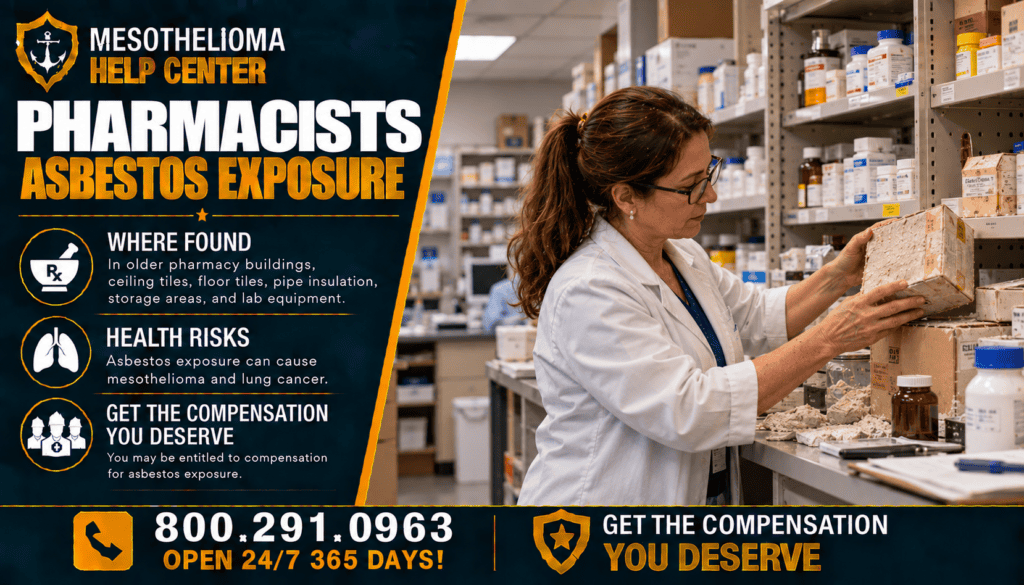
Pharmacists Asbestos Exposure
Pharmacists working in older hospitals, medical centers and institutional buildings may have occupied facilities containing asbestos in pipe and boiler insulation, HVAC insulation, floor or ceiling tile and other building materials. OSHA specifically identifies these materials as potential asbestos sources in older hospital facilities, but employment as a pharmacist does not by itself prove asbestos exposure.
For most pharmacists, a credible asbestos history is more likely to depend on the building and a documented disturbance than on dispensing medications. The facility, years worked, pharmacy location, nearby mechanical systems, renovations, maintenance activity and asbestos surveys should be investigated individually.
Pharmacists and Occupational Asbestos Exposure
Pharmacists can work in hospitals, clinics, medical centers, research institutions, long-term-care facilities and other healthcare buildings. Their ordinary professional duties involve medications rather than asbestos-containing products.
Potential occupational asbestos exposure becomes more plausible when a pharmacist worked for years in an older facility containing confirmed ACM and that material deteriorated or was disturbed near the pharmacy or another area the employee routinely occupied.
OSHA’s Hospitals eTool includes a pharmacy module and separately identifies asbestos as a hospital facilities-management hazard. OSHA also explains that hazards highlighted for one hospital area are not necessarily limited to that area and that employers need a thorough worksite hazard analysis.
Related resources include healthcare, laboratory and technical workers asbestos exposure, high-risk jobs asbestos exposure and asbestos exposure in buildings.
Hospital Pharmacies and Older Healthcare Buildings
Hospital pharmacies may be located inside buildings that have undergone decades of maintenance, remodeling and mechanical-system upgrades. OSHA states that asbestos is commonly found in older buildings and identifies several materials that may contain asbestos in hospital facilities.
Building Conditions Worth Investigating
- Age and construction history of the hospital or pharmacy building
- Asbestos surveys and building-management records
- Renovations performed in or next to pharmacy areas
- Mechanical rooms, pipe chases or utility spaces near the pharmacy
- Ceiling, flooring or wall work performed while areas remained occupied
- Documented asbestos abatement during the pharmacist’s employment
An old hospital is not automatically an asbestos exposure site for every employee. The strongest evidence identifies the ACM, its location and condition, and an event or circumstance capable of releasing fibers into the worker’s environment.
Facility plans, renovation files, asbestos-management records, work orders and abatement reports may help reconstruct conditions decades later.
Potential Asbestos Sources Near Pharmacy Work Areas
OSHA’s hospital asbestos guidance identifies HVAC duct insulation, boiler insulation, pipe insulation, cooling-tower materials, floor and ceiling tile, electrical wiring insulation, wallboard and spackling compounds as potential asbestos sources in older facilities.
Sources Worth Investigating When Confirmed
- Steam or hot-water pipe insulation above ceilings or in utility chases
- Boiler and mechanical-system insulation
- HVAC duct insulation serving pharmacy areas
- Older floor or ceiling tile documented as asbestos-containing
- Wallboard, joint or spackling materials containing asbestos
- Electrical insulation or other building components confirmed as ACM
Age, appearance or location alone does not establish asbestos content. Bulk-sample results, asbestos surveys, specifications, maintenance records and abatement documents are stronger evidence.
Employees who entered mechanical or utility spaces as part of technical or supervisory duties may have different exposure circumstances from pharmacists who remained in finished pharmacy areas.
Related pages include boiler room operators asbestos exposure, HVAC technicians asbestos exposure and maintenance workers asbestos exposure.
Renovation, Maintenance and Bystander Exposure
OSHA warns that significant asbestos exposures can occur when insulation in old buildings is removed during renovation. Although pharmacists generally do not perform this work, they may need to investigate whether confirmed ACM was disturbed near an occupied pharmacy, medication-storage area, corridor or office.
Events Worth Reviewing
- Removal of asbestos-containing ceiling or floor materials
- Pipe or boiler insulation work near pharmacy spaces
- HVAC renovations involving confirmed asbestos insulation
- Wall demolition or remodeling involving ACM
- Emergency repairs above ceilings or inside utility chases
- Major hospital additions connected to occupied pharmacy areas
- Abatement projects performed during continued hospital operations
A credible bystander-exposure history should establish where the pharmacist worked relative to the disturbance, when the work occurred, whether containment was used, how the ventilation system operated and whether monitoring or cleanup records exist.
OSHA’s asbestos standards include requirements concerning exposure limits, regulated areas, engineering controls, respiratory protection, training, housekeeping, medical surveillance and recordkeeping when applicable.
Need help now? Call 800.291.0963
Live chat available 24/7, 365 days a year.
Submit Your Case
Hazardous Drugs and Other Pharmacy Hazards
NIOSH specifically identifies pharmacy personnel among healthcare workers who may be occupationally exposed to hazardous drugs. NIOSH explains that risk depends on the drug, route of exposure, frequency, duration, magnitude of exposure, work practices and available controls.
Hazardous-drug exposure is important occupational-health evidence for pharmacists, but it is separate from asbestos exposure. Handling chemotherapy drugs or other hazardous pharmaceuticals does not establish that asbestos was present in the pharmacy.
Hazards That Should Be Distinguished From Asbestos
- Antineoplastic and other hazardous drugs
- Drug aerosols, powders or contaminated surfaces
- Cleaning and disinfecting chemicals
- Needlesticks or sharps where relevant
- Biological or infectious hazards in healthcare settings
- Ergonomic stress and repetitive work
- Slips, trips and other hospital-wide hazards
NIOSH recommends facility-specific assessment of hazardous-drug exposure and appropriate control strategies. That same evidence-based principle is useful for asbestos: identify the actual hazard and pathway rather than inferring exposure from the occupation alone.
Mesothelioma and Other Asbestos-Related Health Risks
OSHA states that inhaling airborne asbestos fibers can cause serious disease and lists mesothelioma, lung cancer and asbestosis among asbestos-related health effects. NIOSH’s scientific review likewise recognizes occupational asbestos exposure as a carcinogenic hazard.
Asbestos-related disease can develop after a long latency period. A retired pharmacist may therefore need records from a hospital or institutional building where work occurred decades earlier.
Pharmacy employment, an older building or a history of renovation alone does not establish asbestos exposure or disease causation. The asbestos-containing material, disturbance, location, timing, frequency, duration and medical evidence must be evaluated individually.
Medical concerns involving previous occupational asbestos exposure, symptoms, screening or diagnosis should be discussed with a qualified healthcare professional.
Documenting Pharmacist Asbestos Exposure
A useful exposure history connects pharmacy employment to a specific facility, confirmed asbestos-containing material and credible disturbance or contamination pathway.
- Employment: hospital, pharmacy, institution, years and job title
- Location: building, floor, pharmacy department, office and storage areas
- Building evidence: asbestos surveys, sampling and management records
- Renovation: construction schedules, abatement files and contractor records
- Mechanical systems: documented asbestos insulation on pipes, boilers or HVAC systems
- Exposure monitoring: air samples, industrial-hygiene reports and clearance records
- Employment evidence: personnel records, Social Security records and job descriptions
- Witnesses: coworkers, supervisors, maintenance staff, engineers and contractors
Questions That Can Strengthen an Exposure History
Which hospital or pharmacy and years? How old was the building? Where was the pharmacy located? Were pipes or mechanical systems above the ceiling? Did renovations occur while the pharmacy remained open? Was ACM documented? Are surveys, abatement files, work orders, air samples or coworkers available?
Secondary or Take-Home Exposure
Take-home exposure may be relevant only when the pharmacist first encountered asbestos occupationally and fibers contaminated clothing, shoes, hair or personal items. Routine pharmacy work or handling medications does not establish asbestos contamination.
Lawsuits, Trust Funds and Compensation
A pharmacist diagnosed with mesothelioma or another asbestos-related disease may have potential legal or compensation options when evidence supports occupational asbestos exposure and applicable requirements are met.
Pharmacy employment alone does not establish exposure, causation, liability, trust eligibility or compensation. Depending on the evidence and jurisdiction, potential issues can involve asbestos-product manufacturers, insulation or equipment companies, contractors, premises-related parties, workers’ compensation systems or asbestos bankruptcy trusts.
Trust eligibility generally requires satisfying the individual trust’s medical and exposure criteria and connecting the claimant’s history to a covered company, product, facility or qualifying period. Compensation is not guaranteed.
Related Healthcare and Building Resources
Healthcare occupations: Healthcare, Laboratory & Technical Workers Asbestos Exposure
Building exposure: Asbestos Exposure in Buildings
Facility systems: Maintenance Workers Asbestos Exposure · HVAC Technicians Asbestos Exposure
Authoritative Sources
This page uses OSHA and NIOSH government evidence. OSHA specifically identifies asbestos-containing materials and renovation risks in older hospital facilities. NIOSH pharmacy guidance establishes hazardous-drug exposure as a separate occupational concern, helping avoid incorrectly attributing ordinary pharmacy hazards to asbestos.
Pharmacists Asbestos Exposure FAQ
Were all pharmacists exposed to asbestos?
No. Pharmacy employment does not establish asbestos exposure. A specific asbestos-containing building material or other source and a credible exposure pathway should be documented.
Could pharmacists in older hospitals have encountered asbestos?
Potentially. OSHA identifies asbestos-containing insulation, flooring, ceiling materials and other possible sources in older hospital facilities. Exposure depends on the specific building and whether ACM was disturbed.
Could hospital renovation expose pharmacists?
Potentially, if renovation disturbed confirmed ACM near an occupied pharmacy or another area where pharmacists worked. Location, containment, ventilation and timing should be investigated.
Could pipes above a hospital pharmacy contain asbestos insulation?
Some older hospital piping was insulated with asbestos-containing material. The particular pipe insulation should be confirmed through surveys, sampling, specifications or other reliable records.
Are hazardous pharmacy drugs an asbestos exposure?
No. NIOSH identifies hazardous drugs as an important occupational concern for pharmacy personnel, but drug exposure and asbestos exposure are different hazards.
Does working in an old hospital prove asbestos exposure?
No. Building age can justify further investigation, but it does not establish that asbestos was present, disturbed or inhaled by a particular worker.
What records can help document pharmacist asbestos exposure?
Asbestos surveys, renovation and abatement records, mechanical-system documents, air-monitoring reports, employment files, building plans, work orders and coworker statements can help reconstruct exposure.
Can pharmacists qualify for asbestos trust claims?
Some may qualify if they satisfy a trust’s medical and exposure requirements and connect their exposure to a covered asbestos company, product, facility or qualifying period. Pharmacy employment alone does not establish eligibility.
Get Help Reviewing Pharmacist Asbestos Exposure
Call 800.291.0963
Live chat is available 24/7, 365 days a year.
Prior employment as a pharmacist does not automatically prove asbestos exposure, disease causation, liability, claim eligibility or compensation. Each situation depends on the facility, building materials, mechanical systems, renovations, work location, exposure evidence, medical evidence and applicable legal requirements. Compensation is not guaranteed.
⚕️ Legal & Medical Information Disclaimer
This page provides general educational information and is not medical or legal advice. The information does not establish asbestos exposure, diagnosis, causation, liability, claim eligibility or compensation. Medical concerns should be discussed with a qualified healthcare professional, and legal questions should be reviewed with a qualified attorney.