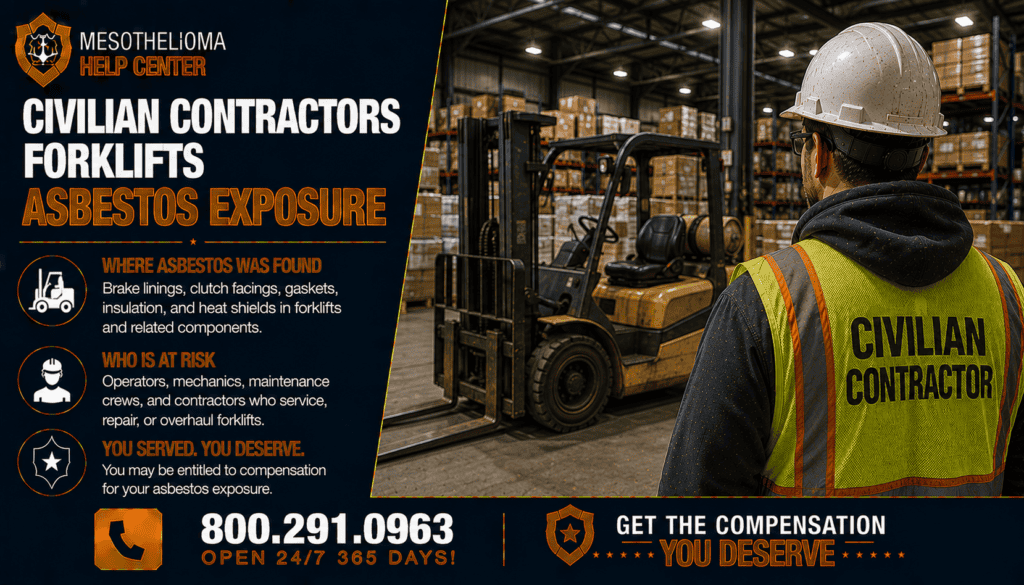
🏗️ Civilian Contractor Forklifts Asbestos Exposure
Civilian contractors have operated, inspected, repaired and rebuilt forklifts in warehouses, factories, shipyards, freight terminals, military depots, construction projects and industrial plants. Some older forklifts or replacement parts may have incorporated asbestos-containing friction, gasket, insulation or electrical materials because asbestos resisted heat and wear.
Forklift workers may also have encountered asbestos from the surrounding workplace—for example, while moving demolition debris or operating near renovation, machinery repair or damaged insulation. These pathways should be investigated separately. Operating an older lift truck or working in an older warehouse does not by itself prove asbestos exposure.
This guide explains how forklift work fits within the Contractor Equipment and Machinery Asbestos Exposure hub and how to document the machine, part, task, worksite and protective controls that may matter.
🧭 On This Page
- Forklift types and contractor roles
- Components and materials to investigate
- Repair and maintenance exposure pathways
- Warehouses, industrial sites and nearby exposure
- Verified forklift and asbestos facts
- Current inspection and dust controls
- Health and household exposure risks
- Documenting forklift work and possible claims
- Frequently asked questions
🚜 Forklift Types and Contractor Roles
Forklifts are powered industrial trucks designed primarily to move materials. Common designs include counterbalance forklifts, reach trucks, order pickers, pallet trucks, side loaders, telehandlers and rough-terrain forklifts. They may use electric batteries, propane, gasoline, diesel or compressed natural gas. Power source and design affect the brakes, transmission, clutch, engine, exhaust and electrical components a mechanic may encounter.
Civilian forklift workers include operators, warehouse personnel, mechanics, field-service technicians, fleet supervisors, rental-company employees, dockworkers, parts workers and safety inspectors. Mechanics generally had the clearest opportunity for direct contact with dusty friction components or old gaskets. Operators may have assisted with adjustments, cleaned the machine or remained in a nearby service bay.
Forklifts may belong to the worksite, a contractor, a leasing company or a rental fleet. Record the manufacturer, model, serial or fleet number, approximate year, power source and owner whenever possible. A data plate, inspection checklist, maintenance sticker, photograph, lease or repair invoice can help identify a machine decades later.
The Civilian Contractors Asbestos Exposure main guide connects lift-truck work with broader occupation, facility, equipment, health and legal resources.
⚙️ Components and Materials to Investigate
Components that may require research on some older forklifts or replacement parts include brake linings, clutch facings, transmission friction materials, engine and exhaust gaskets, heat shields, insulated wiring and electrical arc-resistant components. This list identifies categories for investigation and does not establish that a particular forklift contained asbestos.
Brake design varies. Some forklifts use drum brakes, wet-disc brakes, regenerative braking or combinations of service and parking systems. Electric forklifts do not have internal-combustion engine gaskets, while propane, gasoline and diesel models may. Manual, powershift and hydrostatic drivetrains also have different friction components.
Forklifts frequently remain in service for years and receive replacement parts from multiple suppliers. A lift truck’s manufacture date does not identify every part installed later. Service manuals, part numbers, invoices, packaging, supplier records and safety documentation provide stronger evidence than appearance.
Nearby building or industrial materials may also matter. Forklifts can operate around insulated pipes, boilers, ovens, fireproofing, floor tile, cement panels and machinery gaskets. The material should be tied to a specific task or disturbance rather than assumed from the building’s age.
🔧 Repair and Maintenance Exposure Pathways
Potential friction-component exposure may occur when a mechanic opens a brake or clutch assembly, removes worn parts, drills or grinds a replacement lining or cleans accumulated dust. EPA explains that some—but not all—brake and clutch components in vehicles and other equipment may contain asbestos and that they cannot be identified reliably by sight.
Historical shop practices may have included compressed-air blowing, dry brushing, ordinary shop vacuuming or sweeping the service floor. EPA warns that these methods can distribute fine dust when asbestos is present. Enclosed fleet shops and warehouse maintenance bays may allow dust to settle on benches, tools, floors and clothing.
Other possible tasks include scraping old gaskets, wire-brushing metal surfaces, cutting heat-resistant barriers, repairing electrical panels or cleaning an engine compartment. Operators may have blown dust from the forklift at the end of a shift or driven through a contaminated service area.
Frequency, duration, distance and controls affect the assessment. A technician who completed repeated brake jobs has a different history from an operator who briefly passed a contained repair. Record whether dust was visible, how parts were cleaned, which ventilation was used and whether protective clothing or respiratory protection was provided.
📞 Need Help Identifying an Older Forklift or Part?
Tell us the forklift type, manufacturer, employer, worksite and years worked. Call 800.291.0963, use our live chat 24/7/365 or submit your forklift work history for a free, confidential review.
🏭 Warehouses, Industrial Sites and Nearby Exposure
A forklift can place an operator near asbestos-containing building or industrial materials even when the truck itself has no asbestos parts. Forklifts move supplies and debris through factories, shipyards, depots, power plants and construction sites where maintenance or demolition may disturb legacy materials.
Potential workplace pathways include transporting removed pipe insulation, handling damaged cement products, moving waste containers, operating near boiler or machinery overhauls and entering renovation zones. A sealed, properly labeled load presents different circumstances from loose dry debris spilled in an occupied aisle.
Relevant work environments include:
- warehouses, distribution centers and military supply depots;
- factories, mills, refineries and power plants;
- shipyards, docks, freight terminals and rail facilities;
- construction, demolition and environmental-remediation projects;
- aircraft hangars and vehicle-maintenance shops; and
- forklift dealerships, rental yards and fleet service centers.
Document whether the worker handled the suspect material, drove nearby or merely worked elsewhere in the same large facility. The Civilian Contractors Heavy Machinery Asbestos Exposure page helps connect forklift work with other machines serviced in a shared shop.
✅ Verified Forklift and Asbestos Facts
- OSHA identifies forklifts as powered industrial trucks used across many industries to move materials.
- OSHA’s forklift vehicle-maintenance guidance specifically directs employers to the asbestos standard’s brake-and-clutch repair provisions.
- The EPA’s brake and clutch guidance states that some components in cars, trucks and other equipment may contain asbestos and that worn asbestos and non-asbestos parts cannot reliably be distinguished by appearance.
- EPA warns against compressed-air cleaning, dry rags or brushes and ordinary wet/dry vacuums without HEPA filtration because these methods can spread fine brake or clutch dust.
- The Agency for Toxic Substances and Disease Registry identifies mesothelioma, lung cancer, asbestosis and pleural disease among the health effects associated with breathing asbestos.
These facts support investigation of particular forklift repair histories. They do not prove that a specific forklift part contained asbestos, that dust reached an operator or that forklift work caused an individual illness.
🛡️ Current Inspection and Dust Controls
OSHA requires powered industrial trucks to be examined before being placed in service and removed from service when conditions adversely affect safety. Employers should also follow manufacturer maintenance schedules and ensure repairs are completed by authorized personnel.
When an older brake or clutch component cannot be identified, the employer should follow the applicable asbestos procedure instead of relying on appearance. EPA describes negative-pressure enclosure and HEPA-vacuum systems, low-pressure wet-cleaning systems and a wet-wipe method under specified circumstances.
Compressed air, dry brushing and ordinary shop vacuuming should not replace compliant dust controls when asbestos may be present. Work areas, tools, waste and clothing should be handled so dust does not spread into warehouse aisles, break rooms, vehicles or homes.
Asbestos controls do not replace ordinary forklift safety. Training, daily inspection, brake function, tire condition, load limits, visibility, pedestrian separation, ventilation for combustion exhaust, battery safety and energy control remain essential.
🫁 Health and Household Exposure Risks
Asbestos-related disease may become apparent decades after exposure. ATSDR states that signs of mesothelioma may not appear until 30 to 40 years after exposure. Former forklift mechanics and operators should tell clinicians about equipment repair and dusty industrial work, even when the relevant job occurred long ago.
Persistent shortness of breath, chest pain, cough, fatigue, unexplained weight loss or fluid around the lungs can have many causes. Symptoms do not prove asbestos exposure or disease. A qualified clinician can determine whether imaging, pulmonary testing or specialist referral is appropriate.
Smoking does not cause mesothelioma. However, ATSDR reports that smoking combined with asbestos exposure greatly increases lung-cancer risk. Workers who smoke should discuss cessation support and an individualized medical plan with a clinician.
Dust may have traveled home on work clothes, shoes, gloves, tools or service vehicles. Record whether the worker changed at the shop, used lockers or showers, stored work clothing separately and who laundered it. EPA advises keeping potentially contaminated brake and clutch work clothing out of the home and washing soiled clothing separately.
📂 Documenting Forklift Work and Possible Claims
Build a timeline by employer, worksite and machine. For each forklift or fleet, record:
- manufacturer, model, serial or fleet number and approximate year;
- forklift type, power source, ownership and rental company;
- brake, clutch, gasket, insulation or electrical work performed;
- part numbers, packaging, suppliers and replacement frequency;
- cleaning methods, ventilation, respirators and work clothing;
- nearby renovation, demolition or industrial maintenance; and
- coworkers, supervisors, photographs and surviving records.
Useful evidence may include Social Security earnings, union files, operator certifications, daily inspection sheets, repair orders, parts invoices, manuals, lease records, fleet logs, project documents, asbestos surveys, waste manifests, photographs and coworker statements. Preserve originals and note the source of each copy.
A diagnosis does not automatically identify a legally responsible company. Depending on the evidence and applicable law, an investigation may consider a parts manufacturer, forklift manufacturer, supplier, contractor, premises owner or asbestos bankruptcy trust. Employer immunity, workers’ compensation rules, government contracts and filing deadlines can affect available options.
Occupation-specific pages for civilian mechanics and civilian maintenance workers can help organize overlapping duties. Legal options should be reviewed promptly because deadlines vary by jurisdiction and claim type.
❓ Frequently Asked Questions
Did every older forklift contain asbestos?
No. Some historical brakes, clutches, gaskets or heat-resistant components may have contained asbestos, but machine age alone is not proof. The model, part and replacement history require research.
Which workers may have had the closest component contact?
Mechanics and field technicians who opened, cleaned, adjusted or replaced brakes and clutches may have had direct contact. Operators and warehouse workers could also be nearby during uncontrolled repair work.
Can warehouse dust be a separate exposure source?
Possibly. Forklifts may operate near renovation, insulation removal, equipment repair or damaged materials. The worksite material, disturbance, distance and controls must be documented.
What if the forklift manufacturer is unknown?
Start with the employer, facility, years, power source and coworkers. Data plates, photographs, inspection forms, lease documents and repair records may identify the truck later.
Should a mechanic personally test an old brake lining?
No. Untrained handling or sampling can release dust. Suspect components should be addressed through the employer’s compliant safety process and qualified personnel.
Can families pursue compensation after a worker dies?
Potentially. Wrongful-death or survival claims depend on the diagnosis, exposure evidence, relationship, state law and filing deadline. An individualized review is necessary.
🚀 Turn Forklift Maintenance Records Into Clear Next Steps
If you or a loved one developed mesothelioma or asbestos-related lung cancer after operating or repairing forklifts, a focused review can connect the machine, components, warehouse, employer and repair practices that may matter.
Call 800.291.0963 now, use our live chat 24/7/365 or tell us about your forklift work through the contact form for a free, confidential case review.
🔎 SEO Indexing Tags and Page Rating
SEO title:
Meta description: Learn how forklift contractors may encounter asbestos in older equipment and workplaces. Call 800.291.0963 or chat 24/7/365.
Canonical URL: https://mesotheliomahelp.center/u-s-military-veterans-asbestos-exposure/civilian-contractors-asbestos-exposure/contractor-equipment-machinery-asbestos-exposure/civilian-contractor-forklifts-asbestos-exposure/
Robots: index, follow, max-image-preview:large, max-snippet:-1, max-video-preview:-1
Google indexing: Include the canonical URL in the XML sitemap and request indexing in Google Search Console after publication.
Bing indexing: Include the canonical URL in the XML sitemap and submit it through Bing Webmaster Tools or IndexNow after publication.
Recommended schema: WebPage and BreadcrumbList. Use FAQPage only if the visible questions and answers remain on the published page and the markup follows current search-engine eligibility rules.
SEO rating: 9.5/10 before publication. The page contains original forklift-specific content, one H1, nine descriptive sections, validated jump targets, contextual internal links, primary government sources, careful medical and legal wording, custom calls to action, a canonical tag and index-follow directives. Final performance also depends on editorial accuracy, live-link status, backlinks, site authority, page speed and mobile usability.
Final publishing check: Preserve every heading ID, confirm the WordPress slug matches the canonical URL, test all nine jump links on the live page, verify every internal and external destination, test the telephone and form links, review mobile rendering and request indexing only after the page returns HTTP 200.