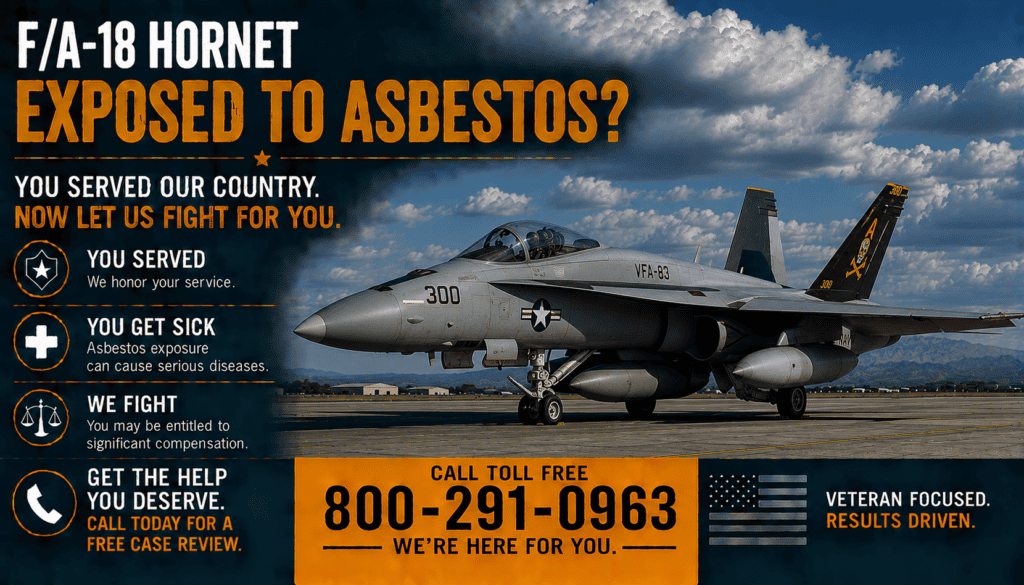
F/A-18 Hornet Asbestos Exposure
F/A-18 Hornet asbestos exposure research should focus on the veteran’s Navy or Marine Corps squadron, aircraft carrier or base, service dates, military specialty, Hornet variant, work area, components, and maintenance duties. Official naval aviation history identifies the Hornet’s first flight in 1978, deliveries beginning in 1980, operational Marine Corps service beginning in 1983, and the first carrier deployment in 1985.
Veterans can strengthen an F/A-18 exposure history with personnel and squadron records, carrier deployment histories, technical manuals, illustrated parts catalogs, aircraft maintenance files, specifications, procurement records, manufacturer information, part numbers, and specific witness statements. Assignment to a Hornet unit does not establish asbestos exposure by itself, so aircraft-, variant-, component-, product-, task-, proximity-, and date-specific evidence is important when investigating older friction, sealing, thermal, electrical, or insulating materials.
F/A-18 Hornet Asbestos Exposure
The F/A-18 Hornet is a twin-engine, carrier-capable strike fighter developed for the U.S. Navy and Marine Corps. Naval aviation history states that the Hornet first flew on November 18, 1978, deliveries began in May 1980, and Marine Fighter Attack Squadron 314 became the first operational squadron to receive the aircraft in January 1983.
Service on or around an F/A-18 does not by itself prove asbestos exposure. Veterans researching possible exposure should identify their service branch, squadron, carrier or base, service dates, military specialty, Hornet variant, work area, component, maintenance task, and records documenting material composition. Technical manuals, parts catalogs, maintenance files, specifications, procurement records, manufacturer information, and specific witness statements can help reconstruct the work performed.
F/A-18 Hornet Naval Service History
The Navy developed the F/A-18 as a multi-mission aircraft capable of air-to-air and air-to-ground operations and intended to replace the F-4 Phantom II and A-7 Corsair II. The National Naval Aviation Museum dates the Hornet’s first flight to November 18, 1978.
Deliveries began in May 1980 to VFA-125 for training. VMFA-314 became the first operational squadron to receive Hornets in January 1983, and the first carrier deployment occurred in 1985 aboard USS Constellation with VFA-25 and VFA-113.
F/A-18 Variants and Service Changes
Early Hornets included the single-seat F/A-18A and two-seat F/A-18B. The Navy received the upgraded F/A-18C beginning in 1987, and the two-seat F/A-18D entered operational service with the Marine Corps in 1990.
Variant identification matters because engines, avionics, mission equipment, structural modifications, and replacement components changed during the aircraft’s service life. Exposure research should use technical and product records applicable to the veteran’s exact model and service period.
Aircraft Systems and Components to Investigate
The F/A-18 contains propulsion, braking, hydraulic, electrical, environmental, landing-gear, avionics, flight-control, and other aircraft systems. Possible asbestos research should be component-specific rather than assuming that a broad aircraft system contained asbestos.
- Brake and friction components where documented
- Engine and exhaust-area heat-resistant materials
- Gaskets, seals, and packing where documented
- Electrical or wiring insulation where documented
- Thermal and fire-resistant materials
- Ground-support equipment associated with Hornet maintenance
F/A-18 Maintenance and Repair Duties
Maintainability was an important part of the Hornet’s design. Naval aviation history notes that squadron personnel could change engines rapidly and that radar equipment was positioned for easier inspection and repair. Maintenance personnel also worked on brakes, landing gear, hydraulics, electrical systems, avionics, engines, flight controls, and airframe components.
Historical exposure research should identify the veteran’s actual duties and whether those duties disturbed a component documented as containing asbestos. Useful details include the component, tools, cleaning or removal method, dust or debris, ventilation, frequency, duration, and proximity.
Brakes, Gaskets and Heat-Resistant Materials
VA identifies historical military asbestos use in friction products and heat-resistant materials, including brakes, gaskets, valves, cements, adhesives, heat-resistant fabrics, and lagging. VA explains that asbestos-containing material presents greater concern when disturbed or damaged and fibers become airborne.
These general military product categories do not establish asbestos content in a specific F/A-18 component. Part numbers, technical manuals, specifications, procurement records, manufacturer documents, and other product-specific evidence should be used to investigate the correct aircraft component and service period.
Carriers, Flight Lines and Hangars
Hornet personnel worked aboard aircraft carriers and at Navy and Marine Corps air stations, flight lines, hangars, squadron maintenance spaces, and intermediate maintenance facilities. The first operational carrier deployment occurred aboard USS Constellation in 1985.
Research should identify the squadron, carrier or installation, deployment, aircraft variant, maintenance organization, work center, and dates. Location evidence is strongest when connected to the veteran’s actual duties and a documented component or material.
Documenting F/A-18 Hornet Work and Exposure
- DD214 and Official Military Personnel File records
- MOS, rating, squadron, unit, carrier, and duty-station records
- Deployment and squadron histories
- F/A-18 operator and maintenance technical manuals
- Illustrated parts catalogs and part-number records
- Aircraft maintenance, inspection, modification, and overhaul files
- Procurement, manufacturer, specification, and product records
- Specific firsthand coworker or witness statements
The strongest evidence connects the veteran to a particular Hornet variant and work location, identifies a documented asbestos-containing component, and describes the activity that could have disturbed that material.
VA Benefits and Exposure Evidence
VA states that veterans may be eligible for disability compensation when they have a health condition caused by asbestos exposure and had contact with asbestos while serving in the military. VA identifies medical records, service records listing the veteran’s job or specialty, and medical evidence connecting military asbestos exposure with the health condition as relevant evidence.
F/A-18 assignment alone should not be treated as proof of asbestos exposure, disease causation, liability, or VA eligibility. Aircraft-specific technical, maintenance, and product evidence can supplement personnel and medical records when reconstructing an alleged exposure.
Frequently Asked Questions
When did the F/A-18 Hornet first fly?
The National Naval Aviation Museum identifies November 18, 1978, as the Hornet’s first flight.
When did the F/A-18 enter operational service?
Deliveries began in 1980, and VMFA-314 became the first operational squadron to receive Hornets in January 1983. The first carrier deployment followed in 1985.
Does working on an F/A-18 prove asbestos exposure?
No. Exposure research should connect the veteran’s duties to a specific component or material documented as containing asbestos during the relevant service period.
Which Hornet components should be researched?
Research may focus on friction components, gaskets, heat-resistant materials, electrical materials, insulation, and other parts only when aircraft-specific documentation supports asbestos content.
What records can help document F/A-18 maintenance duties?
Personnel files, squadron and carrier records, technical manuals, parts catalogs, maintenance records, specifications, procurement files, manufacturer information, and specific witness statements can help reconstruct the veteran’s work.
Confirmed Sources
Review Your F/A-18 Hornet Service History
Write down your service branch, squadron, carrier or base, deployment, service dates, MOS or rating, Hornet variant, maintenance organization, work area, components, repair tasks, tools, nearby maintenance work, and coworkers you remember. Preserve personnel, squadron, ship, technical, maintenance, parts, procurement, manufacturer, product, and medical records and clearly distinguish documented facts from recollection.
Call 800.291.0963 for a no-obligation case evaluation and to speak with a real person 24/7, 365 days a year. Mesothelioma Help Center is not a law firm or medical provider and does not determine VA eligibility.
Disclaimer: General information only—not legal or medical advice. This website is not a law firm. Exposure, VA eligibility, liability and deadlines vary by case and jurisdiction. Do not disturb suspected asbestos. Past results do not guarantee future outcomes.