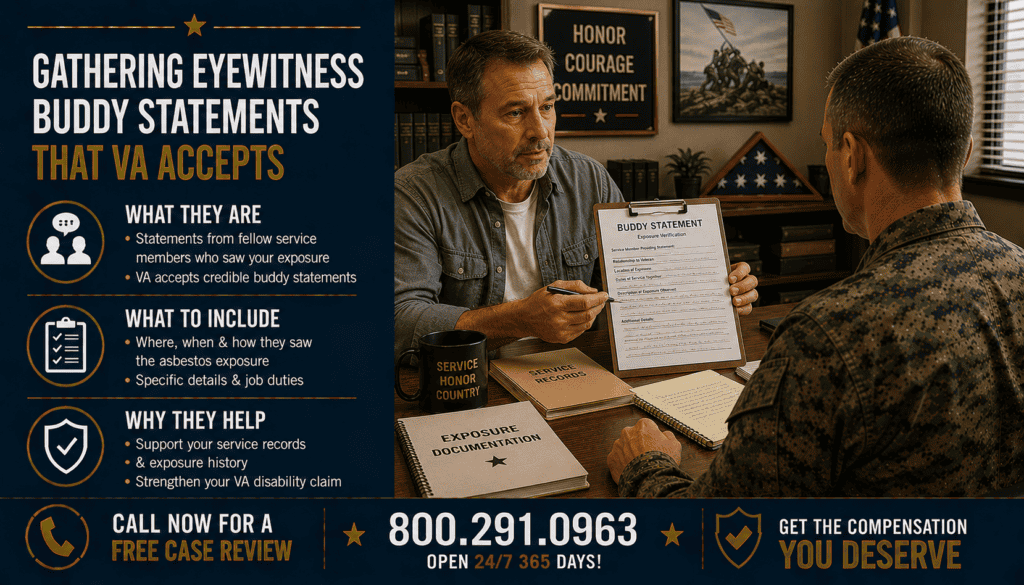
Gathering Eyewitness & Buddy Statements That VA Accepts
Eyewitness and buddy statements can help veterans document military duties, locations, work practices, and events that may not be fully described in official records.
This guide explains how to gather accurate first-hand statements, use VA Form 21-10210, corroborate witness memories with service records, and avoid common problems when documenting possible military asbestos exposure.
How Buddy Statements Can Support a VA Claim
VA recognizes lay evidence as evidence that can support a disability claim. A lay or witness statement—often called a buddy statement—can come from someone who personally knows about relevant events or circumstances. For a veteran investigating asbestos exposure, a former shipmate, coworker, supervisor, family member, or other witness may be able to describe where the veteran worked, what tasks were performed, what materials were handled, and what the witness personally observed.
A buddy statement is most useful when it fills a factual gap without trying to replace records or medical evidence. VA’s asbestos guidance says a compensation claim generally needs evidence of a health condition caused by asbestos, military contact with asbestos, and a medical connection between that military contact and the condition. A witness can help document events or working conditions, but should not diagnose disease or claim that an unknown material contained asbestos without a factual basis.
VA Form 21-10210 is specifically titled Lay/Witness Statement. VA says it may be used to submit a formal statement supporting the veteran’s own claim or another veteran’s or eligible family member’s claim. Each witness should provide a separate statement so VA can identify who supplied each account.
Who Can Provide an Eyewitness or Buddy Statement?
A useful witness is someone with first-hand knowledge of facts relevant to the claim. Former service members who worked in the same shop, ship, base, construction unit, motor pool, boiler room, engine room, maintenance area, or other duty location may be particularly helpful when they personally observed the veteran’s duties or shared the same work environment.
VA also recognizes lay evidence from people outside the military. Family members or friends may be able to describe dusty work clothes, a veteran’s descriptions of particular assignments, or changes they personally observed. Coworkers and supervisors may identify routine tasks, equipment, maintenance procedures, or work locations. The strength of the statement depends on what the person actually knows, not on rank or title alone.
Do not ask a witness to state facts they did not observe. If a witness remembers the veteran removing insulation but does not know the product manufacturer, the statement should say exactly that. If the witness only remembers a general time period, an approximate date clearly identified as approximate is better than a precise date created from guesswork.
Using VA Form 21-10210
VA Form 21-10210 provides a standardized way to submit a lay or witness statement. The form asks the witness to describe what they personally know or observed about facts or circumstances relevant to the claim. It also includes witness contact information and the witness’s relationship to the veteran or claimant.
VA’s online instructions state that each statement needs its own form. If several people are providing statements, each person should use a separate VA Form 21-10210. This keeps the identity, contact information, relationship, and observations of each witness distinct.
A veteran can also submit lay evidence in other accepted formats. VA’s evidence guidance states that lay evidence may be provided on a blank sheet of paper, on VA Form 21-10210, or through a Statement in Support of Claim, VA Form 21-4138. When using any format, clarity and factual accuracy matter more than length.
Keep the Statement Focused on First-Hand Knowledge
The witness should explain how they know the veteran and why they were in a position to observe the events described. A former shipmate might state the vessel, division, rating, approximate dates, and work area. A base coworker might identify the installation, shop, occupation, and period of shared duty.
Next, the witness should describe observable facts. Examples include removing old pipe covering, replacing gaskets, repairing brakes, sweeping insulation debris, cutting construction board, working around boilers, or participating in demolition. Descriptions of dust, damaged insulation, ventilation, cleanup methods, protective equipment, and proximity may add useful context when they are based on personal observation.
The witness should distinguish observation from later information. “I saw him remove old insulation from steam piping” describes an observation. “The insulation definitely contained asbestos” requires a basis for that conclusion. If the witness knew the material was asbestos because of a label, work order, survey, training, or other specific information, that basis should be stated.
Details That Can Make a Statement More Useful
A clear statement usually identifies the veteran, witness, military branch, unit or command, installation or vessel, approximate dates, occupation or rating, work area, and the event being described. It should then explain what the witness personally saw, heard, or did.
For an asbestos-related claim, useful details can include the type of equipment or building component involved, how often the work occurred, whether material was cut, scraped, removed, sanded, drilled, or swept, and how close the veteran was to the activity. If the witness and veteran performed the same tasks, the statement should explain that shared work.
Specific details can make a short statement more informative than a long general narrative. “We replaced valve packing together in the forward engine room during the 1972 overhaul” gives VA a location, task, relationship, and approximate time period to compare with service and technical records.
What Witnesses Should Avoid
Witnesses should avoid exaggeration, speculation, copied wording, and conclusions outside their knowledge. Several statements that use identical language may be less informative than independent accounts written in each witness’s own words. A witness should not be coached to remember details that are uncertain.
Do not ask a witness to provide a medical nexus unless the witness is qualified to offer that opinion. A buddy can describe the work environment and what happened. Medical professionals address diagnosis and medical linkage. VA’s asbestos requirements separately identify medical records, service evidence, and a doctor’s statement connecting military asbestos contact with the claimed health condition.
A statement also should not claim that every old insulation product, gasket, floor tile, brake component, or building material contained asbestos. Product identification should be supported by appropriate records or other reliable evidence whenever possible.
Finding Former Shipmates, Coworkers, and Supervisors
Begin with names already present in personal records. Cruise books, unit rosters, photographs, letters, orders, performance evaluations, training records, shop documents, and address books may identify people who served alongside the veteran. Write down nicknames, ranks, ratings, specialties, units, and approximate dates before searching.
When contacting a potential witness, ask whether the person remembers the veteran and the relevant work before asking for a statement. Provide neutral prompts such as the ship, shop, building, unit, equipment, or overhaul period. Avoid telling the witness what the answer should be.
If the witness agrees to help, send the VA form or explain that VA accepts lay evidence. Ask the witness to use their own words, identify what they personally observed, explain the basis of their knowledge, and include accurate contact information. Keep a copy of the final signed statement.
Match Statements With Military Records
Buddy statements become more useful when they can be compared with independent records. A statement naming a ship and overhaul period can be checked against service records, deck logs, ship histories, maintenance documents, or yard records. A statement about base construction work may be compared with unit assignments, contracts, work orders, building records, or asbestos surveys.
The records do not have to repeat every sentence in the statement. Their purpose is to establish surrounding facts such as presence, assignment, occupation, location, or the existence of a project. A witness may supply details that were never entered into an official personnel record.
Create a simple cross-reference sheet listing each important fact, the witness who described it, and any document that independently supports it. This can reveal both corroboration and conflicts that should be resolved before submission.
Buddy Statement Evidence Checklist
| Statement Element | Useful Information | Possible Supporting Record |
|---|---|---|
| Witness identity | Name, contact information, relationship to veteran | Roster, cruise book, personnel record |
| Shared service | Unit, ship, base, shop, dates | Orders, service records, unit history |
| Observed task | Repair, removal, cutting, cleanup, maintenance | Work orders, manuals, maintenance records |
| Material or equipment | Pipe covering, gasket, brake, tile, insulation | Specifications, surveys, product records |
| Exposure circumstances | Dust, proximity, frequency, ventilation | Project files, photographs, witness accounts |
| Basis of knowledge | What witness personally saw or did | Statement itself plus corroborating records |
The checklist is an organizational tool. VA evaluates the complete evidentiary record, and no single witness statement automatically establishes asbestos exposure or service connection.
Handling Uncertain Dates or Conflicting Memories
Memories from service decades ago can differ. One witness may remember an overhaul in 1971 while another remembers 1972. Do not force the accounts to match. Ask each witness to state what they remember and identify dates as approximate when necessary.
Use official records to narrow the timeline. Orders, muster rolls, unit records, shipyard periods, maintenance records, or other dated documents may resolve uncertainty. If a witness later realizes a date was wrong, preserve the correction rather than silently changing an earlier statement.
Minor differences do not necessarily mean that an account is unusable. The goal is a truthful record. Clearly distinguishing confirmed dates from estimated dates allows reviewers to understand what is documented and what depends on memory.
Submitting and Preserving Statements
VA provides online and paper methods for submitting VA Form 21-10210. VA also allows veterans to upload supporting evidence for disability claims. Follow the current VA submission instructions and keep a complete copy of everything submitted.
Save the signed statement, the date it was received, witness contact information, and any documents supplied with it. If the statement references a photograph, work order, roster, or other record, preserve that item with the statement so the reference remains understandable.
Do not alter a signed witness statement after the witness has completed it. If clarification is needed, ask the witness to prepare an additional or corrected statement. This preserves a clear record of who said what and when.
Buddy Statements in Military Asbestos Claims
VA states that evidence for an asbestos-related disability claim must show asbestos exposure during military service and a disease or disability related to that exposure. VA notes that evidence of military exposure may include the veteran’s military occupational specialty and where the veteran was stationed.
A buddy statement can add detail to those records. For example, a personnel file may show assignment as a machinist’s mate, while a shipmate may describe shared maintenance on valves, pumps, gaskets, or insulated piping. A construction record may show assignment to a base, while a coworker may describe demolition or renovation tasks performed in a particular building.
The statement should support the historical facts it can establish. It should not be presented as a substitute for the medical evidence VA requires to connect the veteran’s health condition with military asbestos contact.
Frequently Asked Questions
Does VA accept buddy statements?
Yes. VA recognizes lay or witness statements as supporting evidence and provides VA Form 21-10210 for this purpose.
Who can write a buddy statement?
A person with relevant knowledge may provide lay evidence. This can include a fellow service member, coworker, supervisor, family member, or friend, depending on the facts being documented.
Does each witness need a separate form?
VA’s instructions say to use a separate VA Form 21-10210 for each statement or witness.
Must a buddy statement be on VA Form 21-10210?
VA states that lay evidence can also be submitted on blank paper or through other accepted statement forms, although Form 21-10210 is specifically designed for lay and witness statements.
Should the witness identify asbestos by sight?
No. A witness should describe what was observed and explain any factual basis for identifying a material as asbestos-containing.
Can a buddy statement replace a medical opinion?
Generally, no. VA separately requires medical evidence for the claimed condition and, for asbestos claims, evidence addressing the relationship between military asbestos contact and the disease.
What if the witness cannot remember an exact date?
The witness can provide an approximate period and clearly identify it as approximate. Records can then be used to narrow the date.
Can multiple witnesses submit statements?
Yes. VA instructs that each witness use a separate statement form.
Should I keep a copy?
Yes. Preserve a complete copy of each submitted statement and any supporting records referenced by the witness.
Review Your Military Exposure Documentation
If you or a family member has been diagnosed with mesothelioma after military service, gather service records, duty stations, occupations or ratings, ship or installation names, work histories, eyewitness names, buddy statements, product or maintenance records, and medical records. Keep original documents and clearly label estimates.
Call 800.291.0963 for a no-obligation case evaluation. Talk to a real person 24/7, 365 days a year. You can also submit your case here.
Many mesothelioma law firms handle qualifying civil cases on a contingency-fee basis; confirm fees and expenses with the firm you retain. Mesothelioma Help Center is not a law firm and does not provide legal or medical advice.
Summary
A useful buddy statement identifies the witness, explains how the witness knows the veteran, describes first-hand observations, and separates known facts from assumptions. For military asbestos claims, witnesses may help document duty locations, work practices, materials, dusty tasks, and the veteran’s presence during relevant events.
VA accepts lay evidence and provides VA Form 21-10210 for formal lay or witness statements. Use a separate statement for each witness, preserve the witness’s own wording, compare the account with military records, and avoid asking a witness to make medical or material-identification conclusions outside the witness’s knowledge.
🔗 Confirmed Sources
- U.S. Department of Veterans Affairs — VA Form 21-10210 Lay/Witness Statement
- U.S. Department of Veterans Affairs — Evidence Needed for Your Disability Claim
- U.S. Department of Veterans Affairs — Upload Evidence to Support Your Disability Claim
- U.S. Department of Veterans Affairs — Veterans Asbestos Exposure
Disclaimer: General information only—not legal or medical advice. This website is not a law firm. Record availability, asbestos identification, exposure, VA eligibility, liability, and deadlines vary by individual circumstances. Do not disturb suspected asbestos. Past results do not guarantee future outcomes.