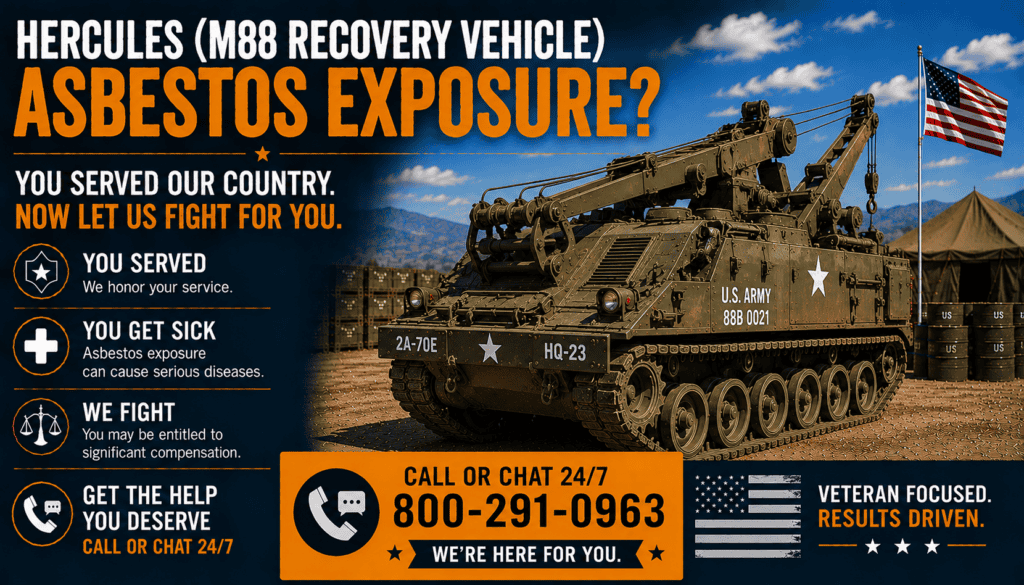
Hercules M88 Recovery Vehicle Army Asbestos Exposure
The M88 armored recovery vehicle family has supported U.S. Army armored forces for more than six decades. Designed to recover, tow, winch and help repair disabled tracked combat vehicles, the M88 placed recovery crews and mechanics around heavy powertrains, braking systems, gaskets, replacement components and the damaged vehicles they were sent to retrieve.
Army records state that the original M88 entered Army service in 1959, with deliveries beginning in 1961. The diesel-powered M88A1 followed, and the M88A2 HERCULES—Heavy Equipment Recovery Combat Utility Lift and Evacuation System—was developed to provide single-vehicle recovery for heavy Abrams tanks. VA identifies brakes, gaskets, valves and other friction or heat-resistant products among historical military asbestos sources. These facts support careful investigation of older M88 maintenance histories, but they do not establish that every M88, M88A1 or M88A2 component contained asbestos.
🛡️ M88 History & Army Service
Army equipment records describe the M88 as a full-tracked armored recovery vehicle designed for medium and heavy battlefield recovery. Its tasks include recovering damaged, stuck, swamped or overturned armored vehicles, towing disabled vehicles and providing maintenance support.
The original M88 was developed to support Patton-series tanks and used running gear related to the M48/M60 family. Army records place acceptance into service in 1959 and production deliveries beginning in 1961. The platform later evolved through diesel-powered and higher-capacity variants as Army combat vehicles became heavier.
For Army-specific exposure context, see U.S. Army Asbestos Exposure. Veterans who served in Guard armored units may also find National Guard Asbestos Exposure relevant.
🚜 M88, M88A1 & M88A2 HERCULES
| Variant | Army history and role | Exposure research focus |
|---|---|---|
| M88 | Original gasoline-powered armored recovery vehicle; Army service began around 1959–1961 | Original-era components, overhaul records and conversion history |
| M88A1 | Diesel-powered improvement; Army documentation states all U.S. Army M88s were converted and conversion was completed by 1982 | Parts used during conversion, replacement braking/powertrain components and depot work |
| M88A2 HERCULES | Heavy recovery upgrade based on M88A1 chassis; first Army vehicles fielded in 1997 | Modernized brake, steering, powertrain, suspension and recovery systems |
The M88A2 significantly increased towing, winching, lifting and braking capability. Army acquisition records describe a 35-ton boom and 70-ton main winch, allowing one HERCULES to recover heavy Abrams tanks. Because the A2 incorporated major new systems, asbestos conclusions about an early M88 or M88A1 should not automatically be transferred to later HERCULES components.
⚙️ Potential Asbestos Components to Investigate
VA identifies brakes, gaskets, valves and related friction or heat-resistant products as historical military asbestos sources. For M88-family vehicles, these categories are starting points for records research rather than proof that a specific component contained asbestos.
| System/component | Historical question | Evidence to seek |
|---|---|---|
| Brake/friction systems | Did the installed or replacement friction material contain asbestos? | Technical manuals, parts lists, NSNs, packaging |
| Gaskets and seals | Were asbestos-containing sealing materials specified? | Parts catalogs, specifications and manufacturer records |
| Engine/powertrain | Were asbestos gaskets or other heat-resistant materials serviced? | Overhaul manuals, work orders and component records |
| Winch/hoist support systems | Were any friction or sealing materials asbestos-containing? | Vehicle-specific maintenance and parts documentation |
| Replacement parts | Did material composition change between M88, A1 and A2 eras? | Procurement records, supplier files, packaging and NSNs |
For broader research, review Military Products Asbestos Exposure. Do not identify a component as asbestos-containing from appearance alone.
🔧 Recovery-Vehicle Maintenance & Repair Exposure
The M88 is itself a maintenance and recovery platform, which means its crews often worked both on the recovery vehicle and around disabled tanks, Bradleys, self-propelled artillery and other tracked equipment. Army documentation describes the M88A1 as the primary recovery vehicle for M1 Abrams tanks, M2/M3 Bradleys, M60-series tanks and heavy self-propelled artillery.
Potential asbestos exposure would require disturbance of a documented asbestos-containing material. Relevant tasks could include friction-component service, gasket removal, engine or transmission overhaul, component cleaning, handling old replacement parts, or assisting repairs on another vehicle containing asbestos products.
VA specifically identifies servicing clutch facings and brake linings as a potential military asbestos-exposure activity. Veterans who performed this work should also review Military Mechanics Asbestos Exposure and Vehicle Mechanics & Motor Pool Crews Asbestos Exposure.
👨🔧 Mechanics, Riggers & Recovery Crews
Potentially relevant personnel include M88 mechanics, tracked-vehicle repairers, recovery specialists, riggers, crew members, motor-pool personnel, depot overhaul workers and supply personnel who handled replacement components.
Operating an M88 or participating in a recovery mission does not by itself prove asbestos exposure. A stronger history identifies what the veteran repaired, whether the work disturbed a documented asbestos-containing product and whether the exposure occurred on the M88 itself or on the disabled vehicle being recovered.
This distinction is especially useful because M88 crews supported many vehicle families, including the M60 Patton Tank, M113 Armored Personnel Carrier, M2 Bradley Infantry Fighting Vehicle, M108 Self-Propelled Howitzer and M109 Self-Propelled Howitzer. Also review M60-Series Recovery & Support Vehicles when relevant.
📂 Documenting M88 Asbestos Exposure
VA says asbestos disability claims require evidence of asbestos exposure during military service, a related health condition and medical evidence connecting the condition to that exposure. Military occupational specialty and duty location can help establish the service history.
Begin with Military Records & Documentation for Asbestos Exposure, Military Service Records & Exposure and How Veterans Prove Asbestos Exposure in the Military.
| Evidence | What it may establish |
|---|---|
| Personnel/MOS records | Recovery or tracked-vehicle maintenance duties |
| Unit records | M88-equipped organization and supported armored vehicles |
| Technical manuals | Maintenance procedures and component identification |
| Parts lists/NSNs | Exact brake, gasket or replacement component |
| Depot/conversion records | M88-to-M88A1 or M88A1-to-M88A2 work |
| Procurement records | Manufacturer, supplier and time period |
| Maintenance/recovery logs | Work performed on the M88 or recovered vehicles |
| Buddy/coworker statements | Firsthand corroboration of maintenance tasks |
An M88 assignment, photograph or vehicle identification alone does not establish that a particular component contained asbestos. Product-specific evidence is stronger.
🫁 Mesothelioma & Lung Cancer After Military Asbestos Exposure
VA explains that asbestos fibers may become airborne when asbestos-containing materials are disturbed or damaged and that asbestos-related disease can appear many years after exposure. Veterans concerned about historical exposure should discuss their military occupational history with a health-care provider or VA Environmental Health Coordinator.
A mesothelioma or lung-cancer diagnosis does not establish that an M88 component caused the disease. Medical diagnosis, exposure history and product identification require separate evidence. Veterans diagnosed with lung cancer can review the Asbestos Lung Cancer Lawsuit resource.
⚖️ VA Benefits, Asbestos Trust Funds & Legal Options
VA states that veterans may qualify for disability compensation when they have a health condition caused by asbestos and had contact with asbestos during military service. Medical records, service records and medical nexus evidence are generally required.
Private asbestos claims are separate from VA benefits. If historical M88 parts or procurement records identify a manufacturer that later established an asbestos bankruptcy trust, review What Are Asbestos Trust Funds?. M88 service alone does not establish eligibility for a particular trust.
❓ Frequently Asked Questions
When did the M88 enter U.S. Army service?
Army equipment records state that the M88 was accepted into Army service in 1959, with deliveries beginning in 1961.
What does HERCULES mean?
HERCULES stands for Heavy Equipment Recovery Combat Utility Lift and Evacuation System, the name used for the M88A2 improved recovery vehicle.
What was the M88A1 designed to recover?
Army records identify the M88A1 as a primary recovery vehicle for systems including M1 Abrams tanks, M2/M3 Bradley Fighting Vehicles, M60-series tanks and heavy self-propelled artillery.
Did M88 recovery vehicles contain asbestos?
VA confirms historical military asbestos use in brakes, gaskets and other products generally, but those sources do not establish that every M88-family vehicle or component contained asbestos. Vehicle-, part- and era-specific evidence is required.
Could M88 brake work involve asbestos?
Potentially, when the specific friction product contained asbestos. VA recognizes brake-lining service generally as a possible military asbestos-exposure activity.
Could M88 crews be exposed while repairing another vehicle?
Potentially. Recovery crews often worked around disabled tracked vehicles. Any exposure claim should identify the other vehicle, component and maintenance task rather than assuming exposure from the recovery mission alone.
Did M88 components change over time?
Yes. The M88A1 introduced diesel power, while the M88A2 HERCULES incorporated substantial upgrades to braking, steering, powertrain, winching, hoisting and suspension systems.
What records are most useful?
MOS and unit records, technical manuals, parts lists, NSNs, depot and conversion records, procurement files, maintenance logs and coworker statements can help reconstruct an M88-specific history.
Can M88 maintenance support VA, trust or civil claims?
Potentially, when the required medical, service, exposure and product evidence is established for the particular type of claim.
📞 Review Your M88 Recovery & Maintenance History
If you or a family member has been diagnosed with mesothelioma after operating or maintaining M88-family recovery vehicles, gather the unit, installation, service dates, MOS, M88 variant, recovery duties, maintenance tasks, components handled, supported vehicle types, part numbers or NSNs, coworkers and medical records.
Call 800.291.0963 for a no-obligation case evaluation. Talk to a real person 24/7, 365 days a year.
Many mesothelioma law firms handle qualifying civil cases on a contingency-fee basis; confirm fees and expenses with the firm you retain.
📝 Summary
The M88 recovery-vehicle family has served Army armored forces from the Patton-tank era through modern Abrams formations. The original M88, diesel M88A1 and M88A2 HERCULES differ substantially in their components and capabilities. VA confirms historical military use of asbestos in friction products, gaskets and related materials, but that general history does not prove asbestos was present in a specific M88 component. A strong investigation connects the veteran’s actual maintenance or recovery task to an identified vehicle, component, manufacturer, supplier and service period.
🔗 Confirmed Sources
- U.S. Department of Veterans Affairs — Veterans Asbestos Exposure
- VA Veterans Health Library — Veteran Exposure to Asbestos
- VA War Related Illness & Injury Study Center — Exposure to Asbestos
- U.S. Army Weapon Systems Handbook — M88A1 Medium Recovery Vehicle
- U.S. Army Weapon Systems Handbook — M88A2 HERCULES
- U.S. Army — Combat Recovery Systems / M88
Disclaimer: General information only—not legal or medical advice. This website is not a law firm. Exposure, VA eligibility, liability and deadlines vary by case and jurisdiction. Do not disturb suspected asbestos. Past results do not guarantee future outcomes.