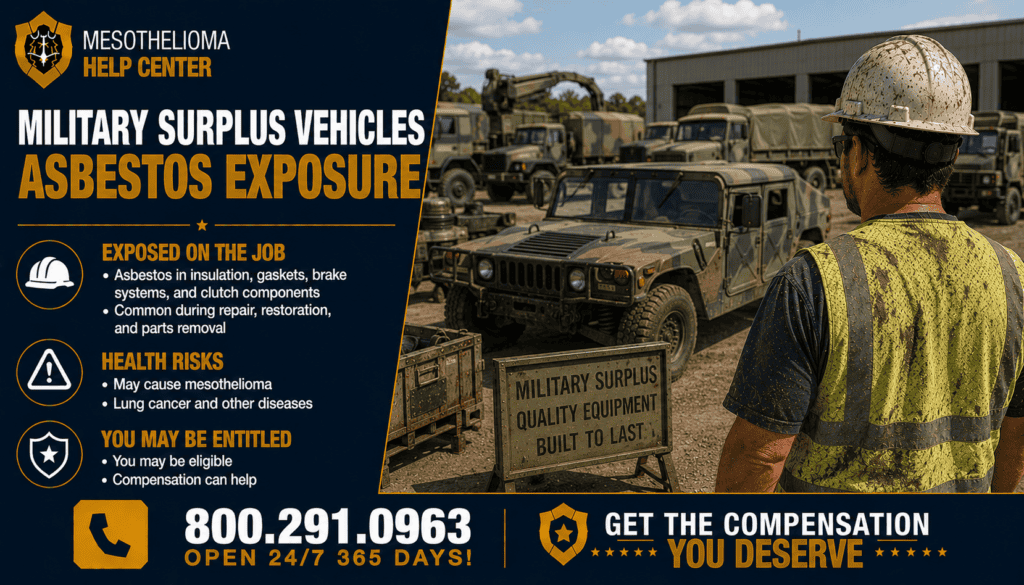
🚛 Military Surplus Vehicles Asbestos Exposure Risks & Legal Options
Military surplus vehicles can remain in service long after leaving a military fleet. Former tactical trucks, cargo vehicles, jeeps, ambulances, buses and specialty vehicles may pass to public agencies, contractors, collectors or private owners. Mechanics and restorers working on an older surplus vehicle may encounter historical friction parts, gaskets or heat-resistant materials that require careful identification.
A military paint scheme, age or surplus title does not prove that a vehicle contains asbestos. Parts differ by model, production contract and repair history, and replacement components may not match the original equipment. A reliable exposure investigation connects a specific component and maintenance task to a particular vehicle, place and time.
🧭 On This Page
- How military vehicles enter civilian use
- People who may have worked around surplus vehicles
- Potential components and exposure tasks
- Buying or restoring an older vehicle safely
- Verified asbestos and surplus-property facts
- Health and secondhand exposure
- Documenting a vehicle and work history
- VA benefits and legal options
- Frequently asked questions
🔄 How Military Vehicles Enter Civilian Use
Government property may be transferred, donated or sold after an agency no longer needs it. The General Services Administration explains that members of the public can purchase federal surplus property through approved sales channels such as GSA Auctions. State and local agencies, eligible organizations and other public entities may use different transfer programs.
GSA Fleet also sells non-tactical federal vehicles after they meet replacement criteria. Its fleet-vehicle sales page lists pickups, buses, ambulances, medium- and heavy-duty trucks and specialty equipment among the types that may appear. Tactical military vehicles can follow other disposal, demilitarization or resale channels.
A vehicle’s post-service use may include emergency response, road maintenance, construction, forestry, farming, utilities, towing, off-road transport, museum display or private restoration. Each new owner may replace parts, swap engines or axles, modify the body, or rebuild the braking system. That long maintenance history is why a vehicle name alone cannot identify the material handled by a later mechanic.
This child page is part of the U.S. military vehicles asbestos-exposure hub. The main military veterans asbestos-exposure guide covers additional occupations, equipment, bases, ships and aircraft.
👷 People Who May Have Worked Around Surplus Vehicles
People who repaired, rebuilt or dismantled an older surplus vehicle may need to examine their work history. This group can include government-fleet mechanics, civilian contractors, heavy-equipment technicians, volunteer fire-department personnel, public-works employees, restoration-shop workers, museum volunteers, parts salvagers, collectors and owners who performed their own repairs.
Drivers and operators were generally less involved with internal components than mechanics, but job titles do not always describe actual duties. An operator might adjust brakes, replace a clutch, scrape a gasket or clean a dusty shop. A supervisor or parts employee could also work near an active brake or engine overhaul.
Exposure questions should focus on tasks rather than assuming a risk level from an occupation. Important details include whether the person opened a brake drum, used compressed air, sanded a lining, removed a transmission, scraped an old gasket, cut a heat shield or swept dust from a shared work area.
Surplus vehicles may also be dismantled for spare parts. Removing axles, engines, transmissions and brake assemblies from a donor vehicle can disturb residue before the component reaches the vehicle being restored. Record work on both the finished vehicle and every parts vehicle involved.
⚙️ Potential Components and Exposure Tasks
| Component or area | Work activity to investigate | Evidence that may identify the part |
|---|---|---|
| Drum brakes, brake shoes or linings | Opening drums, brushing residue, sanding, grinding, riveting or replacing linings | Axle model, brake supplier, part number, service manual and packaging |
| Clutch disc or facing | Removing a transmission, cleaning a housing or replacing the clutch | Engine and transmission model, clutch number, invoice and rebuild record |
| Engine or exhaust gaskets | Separating flanges, overhauling an engine or scraping sealing surfaces | Engine serial number, gasket kit, technical manual and supplier receipt |
| Heat shields or thermal barriers | Drilling, cutting, removing or replacing old heat-resistant material | Photograph, drawing, label, material specification and laboratory result |
| Auxiliary equipment | Repairing pumps, winches, generators, heaters or power-takeoff systems | Equipment data plate, serial number, separate manual and overhaul kit |
| Shop contamination | Dry sweeping, blowing dust from parts, laundering clothing or cleaning tools | Work procedures, witness accounts, photographs and facility records |
Brake service is a major task to investigate because dust can collect inside a drum assembly. When a historical lining contained asbestos, removing the drum or cleaning accumulated residue could release fibers. Grinding or sanding a replacement lining could create additional dust.
Clutch and gasket work present different evidence questions. A manual-transmission vehicle may have undergone several clutch replacements after leaving military service. Engine, exhaust and accessory gaskets can also change during overhauls. Investigators should identify the actual replacement part rather than assuming that the original military specification remained in the vehicle.
Some surplus vehicles carry auxiliary systems that were produced by a company other than the chassis manufacturer. Examples include pumps, winches, heaters, generators, cranes and power-takeoff equipment. Those assemblies need their own model numbers, manuals and parts histories.
🛠️ Buying or Restoring an Older Vehicle Safely
Do not decide that a friction part or gasket is asbestos-free based only on appearance. Before disturbing an unknown component, review the vehicle manual, modification records, parts packaging and available material information. If the composition remains uncertain, a qualified professional can advise whether testing or asbestos controls are appropriate.
Avoid dry brushing, ordinary shop vacuuming, compressed-air cleaning, sanding or grinding an unidentified brake or clutch component. OSHA’s asbestos requirements describe controlled methods for covered brake-and-clutch work, including negative-pressure HEPA-vacuum and low-pressure wet-cleaning systems. Workplace requirements depend on the task and applicable regulation; hobbyists should still avoid creating uncontrolled dust.
Personal protective equipment is not a substitute for identifying a material and controlling the work. A disposable dust mask may not provide the protection required for asbestos work. Removing a suspect material can also create regulated waste and contamination that should not be carried into a home, laundry area or personal vehicle.
Keep old packaging, labels and receipts when a component is removed. Photograph the part in place, its markings and the vehicle data plates before disposal. Do not handle a suspect item solely to create evidence; safe containment and professional guidance come first.
📊 Verified Asbestos and Surplus-Property Facts
- EPA brake-and-clutch guidance states that a person cannot determine whether a brake or clutch component contains asbestos just by looking at it.
- EPA warns that brake and clutch dust can include particles too small to see and advises against uncontrolled compressed-air cleaning.
- OSHA’s mandatory brake-and-clutch appendix specifies engineering controls and work practices for covered asbestos-containing friction parts.
- A NIOSH brake-service evaluation examined engineering controls and work practices intended to reduce mechanics’ asbestos exposure during brake servicing.
- The National Cancer Institute classifies asbestos as a known human carcinogen and links exposure with mesothelioma and several cancers, including lung cancer.
- GSA confirms that used federal personal property and fleet vehicles can be offered for public purchase through government sales programs.
These facts establish why older friction parts deserve caution and how government vehicles can enter civilian ownership. They do not establish that every surplus vehicle or every part contained asbestos. Verification still requires vehicle-, component-, task- and time-specific evidence.
📞 Need Help Identifying a Surplus Vehicle?
Call 800.291.0963, use our live chat 24/7/365 or submit your case information. Tell us the vehicle model, agency or military branch, purchase source, repair tasks and replacement parts you remember.
🫁 Health and Secondhand Exposure
Asbestos-related diseases can develop many years after fibers were inhaled. Mesothelioma affects the thin tissue lining the chest, abdomen or other organs. Asbestos exposure can also cause lung cancer and asbestosis. A surplus-vehicle work history cannot diagnose any condition, and symptoms require evaluation by a qualified healthcare professional.
Former mechanics, restorers and vehicle owners should tell their healthcare providers about dusty brake, clutch, gasket or insulation work. Relevant details include the years of work, how often it occurred, whether components were cut or ground, how dust was cleaned and whether other occupational asbestos exposure occurred.
Possible symptoms such as persistent shortness of breath, chest pain, cough, fatigue, unexplained weight loss or abdominal swelling have many potential causes. A person should not wait for a legal investigation before seeking medical care.
Work dust may also have traveled on coveralls, boots, hair, tools or vehicle upholstery. Family members who shook out or washed dusty clothing may have a separate secondhand exposure history. Document who handled the clothing and when, but do not assume that visible dirt contained asbestos without supporting evidence.
🗂️ Documenting a Vehicle and Work History
Start with a timeline that separates the vehicle’s military history from its civilian ownership. Record when and how it left government service, every known owner, where it was stored and which repairs occurred during each period.
Useful details may include:
- military branch, unit, agency, municipality, contractor or private owner;
- government auction, transfer program, dealer or private-sale information;
- vehicle make, model, variant, registration year, serial number and military identification;
- engine, transmission, axle and brake-system manufacturers and numbers;
- modification plates, rebuild tags and depot or contractor markings;
- component brands, part numbers, National Stock Numbers and packaging;
- dates and locations of brake, clutch, gasket, insulation or auxiliary-equipment work;
- use of compressed air, dry sweeping, sanding, grinding, drilling or scraping;
- names of coworkers, sellers, mechanics, supervisors and restoration-club members;
- manuals, photographs, invoices, auction listings, maintenance logs and correspondence;
- other military, industrial, construction, shipyard or household exposure sources.
Serial numbers can matter because two vehicles with similar bodies may use different axles, engines or brake systems. A post-service conversion may replace the entire drivetrain. Photographs should capture data plates and component markings, not only the exterior vehicle.
Original technical manuals may identify specifications or approved part numbers, but a manual does not prove which component was installed on the day of a repair. Pair documentary evidence with receipts, dated photographs and witness accounts whenever possible.
Avoid guessing when a record is missing. Label estimated dates and uncertain brand names clearly. A careful history that separates known facts from recollections is more useful than a confident but unsupported product list.
⚖️ VA Benefits and Legal Options
A veteran with a health condition caused by asbestos exposure during military service may qualify for VA disability compensation. The VA asbestos-exposure eligibility page explains that a claimant generally needs a condition caused by asbestos and evidence of contact with asbestos during service.
Post-service surplus-vehicle work creates a separate timing issue. VA benefits concern qualifying military-service exposure, while a civil case may focus on a private manufacturer, supplier or other responsible company connected to a component handled during civilian work. The same person may have both service and post-service exposure histories, but each should be documented independently.
Depending on the facts, possible compensation routes may include a personal-injury lawsuit, an asbestos bankruptcy trust claim, workers’ compensation or a wrongful-death claim. Eligibility is not automatic. Each route has its own evidence requirements, procedures and deadlines, which can differ by state, trust and type of claim.
Do not rely on a generic online settlement figure or promised completion date. Compensation depends on the diagnosis, responsible parties, product identification, exposure history, jurisdiction and available evidence. A case-specific review is needed to evaluate the available options.
❓ Frequently Asked Questions
🚛 Did every older military surplus vehicle contain asbestos?
No. Vehicle systems and replacement parts varied by model, production contract, manufacturer and repair history. Age and former military ownership do not prove asbestos content.
🛞 Can I identify an asbestos brake shoe by looking at it?
No. EPA guidance says visual inspection alone cannot determine whether a brake or clutch component contains asbestos. Treat an unknown historical component cautiously and seek qualified guidance before disturbing it.
🔧 Does the military vehicle manufacturer identify every component?
Not necessarily. The engine, transmission, axle, brakes and auxiliary equipment may come from different suppliers. Post-service rebuilds can introduce additional manufacturers and part numbers.
🏛️ Could a city or fire department have received a surplus vehicle?
Government surplus programs can transfer or sell property to public organizations and members of the public. The specific chain of ownership should be verified through auction, title, agency and maintenance records.
🧾 What if the vehicle was restored with parts from several donor vehicles?
Document each donor vehicle and the parts removed from it. Exposure may have occurred while dismantling the donor, cleaning the salvaged component or installing it in the restored vehicle.
⚖️ Is a VA claim the same as a lawsuit against a parts company?
No. VA disability benefits and civil asbestos claims follow different standards. A VA claim concerns qualifying service-related exposure; a civil claim may concern legally responsible private companies.
🚀 Get Help Reviewing Military Surplus Vehicle Exposure
If you or a loved one developed mesothelioma or asbestos-related lung cancer after repairing, restoring or dismantling a military surplus vehicle, a focused review can help organize the vehicle’s ownership, serial numbers, component suppliers, repair work and other possible exposure sources.
Call 800.291.0963, use our live chat 24/7/365 or tell us about your case through the contact form for a free, confidential review of your surplus-vehicle work history.
This surplus-vehicle guide is educational only. It is not medical or legal advice, and it does not guarantee eligibility, benefits, a recovery or any particular claim result.