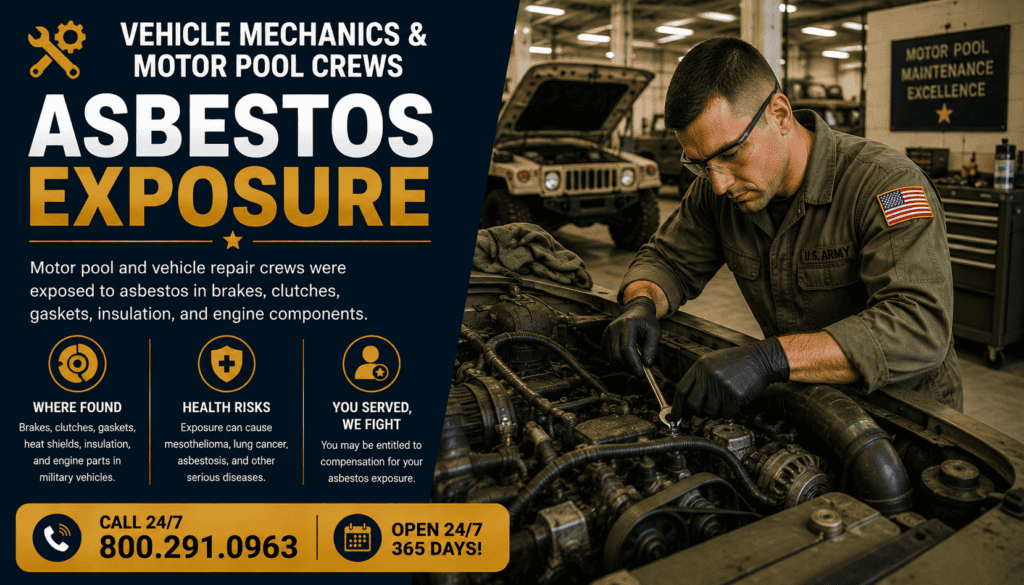
Military Vehicle Personnel Asbestos Exposure
Military vehicle personnel asbestos exposure research should focus on the veteran’s service branch, unit, installation, service dates, military specialty, vehicle type or model, components, maintenance duties, and specific products or materials that may have been disturbed. VA identifies servicing friction products such as clutch facings and brake linings as a potential military asbestos-exposure circumstance and documents historical asbestos use in gaskets and other heat-resistant products.
Veterans can strengthen a military vehicle exposure history with personnel records, vehicle assignments, technical manuals, illustrated parts catalogs, fleet and motor-pool records, work orders, maintenance and overhaul files, procurement documents, manufacturer information, part numbers, and specific witness statements. Vehicle assignment alone does not establish asbestos exposure, so vehicle-, component-, product-, task-, proximity-, location-, and date-specific evidence is important.
Military Vehicle Personnel Asbestos Exposure
Military vehicle personnel could work in and around trucks, jeeps, tanks, buses, transport vehicles, recovery vehicles, and other motorized equipment during operation, inspection, servicing, and repair. VA identifies servicing friction products such as clutch facings and brake linings as a potential military asbestos-exposure circumstance and also documents historical asbestos use in gaskets and other heat-resistant products.
Assignment to military vehicles does not by itself prove asbestos exposure. A stronger history identifies the service branch, unit, installation, service dates, military specialty, vehicle type and model, component, maintenance or repair task, product or part number, work location, and supporting personnel, technical, maintenance, procurement, manufacturer, motor-pool, or witness records.
Military Vehicle Personnel to Investigate
Exposure research should focus on actual duties rather than assuming that everyone assigned to a military vehicle encountered asbestos. Duties varied by service branch, vehicle type, specialty, assignment, maintenance level, and time period.
- Vehicle mechanics and maintenance personnel
- Drivers and operators who assisted with repairs
- Motor-pool and fleet maintenance crews
- Recovery and support-vehicle personnel
- Personnel working near brake, clutch, gasket, or other component servicing
Vehicle Components and Materials to Investigate
VA identifies friction products such as clutch facings and brake linings as possible sources of military asbestos exposure and separately documents historical asbestos use in gaskets. Research should identify the exact component rather than assuming that every military vehicle or replacement part contained asbestos.
- Brake linings where asbestos content is documented
- Clutch facings where asbestos content is documented
- Gaskets and seals where documented
- Heat-resistant materials associated with vehicle systems
- Other parts supported by technical or manufacturer records
Vehicle Maintenance and Repair Work
Asbestos becomes more hazardous when asbestos-containing material is disturbed and fibers become airborne. Vehicle work may therefore become relevant when documented asbestos-containing brake, clutch, gasket, or other components were removed, cleaned, sanded, scraped, repaired, replaced, or otherwise disturbed.
Document the vehicle, component, task, tools, material condition, visible dust or debris, ventilation, cleanup practices, frequency, duration, and proximity to nearby repair work whenever those details are known.
Motor Pools, Garages and Maintenance Shops
Military vehicle personnel could work in motor pools, maintenance garages, depot shops, field maintenance areas, base transportation facilities, vehicle bays, or temporary repair locations. Exposure research should identify the exact installation, shop, unit, vehicle section, or field location.
Location-specific evidence can help distinguish vehicle-component sources from asbestos associated with surrounding buildings, boilers, piping, construction, renovation, or other maintenance activities.
Documenting Military Vehicle Exposure
- DD214 and Official Military Personnel File records
- MOS, rating, AFSC, specialty, unit, and duty-station records
- Driver, mechanic, maintenance, and qualification records
- Vehicle assignments, fleet records, and motor-pool documentation
- Technical manuals, parts catalogs, and maintenance records
- Work orders, inspection records, and overhaul files
- Part numbers, procurement, manufacturer, and contractor records
- Specific firsthand coworker or witness statements
National Archives states that OMPFs can contain duty stations, assignments, training, qualifications, performance, and other personnel information. DD214 information may also include the veteran’s last duty assignment, rank, military job specialty, military education, and service history.
Identifying Specific Vehicles and Parts
Vehicle-specific research can be important because military fleets used different models, configurations, manufacturers, replacement parts, and maintenance procedures over time. Technical manuals, illustrated parts catalogs, procurement files, supply records, manufacturer documents, and part numbers can help determine whether a specific component contained asbestos.
Evidence should be matched to the correct vehicle model, component, manufacturer, replacement part, service period, and maintenance activity whenever possible.
Mesothelioma and Medical Follow-Up
Veterans concerned about possible military vehicle asbestos exposure should tell their health-care provider about the service branch, military specialty, duty stations, vehicle types, components serviced, maintenance tasks, and approximate exposure dates. VA notes that asbestos exposure during military service can be associated with serious health conditions that may develop long after exposure.
Persistent shortness of breath, coughing, chest pain, unexplained weight loss, or other concerning symptoms should be evaluated by a qualified medical professional. A military vehicle work history alone cannot diagnose disease.
VA Benefits and Exposure Evidence
VA states that veterans who were exposed to asbestos during service and developed a related disease may receive service-connected compensation benefits when eligibility requirements are met. VA specifically identifies servicing friction products such as clutch facings and brake linings among occupations or activities in which veterans may have been exposed.
Military personnel, assignment, technical, vehicle, maintenance, product, and medical records can help document the circumstances being investigated. Each VA claim is evaluated on its individual evidence.
Frequently Asked Questions
Were military vehicle personnel exposed to asbestos?
Some may have been. VA specifically identifies servicing friction products such as clutch facings and brake linings as a potential military asbestos-exposure circumstance.
Did every military vehicle contain asbestos parts?
No. Components varied by vehicle, manufacturer, replacement part, and service period. Vehicle-specific technical and product records should be used to investigate asbestos content.
Which vehicle components should be investigated?
Brake linings, clutch facings, gaskets, and other heat-resistant components may warrant research when records document asbestos content.
What records can document a veteran’s vehicle duties?
OMPFs can contain duty stations, assignments, training, qualifications, and other service-history information. Technical manuals, fleet records, work orders, and parts records can add vehicle-specific detail.
Can military vehicle exposure support a VA claim?
VA states that veterans exposed to asbestos during service who developed a related disease may qualify for service-connected compensation when the applicable eligibility and evidence requirements are met.
Confirmed Sources
Review Your Military Vehicle Exposure History
Write down the service branch, unit, military installation, service dates, military specialty, vehicle types and models, brake or clutch work, gaskets or other components, maintenance duties, motor pools or shops, contractors, and coworkers you remember. Preserve available personnel, training, vehicle, technical, maintenance, procurement, manufacturer, overhaul, and medical records and clearly distinguish documentation from recollection.
Call 800.291.0963 for a no-obligation case evaluation and to speak with a real person 24/7, 365 days a year. Mesothelioma Help Center is not a law firm or medical provider and does not determine VA eligibility.
Disclaimer: General information only—not legal or medical advice. This website is not a law firm. Exposure, VA eligibility, liability and deadlines vary by case and jurisdiction. Do not disturb suspected asbestos. Past results do not guarantee future outcomes.