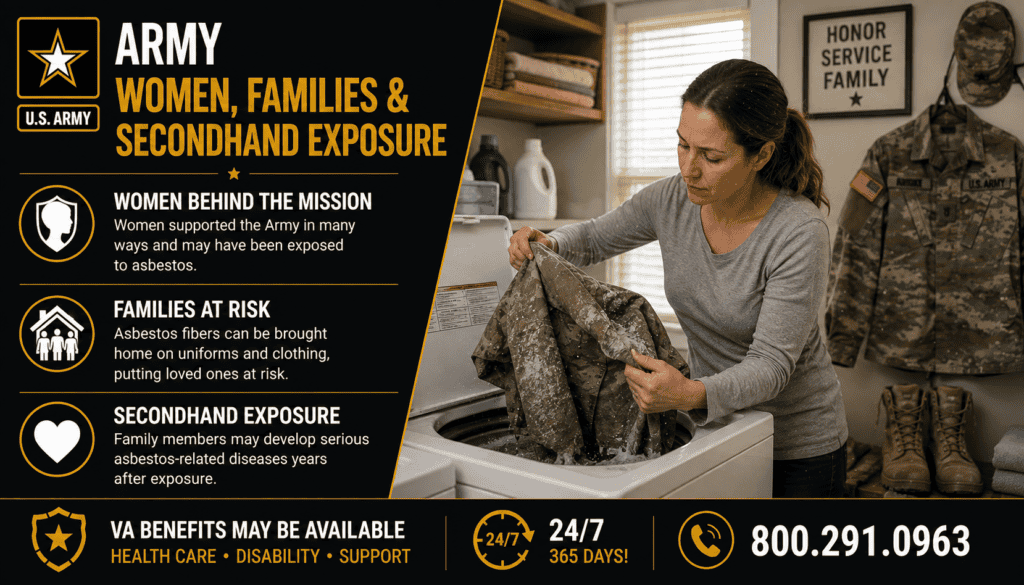
Army Women & Families Secondhand Exposure
Army women and families may have experienced secondhand asbestos exposure when fibers from a service member’s workplace were carried into vehicles or homes on contaminated clothing, shoes, skin, hair, tools, or personal items. Historical take-home exposure is a recognized occupational-health pathway, but an individual family’s history should be reconstructed from actual Army duties, work locations, materials, household routines, and supporting evidence.
This guide explains Army women and families secondhand exposure, including take-home pathways, work clothing and laundry, vehicles and housing, women’s direct and household exposure histories, documentation, health considerations, VA benefits, and civil legal options. It also explains how to separate occupational, household, housing, and civilian exposure sources so a decades-old history can be evaluated more accurately.
Army Women & Families Secondhand Exposure Overview
Army families may have experienced secondhand, household, or “take-home” asbestos exposure when fibers from occupational settings were carried away from a work area on clothing, shoes, skin, hair, tools, personal items, or vehicles. NIOSH identifies asbestos as one of the hazardous substances documented in take-home exposure research and explains that workplace contaminants can enter homes and vehicles where family members may then be exposed.
For Army families, a historical investigation should focus on the service member’s actual occupation, installation, work area, tasks, materials, work clothing, transportation, laundry practices, and household routines. Being married to or living with an Army veteran does not by itself establish asbestos exposure.
Women can appear in these histories in different ways: as Army veterans with their own occupational exposure, as spouses or relatives who handled contaminated clothing, or as family members who shared vehicles and living spaces. Each pathway should be documented separately rather than assuming that all exposure occurred through laundry.
This page complements Army family secondhand asbestos exposure, the main U.S. Army asbestos exposure section, and the Women’s Army Corps asbestos exposure resource.
How Take-Home Asbestos Exposure Could Occur
NIOSH describes take-home exposure as workplace contamination transported away from work. Hazardous substances can travel on a worker’s skin, hair, clothing, shoes, and personal items and can contaminate cars, floors, furniture, and other household areas. CDC specifically lists asbestos among examples of take-home exposures.
In an Army context, the potential pathway begins with a documented occupational source. A mechanic, construction worker, maintenance worker, engineer, or other service member may have performed tasks around asbestos-containing materials. If fibers contaminated clothing or other items and those items were brought into a family environment, a secondary pathway may have existed.
Potential occupational starting points can be researched through Army mechanics asbestos exposure, Army maintenance workers asbestos exposure, and Army construction units asbestos exposure. These occupational categories provide context; they do not establish an individual family member’s exposure.
A strong historical reconstruction identifies both ends of the pathway: what contaminated the service member and how a particular household member may have contacted the contamination. Dates, frequency, duration, work practices, clothing routines, vehicle use, and witnesses can all add context.
Work Clothing and Laundry Exposure
Work clothing is one of the best-known take-home pathways. NIOSH’s worker-family research describes contamination transported on workers’ clothing and external body surfaces and includes asbestos among substances for which take-home exposure has been documented. Historical recommendations included leaving soiled clothing at work, changing before leaving, keeping work and street clothes separate, and laundering contaminated work clothing separately.
For an older Army exposure history, document whether uniforms or coveralls were worn during dusty maintenance or construction work, whether they were visibly dusty, where the service member changed clothes, how garments were transported home, who shook out or sorted the clothing, and who performed the laundry.
Laundry practices can be especially important when a spouse or family member repeatedly handled dusty work clothing. Record whether clothes were shaken before washing, washed with family clothing, stored in shared hampers, or handled in small enclosed spaces. Avoid assuming these practices occurred; document what the family actually remembers.
Modern CDC guidance emphasizes preventing workplace contamination from entering the home in the first place. Historical family exposure investigations, however, often concern periods before current hygiene practices and awareness were widespread.
Vehicles, Housing, and Household Contamination
Take-home contamination is not limited to laundry. CDC explains that contaminants transported on a worker can enter vehicles and homes and settle on floors, furniture, and other surfaces. A service member who drove home in contaminated work clothing could potentially transfer material to seats, floor areas, and personal belongings.
Army families may also have lived in installation housing or nearby civilian housing. Keep possible occupational take-home exposure separate from potential building-related exposure. An older residence could have its own construction-material history that is distinct from fibers potentially carried home from a workplace.
The Army base housing asbestos exposure and Army dependent housing asbestos exposure pages address housing-related research. The broader Army bases asbestos exposure hub can help identify installation records.
When reconstructing a household pathway, record addresses, dates, vehicles, changing routines, laundry locations, family members present, renovation work, and whether work tools or dusty items were routinely stored in the home or garage. Separating these potential sources can make the chronology more accurate.
Women and Family Exposure Histories
Women in Army-related asbestos histories should not automatically be characterized only as spouses or laundry handlers. Some women served in the Army and Women’s Army Corps and may have had direct occupational or environmental exposure of their own. Others may have experienced household exposure through a spouse, parent, sibling, or another family member.
When more than one pathway is possible, create separate timelines. A woman who served in an older Army facility and later laundered a spouse’s dusty work clothes, for example, may have two distinct exposure histories that require different evidence.
Family histories should also identify civilian occupations. A spouse or parent may have worked independently in construction, manufacturing, automotive repair, utilities, shipyards, or another occupation involving asbestos. Ignoring those jobs can produce an incomplete exposure history.
The Women’s Army Corps asbestos exposure page provides context for women with direct Army service. For household pathways, Army family secondhand asbestos exposure provides additional legal and evidentiary discussion.
Documenting Secondhand Exposure
A secondhand exposure history usually begins with the service member’s records. Gather DD-214 or separation documents, Official Military Personnel File materials, MOS information, assignment orders, unit records, installation details, maintenance documents, equipment records, photographs, and coworker statements.
Then document the household connection. Useful information can include marriage records, addresses, housing records, family photographs, letters, employment records, vehicle information, laundry routines, statements from relatives, and recollections about work clothes, shoes, tools, or other items brought home.
The Army asbestos exposure timeline guide can help organize this information. Create parallel entries showing the service member’s workplace event and the family member’s potential contact. Do not assign exact dates when only an approximate period is known.
Consistency is important. Preserve prior VA applications, medical histories, depositions, trust submissions, lawsuits, statements, and other records describing exposure. If memories conflict, record the uncertainty rather than rewriting the history to fit a claim theory.
Health Risks and Medical Follow-Up
NIOSH has documented that asbestos transported from workplaces into homes has caused disease among workers’ family members. CDC continues to identify asbestos as an example of a take-home exposure. These public-health findings establish the pathway as real but do not determine whether a specific family member was exposed or whether an individual illness was caused by that exposure.
VA Public Health states that symptoms of asbestos-related diseases often do not appear until 20 to 50 years after exposure. Long latency can make household histories from decades earlier relevant when a physician takes an occupational and environmental exposure history.
A person concerned about past household asbestos exposure should discuss the history with a qualified health care provider. Medical evaluation, imaging, pathology, and other diagnostic decisions should be based on individual clinical circumstances rather than exposure history alone.
See Army asbestos exposure health risks for additional background. Do not disturb suspected asbestos in an old home, military artifact, work garment, vehicle, or stored equipment in an attempt to establish historical exposure.
VA Benefits and Legal Options
VA asbestos disability compensation focuses on eligible veterans. VA states that a veteran may qualify when the veteran has a health condition caused by asbestos and had contact with asbestos during military service. Supporting evidence includes medical records, service records identifying the veteran’s job or specialty, and medical evidence connecting military asbestos contact with the condition.
A family member’s independent secondhand asbestos claim is different from the veteran’s VA disability claim. Depending on jurisdiction and facts, a civil investigation may examine product manufacturers, suppliers, contractors, premises entities, or other potentially responsible parties and may address household or take-home exposure under applicable state law.
Asbestos bankruptcy trust claims are another separate process. Review Army asbestos legal options, VA benefits vs Army mesothelioma lawsuits, Army asbestos trust fund claims, and Army asbestos statute of limitations.
If a family member has died, wrongful-death or estate procedures may also need review. See Army wrongful death asbestos lawsuits. Deadlines, liability rules, eligible claimants, and available remedies vary by jurisdiction.
Frequently Asked Questions
What is secondhand or take-home asbestos exposure?
It describes asbestos fibers transported from a workplace into another environment, potentially on clothing, shoes, skin, hair, tools, personal items, or vehicles.
Has CDC recognized asbestos as a take-home exposure?
Yes. NIOSH and CDC materials identify asbestos among hazardous substances associated with workplace-to-home contamination.
Could laundering work clothes have exposed family members?
Potentially. Historical take-home research includes contamination on work clothing, and repeated handling or laundering may be relevant when the underlying workplace asbestos source can be documented.
Was laundry the only possible household pathway?
No. Contamination could potentially be transported through shoes, skin, hair, personal items, tools, and vehicles as well.
Can women veterans have direct Army exposure too?
Yes. Women who served in the Army may have their own occupational or facility exposure histories separate from any household pathway.
Does living with an Army veteran prove asbestos exposure?
No. Evidence should connect the veteran to an asbestos source and then document a plausible pathway from that source to the family member.
Can Army housing create a separate exposure issue?
Potentially. Building-related exposure should be investigated separately from asbestos that may have been carried home from an occupational setting.
Do VA disability benefits directly compensate a non-veteran spouse for secondhand exposure?
VA’s asbestos disability compensation page addresses qualifying veterans and military asbestos exposure. Family members should obtain case-specific guidance about any benefits or civil remedies potentially available to them.
What records are useful for a household exposure history?
Military personnel records, job and installation evidence, maintenance records, household addresses, marriage or family records, photographs, laundry routines, vehicle information, witness statements, and medical records can all provide context.
Review an Army Family Secondhand Exposure History
If an Army veteran or family member has been diagnosed with mesothelioma, gather the veteran’s DD-214, OMPF, MOS and assignment records, unit and installation information, job and equipment records, photographs, coworker statements, civilian employment history, family addresses, housing documents, vehicle information, laundry routines, witness statements, pathology and treatment records, VA decisions, trust submissions, prior lawsuits, settlements, and releases. Build a chronology that separates direct occupational, household, housing, and civilian exposure pathways.
Call 800.291.0963 for a no-obligation case evaluation. Talk to a real person 24/7, 365 days a year. You can also submit your case here.
Many mesothelioma law firms handle qualifying civil cases on a contingency-fee basis; confirm fees, expenses, representation scope, potential defendants, governing jurisdiction, and deadlines with the firm you retain. Mesothelioma Help Center is not a law firm and does not provide legal or medical advice.
🔗 Confirmed Sources
- CDC/NIOSH — About Take-Home Exposures
- CDC/NIOSH — Asbestos
- NIOSH — Protecting Workers’ Families: A Research Agenda
- U.S. Department of Veterans Affairs — Veterans Asbestos Exposure
- Veterans Benefits Administration — Asbestos Exposure Compensation
- VA Public Health — Asbestos
Disclaimer: General information only—not legal or medical advice. This website is not a law firm. Exposure, VA eligibility, liability and deadlines vary by case and jurisdiction. Do not disturb suspected asbestos. Past results do not guarantee future outcomes.