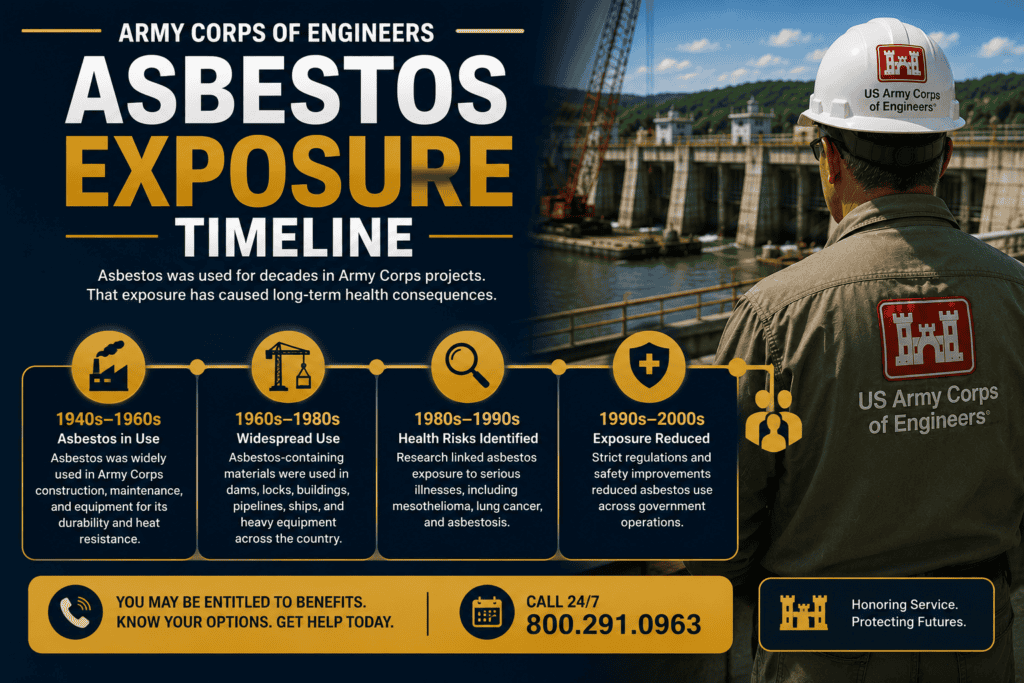
Army Corps Asbestos Exposure Timeline
Asbestos was widely used in construction, insulation, mechanical systems, vehicles, and industrial products during much of the 20th century. Because the U.S. Army Corps of Engineers has long been involved in military construction, infrastructure, maintenance, engineering, and facility operations, some personnel may have worked around asbestos-containing materials depending on the project, location, equipment, product, and era.
This timeline is intended to help veterans and families understand how historical asbestos use may overlap with Army Corps service. It does not mean every Army Corps project, building, vehicle, or assignment involved asbestos. Exposure must be evaluated using the specific facts of a person’s service history.
For broader context, see the U.S. Army Corps of Engineers Asbestos Exposure guide and the main U.S. Army Asbestos Exposure resource.
🕰️ Army Corps Asbestos Exposure Timeline Overview
The likelihood of encountering asbestos-containing materials generally depends on when and where a veteran served and what work was being performed. Older military construction, mechanical systems, utilities, vehicles, and equipment may warrant closer investigation because asbestos use was historically more common before modern restrictions and abatement practices became widespread.
A useful exposure timeline should connect service dates to identifiable duty stations, projects, buildings, equipment, maintenance activities, and products rather than relying on rank or branch alone.
🏗️ Early Military and Construction Use of Asbestos
Before World War II, asbestos was increasingly used in commercial, industrial, and military construction because of its resistance to heat and fire. Products could include insulation, pipe covering, boiler materials, cement products, roofing, flooring, gaskets, packing, and other heat-resistant components.
For Army Corps personnel serving during early construction periods, relevant records may include project specifications, engineering drawings, procurement files, facility plans, and maintenance documentation.
⚙️ World War II and Postwar Construction
During World War II and the years that followed, military construction expanded rapidly. Army engineers and Army Corps personnel were involved in building, repairing, and maintaining barracks, depots, utilities, hospitals, airfields, workshops, power systems, and other infrastructure.
Depending on the material and work activity, asbestos exposure could occur during installation, cutting, repair, renovation, demolition, or maintenance. Personnel working nearby could also experience bystander exposure if asbestos-containing material was disturbed and fibers became airborne.
Not every material or facility contained asbestos. Manufacturer, product, supplier, facility, and construction date should be verified whenever possible.
🏢 Cold War Construction and Infrastructure
Military construction and modernization continued throughout the Cold War. Many installations, mechanical plants, utility systems, warehouses, maintenance facilities, and command buildings from this era used materials common to mid-20th-century construction.
Army Corps personnel assigned to engineering, facilities, maintenance, construction, inspections, vehicle operations, or infrastructure projects may have worked in areas containing older insulation, pipe systems, boilers, HVAC components, pumps, valves, flooring, roofing, or other materials that require investigation for historical asbestos content.
The Army Corps asbestos exposure resource provides additional context for service-specific duties and work environments.
⚠️ 1970s–1980s Asbestos Controls and Legacy Materials
As awareness of asbestos health risks increased, regulations and workplace controls began reducing many new uses. However, older buildings, ships, vehicles, equipment, and mechanical systems often remained in service for years after restrictions began.
As a result, personnel serving during the 1970s and 1980s could still encounter legacy asbestos-containing materials during repair, renovation, demolition, maintenance, or removal activities. The key question is not simply the year of service, but whether older asbestos-containing materials remained present and were disturbed.
🔧 Later Service and Exposure From Older Materials
Veterans who served after the peak years of asbestos use should not automatically assume exposure was impossible. Older military facilities and equipment may have retained legacy materials until they were renovated, replaced, or abated.
Later exposure investigations may focus on the age of the building or equipment, renovation history, maintenance records, abatement reports, engineering specifications, and whether the veteran was present when suspect materials were disturbed.
This is especially relevant when older systems remained in operation within facilities constructed decades earlier.
📋 Evidence Used to Reconstruct Army Corps Exposure
Because asbestos-related diseases often develop decades after exposure, records are especially important when reconstructing a veteran’s work history.
| Evidence | What It May Help Establish |
|---|---|
| DD-214 and personnel records | Service dates, units, duty stations, rank, and assignments |
| Unit histories and project files | Engineering, construction, renovation, maintenance, and demolition activities |
| Facility plans and specifications | Age, construction materials, mechanical systems, and renovation history |
| Technical manuals and maintenance logs | Equipment, vehicles, components, and repair procedures |
| Procurement and product records | Manufacturers, suppliers, and materials used during a relevant period |
| Work orders and abatement records | Repair, removal, renovation, or asbestos-control activities |
| Coworker and witness statements | Actual duties, proximity, frequency, duration, and work practices |
| Photographs and medical records | Work environments, equipment, diagnosis, and medical history |
🫁 Long-Latency Asbestos Health Risks
Asbestos exposure is associated with mesothelioma, lung cancer, and asbestosis. These diseases may develop decades after exposure, which is why military service from many years ago can still be medically and legally relevant today.
A diagnosis does not by itself identify the source of exposure. Medical, occupational, and military histories should be evaluated together to determine whether Army Corps service may have contributed.
Need help now? If you are trying to match Army Corps service dates with older military construction, buildings, mechanical systems, vehicles, equipment, maintenance, renovation, or demolition work, Call 800.291.0963, use our 24/7 live chat, or Submit Your Case.
⚖️ Legal and Benefits Investigation
A veteran diagnosed with an asbestos-related disease may be able to investigate legal claims or veterans benefits depending on the individual circumstances. The most important evidence usually includes diagnosis, service history, exposure history, products or materials, duty locations, responsible companies, jurisdiction, and applicable filing deadlines.
No single year, project, rank, or diagnosis automatically establishes a legal claim. Eligibility depends on the specific evidence and responsible parties involved.
❓ Frequently Asked Questions
When was asbestos most commonly used in military construction?
Asbestos use was especially widespread during much of the mid-20th century. However, exact use varied by product, supplier, facility, system, and project.
Could an Army Corps veteran have been exposed after the 1970s?
Possibly. Older buildings and equipment could continue to contain legacy asbestos materials after many new uses were restricted.
Does service during a particular decade prove asbestos exposure?
No. The veteran’s actual duty station, project, building, equipment, work activity, and specific materials must be investigated.
Could Army Corps officers have bystander exposure?
Possibly. Officers conducting inspections, site visits, or project oversight could be near construction, renovation, demolition, or maintenance work where asbestos-containing materials were disturbed.
Could enlisted Army Corps personnel have direct exposure?
Possibly. Depending on military occupational specialty and assignment, enlisted personnel may have performed construction, maintenance, equipment, vehicle, utility, or repair work.
What records can help establish when exposure may have happened?
Personnel records, unit histories, project files, facility plans, technical manuals, maintenance records, procurement files, photographs, and witness statements can all be useful.
Can asbestos exposure cause lung cancer?
Yes. Asbestos exposure is a recognized cause of lung cancer. Individual medical questions should be discussed with qualified healthcare professionals.
Can surviving family members investigate a veteran’s exposure history?
Yes. Family members may be able to reconstruct service and exposure using military, project, facility, employment, and medical records, depending on what remains available.
☎️ Help Investigating an Army Corps Asbestos Exposure Timeline
If you or a family member served with the U.S. Army Corps of Engineers and later developed mesothelioma or lung cancer, an investigation can compare service dates with duty stations, construction projects, facilities, vehicles, equipment, mechanical systems, renovations, maintenance activities, products, manufacturers, and coworkers to help reconstruct possible exposure.
Call 800.291.0963 to discuss an Army Corps asbestos exposure history. Live chat is available 24/7, 365 days a year. You can also Submit Your Case online.
There is no guarantee that a diagnosis or service history will qualify for compensation or benefits. Eligibility depends on the individual facts, evidence, responsible parties, jurisdiction, and deadlines.
⚕️ Legal & Medical Information Disclaimer
This page provides general educational information and is not medical or legal advice. It does not establish diagnosis, asbestos exposure, causation, liability, eligibility, or compensation. Consult qualified medical and legal professionals for guidance specific to your situation.